2B Class Reading Knowledge Assessment - Restrictive, Unclassified CM
 Studied by 0 people
 Call Kai
 Learn
Learn Practice Test
 Spaced Repetition
 Match
Match Flashcards
 Knowt Play
1/18

Earn XP
Description and Tags
1 wrong (will fix
Name | Mastery | Learn | Test | Matching | Spaced | Call with Kai |
|---|
No analytics yet
Send a link to your students to track their progress
19 Terms
Amyloidosis is an infiltrative cardiomyopathy where the myocardium is infiltrated with an excess of __ .
protein
Endomyocardial fibrosis is an infiltration of __ that lines the inner lining of the myocardium.
fibrotic tissue
__ causes excessive glycogen storage in the tissues.
Pompes
The sonographer should rule out areas of necrosis in the patient with endomyocardial fibrosis.
True
With restrictive cardiomyopathy, systolic function is normal and heart failure symptoms are due to diastolic dysfunction, also known as:
HFpEF
In chronic restrictive cardiomyopathies, systolic dysfunction may occur.
True
Stiffening of the LV transmits the diastolic pressure to the LA and pulmonary veins resulting in extreme atrial dilation with relatively preserved LVID.
True
Scanning in both harmonic and fundamental frequencies may be useful to distinguish 'ground glass' texture of myocardium in restrictive cardiomyopathies.
True

Apical sparing of global longitudinal strain has been reported as a specific marker of cardiac amyloid in comparison to other hypertrophic pathologies.
True

In advanced restrictive cardiomyopathy, this would be a common E/A pattern.
False
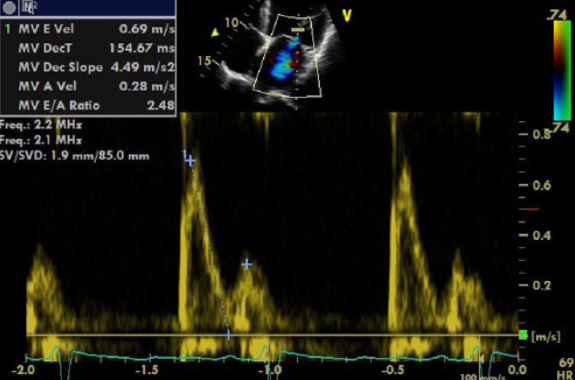
In early stages of restrictive cardiomyopathy, this would be a common E/A ratio.
False
Muscular dystrophies and Friedrich ataxia may have cardiac involvement and would be important clinical history information.
True
Uhl Disease in an acquired abnormality of the LV seen in advanced age.
False
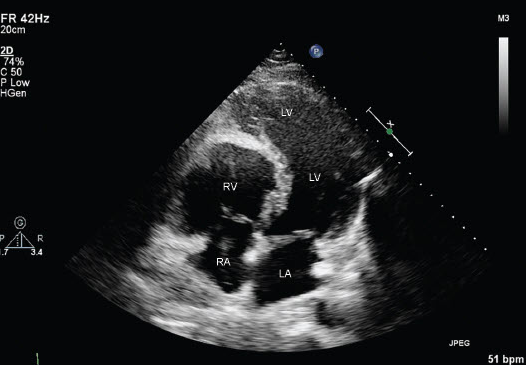
Uhl Disease may demonstrate a 'banana' shaped LV such as this image below:
True
__ may present with concentric and asymmetric hypertrophy mimicking hypertrophic cardiomyopathy and regional wall motion abnormalities that may mimc CAD.
Fabry disease
Which of the following is a common restrictive/infiltrative cardiomyopathy finding?
stiff, rigid ventricular walls
biatrial enlargement
resembles constrictive pericarditis
All of the above
What disease process typically occurs early in life causing cardiac enlargement and heavily thickened due to excessive glycogen storage in the tissues?
Pompe disease
What technique is utilized to provoke LV outflow tract obstruction?
coughing
Valsalva maneuver
exercise
All of these
A 19-year-old presents with chest pain and shortness of breath. A small, hyperdynamic LV with LV brightening is demonstrated. IVS/PW thickness ratio = 1.7. SAM/LVOT peak gradient is 64 mmHg. There is moderate MR and LA volume index is 46 mL/m2.
What is the most likely diagnosis?
asymetric septal hypertrophy, systolic anterior motion of the mitral valve, and LVOTO
 Note
Note  Flashcards (24)