NARRATIO XIII: AENEAS AD INFERNOS And CROSSWORD TRANSLATION AND GRAMMAR CONCEPTS
 Call Kai
 Learn
Learn Practice Test
 Spaced Repetition
 Match
Match Flashcards
 Knowt Play
1/16

Earn XP
Description and Tags
https://doc-04-3k-apps-viewer.googleusercontent.com/viewer/secure/pdf/q84r2g90dueeb80npnqqbdt4c1ftdpo7/1ltql71smbgobj0hgufbqstobsa4d593/1774397175000/drive/08662025981934008271/ACFrOgCi5JA3eRPKT61A5xvx9EwVZ-kW8zQEGBxAK1UGE_hy-kc1AZEYfDojV5XKgbN-ohmekdypHJCMZ47es0if0b3zuM5RJZdGJdoxShnia7edGy7XcF1BC_IHS_rswYedDQYKR0MYM7T_txjFfxkt98Dlxyc_s5qXtvU2o6n7mk8m-ygmqIlVGnLYKwISfFUBU-U2jDMakq4W8vJVHMDmArMzZbeNwQdwR6uaN8Id5tPOeRTJibLEzLNv6kQ=?print=true&nonce=nvon1jo0f4foi&user=08662025981934008271&hash=soqs80glu4j11vloos4nattf8co9pt72
Name | Mastery | Learn | Test | Matching | Spaced | Call with Kai |
|---|
No analytics yet
Send a link to your students to track their progress
17 Terms
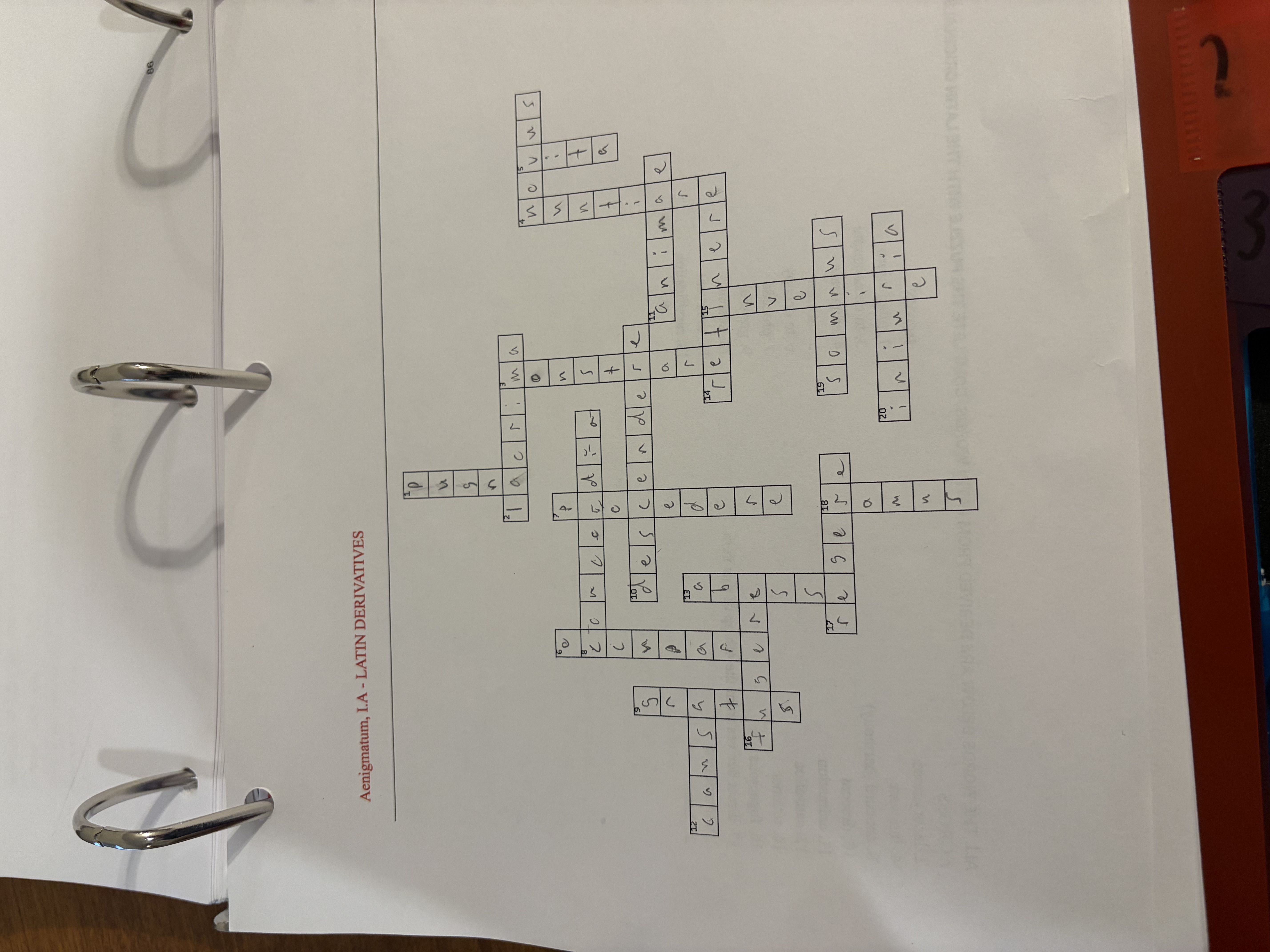
Crossword answers
ALL THE WORDS BELOW ARE DERIVED FROM LATIN WORDS. COMPLETE THE PUZZLE WITH THE LATIN ORIGINALS!
ACROSS 2. lachrymose 4. innovate 8. concord (harmony) 10. descent 11. animation 12. causation 14. retainer 16. fugacious 17. direct derives from the 4th pp of this verb 19. somnolent 20. harm DOWN 1. pugnacious 3. to demonstrate 4. enunciate 5. vitamin 6. to occupy 7. procede 9. grateful 13. absent 15. to invent 18. ramification
PLOT SUMMARY: After finding the Golden Bough that will open the gates of the underworld to him and guided by the Sibyl, Aeneas enters this strange realm populated with the souls of heroes and villains of the Trojan war. In our passage, he encounters the shade of Anchises (his deadfather) and the shade of Queen Dido, who ignores him when he speaks to her about her tragic end.
The Latin Story In Latin
Aenēas fīlius Anchisae fuit, quī in Siciliā ē vītā excesserat. Tum Anchisēs in somnō ad fīlium vēnerat et fīlium vocāverat:“Venī, fīlī, ad inferōs, ubi sum. Sibylla viam nōvit et tē dūcet.”
Ita Aenēas in Italiam prōcessit, ubi Sibylla habitābat. Cōnsilium Sibyllae erat: “Sī in silvā rāmum aureum invēniēs, ad inferōs tē prōdūcam et sine perīculō redūcam; sed sine rāmō numquam tē prōdūcam.”Ita Aenēas in silvam properāvit. Auxiliō Veneris rāmum invēnit et cum Sibyllā ad inferōs dēscendit. Ibi multa nova vīdit et nōvit.
Tum ad magnam silvam vēnērunt. Ibi erat Dīdō. Aenēas rēgīnam vīdit et vocāvit: “Nuntūsnē vērum nuntiavit? Vītamne āmīsistī? Causa fuī? Invitus ē patriā tuā excessī, sed ita deus imperāvit” Sed rēgīna, nunc inimīca, verbīs lacrimīsque Aenēae nōn movētur. Neque Aenēam spectāvit neque respondit, sed in silvam fugit.
Aenēas tardē ē silvā excessit et locum vīdit ubi malī poenā afficiēbantur. Tum Aenēas Sibyllaque in Elysium prōcessērunt.
Ibi animae bonōrum in concordiā vītam agēbant. Iniūriae et pugnae aberant. Ibi Anchisēs erat.
Grātus fīlium accēpit et nūntiāvit: “Clārōs Rōmānōs quī postea ē tē erunt et glōriam populī tuī mōnstrābō. Rōmānī malōs superābunt et populōs aequē regent.”
Aenēas ab Anchise nōn retinētur et ā Sibyllā in terram redūcitur. Tum loca commoda in Italiā occupāre mātūrāvit.
The Latin Story In English
Aeneas was the son of Anchises, who had died in Sicily. Then Anchises came to his son in a dream and called to his son: “Come, son, to the Underworld, where I am. The Sibyl knows the way and will tell you.”
So Aeneas proceeds into Italy, where the Sibyl lives. The plan of the Sibyl was this: “If you find a golden branch in the forest, I will lead you to the Underworld and bring you back without danger; but without the branch I will never lead you.” So Aeneas hurried into the forest. With the help of Venus he found the branch, and with the Sibyl he descended to the Underworld. There he saw many new and strange things.
Then they came to a great forest. There was Dido. Aeneas saw the queen and called out: “Surely you are not truly dead? Why did you leave life? Was I the cause? “I left your homeland unwillingly, but a god commanded it.”” But the queen, now an enemy, did not move Aeneas with her tearful words. Nor did she look at Aeneas or reply, but fled into the forest.
After leaving the forest, Aeneas saw a place where punishments were inflicted on the wicked. Then Aeneas and the Sibyl went on into Elysium. There the souls of the good lived in harmony. Injuries and battles were absent. There was Anchises.
He gladly received his son and announced: “I show you the famous Romans who will come from you and the glory of your people. The Romans will overcome evils and will rule the peoples.” Aeneas was not held back by Anchises and returned with the Sibyl to the land above. Then he was about to occupy favorable places in Italy.
Questions with textual evidence
question 1. Where did Aeneas’ father die?
In sicilia ē vita excesserat
“In Sicily he had departed from life.”
question 2.What did Aeneas’ father ask him to do?
Veni, fili, ad inferos, ubi sumo
Come to the underworld
question 3. Whom did Aeneas need to lead him into the Lower World?
Sibylla viam novit et te ducet
The sibyl
question 4.What did Aeneas need to find in order to go into the Lower World and come back safely?
rāmum aureum invēniēs
needs to find a golden branch
question 5. What questions did Aeneas ask of Dido?
“Nuntūsnē vērum nuntiavit? Vītamne āmīsistī? Causa fuī?
did the messenger announce the truth
have you lost your life
Was I the cause
question 6. What reason did he give for leaving her country?
Invitus ē patriā tuā excessī, sed ita deus imperāvit”
I left your homeland unwillingly, but a god commanded it.
question 7. How did Dido react and where did she go?
Sed rēgīna, nunc inimīca, verbīs lacrimīsque Aenēae nōn movētur. Neque Aenēam spectāvit neque respondit, sed in silvam fugit.
but the queen, now an enemy, is not moved by the words and by tears of Aeneas. She neither looked at Aeneas nor replied, but fled into the forest
question 8. Where did Aeneas go after leaving Dido?
Aenēas tardē ē silvā excessit et locum vīdit ubi malī poenā afficiēbantur. Tum Aenēas Sibyllaque in Elysium prōcessērunt.
After leaving the forest, Aeneas saw a place where punishments were inflicted on the wicked. Then Aeneas and the Sibyl went on into Elysium
question 9. Whom did he see next and what was he shown?
a. Ibi Anchises erat
there was anchises
b.Clārōs Rōmānōs quī postea ē tē erunt et glōriam populī tuī mōnstrābō. Rōmānī malōs superābunt et populōs aequē regent.”
“I show you the famous Romans who will come from you and the glory of your people.
IMPORTANCE OF STORY
This passage tells the story of Aeneas’ journey to the Underworld. After his father Anchises dies, he appears in a dream and tells Aeneas to visit him. Aeneas travels to Italy and, with the help of the Sibyl and a sacred golden branch, descends into the Underworld.
There, he sees many things:
He meets Dido, who refuses to speak to him and runs away
He sees the punishment of the wicked
He reaches Elysium, where the good live peacefully
Finally, he meets his father Anchises, who shows him the future of Rome and the great Romans who will come from his line. Aeneas then returns to the world above and prepares to settle in Italy.
Importance of the Story
I. Explains Aeneas’ Mission
This shows that Aeneas is not just wandering—he is destined by the gods to found the Roman people.
II. Justifies Leaving Dido
Aeneas explains he left because a god commanded it, not because he wanted to—this reinforces his duty (pietas).
III. Introduces Roman Destiny
Anchises’ prophecy connects Aeneas directly to:
The future greatness of Rome
Roman power and leadership over other peoples
IV. Shows Roman Values
Key Roman ideals appear:
Duty over emotion (Aeneas vs. Dido)
Respect for the gods
Fate is unavoidable
V. Structure of the Underworld
The story teaches:
Wicked are punished
Good are rewarded (Elysium)
Grammar on Aeneas ad inferos
I. Key Grammar Concepts 1. Tenses (VERY important)
Perfect = completed action
vēnit, invēnit, dēscendit → “came, found, descended”
Pluperfect = happened before another past action
excesserat → “had died”
Imperfect = ongoing/repeated
agēbant → “were living”
👉 Watch this contrast:
Anchisēs mortuus est = died
Anchisēs mortuus erat = had died (comes first in timeline)
2. Passive Voice
movētur → “is moved”
afficiēbantur → “were being affected/punished”
👉 Ending clues:
-tur / -ntur = passive
3. Ablative of Means
verbīs lacrimīsque → “by words and tears”
auxiliō Veneris → “by the help of Venus”
👉 No preposition → means “by/with”
4. Ablative of Separation
ē vītā excesserat → “departed from life”
ē patriā tuā excessī → “I left from your homeland”
👉 Look for ē/ex/ā/ab
5. Indirect Statement (Accusative + Infinitive idea)
Even though simplified here, idea appears in:
Sibylla viam nōvit et tē dūcet
→ shows future action tied to another subject
6. Participles / Adjectives
invitus → “unwilling” (describes Aeneas)
inimīca → “hostile/enemy” (describes Dido)
👉 Must match subject in gender/number/case
7. Question Words + Enclitic -ne
vītamne āmīsistī? → “Did you lose your life?”
nūntiusne vērum nūntiāvit? → “Did the messenger report the truth?”
👉 -ne = yes/no question
II. Key Vocabulary to Know
inferī = Underworld
rāmus aureus = golden branch
Sibylla = prophetess/guide
Elysium = place of the good
poena = punishment
anima = soul
imperāre = to command
excedere = to leave
reading comprehension
III. Reading Comprehension (Big Ideas) 1. Why does Aeneas go to the Underworld?
→ To see his father (Anchisēs)
2. What does he need first?
→ rāmum aureum (golden branch)
3. What happens with Dido?
→
Aeneas apologizes
Says a god forced him to leave
Dido ignores him and leaves
4. What are the two main places he sees?
Punishment area → bad people
Elysium → good people
5. What does Anchises show him?
→ Future Romans and the glory of Rome
IV. Most Testable Lines (MEMORIZE THESE)
ē vītā excesserat → had died
rāmum aureum invēniēs → you will find the golden branch
sed ita deus imperāvit → but a god commanded it
verbīs lacrimīsque nōn movētur → not moved by words and tears
in silvam fugit → fled into the forest
Rōmānī populōs regent → Romans will rule the peoples

