EarthSci - Intro to Geology
 Studied by 0 people
 Call Kai
 Learn
Learn Practice Test
 Spaced Repetition
 Match
Match Flashcards
 Knowt Play
1/10

There's no tags or description
Looks like no tags are added yet.
Name | Mastery | Learn | Test | Matching | Spaced | Call with Kai |
|---|
No analytics yet
Send a link to your students to track their progress
11 Terms
Spatial Scales
Atom → Mineral → Rock
Mountain → Continent → Earth
Temporal Scale
Earth - 4.6 billion yrs
Atlantic Ocean to open - 150 million yrs
Rocky Mountains age - 60 million yrs
Humans evolve - 2 million yrs
Last big glaciation in Hamilton - 10K yrs
Eruption of Mt. St. Helen - 6 mins
Earthquakes - few seconds
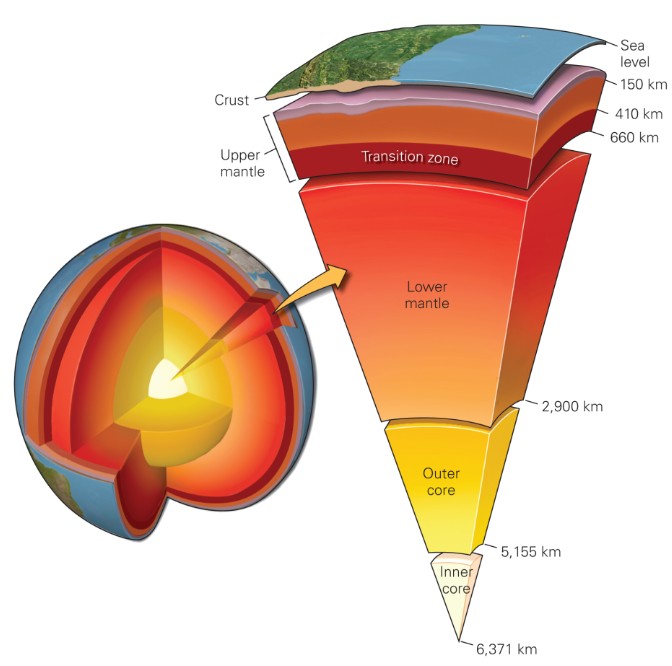
Four layers of the Earth
Crust (solid)
Mantle (flowing solid & molten)
Outer Core (molten)
Inner Core (solid)
Layers of the Earth
Lithosphere - crust + uppermost mantle (solid)
Asthenosphere - lower mantle (flow)
Earth’s Composition
Contains heavier elements
By least to most:
Iron
Oxygen
Silicon
Magnesium
Nickel, sulfur, calcium, aluminum
Crust’s Composition
Contains light elements
Oxygen
Silicon
Aluminum
Iron
Magnesium, calcium, potassium, sodium
Continental crust - thicker, granitic rocks, rich in Si, Al, Na & K (light elements)
Oceanic crust - thinner & denser/heavier, basalt & gabbro rocks, rich in Fe & Mg
What causes thinning & thickening of the crust?
Thinning: crustal stretching
Thickening: mountain building
Mantle’s composition
Makes up most of the Earth’s volume & mass
Rich in Fe & Mg = Peridotite
Outer Core’s composition
Density changes due to it being molten
Mostly Fe & Si
How is the Earth’s magnetic field generated?
From the outer core. Convection of really hot electrically conductive liquid iron & nickel, driven by heat from the inner core & Earth’s rotation, creates electric currents that produce their own magnetic fields.
Inner Core’s composition
Solid, metallic core made of mainly Fe & Ni
 Note
Note  Flashcards (42)