enzymes and digestion
 Studied by 0 people
 Call Kai
 Learn
Learn Practice Test
 Spaced Repetition
 Match
Match Flashcards
 Knowt Play
1/60

Earn XP
Description and Tags
Name | Mastery | Learn | Test | Matching | Spaced | Call with Kai |
|---|
No analytics yet
Send a link to your students to track their progress
61 Terms
define tissue
a group of similar specialized cells that work together to carry out a specific function
define organ
a structure of different tissues that work together to perform a specific function
define organ system
a group of organs that work together to perform a specific function
function of the mouth
Amylase released from the salivary glands breaks down carbs and starches
function of the esophagus
transports food (bolus) from the pharynx to the stomach via wave-like muscular contractions called peristalsis
function of the stomach
breaks down protein into amino acids. Protease breaks down the protein and the stomach acid balances the ph for easier and quicker digestion
function of the liver
produces bile for digestion. Bile regulates protein and hormone levels
function of the gall bladder
stores bile
function of the bile duct
transport bile from liver to small intestine
function of the pancreas
makes all enzymes:
-protease
-amylase
-lipase
function of the small intestine
contains villi, protease, and amylase that break down the remaining carbs and proteins. and lipase for fats
function of the large intestine
absorbs water and compacts waste
function of the anus
expells poo from body
function of the rectum
temporarily stores feces (undigested waste) before egestion (removal) via the anus
function of the brain
coordinate everything from automatic bodily processes like heartbeat and breathing to conscious actions like movement, speech and thought
function of the heart
pump blood throughout the body, delivering oxygen and nutrients while removing carbon dioxide and waste products
function of the skin
protects the body by acting like a barrier protecting it from stuff like pathogens, physical damage and uv radiation
function of the kidneys
filter waste products and excess water from the blood to produce urine
function of the lungs
facilitate gas exchange
function of the bladder
store urine produced by the kidneys and expel it from the body
function of the digestive system
to break down food into smaller absorbable nutrients to fuel the body for energy, growth, and repair
all the organs involved in the digestive system
mouth, esophagus, stomach, small intestine, large intestine, rectum, and anus, along with accessory organs (liver, gallbladder, pancreas) that aid digestion.
the summary of the process of digestion
the multi-stage process of breaking down food into nutrients for energy, growth, and repair.
Mouth & Esophagus: Teeth mechanically grind food, while saliva (containing amylase) begins breaking down carbohydrates. Food is formed into a bolus and moves down the esophagus via peristalsis.
Stomach: The stomach churns food, mixing it with gastric acid and enzymes (like pepsin) to break down proteins. The mixture becomes a liquid called chyme.
Small Intestine (Primary Digestion/Absorption): The pancreas releases enzymes to break down carbs, fats, and proteins. The liver provides bile to emulsify fats. Nutrients are absorbed into the bloodstream through the walls of the small intestine.
Large Intestine & Elimination: Water and vitamins are absorbed from remaining waste in the colon. The remaining solid waste is stored in the rectum and expelled through the anus.
Key accessory organs include the liver (bile production), gallbladder (bile storage), and pancreas (enzyme production).
food is broken down in two ways
mechanical digestion - teeth grinding and our stomach churning up food
chemical digestion - where enzymes help break down food.
function of the circulatory system
to transport oxygen, nutrients, and hormones to the body's cells and remove waste products
function of the reproductive system
to produce offspring to ensure the survival of species
enzymes
- An enzyme is a protein that acts as a biological catalyst
- This means they speed up a reaction in living things, but are not used up themselves
- They are also affected and damaged in certain conditions
starch simple structure
All of the glucose together is starch
They are long molecules, made out of lots of smaller molecules/it is a polymer made out of lots of monomers
protein simple structure
Lots of DIFFERENT amino acids altogether make protein
lipids simple structure
a glycerol molecule bonded to 1, 2 or 3 fatty acid chains
sugars simple structure
a chain of chemically bonded glucose and fructose molecules chemically bonded to make sucrose
how are enzymes used in digestion
they are proteins that speed up the breakdown of large food molecules into smaller, more absorbable ones that the body can use
why are enzymes needed in digestion
they act as biological catalysts that speed up the breakdown of large, complex, insoluble food molecules into small, simple, and soluble molecules. These smaller molecules—such as amino acids, glucose, and fatty acids—can then be absorbed into the bloodstream for energy, growth, and repair.
why is the lock and key theory vital for the enzyme to function
because the active site has a unique 3D shape that is complimentary to the shape of the substrate
independent variable
what we change
dependent variable
what we measure
control variable
What stays the same
(always put 2)
Why do high temperatures prevent enzymes from catalyzing reactions
because it denatures the enzyme, because it is not at its optimum temperature
-That's why our body heat is around 37 degrees, because that is the optimum temperature for enzymes to catalyse reactions
Why does the pH change how well enzymes catalyse reactions
because it denatures the enzyme and the active site, so it is not at the optimum pH
- That's why we have stomach acid, so it can create the right environment for the enzymes to work at their best
function of bile
- to neutralize the acid from the stomach, otherwise, the enzymes in the small intestine would denature
- to emulsify fats, which means to break down the fats into fat droplets, increasing the surface area so lipase can break them down more easily.
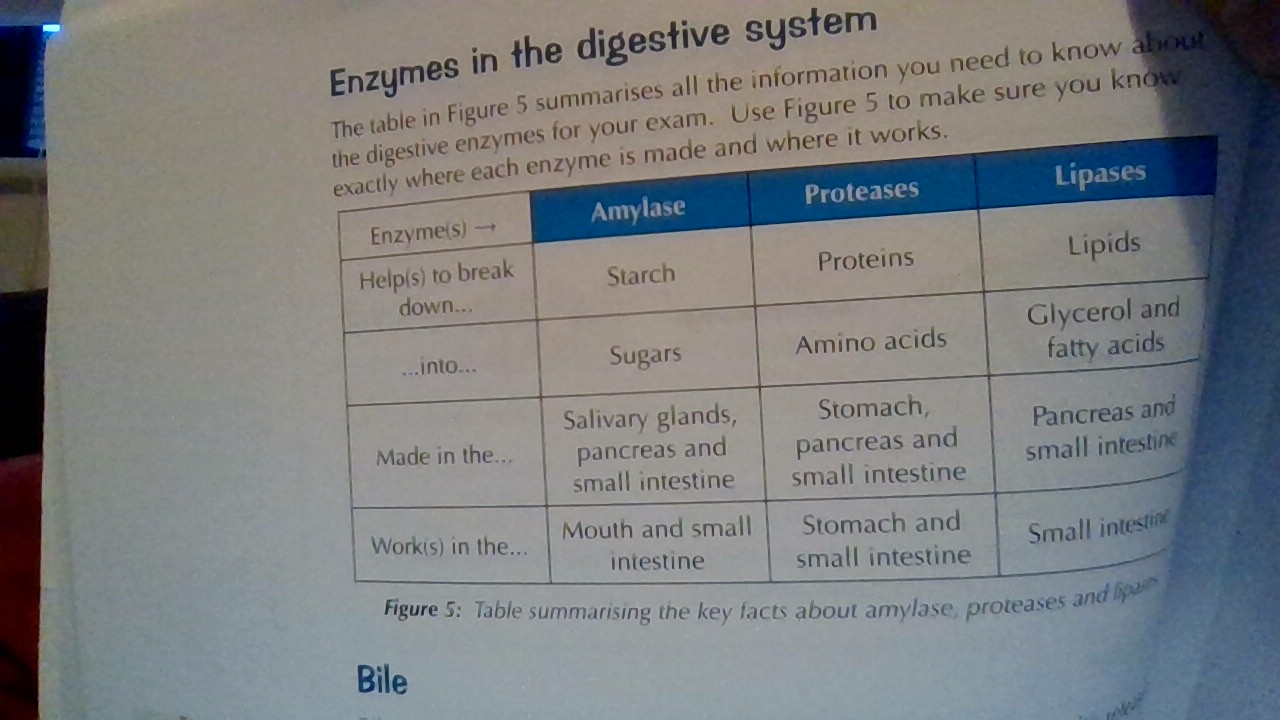
What enzyme acts on carbs
-carbohydraise
-amylase (starch)
What enzyme acts on lipids
-lipase
What enzyme acts on protein
-protease
Where are enzymes produced
-carbohydraise
-lipase
-amylase
-protease
all made in the pancreas
lipase can be produced in the small intestine
protease can be produces in the stomach and small intestine
amylase can be produced in the salivary glands and small intestine all
enzymes in the digestive system summary
what is product from carbs breaking down
glucose
what is the product from lipids breaking down
fatty acids and glycerol
what is the product from proteins
amino acids
food test for presence of starch
- place a small amount of the food on a spotting tile
- add a few drops of iodine
- if the colour changes from yellow-red to blue-black
food test for presence of sugars/glucose
- place a small amount of the food into a test tube
- add water
- add a small amount of blue benedicks solution
- heat test tube in a warm water bath
- if colour changes from nlue to brick red, sugar is present
food test for presence of protein
- place a small amount of food onto a spotting tile
- add a few drops of bieuret solution
- if colour changes from blue to purple, protein is present
food test for fats (lipids)
- place a small amount of food into the test tube
- add a few drops of clear ethanol to the solution
- shake the test tube and leave for 1 minute
- pour the ethanol into a test tube of water, or add water to the ethanol
- a cloudy white layer will appear on top of the water if fats are present
what are vitamins needed for
maintain bodily function
what is fat needed for
insulation, protection, and emergency energy
what is protein needed for
growth and repair
what is glucose needed for
quick release energy
what is starch needed for
slow release energy
How to calculate the mean rate of
an enzyme-catalysed reaction.
- quantity of product formed / time taken
or
- quantity of reactant used / time taken
How is starch broken down
starch is broken down into maltose. then maltose is broken down by maltase into simple sugars and glucose. starts as a polymer and ends as monomers
investigating enzymatic reactions - investingating the effect of ph on amylase
the enzyme amylase catalyses the breakdown of starch to maltose. Its easy to detect starch using iodine solution, if starch if present, the iodine will change from browny orange to blue black
put a drop of iodine solution in every well of a spotting tile
put a beaker of water on a tripod stand with a gauze with a bunsen underneath until the water is 35 degrees. Try to keep the temp of the water constant through the experiment
with a syringe add 1cm³ of amylase solution and 1cm³ of a buffer solution with a ph of 5 to a boling tube. Put the tube into the beaker of warm water for 5 mins.
add 5cm³ of a starch solution to the boiling tube
use continous sampling to record how long it takes for the amylase to break down all the starch. to do this take a dropping pipette to take a sample from the boiling tube every thirty seconds to put a drop into a well. the idonie solution remains browny orange when starch is no longer present
repeat the whole experiment with buffer solutions to different ph values to see how ph effects the time taken for the starch to be broken down
remember to control any variables each time to make it a fair test
calculating the rate of reaction
rate = 1000 // time
 Note
Note  Flashcards (46)