Aerobic Respiration and Fermentation
 Call Kai
 Learn
Learn Practice Test
 Spaced Repetition
 Match
Match Flashcards
 Knowt Play
1/21

There's no tags or description
Looks like no tags are added yet.
Name | Mastery | Learn | Test | Matching | Spaced | Call with Kai |
|---|
No analytics yet
Send a link to your students to track their progress
22 Terms

glucose is getting oxidized
oxygen is reduced
each electron transfer is
exergonic
what drives ATP synthesis
released free energy from electron transfer (electrons in H2O have less potential energy than they did in glucose
energy from glucose ____ released at once
energy from glucose IS NOT released at once
NAD+ does ____
important electron acceptor (gets reduced) during cellular respiration
cellular respiration is a cumilative of four steps
glycolysis
pruyvate oxidation and citric acid cycle (oxidation of carbon and salvaging of high energy e-)
oxidative phosphorylation (electron transport/ATP synthesis)
glycolysis
sugar splitting
6 carbon sugar (glucose) to 2× 3 carbon sugar (pyruvate)
occurs in the cytosol
glycolysis steps
priming the pump (add two ATP) energy investment phase
cleavage, rearrangement and energy release (4 ATP molecules + NADH)
substrate level phosphorylation
in glycolysis ATP is generated by the transfer of a phosphate group from a phosphorolayted substrate to ADP to make ATP
pyruvate kinase
in the final step of glycolysis it phosphorolyates to make pyruvate
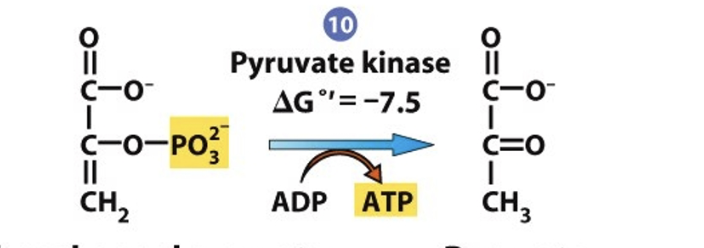
at the end of glycolysis
no O2 was used
no C fully oxidized to CO2
2 ATP molecules were made
how efficent is glycolysis?
very efficent, it only makes two molecules, but it is very fast
why is glycolysis not enough
glycolysis requires a continues supply of NAD+ to keep operating, but NAD+ is limited in cells
fermentation
absence of oxygen
allows glycolysis to continue by regenerating NAD+
aerobic respiration occurs in the matrix
two types
lactate
alcoholic
lactate fermentation
pyruvate is reduced, NADH is oxidized, and lactate and NAD+ is formed
alcholic fermentation
pyruvate is converted into acetaldehyde and carbon dioxide
first step relases for CO2
second step creates ethanol
intermediate complex
Recall that, in some chemical reactions, enzymes may bind to several substrates that react with each other on the enzyme, forming an intermediate complex. An intermediate complex is a temporary structure, and it allows one of the substrates (such as ATP) and reactants to more readily react with each other;
if there is not enough pyruvate kinase what will happen?
The last step in glycolysis will not occur if pyruvate kinase, the enzyme that catalyzes the formation of pyruvate, is not available in sufficient quantities. In this situation, the entire glycolysis pathway will proceed, but only two ATP molecules will be made in the second half. Thus, pyruvate kinase is a rate-limiting enzyme for glycolysis.
which processes create CO2
electron transport
citric acid cycle
alcholic fermentation
Describe the redox reaction that happens as electrons leave the NADH and jump onto Complex I
NADH is oxidized
Complex 1 is reduced
How does the potential energy of electrons change as they move through the ETC?
potential energy decreases
each complex is more electronegative
elctrons have the least amount of potential energy when with oxygen
Which results in higher ATP production: NADH or FADH2?
NADH

