4.2 Exchange rates
 Studied by 1 person
 Call Kai
 Learn
Learn Practice Test
 Spaced Repetition
 Match
Match Flashcards
 Knowt Play
1/15

There's no tags or description
Looks like no tags are added yet.
Name | Mastery | Learn | Test | Matching | Spaced | Call with Kai |
|---|
No analytics yet
Send a link to your students to track their progress
16 Terms
Exchange rate
The price of one currency in terms of another
Fixed exchange rate
A system in which the government of a country agrees to fix the value of its currency in terms of that of another country
Floating exchange rate
A system in which the exchange rate is permitted to find its own level in the market through the forces of demand and supply
Link between interest rates and exchange rates
If UK interest rates are high relative to other countries, they will attract overseas investment increasing the demand for pounds
Devaluation
A devaluation occurs when a country makes a conscious decision to lower its exchange rate in a fixed exchange rate
Depreciation
When there is a fall in the value of a currency in a floating exchange rate
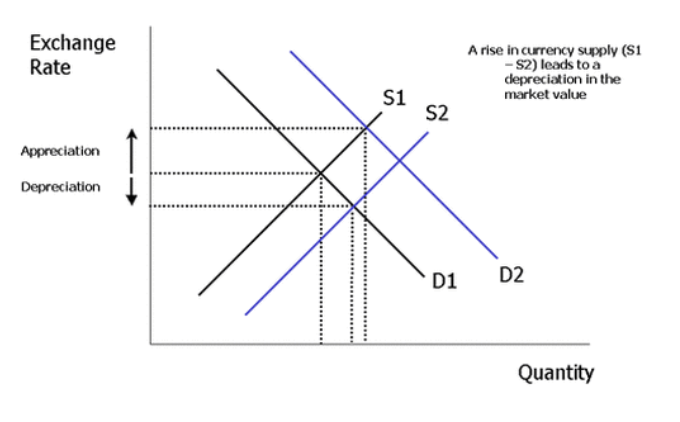
Floating exchange rate system diagram
Money is flowing out of the domestic economy, and increasing the supply of the currency in the foreign exchange market. This causes a depreciation in the value of the currency. S1 to S2
If there is an increased demand for a currency relative to its supply, its value can appreciate. Factors that influence demand include higher interest rates, a strong economy, attractive investment opportunities,D1 to D2
Tools for Managing Floating Exchange Rates
Changes in interest rates e.g. lower interest rates to depreciate the exchange rate: Causes movements of “hot money” banking flows into or out of a country
Quantitative easing: Increase liquidity in the banking system, usually causes outflow of money – depreciation of the exchange rate
Direct buying / selling in the currency market (intervention)
Taxation of foreign deposits in banks cut the profit from hot money inflows: Controls on the free flow of capital into and out of a country
Factors determining a currency’s value
Current account surplus on the balance of payments
Strong inward investment inflows + portfolio flows
Relatively high policy interest rates
Speculative currency demand
Advantages of a floating exchange rate
Reduces the need to hold large amounts of currency reserves
Freedom to set monetary policy interest rates to meet domestic objectives
May help to prevent imported inflation
Insulation for an economy after an external shock especially for export-dependent countries
Partial automatic correction for a current account deficit
Less risk of a currency becoming significantly over/undervalued
Disadvantages of a floating exchange rate
No guarantee that floating exchange rates will be stable
Volatility in a floating exchange rate might be detrimental to attracting inward investment
A lower (more competitive) exchange rate does not necessarily correct a persistent balance of payments deficit
Advantages of a fixed exchange rate
Certainty of currency value gives confidence for inward investment
Reduced costs of “currency hedging” for businesses
Stability helps to control inflation – i.e. it is a discipline on businesses to keep their unit labour costs low
Can lead to lower borrowing costs (i.e. lower yields on bonds)
Imposes responsibility on government macro policies
Less speculation if the fixed exchange rate is credible
Disadvantages of a fixed exchange rate
Reduced freedom to use interest rates for other macro objectives
Many developing countries do not sufficient foreign currency reserves to be able to maintain a fixed exchange rate
Difficult for countries to use a competitive devaluation of their fixed exchange rate - creates political tensions and might lead to a protectionist response
Devaluation of a fixed exchange rate can lead to a surge in cost-push inflation - damaging for competitiveness and has regressive effects on poorer families
Impact of a currency depreciation
Inflation: Higher import prices feed into increased consumer prices, may help the UK to avoid deflation, lower real interest rates
Economic growth: Lower £ is a stimulus to growth e.g. from higher net exports
Unemployment: Competitive currency will help to increase domestic production, export multiplier effect, upturn in tourism /overseas students
Balance of trade: Dependent on price elasticities of demand for exports & imports, possible J curve effect in the short run Weak demand in key export markets including the Euro Zone
Business investment: Should help to improve profitability e.g. overseas earnings of UK plc in US dollars and Euros will be worth more in £s (rising GNI)
Wider effects: Depreciation is similar to a cut in interest rates i.e. an expansion of monetary policy) but there are risks too, including higher costs of importing components, raw materials and capital technologies.
Effects of a currency depreciation depend on
The length of time lags as consumers and businesses respond
The scale of any change in the exchange rate i.e. a 5%, 10%, 20%
Whether the change in the currency is short-term or long-term – i.e. is a change in the exchange rate temporary or likely to persist
Price elasticity of demand for imports and exports
The size of any second-round multiplier and accelerator effects
When the currency movement takes place – i.e. Which stage of an economic cycle (recession, recovery etc.)
The type of economy (e.g. small developing v large advanced)
The degree of openness of the economy to international trade
Effects of currency appreciation
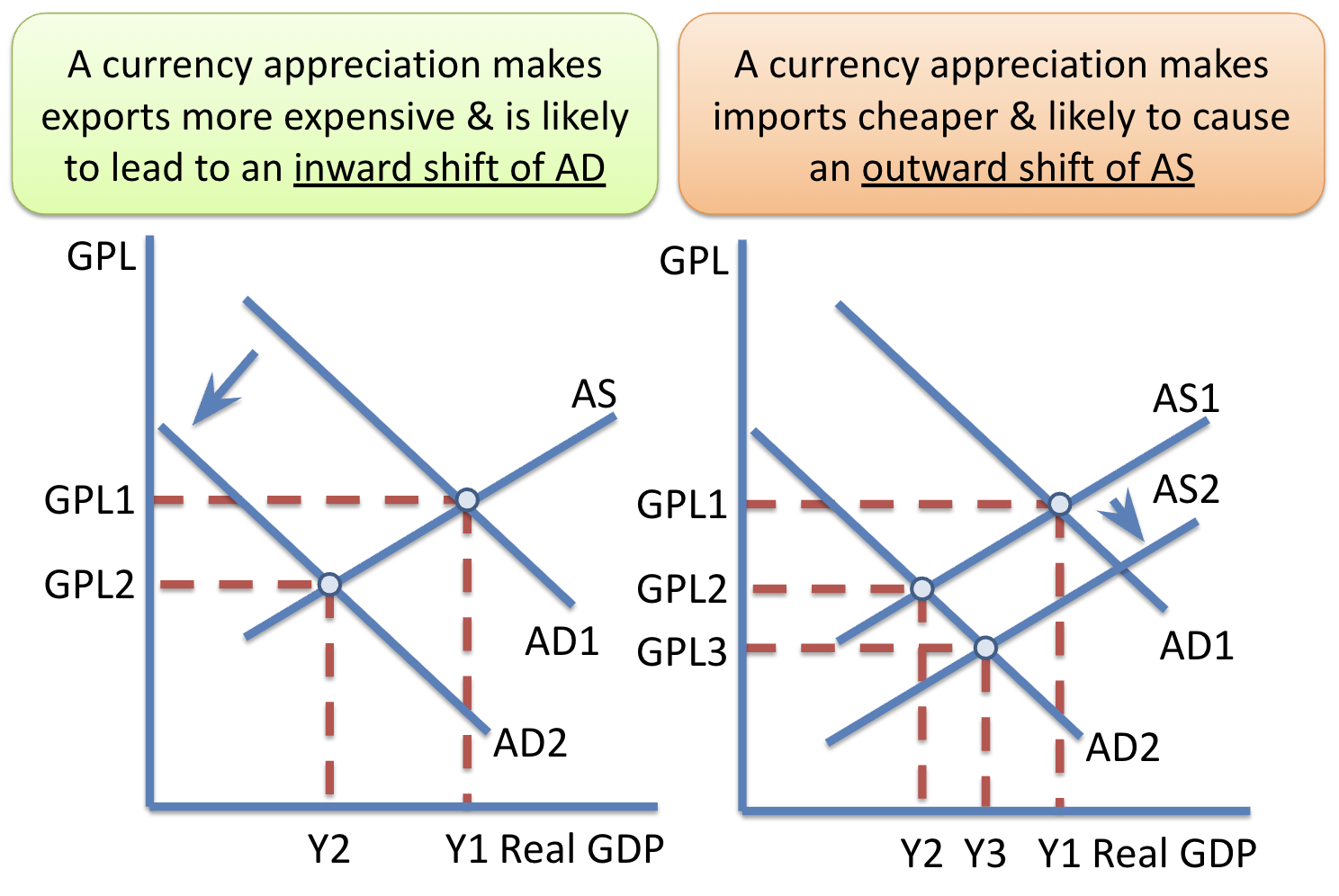
Rise in external purchasing power e.g. £1 buys more Euros
Cheaper to import goods and services
Rising demand for imports (depends on elasticity of demand for imports)
Worsening of the trade balance (Trade deficit may rise)
Fall in aggregate demand because of rising leakages from circular flow
 Note
Note  Flashcards (73)