psych exam 2
 View linked note
 Call Kai
 Learn
Learn Practice Test
 Spaced Repetition
 Match
Match Flashcards
 Knowt Play
1/128

There's no tags or description
Looks like no tags are added yet.
Name | Mastery | Learn | Test | Matching | Spaced | Call with Kai |
|---|
No analytics yet
Send a link to your students to track their progress
129 Terms
Katie notices there is a new barista at her favorite coffee shop. She also notices that her vanilla latte tastes just slightly sweeter than usual. The taste difference is right at the ______________ threshold.
difference
Anna is reading her psychology text. The activation of receptors in her retina is called ________; her interpretation of the stimuli as particular words is termed ________.
sensation; perception
Because the brain cannot process physical stimuli directly, it must convert the stimuli into chemical and electrical signals that can be interpreted by the brain. This process is known as ________.
transduction
Leroy throws a party while his parents are out of town. During the party, Monica runs up to Leroy and exclaims, "Your mom just pulled up to the house in her Jeep!" When he looks out the window, he is able to quickly determine that the Jeep is not his parents' because it is not the right color. In signal detection terminology, Monica's response is a ______________, while Leroy's response is a ______________.
false alarm; correct rejection
No rods or cones exist on the spot where the optic nerve attaches to the retina.
Why does a blind spot exist in our visual field?
Carlos accidentally added an extra tablespoon of sugar to his cake batter. This will probably not change the cake's flavor in a significant way, although the same tablespoon of sugar, would be noticeable if he put it in his cup of tea. What explains this difference?
Weber’s law
Japhet knows that while rods are spread throughout the retina, cones are concentrated around the fovea. Based on this knowledge, what might Japhet infer about visual perception?
Color is easier to see in the center of the visual field.
Merlin is growing older and losing his ability to hear. Luckily, his pet owl not only hears well, but also can use cues to locate where a sound comes from. How is Merlin's owl capable of locating the source of a sound?
Sounds reach the closer ear first, and this small timing difference gives away the source's location.
Frequency of the action potential.
How can a neuron signal the difference between an intense stimulus and a week stimulus?
Hannah is having dinner at a Mexican restaurant. When she tries the three kinds of sauces to see how hot they are, she is assessing ________ differences. When she compares the taste of her margarita to the taste of her friend’s Mexican beer, she is assessing a ________ difference.
quantitative; qualitative
Shaping is ______________.
rewarding behaviors that increasingly resemble the desired behavior.
What term is used to describe a decrease in a behavioral response after repeated exposure to nonthreatening stimuli?
habituation
What is a conditioned stimulus
something that elicits a response only after learning
What is the process whereby the conditioned response is weakened when it is no longer presented with the unconditioned stimulus
extinction
Allie is afraid of her neighbor’s large dog. She then becomes afraid of any dog she sees on the street, and eventually she fears even pictures of dogs or toy dogs. This change in her fear of dogs represents ______________.
Stimulus generalization
Thorndike’s studies with cats led him to state that behavior that leads to a “satisfying state of affairs” is likely to occur again, whereas behavior that leads to an “annoying state of affairs” is not likely to occur again. This principle is known as ______________.
the law of effect
involve the administration of a stimulus.
Positive reinforcement and positive punishment are similar in that both
produce a decrease in the probability of a behavior.
Positive punishment and negative punishment are similar in that both
aggressive behavior can be learned through observation
As discussed in the text, Bandura’s study of children’s play habits with the “Bobo” doll provided evidence that
Classical conditioning trains the learner to do something without thinking about it. Operant conditioning trains the learner to do something in order to receive a reward.
What is the difference between classical conditioning and operant conditioning?
What is the correct order of a memory stage?
encode; store; retrieve
To remember more information, ________ can be used to organize information into meaningful units.
chunking
A children’s flipbook consists of a series of pictures of Mickey Mouse with his feet in slightly different positions. If you look at the pages one at a time, slowly, all you see are the individual pictures of Mickey. However, if you flip the pages quickly, you see Mickey running. This illusion is due to storage of the successive pictures in ________ memory.
sensory
Sensation
the detection of external stimuli
and the transmission of this information to
the brain
Perception:
the processing, organization, and
interpretation of sensory signals
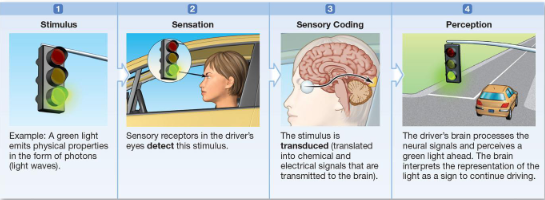
steps of sensory info being transmitted
review steps of sensory info being transmitted
Bottom-up processing
perception based on the physical features of the stimulus
Top-down processing
how knowledge,
expectations, or past experiences shape the
interpretation of sensory information
Sensory coding
sensory receptors translate the physical properties of stimuli into patterns of neural impulses
Transduction
the process by which sensory
stimuli are converted to signals the brain can
interpret
Qualitative information
describes the characteristics or qualities of a stimulus, rather than numerical measurements
Quantitative information
consists of the degree, or magnitude of those qualities. It provides numerical measurements of a stimulus, such as intensity or frequency.
Ernst Weber and Gustav Fechner
developed the principles of psychophysics, which explore the relationship between physical stimuli and the sensations and perceptions they produce in the human mind.
Absolute threshold
the minimum intensity of stimulation that must occur before you experience a sensation
Difference threshold
the minimum amount of
change required for a person to detect a
difference between two stimuli
Weber’s law
the just noticeable difference between
two stimuli is based on a proportion of the original
stimulus rather than on a fixed amount of difference
Signal detection theory
a theory of perception based on the idea that the detection
of a stimulus requires a judgment—it is not an
all-or-nothing process
crude camera analogy
suggests the eye functions like a camera, merely capturing images. However, it does not sufficiently explain the intricate processes that take place in the eye, including how light is converted into neural signals, how the brain interprets these signals, and how perception involves more than just raw data capture.
Accommodation
What can change the shape of the lens
Retina
the thin inner surface of the back of
the eyeball; it contains the sensory receptors
that transduce light into neural signals. retina has two types of receptor cells
Rods
highly sensitive retinal cells that respond to low levels of light
and result in black-and-white perception
Cones
retinal cells that respond to higher levels of
light and result in color perception
Fovea
the center of the retina, where cones are
densely packed
Transmission From the Eye to the Brain
generation of electrical signals by the sensory receptors in
the retina. These receptors contain photopigments, protein
molecules that become unstable and split apart
when exposed to light. decomposition of the photopigments
alters the membrane potential of the photoreceptors
and triggers action potentials.Ganglion cells are the first neurons in the visual
pathway with axons, which are gathered into a
bundle called the optic nerve.axons in the optic nerves
cross to the left and right hemispheres, and travel
to visual areas of the thalamus and then to the
primary visual cortex.
When is graphical representation useful in explaining the absolute threshold?
Graphical representation is useful in illustrating the absolute threshold when showing how the minimum intensity of stimulation (x-axis) correlates with the perceived sensation (y-axis). It can depict the point at which a stimulus is detected versus when it is not, often represented with a curve that demonstrates the transition from non-perception to perception as intensity increases.
Ventral stream / “what” stream
appears to be specialized for the
perception and recognition of objects
Dorsal stream/“where” stream.
specialized for spatial perception
Audition
hearing; the sense of sound perception
Sound wave
a pattern of changes in air pressure during a period of time; it produces the percept of a sound
Eardrum
a thin membrane that marks the beginning of the middle ear; sound waves cause it to vibrate
Hearing pathway
Sound waves → outer ear → eardrum
Sound Localization
The brain integrates the different sensory
information coming from each ear.
– barn owl research subjects
behaviorism
John B. Watson developed it which emphasized
environmental effects on observable behaviors. reaction against psychology’s earlier
focus on conscious and unconscious mental processes
Nonassociative learning
when behavior changes without linking two things together, just from repeated exposure to one stimulus.
Associative learning
linking two stimuli, or
events, that occur together
Social learning
learning by instruction or
observing how others behave
Habituation
a decrease in behavioral
response after repeated exposure to a
stimulus
Dishabituation
an increase in a response
because of a change in something familiar
Sensitization
an increase in behavioral
response after exposure to a stimulus
Stimuli that most often lead to sensitization are
those that are threatening or painful
Ivan Pavlov
Classical Conditioning with Ivan Pavlov’s
research on the salivary reflex, an automatic
response when a food stimulus is presented to
a hungry animal.
Classical conditioning
a neutral object comes to elicit a response when it is
associated with a stimulus that already
produces that response
Conditioning trials
a neutral stimulus and an
unconditioned stimulus are paired to produce a
reflex
Neutral stimulus
anything the animal can see or hear
as long as it is not associated with the reflex being
tested
Unconditioned stimulus
stimulus that elicits a response, such as a reflex, without any prior learning(e.g., food)
Test trials
the neutral stimulus alone is
tested, and the effect on the reflex is
measured
Unconditioned response
a response
that does not have to be learned, such as a
reflex
Unconditioned stimulus
a stimulus that
elicits a response, such as a reflex, without any
prior learning
Conditioned stimulus
a stimulus that
elicits a response only after learning has taken
place
Conditioned response
a response to a
conditioned stimulus; a response that has
been learned
Acquisition
the gradual formation of an
association between the conditioned and
unconditioned stimuli
– The critical element in the acquisition of a learned
association is time, or contiguity
The CR is stronger when there is a very brief
delay between the CS and the US
The CR is stronger when there is a very brief
delay between the CS and the US
Extinction
a process in which the conditioned
response is weakened when the conditioned
stimulus is repeated without the unconditioned
stimulus
Spontaneous recovery
a process in which a
previously extinguished conditioned response
reemerges after the presentation of the
conditioned stimulus
Second-order conditioning
A CS becomes
associated with other stimuli associated with
the US. This phenomenon helps account for
the complexity of learned associations.
– Second-order conditioning helps account for the
complexity of learned associations, especially in
people
Stimulus generalization
learning that occurs
when stimuli that are similar, but not identical,
to the conditioned stimulus produce the
conditioned response
Stimulus discrimination
a differentiation
between two similar stimuli when only one of
them is consistently associated with the
unconditioned stimulus
Operant conditioning (Instrumental
conditioning)
a learning process in which the
consequences of an action determine the
likelihood that it will be performed in the
future
Law of Effect
any behavior that leads to a
“satisfying state of affairs” is likely to occur again,
and any behavior that leads to an “annoying state
of affairs” is less likely to occur again
Edward Thorndike using a puzzle
box
States of “satisfaction”
Reinforcement Increases Behavior,
Punishment Decreases Behavior Skinner
developed a more formal learning theory,
based on the law of effect
Reinforcer
a stimulus that follows a response and
increases the likelihood that the response will be
repeated
Shaping
an operant-conditioning technique that
consists of reinforcing behaviors that are
increasingly similar to the desired behavior
Successive approximations
process of reinforcing small steps that get closer and closer to a desired behavior.
Primary reinforcers
satisfy biological needs
such as food or water
Secondary reinforcers
events or objects
established through classical conditioning that
serve as reinforcers but do not satisfy
biological needs
Premack principle
using a more valued
activity can reinforce the performance of a
less valued activity.
Positive reinforcement
the administration of a
stimulus to increase the probability of a behavior
being repeated
Negative reinforcement
the removal of a
stimulus to increase the probability of a behavior
being repeated
Positive punishment
the administration of a
stimulus to decrease the probability of a behavior
recurring
Negative punishment
the removal of a stimulus
to decrease the probability of a behavior recurring
social learning
Learning behaviors through observation and interaction with others, emphasizing imitation and modeling.
Bandura’s Bobo Doll Studies
Children learn aggression through observational learning (modeling) by watching others behave aggressively
Modeling
the imitation of observed behavior
Vicarious learning
learning the consequences of an action by watching others being
rewarded or punished for performing the
same action
Memory
the ability to store and retrieve
information
Encoding
the processing of information so that it can
be stored
Storage
the retention of encoded representations
over time
Consolidation
the neural process by which encoded
information becomes stored in memory
Retrieval
the act of recalling or remembering stored
information when it is needed
Reconsolidation
the re-storage of memory
after retrieval
