PSYS 2200 Exam 1
 Studied by 0 people
 Call Kai
 Learn
Learn Practice Test
 Spaced Repetition
 Match
Match Flashcards
 Knowt Play
1/65

Earn XP
Description and Tags
PSYS 2200 Biopsychology, Hammack, Spring 2026 Exam 1 review questions
Name | Mastery | Learn | Test | Matching | Spaced | Call with Kai |
|---|
No analytics yet
Send a link to your students to track their progress
66 Terms
What is biopsychology?
The study of the biological mechanisms of behavior and experience

What else is biopsychology called?
Behavioral neuroscience, behavioral biology, psychobiology

What did the accident of Phineas Gage imply?
Tamping rod through frontal lobe → suggests that personality and emotion could be tied to a specific part of the brain

How many neurons are in a brain? How many connections can they make?
~100 billion neurons, each making 1,000-10,000 connections with other neurons

What is trephination? (Trephining)
Surgical technique involving drilling/scraping hole in skull to relieve pressure

What did Hippocrates say was the source of all intellect? Where was intellect thought to be until that point?
Hippocrates said brain was the source of intellect (c. 400 BC); Previously believed to be in the heart

What was the Edwin Smith Surgical Papyrus?
An ancient Egyptian surgical text describing scientific approaches for treating trauma, largely in brain, and introducing words for brain, describing it as having bumps and folds.
Discovered by Egyptologist Edwin Smith

Where did the Egyptians think that spirit was located?
Spirit and intellect in heart, which they carefully preserved after death; brain was scrambled and removed

Where did the Mesopotamians think that emotion was located?
Believed emotion was mediated by liver

What did Galen suggest?
The mind/soul are located in the ventricles of the brain
What is the Mind/Brain problem?
What is the relationship between the mind and the brain?

What is the difference between monism and dualism?
Monism is the belief that the mind and brain are one; dualism is the belief that they are made of different substances and exist independently

Was Descartes a monist or dualist? How did he solve this problem?
Descartes was a dualist. He addressed the interaction problem by suggesting that the pineal gland acts as the point of union where the soul directly interacts with the body.

What is meant by materialism?
Everything that exists is physical; consistent with monism

Who invented phrenology? What important idea was introduced with phrenology?
Invented by Franz Joseph Gall
Phrenology is the study of the skull structure to determine a person’s character. Gall assumed that if someone exhibited a trait more, the responsible part of the brain and the surrounding skull would be larger.

What did William James suggest?
The mind is a function of the brain and all human cognition and behavior is the result of physiological processes.

Physiological psychology
Neural mechanisms of behavior.
Psychopharmacology
Chemical mechanisms of behavior and the effects of drugs on behavior.
Neuropsychology
Psychological effects of brain damage on behavior.
Psychophysiology
Interaction between physiological processes and psychological processes in humans.
Cognitive neuroscience
Neural mechanisms of 'cognition'.
Comparative psychology
Biology of behavior among species.
Behavioral genetics
Genetic basis of behavior.
Neurological surgeon
A physician who performs surgery on the nervous system
Neurologist
A physician who diagnoses and treats disorders of the nervous system
Psychiatrist
A physician who diagnoses and treats mental disorders
What are four important goals of biopsychology?
1. How does the brain function?
2. Can we improve normal functioning?
3. What things can go wrong in the brain?
4. Can disease be prevented or cured?

How do biopsychologists achieve these goals?
Associating abnormal behavior with deficits in brain function, observing the brain in response to alterations in the environment and consequent changes in behavior

What is agnosia?
Loss of ability to recognize objects, persons, sounds, shapes or smells while the specific without defect/loss of sense or memory; Usually associated with brain injury or neurological illness, particularly after damage to the temporal lobe.

What is unilateral neglect?
Patients often fail to see/respond to objects on the side opposite to their brain damage (ex. patients with damage to the right side of their brain often only eat food from the right side of their plate, bump into the left side of doorways, and only shave right side of face). Cannot be accounted for by loss of vision/perception; fail to orient in order to perceive objects in their bad field.

What makes up the central nervous system?
Brain and spinal cord

What makes up the peripheral nervous system?
Nerves; split into divisions:
Autonomic→Parasympathetic/Sympathetic
Somatic

What makes up the autonomic nervous system?
Sympathetic and parasympathetic nervous systems

How is sensory information processed in the central nervous system? What is the role of the thalamus, tectum, and cortex?
Sensory information is processed in the central nervous system by traveling from receptors through the spinal cord or brainstem, with most signals relayed through the thalamus to the cortex for conscious perception. The tectum integrates visual, auditory, and somatosensory information.
What are some regions important for movement?
Cerebellum, substantia nigra, telencephalon

What are the consequences of cerebellum damage and/or inhibition by alcohol?
Pons and cerebellar damage lead to disturbances in fine motor control, coordination and posture

What region degenerates in Parkinson’s Disease?
Neurons in the Substantia Nigra

What regions are important for motivation and emotion?
Limbic system (amygdala, hippocampus, septum, cingulate cortex), hypothalamus

What is homeostasis?
Maintaining a stable, constant condition

What separates the frontal lobe from the parietal lobe?
Central sulcus fissure
What separates the temporal lobe from the frontal lobe?
Lateral sulcus fissure

Where is the precentral gyrus? Postcentral gyrus? What is the function of each?
Precentral gyrus (primary motor cortex) sits in the posterior frontal lobe for initiating voluntary movement
postcentral gyrus (primary somatosensory cortex) sits in the anterior parietal lobe to process sensory information.

What is an aphasia?
An impairment of the ability to use and comprehend words

What layers of cortex have projection neurons? Interneurons? What is the difference between these two neuron types?
Interneurons are local projections that stay in the brain region and are found in layers 2 and 4.
Projection neurons project out of the brain region and are found in layers 3 and 5.

What and where are the three meninges? Blood vessels?
Meninges: layers of membranes beneath the skull that surround the nervous system tissues
Dura mater, arachnoid membrane, pia mater
Blood vessels found between mater and arachnoid in subarachnoid space
Where is cerebrospinal fluid located?
CSF is located within the brains ventricles, the subarachnoid space surrounding the brain and spinal cord, and the central canal of the spinal cord
Describe the flow of CSF.
Produced in the lateral ventricles (technically ventricles 1 and 2) → third ventricle → fourth ventricle → subarachnoid space → brain and spinal cord/around brain → reabsorbed into bloodstream
What is hydrocephalus? How is it caused? How can it be treated?
A buildup of cerebrospinal fluid in the ventricular system causing potentially damaging increased pressure in the head.
Two base causes: the bloodstream is not fully absorbing the fluid due to a damaged filter
in the brain or the flow of fluid within the ventricles is blocked.
Can be treated with a shunt- tube to drain fluid to different part of body

What are the two main arteries that supply blood to the brain?
Vertebral artery and carotid artery
How much oxygenated blood does the brain use?
750 ml/minute, 20% of bodies oxygen
What is a sinus in the brain?
Large blood vessels that collect deoxygenated blood and return it to heart through the jugular vein

What is the blood brain barrier and why do we need one?
a filtering mechanism of the capillaries that carry blood to the brain and spinal cord tissue that protects the brain from "foreign substances," hormones, and neurotransmitters in the rest of the body and maintains a constant environment for the brain.

What can break down the blood brain barrier?
Hypertension, injury to brain (Trauma, Ischemia, Inflammation, Pressure), exposure to microwaves, radiation, or infection.
Not fully formed at birth.
Weak spots, including the “chemical trigger zone”—the area that controls vomiting.

What do the dorsal and ventral horns of the spinal cord do?
Ventral: motor info out
Dorsal: sensory info in

What is a dermatome?
Area of skin supplied by nerve root
How many neurons mediate the patellar reflex?
Two types- one sensory (afferent) and one motor (efferent) forming reflex
What kind of information can cranial nerves carry?
Information for special senses (sight, smell, hearing, balance, taste)
General sensation (touch, pain, temperature)
Motor control (facial muscles, eye movement, tongue movement)

What did Cajal say that was so important?
Neuron doctrine: the nervous system is made of many separate cells (previously believed to be a single web)
Used golgi stain (stained some neurons) to view individual neurons

What are the parts of a neuron? How is information carried through the nervous system?
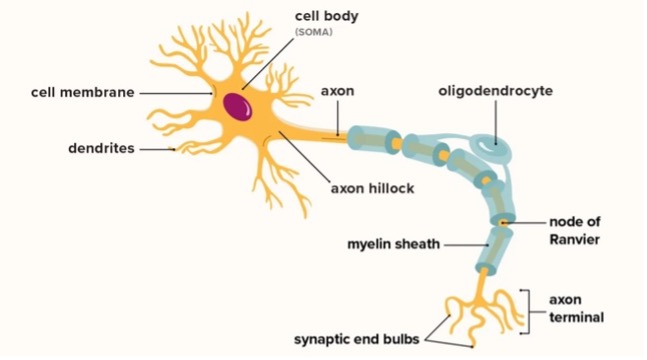
Cell body/soma: integrates incoming signals from dendrites, generates action potentials to transmit information
Axon: carries signal from soma → axon terminal
Axon hillock: beginning of neuron where action potentials initiate
Axon terminal: end of axon where neurotransmitters are released
Myelin Sheath: Speeds up/↑ efficiency of signal transfer
Dendrite: Receive most contacts from other neurons
Dendritic Spines: Protrusions in dendrites that make connections w/ other neurons
What is a dendritic spine? What is one reason some dendrites have spines?
Protrusions from dendrites that make connections with other neurons

What shapes can neurons have?
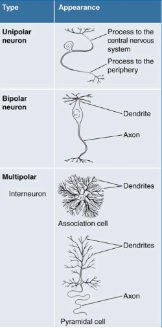
Unipolar: one process that splits (often sensory)
Bipolar: one axon and one dendrite (e.g., retina)
Multipolar: one axon and multiple dendrites
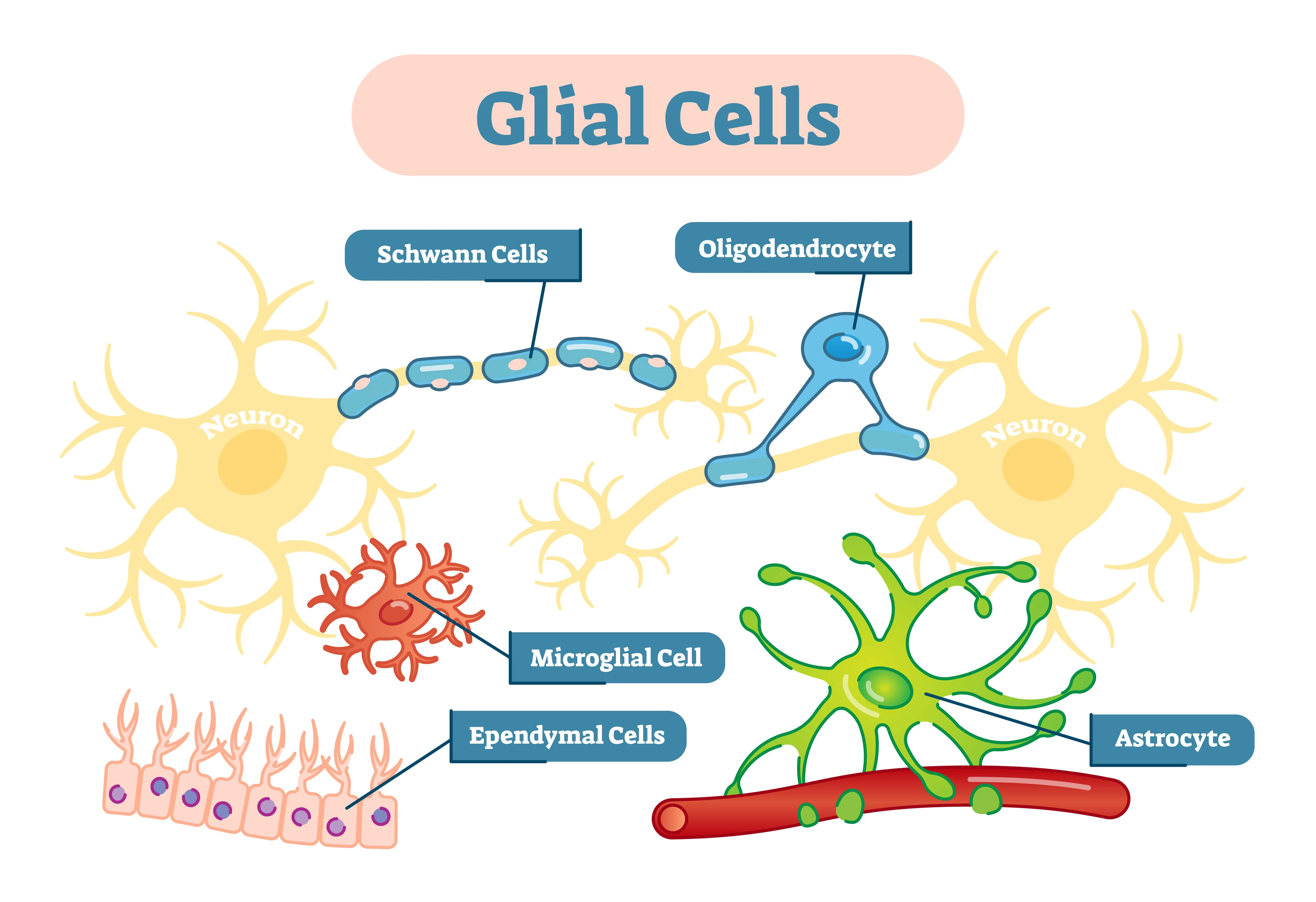
What are the types of glial cells and how do they differ?
Oligodendrocytes: form myelin sheath around/insulate axons in the CNS
Schwann cells: form myelin sheath around/insulate axons in the PNS
Astrocytes: Many functions, including passage of chemicals from blood to neurons, forming BBB
Microglia: immune cells of the nervous system
What ions are important for resting membrane potential? For action potentials?
Resting: Na+, K+, Cl-
Action: Na+, K+

Which ions are found in greater amounts outside the cell? Inside? What is the charge of each?
Inside of cell: K+, negatively charged
Outside of cell: Na+ and Cl+, positively charged

What voltage levels do neurons usually rest at?
Resting membrane potential: -70 mV
Equilibrium potentials: K+ = -85 mV, Cl+ = -66 mV, Na+ = +55 mv

What forces move ions into or out of neurons? Which way do these forces move each ion?
Electrostatic pressure: positively charged ions move into negatively charged cell
K+ and Na+ in, Cl- out.
Chemical concentration: ions move from high to low concentration
K+ out, Na+ and Cl- in.

 Note
Note  Flashcards (50)