7: Sedimentary Structures
 Call Kai
 Learn
Learn Practice Test
 Spaced Repetition
 Match
Match Flashcards
 Knowt Play
1/56

Earn XP
Description and Tags
Name | Mastery | Learn | Test | Matching | Spaced | Call with Kai |
|---|
No analytics yet
Send a link to your students to track their progress
57 Terms
what does sedimentary structures include? what are these called?
structures formed just before, during, or just after deposition, primary
what does sedimentary structures not include? what are these called?
structures formed during or after lithification, secondary
what are the types of classification sedi structures?
depositional, erosional, deformational, biogenic
what are deformational structures?
soft-sediment deformation after deposition
what are biogenic structures? examples?
modifications by live organisms, trace fossils, coral
what are beds?
tabular or lenticular layers of sedi rock that have lithologic, textural, or structural similarities, distinguished from strata above and below
what are bedding planes?
upper and lower surfaces of beds
what are laminae?
layers less than 1 cm thick
how to dinstinguish between wavy parallel and wavy nonparallel?
nonparallel will have intersecting lines
what does tabular mean?
even thickness
what does lenticular mean?
shaped like a lens, thicker in the middle and tapered on the edge
how are parallel laminae formed?
settling of very fine grained particles out of suspension or traction in water or air. OR, by very fast flow allowing no ripples
how is cross bedding formed?
sediment deposited on the lee side of a dune, layer by layer creating an angled bed
if the bottom of the dune structure is the head of an arrow, which way do crossbeds point?
downstream
what is the difference between tilted rocks and tilted bedding?
tilted rocks are macroscopic, the current will push them over, so the top points downstream, tilted bedding is microscopic, the sediment is deposited on a dune, so the bottom points downstream
what are bedforms? examples?
distinct topographic forms that develop on a surface of sedi due to specific conds of fluid velocity and sedi transport depositions, ripples and dunes
what is the difference between ripples and dunes?
ripples are less than 5-6cm in height, dunes are larger and are spaced 1-100m apart
what are ripples controlled by?
viscous sublayer
what is the lee side?
downwind, the side where sediment gets deposited
what is the stoss side?
upwind, the side where sediment is pushed uphill
what is angle of climb?
the angle that the base of the ripple/dune is building on
what is important about angle of climb?
if it’s zero, none of the ripples will be preserved
what are sinuous/undulatory ripples/dunes? what will it cause? what type of foreset will it cause?
the “line” visible from the top is wavy, not straight, curved preservations in the cross section, asymmetrical
what are linguoid ripples/dunes? what will it cause? what type of foreset will it cause?
the lines from the top look like channels, curved preservation sin the cross section, tangential and asymptotic
what will 3D transverse ripples/dunes look like? what will the cross section look like?
sinoidal shape, out of phase, in direction of flow cross section will look lenticular intersecting, direction parallel to flow will look like regular 2D with angle of climb
what will a low flow velocity over a ripple/dune cause?
sharp angular lee side
what will medium flow velocity over a ripple/dune cause?
a curved asymptotic lee side
what will high flow velocity over a ripple/dune cause?
counter-current ripples on the lee side
what will occur in low flow regimes? what froude number?
Fr<1, ripples and dunes form
what will occur in high flow regimes? what froude number?
Fr>1, flat plane bed, then antidunes, then chutes and pools
what are antidunes? where are they formed?
fairly symmetric dunes migrating upstream with low angle cross beds dipping upstream (opposite of expected), in high flow regimes
briefly explain the controls on bedform stability graph?
coarse grains don’t produce ripples, the transition between no motion to lower plane then dunes then upper plane is gradual, the transition between ripples to dunes or ripples to upper plane is abrupt. there is a diagonal trend between small grains at low speed = ripples and large grains at higher speed = dunes
what is required for significantly high climbing ripples? why? why wouldn’t another way work?
low velocity with a lot of sediment, lots so they will be deposited and not just wash away, and if it was high flow velocity they would crash into each other with force and destroy the ripples
what is important about wave ripples?
the surface will be symmetrical but the cross section can be intertwining
what can symmetrical ripples have than asymmetrical may not?
laminations or cross bedding angled in both directions
what is hummocky cross stratification
dune scale bedforms with cross laminae dipping in all directions away from a high convex crestal area
what is information about HCS? (wavelength, angle, grain size, formed by?)
1-5m wavelengths, thin laminae draping over hummocks and dip at low angles (12*), with low angle intersections, only fine-grained sands, formed in combined flow of strong oscillatory currents (storms) and unidirectional flow
how to distinguish HCS?
look at big picture, small areas may appear planar, look for intersections at low angles
what is herringbone cross stratification? what is it caused by? how is it formed?
looks like cross bedding, in tidal areas, flow going in one direction, then ebbing and letting fine grained particles deposit, and direction changing, causing laminae to be angled the opposite direction
what is slack water? what does it allow?
when the water velocity goes to zero as the flow direction is changing, mud deposition (much finer grains)
what is heterolithic bedding? where does it occur?
interbedded mud and sand laminae, variations in currents and sediment supplly
what are the types of heterolithic bedding?
lenticular, wavy, flaser
what is lenticular bedding?
more mud than sand
what is wavy bedding?
same mud and sand
what is flaser bedding?
more sand than mud
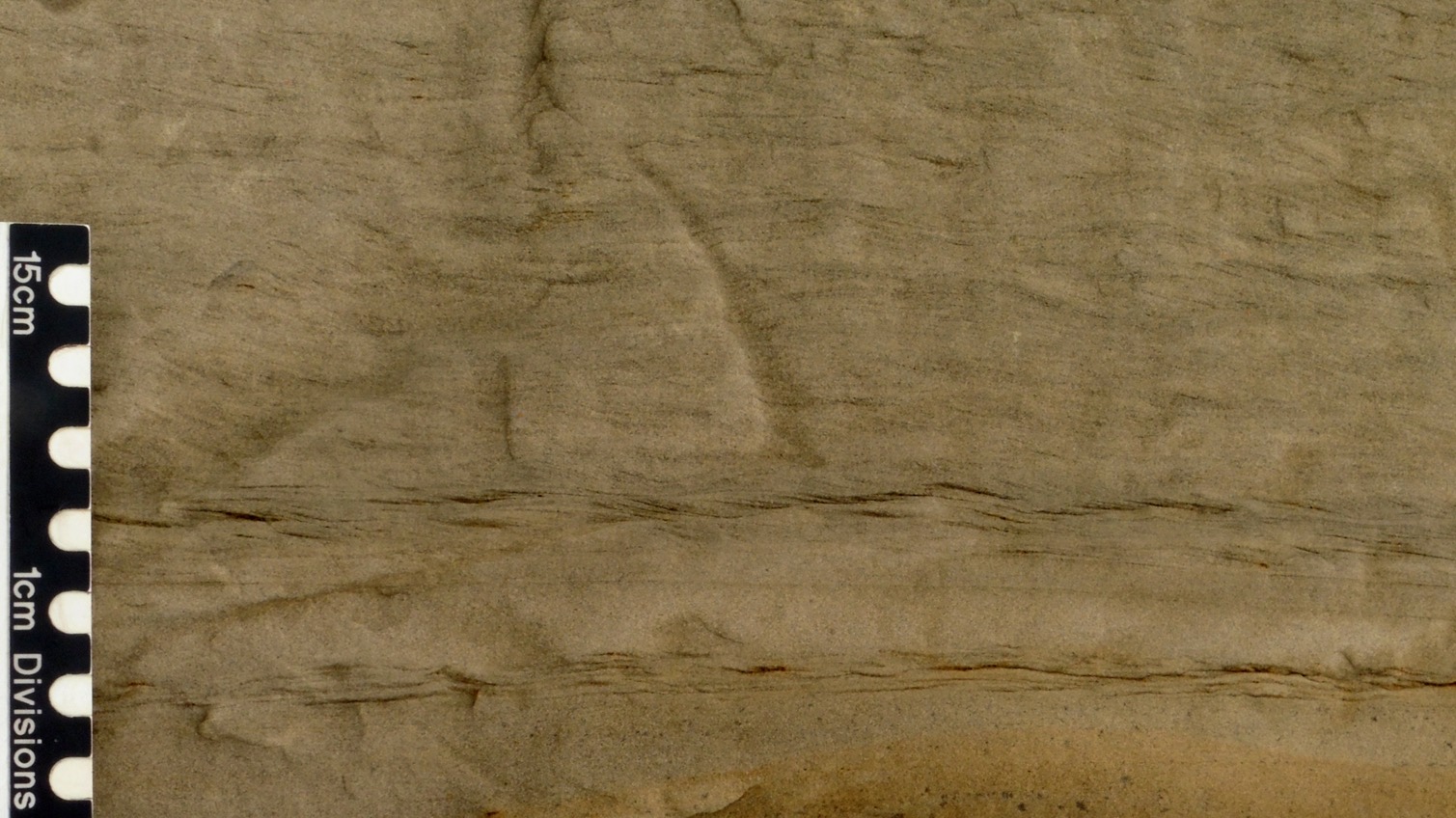
describe this photo
climbing ripples, flow direction to the right, ripples are asymmetric
what are flute casts? what are they usually carving into? how to know upstream?
sediment fills a depression that was scoured in cohesive sediment by turbulent eddies, mud, deeper and steeper upstream
what are tool marks? how are they formed?
elongated, irregularly shaped ridges that result from infilling of erosional relief, sticks or shells dragging or bouncing along the bottom
what are channels?
elongate continuous depressions that cut older bedding
how to identify channels?
look for a border where the angle of bedding is different above vs below
what are the forms of soft sediment deformation?
convolute bedding, flame structures, ball and pillow
what is convolute bedding? what is it caused by?
complex folding and intricate crumpling of beds and laminae, from loading/dewatering/slumping
what are flame structures? what are they caused by?
wavy or flame shapes of sediment squeezed upward into the overlying layer, from loading a denser material (sand/gravel) on top of less dense, saturated sediment (mud)
what are ball and pillow structures? what are they caused by?
hemispherical masses of sand, partially separated from the base of a unit with internal or deformed lamination, from breaking up semi-consolidated sand beds due to liquefaction of underlying mud
what can you infer from ball and pillow structures?
ball is fully separated, pillow is not, can be caused by earthquake, used to date seismic activity if many are at the same level
what are dessication/mud cracks? what are they caused by?
downward tapering V shaped fractures, show a polygonal pattern in plan view, area between cracks becomes concave, from drying of an exposed surface
what are synaeresis cracks? what are they caused by?
more variable and discontinuous, spindle shaped, from fluctuations in saline or swelling clays, start straight but often become compacted and deformed

