ED. 13 Fungi
 Studied by 0 people
 Call Kai
 Learn
Learn Practice Test
 Spaced Repetition
 Match
Match Flashcards
 Knowt Play
1/22

There's no tags or description
Looks like no tags are added yet.
Name | Mastery | Learn | Test | Matching | Spaced | Call with Kai |
|---|
No study sessions yet.
23 Terms
Kingdom overview
Likely to be the first multicellular terrestrial organisms
900 million years ago - carboniferous radiation ca. 300 MYA
They are very good at recycling nutrients and causing disease to weaker organisms
• At least 6 phyla recognised so far
Fungi use the environment as their gut, releasing enzymes extracellularly and break down complex molecules and take in simpler molecules
• ‘True fungi’/ Fungi - a monophyletic group, other eukarya such as stramenpiles are not part of this group because they converge
they have chitin cell calls
How many fungi are there
Estimates of species 1.5 mill - 3.5 mill - 9 mill species -> so far only 150k have been described by scientists, only 10k have been cultivated axenically (away from anything else) many of them remain unculturable typically because fungi often have complex nutritional requirements
Most fungi are microscopic for most of their life - a few form macroscopic structures e.g. mushrooms
Filamentous growth which are microscopic and hidden away
They might produce reproductive structures if they have enough nutrients
‘Cryptic species’ - two or more species which are physically indistinguishable and have thought to be from one species
Dark taxa - organisms we know only from DNA, we don’t know their phenotype
Roles of fungi
Mutualists - lichens, mycorrhizas
Pathogens - rusts, blasts, blights, moulds, wilts, spots, smuts, mildews, cankers, diebacks, rots
Recyclers - degradation of wood, leaves and roots
Animal mutualist - rumen fungi, ant/termite/beetle farmers of recyclers
Animal pathogens - amphibian decline, bat decline, sea fan coral death, human mycoses
Industry - bread, beer, wine, sake, cider, gin, rum, tequila, vodka, whiskey, marmite etc., ca. 44 trillion pounds
Eukaryotic models - yeasts, >6,600 genomes
Characteristics of most fungi
Most fungi have sexual and asexual reproduction - meiotic and mitotic spores, or fragmentation
Symbiosis - the living together or unlike organisms,
Biotrophy - connecting with another species to live
Indeterminate growth - able to take the shape or size of whatever they are growing in
Growth within solid matrices - e.g. soil, plant, animal, fungus
No motile cells - no cells that can swim
Absorptive nutrition - enzymes only active outside, typically hydrolytic
Filamentous - form networks and connect with themselves, undergoing cell fusion
Cell walls of branched gluten, glycoprotein and chitin
Store glycogen and/or lipids - they have ergosterol in cell membranes, allowing the creation of antifungals
Hyperdiverse life cycles - diploid, haploid, dikaryon, multikaryon; homo-or heterokaryotic; parasexual
Parasexual - they go from diploid to haploid through losing chromosomes gradually
Growth forms of fungi
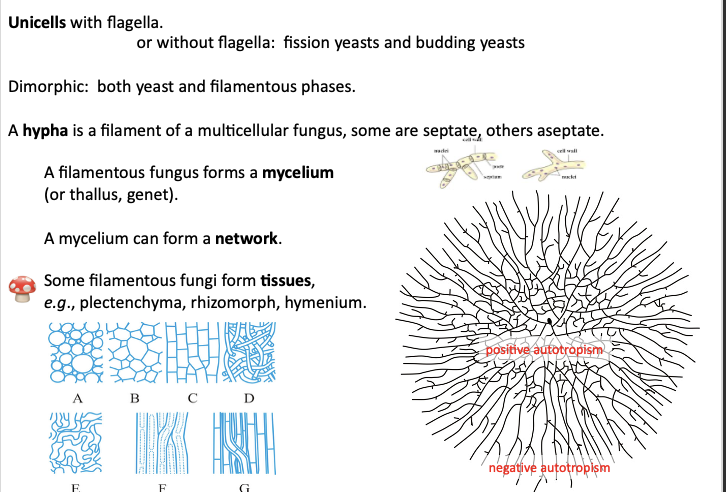
Unicells with flagella/or without flagella - fission yeasts and budding yeasts
Hypha - a filament of a muticellylar fungus, some are septate, others aseptate
Fungi evolved multicellularity at least 7 times (humans+plants only did this once)
Budding yeasts - go through mitosis and make a daughter cell which is smaller, a scar is left where they give birth to the daughter cell
Yeasts have evolved from multicellular back to unicellular multiple times
Unicellular - ideal for when they are in liquid,
Filaments/multicellular - are ideal When they are in a solid
Dimorphic fungi - both yeast and filamentous phases
Filamentous fungi - forms a mycelium, these can form a network, some filamentous fungi form tissues
The mycelium tries to grow away from itself - negative autotropism
In the centre of the fungal network - there is positive auto tropism because they want connections with themselves for stability
Need alternating signalling to allow the fungi to find itself and grow towards itself
some filamentous fungi form tissues e.g. plectenchyma, rhizomorph, hymenium
Hyphal structure
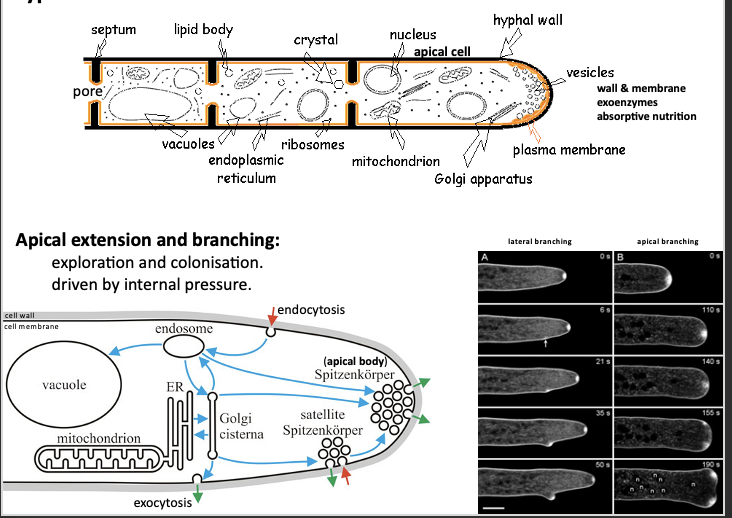
Apical cell - this is the one that feeds, grows, steers - this is where the thinnest cell wall is
The older cells tend to have a bigger vacuole - under internal pressure and held by the cell wall
In the apical cell - exploration and colonisation is driven by internal pressure
Fusion
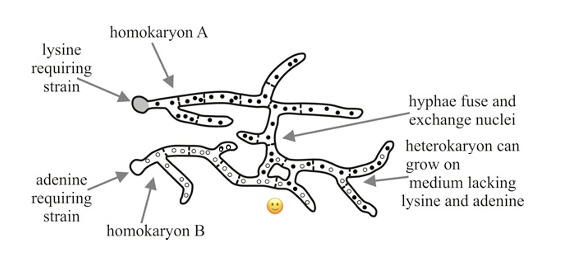
Fusions - two hyphae fuse at the crossing point, or they form a bridge between two strands, or they just fuse side to side
Sometimes fusions are unsuccessful - it is tightly controlled by genetics
Sexual fusion - mating loci, alleles must differ, so it is a successful fusion
Asexual fusion (making a network with themselves) - different set of loci called compatibility loci for self/non-self recognition, alleles must match
There needs to be a balance between negative and positive autotropisms, this gives efficient resource translocation, mycelial stability, and genetic variation
Fungi colonising plants
Can be doing this to live somewhere, be parasitic etc.
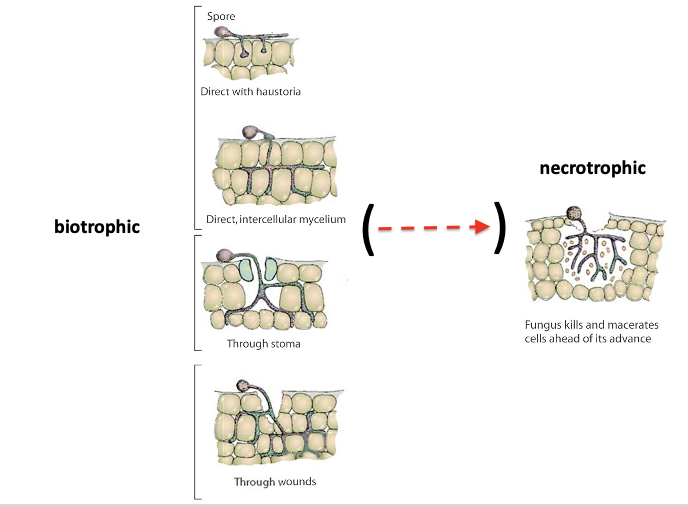
Biotrophic - needing another organism to live
They will be breaking a hole in the cell wall of the plant, but not break the cell membrane allowing them to exchange resources
Or they could grow in between cells
Either create their entry point or enter through an existing entry point
Once inside, once they have enough resources they become necrotrophic
They start to kill the cells using enzymes
Fungi colonising humans
We are often inhaling a number of spores
• Main fungi part of our flora is usually candida and malassezia - both are mainly going to live as yeasts, but they are both opportunistic pathogens, if we are in a weakened state they can switch and become filamentous and attack our cells
Dikarya - ascomycota
More than 50k species described
Licensed - they take on green algae
Commensal - grow within a living organism but don’t cause really any harm
Most spend their life as haploid septate filaments
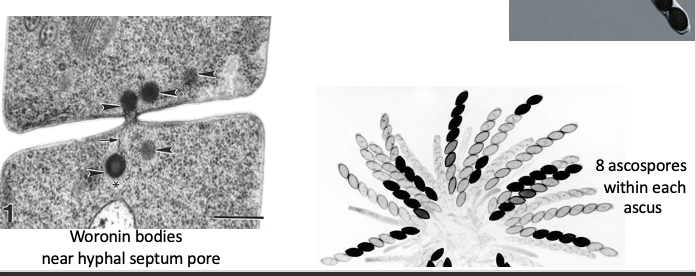
Meiotic ascospores formed within a hypha called ascus - there are 8 ascospores within each ascus
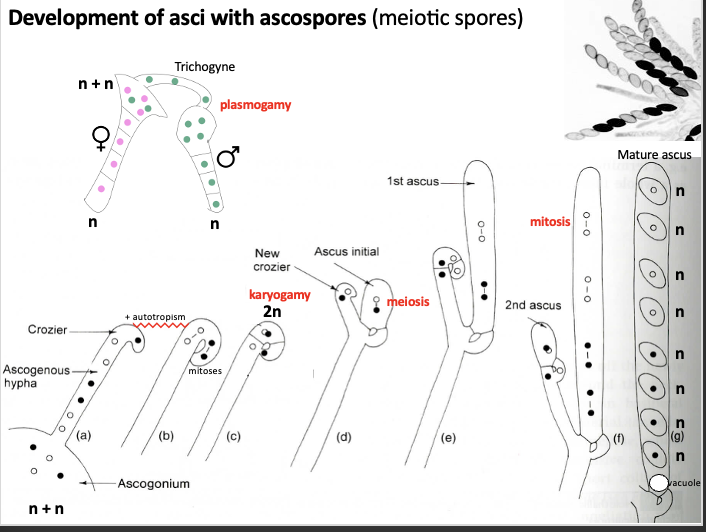
Development of sci with ascospores
Development of sci with ascospores - two filaments one from male and other from female, at the tip there is repeated mitosis without cytokinesis so we end up with a lot of nuclei - these release pheromones which allows them to recognise that there is a female/male nearby
> the female grows a filament towards the male that fuses with it (called a trichogyne) the nuclei from the male moves through the trichogyne and ends up in the tip of the female filament, so there is a mixture of female and male nuclei
The nuclei are lined up alternating female and male, they move into the tip of the filament - a hook shape is created by the tip moving in a positive autotrophic way -> mitosis occurs and the curved tip fuses with the same stem -> this forms a diploid cell
Then the tip goes through meiosis (two male and two female nuclei) -> another round of mitosis which results in 4 female and 4 male nuclei, the result is the formation of 8 nuclei
At the base of the tip there is a vacuole that forms internal pressure, this pushes the ascus pores together and essentially acts as a canon and disperses the ascus
Development of conidia
mitotic sports and asexual production

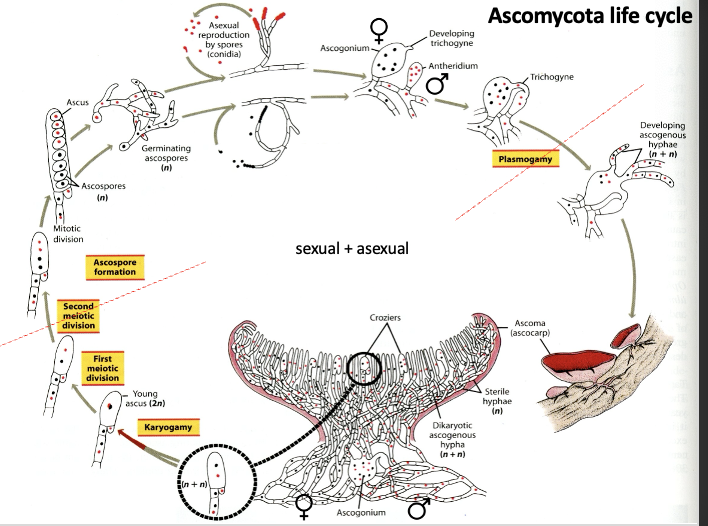
Ascomycota life cycle
Lichens
Symbiotic body - can only make that body using symbiosis
They are very early in the development of ecosystems
They can grow on bare rock, bark, sand - they are tough but cannot cope with air pollution
Mycobiont host, mainly ascomycetes, mostly obligate tropes
Photobion, mostly Trebouxia (green algae), few with cyanobacteria, or both - Trebouxia so far unknown outside lichens: obligate biotrophs
Together form a thallus unlike that of either alone: symbiosome, synergy
dominant macro-organisms at highest latitudes and altitudes
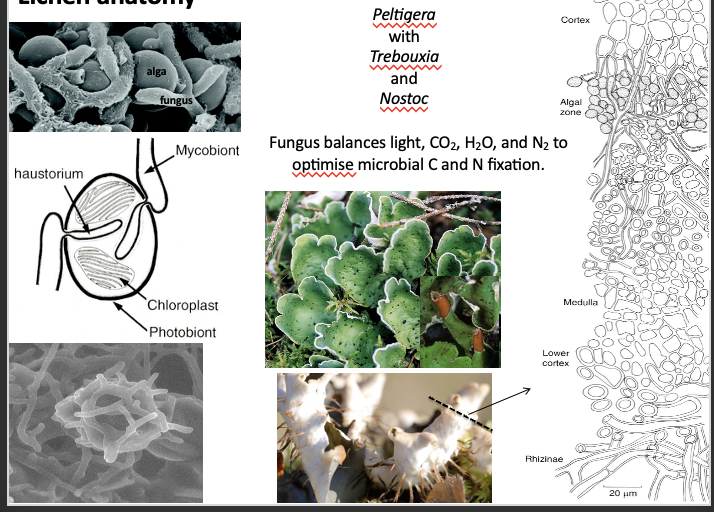
Lichen anatomy
Mycobiont of the lichen pokes through the cell wall of the plant cell but does not break open the cell membrane
• ⁃ Without living with the lichen, the algae could not live on land - usually these alga are aquatic organisms
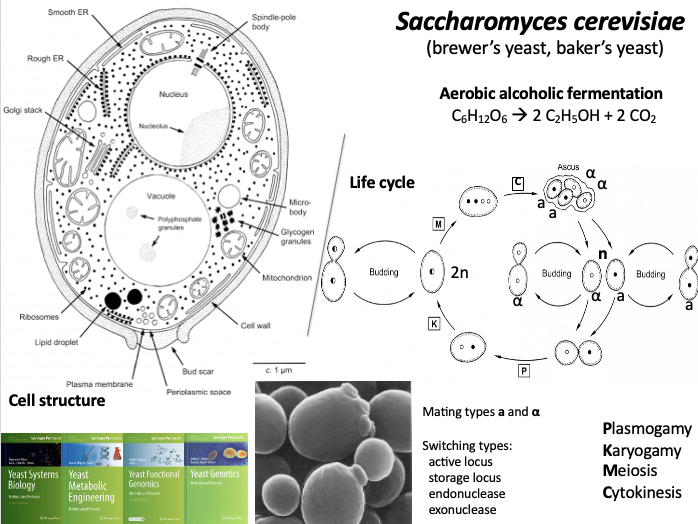
Brewers/Bakers yeast
Able to carry out aerobic fermentation in anaerobic conditions
First eukaryotic genome that was sequenced
Diploid cell (bigger than haploid cells) can go through budding and produce daughter cells (4), then the mother cell bursts and the daughter cells are released
-> the daughter cells can go through asexual budding and make more copies of themselves, when they detect each other they become sticky so male and female cells stick together
Mating type switching - the mother cell releases a daughter cell with the same mating type as the mother, the mother cell then switches mating type so that it can mate with the daughter cell just produced
Endonuclease cuts off the active locus and exonucelus destroys it and the mother is then able to switch mating types
Mating types - are either a or alpha
Can only switch mating types after you bud off the daughter cell
Basidiomycota
Second most diverse phylum - so far 30k species
Many are pathogens, some mycorrhizal
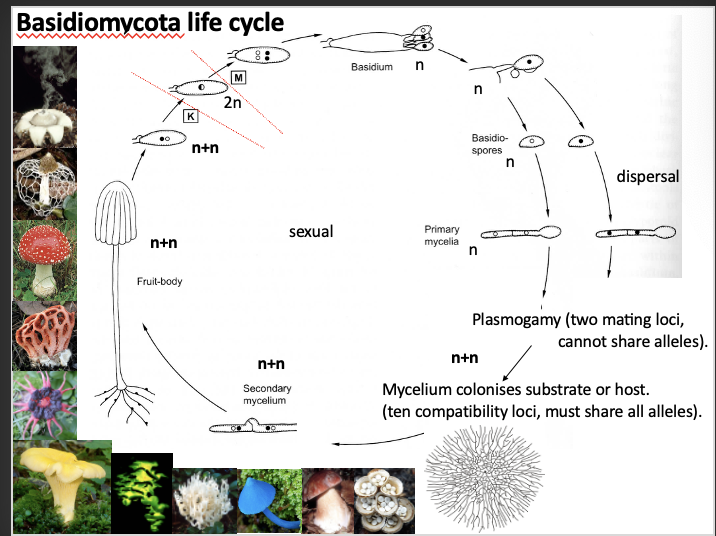
Most of their life cycle is spent as a dikaryotic septate filaments
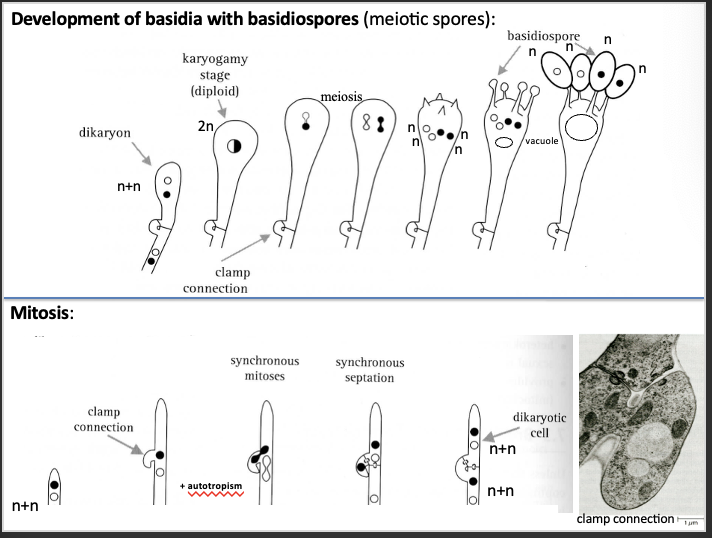
Basidium is the tip of the hyphae, and outside of it, it will make 4 basidiospores - the basidiospores are meiotic
Development of basidia with basidiospore (meitotic spores)
n+n = 2n (diploid) -> meiosis occurs so there is 4 nuclei, each nuclei moves into each basidiospore
• Mitosis - a clamp connection is made where the tip grows into itself by positive auto tropism and nuclei goes through mitosis and the new copies move through the connection and ends up towards the bottom of the tip so there are 4 nuclei
Anatomy of Basidium
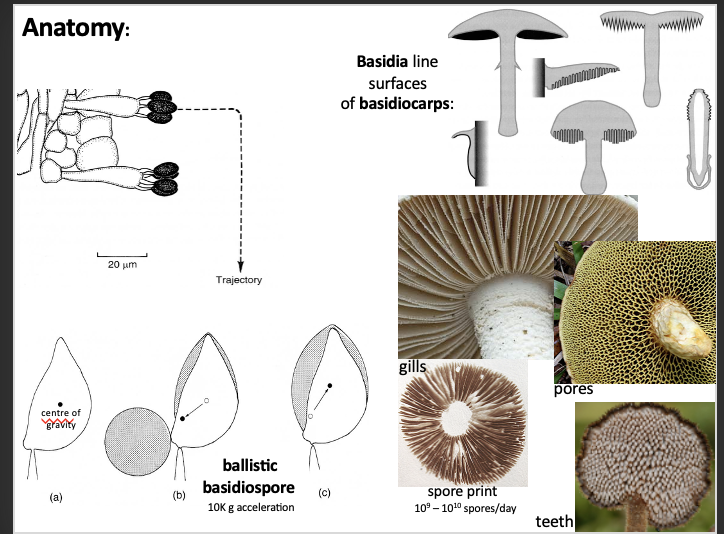
• At the top of the basidiospore carbohydrates are released and are hydroscopic (captures water, air has to be moist),
condensation occurs and a lot of water forms in a droplet connected to the basidiospore which moves the centre of gravity
the two droplets coalesce with each other and this propels the spore
Basidiomycota life cycle
Biomass recycling
95% of terrestrial biomass is wood
Wood has polymers full of sugar which is ideal to feed on, however lignin creates obstacles in feeding on the sugars
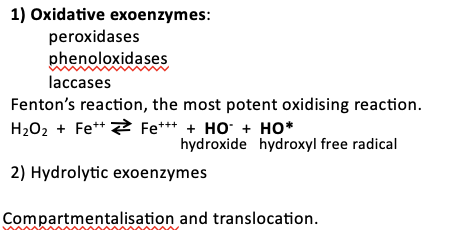
A different kind of enzyme is evolved which is oxidative to be able to break down the lignin
The fungi break down the lignin all the way to c02 and water, this enables them to access the cellulose
The wood ends up being bleached and destroyed
• Rhizomorphs contain a vasculature allowing mass flow of nutrients
Main components of wood:
lignin - complex heteropolymer, irregular cross-links, aromatic ring backbone, insoluble + impermeable, massively C-rich
hemicellulose (pentose-hexose polymer) ← hemicellulases
pectin (galacturonic acid polymer) ← pectinases
White rot fungi break down lignin, cellulose, hemicellulose and pectin
some necrotrophic - this means it kills living host cells and feeds on the resulting dead organic matter
only some basidiomycetes and a few ascomycetes
the largest organisms
1) Oxidative exoenzymes - peroxidases, phenoloxidase , laccases
2) Hydrolytic exoenzymes
compartmentalisation and translocation
 Note
Note  Flashcards (26)