Carbohydrate Digestion & Absorption
 Call Kai
 Learn
Learn Practice Test
 Spaced Repetition
 Match
Match Flashcards
 Knowt Play
1/7

Earn XP
Description and Tags
week 12, lesson 1
Name | Mastery | Learn | Test | Matching | Spaced | Call with Kai |
|---|
No analytics yet
Send a link to your students to track their progress
8 Terms
carbohydrates
ingested dietary carbohydrates are categorized based on their structure, complex or simple. complex carbs include the glucose polymers of starch and glycogen. whereas starch and glycogen are easy for our digestive tracts to digest, complex carbs like cellulose are not digestible. also called dietary fibre, these are still important components our diet, contributing to functions like promoting health bacteria growth in our large intestine.
Simple sugars include the monosaccharides, glucose, fructose and galactose, while disaccharides are lactose, maltose, and sucrose.
chemical digestion of carbohydrates
it is necessary to digest all carbs into either glucose or galactose or fructose, since it is the monosaccharide that can be absorbed by the absorptive cells of the small intestine. ingested monosaccharides therefore do not need to be chemically digested.
complex carbohydrates like starch and disaccharides do need to be chemically digested.
starch is a mixture of both linear and branched glucose polymers, called amylose and amylopectin, respectively. The enzyme amylase digests amylose and the linear portion of amylopectin. enzyme activity produces smaller glucose polymer chains and can also release the disaccharide maltose. both salivary amylase and pancreatice amylase have the same enzyme activity, but are secreted from diff parts of the digestive tract.
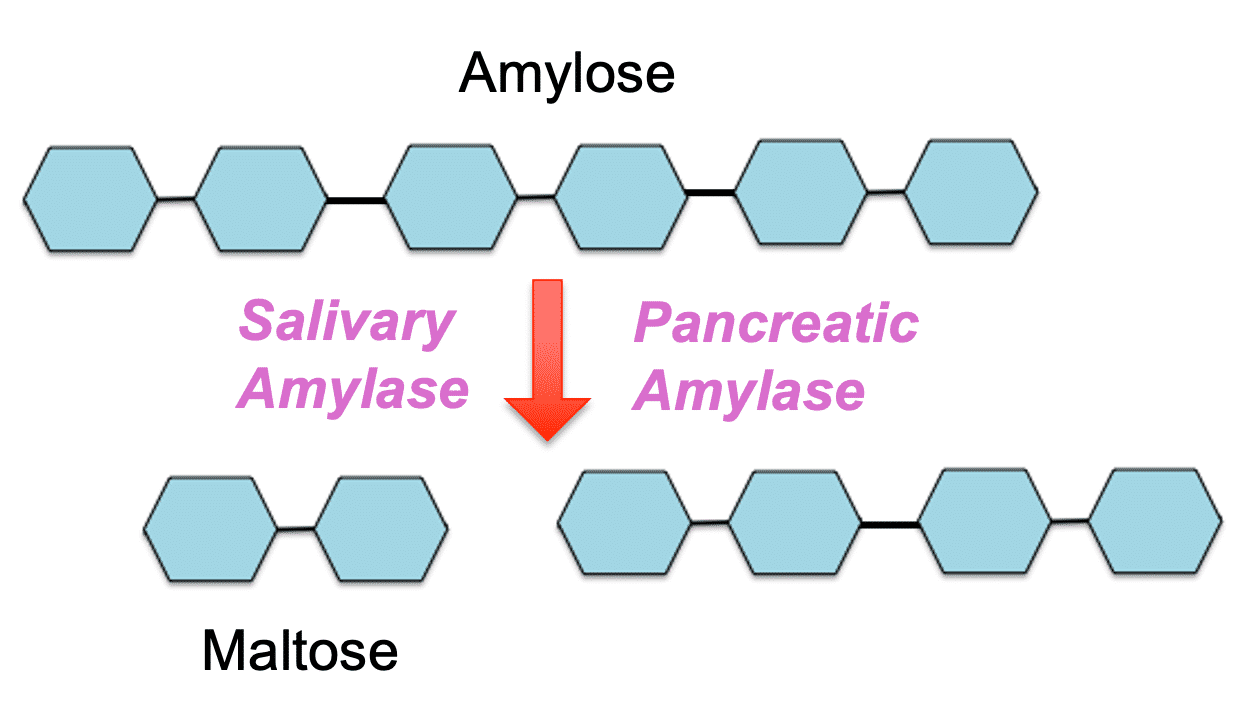
The branched parts of amylopectin are chemically digested by another enzyme,
alpha-limit dextrinase, another brush border enzyme. this releases all linear glucose polymers, which can then be digested by amylase.
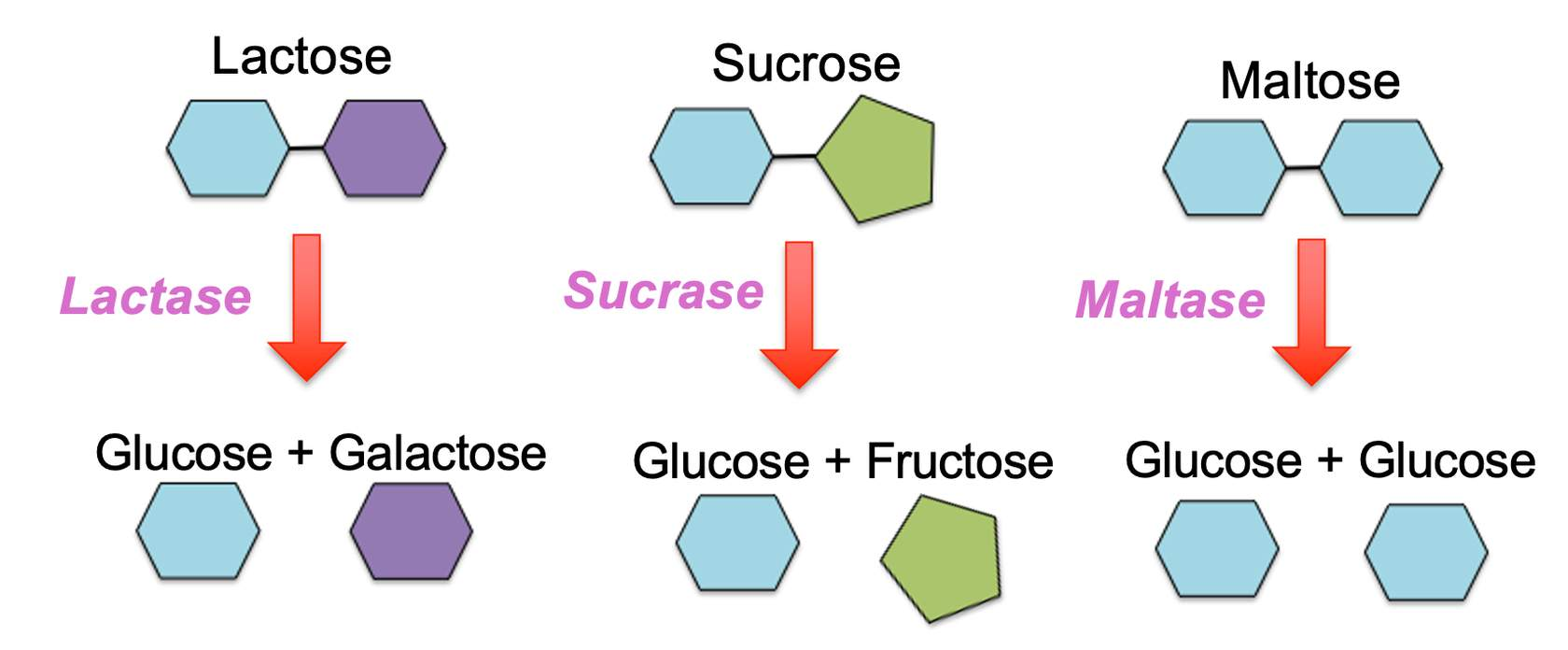
The disaccharides, lactose, sucrose and maltose are chemically digested by
the disaccharidases; lactase, sucrase and maltase. Recall that these enzymes are part of the apical membrane of enterocytes in the small intestine, which are also called brush border enzymes.
carb absorption
Enterocytes of the small intestine express transporters to absorb monosaccharides. glucose and galactose can be moved from the lumen of the small intestine, into the absorptive cells by a sodium (Na) symporter on the apical membrane. also, on the apical membrane, fructose is absorbed fructose is absorbed by a fructose uniporter. On the basolateral membrane, a monosaccharide uniporter can move all three of the monosaccharides out of the enterocyte, into the interstitial fluid and then these sugars can move into the blood.
lactose intolerance
the disaccharide lactose is a sugar that is found in higher amounts in dairy products, like cheese. individuals can become lactose intolerant as they age, resulting in symptoms of gastrointestinal discomfort, including bloating, cramping and diarrhea. the intolerance to this sugar is due to the loss of the enzyme lactase from the small intestine. when this enzyme is not presnt or functioning at full capacity, the lactose cannot be digested, and lactose itself cant be absorbed. the lactose moves to the large intestine, mostly undigested. the bacteria, however, in the large intestine can partially metabolize the lactose, but it produces gases as a byproduct, resulting in the digestive upset.
Dairy Allergy is NOT the Same as a Lactose Intolerance
Lactose intolerance, although not comfortable, is not a food allergy. A common misconception is for individuals to rename a lactose intolerance as a lactose or dairy allergy. While lactose intolerance is unpleasant, it is not life threatening. A dairy allergy is due to the body having an immune reaction to the protein(s) in a food. In a dairy allergy, the common proteins that can cause an allergic reaction are the proteins whey and casein. Individuals with a food allergy need to avoid the food and should carry the life saving medication, epinephrine, for cases of accidental dairy exposure.

