integ: abpsych sir sy (neurodev)
 Call Kai
 Learn
Learn Practice Test
 Spaced Repetition
 Match
Match Flashcards
 Knowt Play
1/51

There's no tags or description
Looks like no tags are added yet.
Name | Mastery | Learn | Test | Matching | Spaced | Call with Kai |
|---|
No analytics yet
Send a link to your students to track their progress
52 Terms
they change over time
Most psychological disorders are developmental which means?
Full symptoms may appear later in life
Many disorders originate in childhood, but:
“Childhood disorder” can be misleading
Early-onset disorders often persist into adulthood which means
intellectual disability
specific learning disorder
autism spectrum disorder
motor disorders
feeding and eating disorders
disruptive, impulse-control, and conduct disorders
anxiety disorders
mental retardation —>
learning disorders —>
pervasive developmental disorders (autism, asperger’s) —>
motor skills disorders —>
feeding disorder of infancy or early childhood —>
conduct disorder & oppositional defiant disorder —>
selective mutism & separation anxiety disorder —>
no specific requirement for IQ in the renameddiagnosis of intellectual disability.
The essential features of intellectual disability
(intellectual developmental disorder) relate to both
intellectual impairment and deficits in adaptive
function. In contrast to DSM-IV, which specified
“an IQ of approximately 70 or below” for the former
diagnosis of “mental retardation,” DSM-5 has
intellectual disability
deficits in general mental abilities
reasoning, abstract thinking, problem solving, academic learning, planning, and learning from experience
the deficits result in impairments of adaptive functioning
conceptual, practical, social
onset of intellectual and adaptive deficits during the developmental period
global developmental delay
used when there is insufficient information to make the diagnosis of intellectual developmental disorder.

autism spectrum disorder
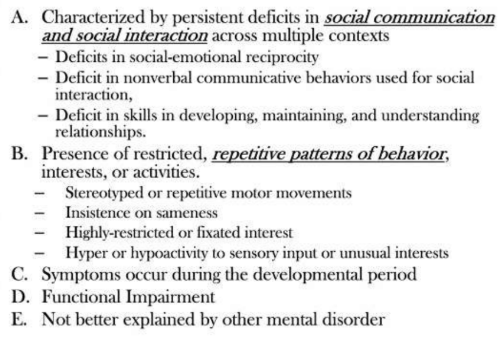
All three social communication deficits (A1–A3)
Restricted/repetitive behaviors (at least 2 types)
dsm-5 asd requires
Social-emotional reciprocity (present)
Difficulty with back-and-forth conversation
Trouble sharing feelings
Nonverbal communication (not present)
Good eye contact
Normal speech intonation
Appropriate facial gestures
Appropriate affect
These are intact, meaning no deficit here
relationships (present)
Difficulty making friends
Restricted/repetitive behaviors (present)
Intense, focused interest in trains
Limited imaginative play
attention-deficit/hyperactivity disorder
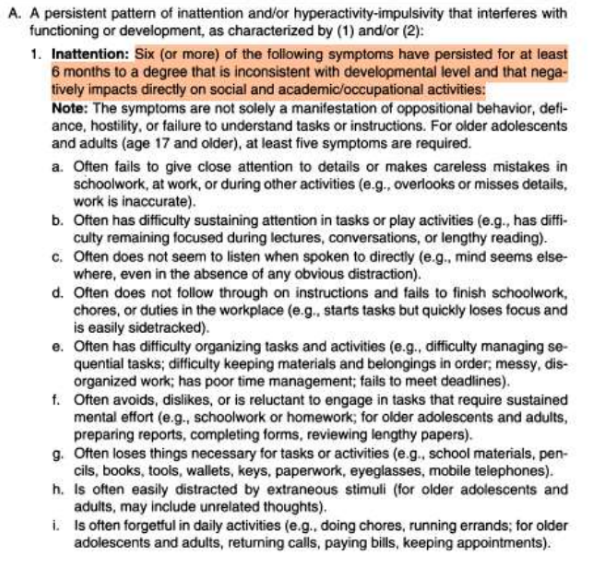
attention-deficit/hyperactivity disorder
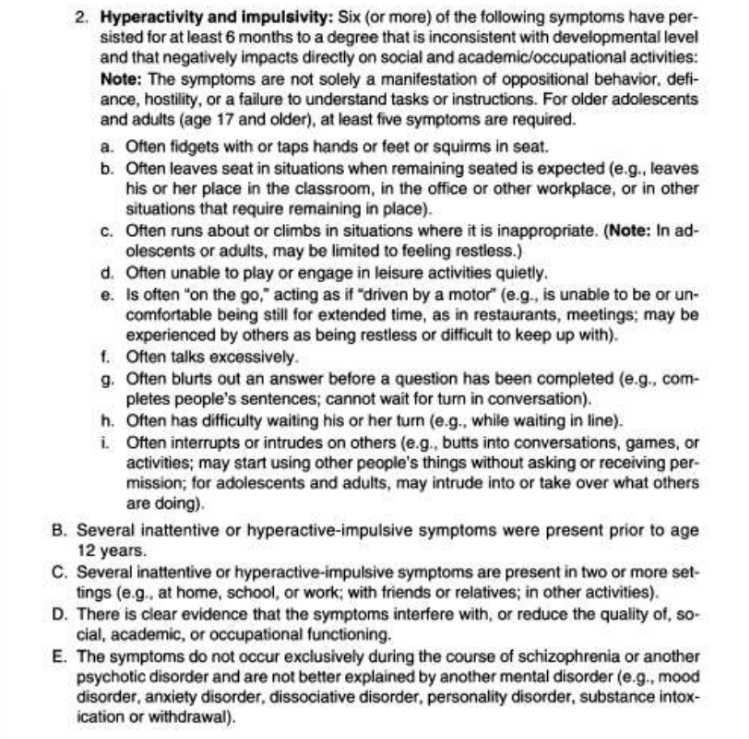
combined presentation
if both criterioan A1 (inattention) and criterion A2 (hyperactivity-impulsivity) are met for the past 6 months
predominantly inattentive presentation
if criterion A1 (inattention) is met but criterion A2 (hyperactivity-impulsivity) is not met for the past 6 months
predominantly hyperactivity/impulsive presentation
if criterion A2 (hyperactivity-impulsivity) is met and criterion A1 (inattention) is not met for the past 6 months
in partial remission
in ADHD, When full criteria were previously met, fewer than the full criteria
have been met for the past 6 months, and the symptoms still result in impairment in
social, academic, or occupational functioning.
minor
in ADHD, Few, if any, symptoms in excess of those required to make the diagnosis are
present, and symptoms result in no more than minor impairments in social or occupa-
tional functioning.
moderate
in ADHD, Symptoms or functional impairment between “mild” and “severe” are present.
severe
in ADHD, Many symptoms in excess of tliose required to mal<e tlie diagnosis, or several
symptoms that are particularly severe, are present, or the symptoms result in marked
impairment in social or occupational functioning.
specific learning disorder
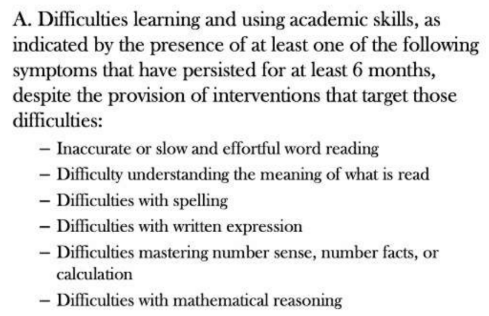
specific learning disorder
With impairment in reading:
in SLD:
Word reading accuracy
Reading rate or fluency
Reading comprehension
Dyslexia is an alternative term used to refer to a pattern of learning difficulties
characterized by problems with accurate or fluent word recognition, poor decoding,
and poor spelling abilities. If dyslexia is used to specify this particular pattern of dif-
ficulties, it is important also to specify any additional difficulties that are present,
such as difficulties with reading comprehension or math reasoning.
Witli impairment in written expression:
in SLD:
Spelling accuracy
Grammar and punctuation accuracy
Clarity or organization of written expression
With impairment in mathematics
in SLD:
Number sense
Memorization of arithmetic facts
Accurate or fluent calculation
Accurate math reasoning
Dyscalculia is an altemative term used to refer to a pattern of difficulties char-
acterized by problems processing numerical information, learning arithmetic facts,
and performing accurate or fluent calculations. If dyscalculia is used to specify this
particular pattern of mathematic difficulties, it is important also to specify any addi-
tional difficulties that are present, such as difficulties with math reasoning or word rea-
soning accuracy.
mild
in SLD: Some difficulties learning skills in one or two academic domains, but of mild enough
severity that the individual may be able to compensate or function well when provided with
appropriate accommodations or support services, especially during the school years.
moderate
in SLD: Marked difficulties learning skills in one or more academic domains, so that
the individual is unlikely to become proficient without some intervals of intensive and
specialized teaching during the school years. Some accommodations or supportive
services at least part of the day at school, in the workplace, or at home may be needed
to complete activities accurately and efficiently.
severe
in SLD: Severe difficulties learning skills, affecting several academic domains, so that
the individual is unlikely to learn those skills without ongoing intensive individualized
and specialized teaching for most of the school years. Even with an array of appropri-
ate accommodations or services at home, at school, or in the workplace, the individual
may not be able to complete all activities efficiently.
specific learning disorder
defined by a discrepancy
The individual’s academic performance is significantly below what is expected given their intelligence (IQ)
A person can have average or even high intelligence but still struggle in specific academic areas (reading, writing, math)
Stereotypic Movement Disorder
A. Repetitive, seemingly driven, and apparently purposeless motor behavior (e.g., hand shaking or waving, body rocking, head banging, self-biting, hitting own body).
B. The repetitive motor behavior interferes with social, academic, or other activities and may result in self-injury.
C. Onset is in the early developmental period.
D. The repetitive motor behavior is not attributable to the physiological effects of a substance or neurological condition and is not better explained by another neurodevelopmental or mental disorder (e.g., trichotillomania [hair-pulling disorder], obsessive-compulsive disorder).
With self-injurious behavior
behavior that would result in an injury if preventive measures were not used
Mild
in SMD: Symptoms are easily suppressed by sensory stimulus or distraction.
Moderate
in SMD: Symptoms require explicit protective measures and behavioral modification.
Severe
in SMD: Continuous monitoring and protective measures are required to prevent seri-
ous injury.
language disorder
A. Persistent difficulties in the acquisition and use of language across modalities (i.e.,
spoken, written, sign language, or other) due to deficits in comprehension or produc-
tion that include the following:
1. Reduced vocabulary (word knowledge and use).
2. Limited sentence structure (ability to put words and word endings together to form
sentences based on the rules of grammar and morphology).
3. Impairments in discourse (ability to use vocabulary and connect sentences to ex-
plain or describe a topic or series of events or have a conversation).
B. Language abilities are substantially and quantifiably below those expected for age, re-
sulting in functional limitations in effective communication, social participation, aca-
demic achievement, or occupational performance, individually or in any combination.
C. Onset of symptoms is in the early developmental period.
D. The difficulties are not attributable to hearing or other sensory impairment, motor dys-
function, or another medical or neurological condition and are not better explained by in-
tellectual disability (intellectual developmental disorder) or global developmental delay.
Speech Sound Disorder
A. Persistent difficulty with speech sound production that interferes with speech intelligi-
bility or prevents verbal communication of messages.
B. The disturbance causes limitations in effective communication that interfere with social
participation, academic achievement, or occupational performance, individually or in
any combination.
C. Onset of symptoms is in the early developmental period.
D. The difficulties are not attributable to congenital or acquired conditions, such as cere-
bral palsy, cleft palate, deafness or hearing loss, traumatic brain injury, or other medi-
cal or neurological conditions.
Social (Pragmatic) Communication Disorder
A. Persistent difficulties in the social use of verbal and nonverbal communication as manifested by all of the following:
1. Deficits in using communication for social purposes, such as greeting and sharing
information, in a manner that is appropriate for the social context.
2. Impairment of the ability to change communication to match context or the needs of
the listener, such as speaking differently in a classroom than on a playground, talk-
ing differently to a child than to an adult, and avoiding use of overly formal language.
3. Difficulties following rules for conversation and storytelling, such as taking turns in
conversation, rephrasing when misunderstood, and knowing how to use verbal and
nonverbal signals to regulate interaction.
4. Difficulties understanding wliat is not explicitly stated (e.g., making inferences) and
nonliteral or ambiguous meanings of language (e.g., idioms, humor, metaphors,
multiple meanings that depend on the context for interpretation).
B. The deficits result in functional limitations in effective communication, social participa-
tion, social relationships, academic achievement, or occupational performance, indi-
vidually or in combination.
C. The onset of the symptoms is in the early developmental period (but deficits may not
become fully manifest until social communication demands exceed limited capacities).
D. The symptoms are not attributable to another medical or neurological condition or to low
abilities in the domains of word structure and grammar, and are not better explained by
autism spectrum disorder, intellectual disability (intellectual developmental disorder),
global developmental delay, or another mental disorder.
tic disorder
a sudden, rapid, recurrent, nonrhythmic motor movement or vocalization.
Tourette’s Disorder
A. Both multiple motor and one or more vocal tics have been present at some time during
the illness, although not necessarily concurrently.
B. The tics may wax and wane in frequency but have persisted for more than 1 year since
first tic onset.
C. Onset is before age 18 years.
D. The disturbance is not attributable to the physiological effects of a substance (e.g., co-
caine) or another medical condition (e.g., Huntington’s disease, postviral encephalitis).
Persistent (Chronic) Motor or Vocal Tic Disorder
A. Single or multiple motor or vocal tics have been present during the illness, but not both
motor and vocal.
B. The tics may wax and wane in frequency but have persisted for more than 1 year since
first tic onset.
C. Onset is before age 18 years.
D. The disturbance is not attributable to the physiological effects of a substance (e.g., co-
caine) or another medical condition (e.g., Huntington’s disease, postviral encephalitis).
E. Criteria have never been met for Tourette’s disorder.
Provisional Tic Disorder
A. Single or multiple motor and/or vocal tics.
B. The tics have been present for less than 1 year since first tic onset.
C. Onset is before age 18 years.
D. The disturbance is not attributable to the physiological effects of a substance (e.g., co-
caine) or another medical condition (e.g., Huntington’s disease, postviral encephalitis).
E. Criteria have never been met for Tourette’s disorder or persistent (chronic) motor or
vocal tic disorder.______________________________________________________
intellectual disability

global developmental delay

communication disorder

autism spectrum disorder

attention-deficit/hyperactivity disorder

specific learning disorder

motor disorder

tic disorder

Developmental Coordination Disorder
A. The acquisition and execution of coordinated motor skills is substantially below that ex-
pected given the individual’s chronological age and opportunity for skill learning and
use. Difficulties are manifested as clumsiness (e.g., dropping or bumping into objects)
as well as slowness and inaccuracy of performance of motor skills (e.g., catching an
object, using scissors or cutlery, handwriting, riding a bike, or participating in sports).
B. The motor skills deficit in Criterion A significantly and persistently interferes with activ-
ities of daily living appropriate to chronological age (e.g., self-care and self-mainte-
nance) and impacts academic/school productivity, prevocational and vocational
activities, leisure, and play.
C. Onset of symptoms is in the early developmental period.
D. The motor skills deficits are not better explained by intellectual disability (Intellectual devel-
opmental disorder) or visual impairment and are not attributable to a neurological condi-
tion affecting movement (e.g., cerebral palsy, muscular dystrophy, degenerative disorder).

