International economics- Ch.2
 Studied by 0 people
 Call Kai
 Learn
Learn Practice Test
 Spaced Repetition
 Match
Match Flashcards
 Knowt Play
1/39

There's no tags or description
Looks like no tags are added yet.
Name | Mastery | Learn | Test | Matching | Spaced | Call with Kai |
|---|
No analytics yet
Send a link to your students to track their progress
40 Terms
Ricardian model of trade
A classic model that explains why countries trade based on differences in technology. The model explains trade patterns using comparative advantages
Why do countries trade? - THEORY 1
Differences in technology
Differences in resources (labor, capital, land)
Differences in offshoring costs (shipping, coordination, production)
Differences in proximity and transport costs.
What are offshoring costs?
Extra costs from producing parts of a product in different countries — including shipping, coordination, and production costs.
What are proximity costs?
Transport costs from moving goods between places; closer countries have lower shipping costs, making trade between them more attractive.
Why do countries trade - THEORY 2
Mercantilitsm - Thomas Munn’s View believed that
Export = good
Imports = bad
Trade is a zero-sum game, meaning if one wins, the other loses
Munn thought by selling more goods to other countries (exports) and buying fewer from them (imports) — thus gaining wealth by exporting more than it imports a country will become richer
Why do countries trade - Theory 3
Adam Smith theory:
Trade is not a zero-sum game — everyone can gain
Countries should specialize where they are efficient and buy goods that others can produce more cheaply
Just as individuals specialize in what they are good at (e.g., a tailor buys shoes instead of making them), countries should do the same.
What is the key idea of the Ricardian model?
Trade patterns are determined by comparative advantage, not absolute advantage — countries benefit by specializing in goods they produce relatively efficiently.
Who developed the concept of comparative advantage?
David Ricardo.
What is absolute advantage
a country/person can produce more of a good with same reusources than someone else
What is Comparative Advantage?
Comparative advantage means that a country should specialize in producing and exporting the goods it can make at a lower opportunity cost than other countries —
even if it’s less efficient overall in absolute terms.
Why is Comparative Advantage more important than Absolute Advantage for explaining trade?
Because countries gain by specializing in what they’re relatively best at and trading for what they’re relatively worse at, even if one country is better at producing all goods.
According to Comparative Advantage, what should countries do?
Produce what they’re relatively best at
Trade for what they’re relatively worse at
Everyone ends up better off
What is the heart of the Ricardian Model?
Comparative Advantage — countries benefit when each specializes in goods they produce relatively efficiently and trade with others.
What is International Trade Equilibrium?
It’s when the relative price of a good (like wheat) is the same in both countries after trade begins.
What happens to prices before and after trade?
Before trade: Each country has its own internal price of goods based on opportunity cost.
After trade: There is one shared world price, so no country has a reason to change who they trade with.
What does the world price represent in trade equilibrium?
It shows what each country can now afford to consume and allows them to reach higher indifference curves (higher satisfaction levels).
Once trade begins, what does each country do?
Specializes in what it’s best at (comparative advantage)
Trades to get more of what it wants
Consumes more than before — showing the gain from trade
What are the two main lessons of the Ricardian Model?
Each country exports the good where it has a comparative advantage.
Both countries gain from trade — through higher production or higher utility.
In the Ricardian Model, what determines wages?
Absolute advantage — countries that are more productive overall have higher wages.
In the Ricardian Model, what determines trade patterns?
Comparative advantage — countries trade based on who has the lower opportunity cost in producing a good.
Is the slope of the PPF equal to the MRS or the MRT?
The slope of the PPF represents the Marginal Rate of Transformation (MRT) — the opportunity cost of producing one good in terms of the other. Meaning:how much of one good must be given up to produce one more unit of the other good. It comes from PPF(supply side)
Indifference curves
Shows all combinations of two goods that give the sam satification or utility to a person or a country. Every point on a curve = same utility. A higher curve= more utility. The shape shows the trade-off between two goods.
What does relative price mean
The price of one good compared to another good — it tells us how many units of one good must be given up to buy one unit of another. It’s basically the price ratio between two goods.
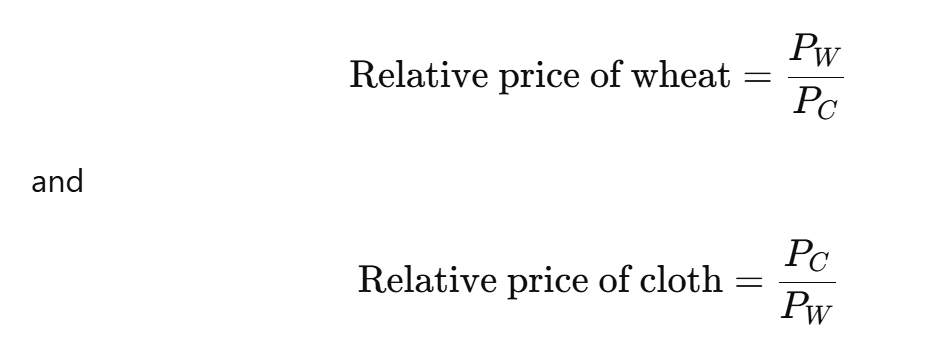
What is the formula for the relative price?If we have two goods — Wheat (W) and Cloth (C)
Example: “ how many units of cloth must you give up to get one unit of wheat:
Solution:
Price of wheat(Pw) = 4
Price of cloth(Pc) = 2
→Relative price of wheat = Pw/Pc = 2
So 1 extra unit of wheat costs 2 units of cloth
Pw/Pc & Pc/Pw are inverse of eachother. They show relative opportunity costs and determine the terms of trade between goods
Is MRT=Pw/Pc only true in perfect competition?
Yes — this equality holds only under perfect competition.
Under perfect competition: firms produce where P = MC, so prices reflect true opportunity costs. Meaning price = realcost, therefor MRT = Pw/Pc
In other markets (like monopoly): firms produce where MR = MC, and P > MC, so prices don’t reflect real costs
How are wages determined in a free marked
Company pay workers based on what they produce:
Wage - Price of good * Output per worker(MPL)
Difference between free marked and perfect competition
All perfectly competitive markets are free markets —
but not all free markets are perfectly competitive.A free market means no government control; perfect competition means no one has market power.
Terms of trade
This tells us how much a country gets for its exports in exchange for what is has to pay for imports.
Formula: Price of export/ Price of import
If TOT goes up, the country can buy more imports for each export — it’s better off.
If TOT goes down, it can buy fewer imports per export — it’s worse off.
How to define absolute advantage and comparative advantage
Absolute advantage
Compare productivity (MPL) numbers (output per worker).
Comparative advantage
Compute opportunity cost for each good.
Opportunity cost a = MPLb/ MPLa
Compare between countries
The lowest opportunity cost = comparative advantage
Domestic production (general definition)
means the total amount of goods and services produced within a country’s borders during a certain period of time, using the country’s own resources (like labor, land, and capital).
How to choice relative price of a good when trade opens
When trade opens, both countries should be better off
There will be one single world price for that good
The world price must lie between the two relative price of good(home) and relative price of good(foreign’)
Assumption of ricardian model
Perfect competition — all firms are price takers, P=MC
Constant returns to scale (straight-line PPF).
Labour is the only input, mobile within a country but not across countries.
No trade barriers, no transport costs (simplified).
Prices reflect opportunity costs → MRT=Pw/Pb
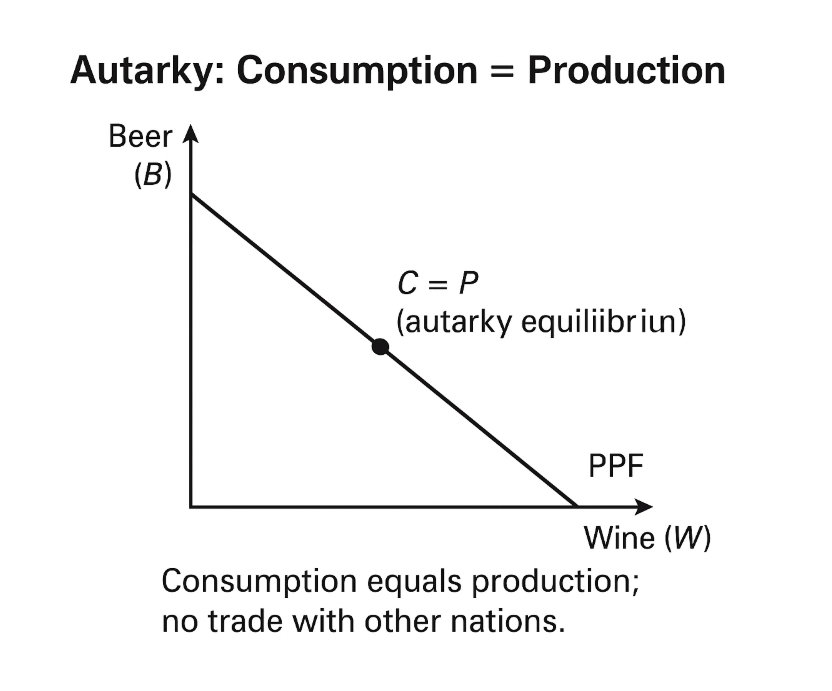
What is the assumption for a country under autarky regarding its consumption and production?
Under autarky, consumption = production, meaning a country can only consume what it produces since there is no trade with other nations.
What does real wage mean
The amount of goods and services a worker can buy or consume with one hour of work. It shows purchasing power, not how much money they earn, but what that money(or output) can actually get the.
Why do we talk about workers under realwage and not consumer when talking about purchasing power
Workers earn income (through wages), and then use that income to consume. Look at how much workers produce per hour → this gives us their real wage.Then assume that workers are also the consumers. In basic trade and productivity models, workers = consumers.
When is Real wage = MPL
Only applies under autarky, where consumers only consume their own output → Realwage = MPL
When is Real wage = MPL * terms of trade(realtive price)
With trade:
Workers specialize in one good
They trade at the world relative price
So: Real wage = What they produce × What they can get for it
Real wage = MPL × (price of traded good in terms of what they want to consume)
MPL → How much of the good a worker produces per hour (based on what the country specializes in after trade)
Price (Relative price) →The world price of the good they produce, measured in units of the other good
What does the world relative price give?
The trade ration between good. Relative price = how many units of the other good you must give up to get 1 unit of this good
If the relative price of cauliflower = 1, then 1 cauliflower= 1 turnip. 1-1 ratio
If the realtive price of cailoflower = 2, then caulilflower is twice(2x) as expensice as turnip. Meaning 1 cauliflower = 2 turnip or 1 turinip = 0,5 cauliflower
Connection between real wage and relative price
Real wage = what a worker can buy with what they produce
Real wage in X = MPLx - with no trade, they consume what they produce
Relative price = how much of one good trades for another
Connection between:
Real wage in the other good - if the worker produces X but wants to know how much Y they can buy. Real wage in Y = MPLx * px/py with trade. Workers can convert what they produce into what they want to consume
If realtive price for wheat = 2 sugar, how much is realtive price for 1 sugard
1) To get one wheat we need to trade 2 sugars
2) To get 1 sugar we need to give up ½ wheat
3) Rule: 1/(the given amount for sugar)
 Note
Note  Flashcards (260)