4.2 - Pyruvate Oxidation
 Call Kai
 Learn
Learn Practice Test
 Spaced Repetition
 Match
Match Flashcards
 Knowt Play
1/38

There's no tags or description
Looks like no tags are added yet.
Name | Mastery | Learn | Test | Matching | Spaced | Call with Kai |
|---|
No analytics yet
Send a link to your students to track their progress
39 Terms
What is the purpose of pyruvate oxidation?
To extract remaining free energy from pyruvate before entering the citric acid cycle
Why must pyruvate enter the mitochondria?
Because the citric acid cycle occurs in the mitochondrial matrix.
How does pyruvate pass through the outer mitochondrial membrane?
Through large pores.
How does pyruvate cross the inner mitochondrial membrane?
Using a pyruvate-specific carrier protein.
What is pyruvate converted into during pyruvate oxidation?
An acetyl group attached to coenzyme A (acetyl-CoA).
What is acetyl-CoA?
A high-energy intermediate formed when an acetyl group bonds to coenzyme A.
How many pyruvate molecules are produced from one glucose in glycolysis?
2 pyruvate molecules.
What type of reaction converts pyruvate to acetyl-CoA ?
Decarboxylation reaction.
What is decarboxylation?
The removal of a carboxyl group to form CO₂.
What happens to the removed carbon during pyruvate oxidation?
It is released as CO₂.
What fraction of exhaled CO₂ is produced during pyruvate oxidation?
About one-third.
What happens to the remaining 2-carbon molecule after decarboxylation?
It is oxidized to form an acetyl group.
What is a dehydrogenation reaction?
The removal of a hydrogen atom from a molecule.
What happens to electrons and protons removed during oxidation?
They are transferred to NAD⁺ to form NADH and H⁺.
What does NAD⁺ become during pyruvate oxidation?
NADH
What reacts with the acetyl group to form acetyl-CoA?
Coenzyme A (CoA).
Why are there 2 of each product in pyruvate oxidation?
Because 1 glucose produces 2 pyruvate molecules.
What was the starting molecule of glycolysis?
Glucose
What was the final product of glycolysis?
Pyruvate
What products of pyruvate oxidation go to the citric acid cycle?
2 acetyl-CoA.
What products of pyruvate oxidation go to the electron transport chain?
2 NADH.
What happens to the CO₂ produced in pyruvate oxidation?
It diffuses out of the mitochondria and the cell as waste.
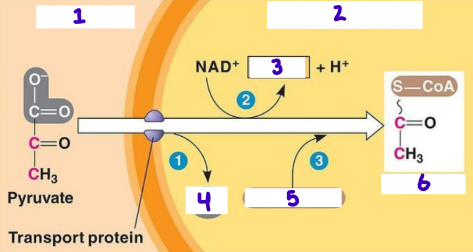
label the diagram
cytosol
mitochondrion
NADH
CO2
Coenzyme A
Acetyl CoA
How many pyruvate molecules are at the beginning of pyruvate oxidation?
2
what are the products of pyruvate oxidation?
2 Acetyl-CoA
2 NADH
2 CO2
2 H+
What are the 3 main steps of pyruvate oxidation?
Decarboxylation, oxidation (NAD⁺ → NADH), and formation of acetyl-CoA.
What happens in step 1 of pyruvate oxidation?
Pyruvate undergoes decarboxylation, losing one carbon as CO₂.
What happens in step 2 of pyruvate oxidation?
Electrons and a proton are transferred to NAD⁺, forming NADH and H⁺.
What happens in step 3 of pyruvate oxidation?
The remaining 2-carbon acetyl group binds to coenzyme A to form acetyl-CoA.
Why are there 2 of each molecule in the overall equation?
Because 1 glucose produces 2 pyruvate molecules.
What is the role of NADH produced in pyruvate oxidation?
It is later used to produce ATP in the electron transport chain.
What happens to CO₂ produced in pyruvate oxidation?
It diffuses out of the mitochondria and the cell as waste.
What is acetyl-CoA?
A 2-carbon molecule attached to coenzyme A that enters the citric acid cycle.
Why is acetyl-CoA considered a central molecule in metabolism?
Because many macromolecules (carbs, lipids, proteins) are converted into it.
What types of molecules can be converted into acetyl-CoA?
Carbohydrates, lipids, and proteins.
What happens to acetyl-CoA when the body needs energy?
It enters the citric acid cycle to produce ATP.
What happens to acetyl-CoA when the body has high energy levels?
It is used to synthesize lipids for energy storage.
Why is acetyl-CoA considered multifunctional?
Because it can be used to produce ATP or to store energy as fat.
Is storing fat a true method of energy storage and why?
Yes, because fat stores large amounts of energy that can be used later to produce ATP.

