ITSS3300 quiz
 Call Kai
 Learn
Learn Practice Test
 Spaced Repetition
 Match
Match Flashcards
 Knowt Play
1/39

There's no tags or description
Looks like no tags are added yet.
Name | Mastery | Learn | Test | Matching | Spaced | Call with Kai |
|---|
No analytics yet
Send a link to your students to track their progress
40 Terms
Information Age
Production, Distribution and control of Information
Digital Revolution
Conversion from mechanical/analogue devices to digital devices
Bell’s Law
New class of computers establishes new industry each decade. new platforms, programming environments, industries, networks, and information systems
Force – 1: Moore’s Law (1965)
The number of transistors per sq inch on an IC doubles every 18 months
Increased processing power -> new devices, new applications, new companies
Force – 2: Metcalfe’s Law
network value equal to square of number of users connected to it
Force – 3: Nielsen’s Law
Network connection speeds for high-end users will increase by 50% per year
Emergence of new companies, products, platforms
Force – 4: Kryder’s Law
Storage Density on magnetic disk increasing at an exponential rate
Non-routine cognitive skills
- Abstract Reasoning
- System thinking
- Collaboration
- Ability to Experiment
System
group of components that interact to achieve some purpose
Information System
A group of components that interact to produce information
Can be bought
Hardware
Software
Data
CANT be bought
Procedures
People
Five Components of an Information System
The five components of an information system include hardware, software, data, procedures, and people, which work together to collect, process, store, and disseminate information.
Information Technology (IT)
Products
Methods
Inventions
Standards
IT Drives development of new
Information System
Business Professionals need to:
- active role to make sure systems meet needs
- understand how IS constructed
- Consider users needs during development
- Learn how to use Information System
- Remember security & backups
What questions need to be asked and how do you ask them (art of asking smarter questions)
1. “What is the purpose of our xxx (e.g., Facebook page)?”
2. “What is it going to do for us?”
3. “What is our policy for employees’ contributions?”
4. “What should we do about critical customer reviews?”
5. “Are the costs of maintaining the page sufficiently offset by the benefits?”
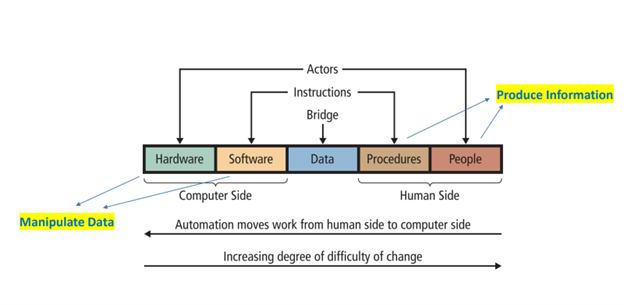
Produce Information
Procedures & People
Manipulate Data
Hardware & Software
Common Mistake
Can not buy an Information System
Low-Tech IS
human work is required (eg. send emails manually)
High-Tech IS
more work has moved from human to computer (eg. send emails automatically)
Scope of new info systems
What new HW would you need
What programs would you need to license?
What databases and other data must you create?
What procedures will need to be developed for both use and administration of the IS?
What will be the impact of new tech on people?
IF ON PAPER OR SCREEN
IT IS DATA
IF IN MIND OR HUMAN
IT IS INFORMATION
Characteristics of Data required for Good Information
Accurate
Users must be able to rely on results of IS
Timely
Available in time for its intended use
Each IS contains an application
HW, SW, data
One business process can use many IS
Single IS can support many business processes
BPM (Business Process Model)
Create new business processes and to make changes to existing processes
SDLC (System Development Life Cycle)
process used to develop both IS and applications
SCRUM
new development process that was made to overcome problems created when using SDLC
Business Analyst
To ensure VP and IS meets organizations competitive strats
System Analyst
IS professionals who understand both business and IT. Focused on IS development
3 reasons business processes need management
improve process quality
Change in Technology
Change in business environment
Customer Relationship Management (CRM)
Sales application
Relationship Management Application
Customer Support Application
(Elimates duplicated data)

