Topic 3 - Files and Indexing (Drives, RAID, Indices)
 Studied by 0 people
 Call Kai
 Learn
Learn Practice Test
 Spaced Repetition
 Match
Match Flashcards
 Knowt Play
1/39

There's no tags or description
Looks like no tags are added yet.
Name | Mastery | Learn | Test | Matching | Spaced | Call with Kai |
|---|
No analytics yet
Send a link to your students to track their progress
40 Terms
What are the Primary/Secondary/Tertiary types in the Storage Pyramid in order (fastest to slowest)?
Primary: CPU registers → Cache Memory → Main Memory
Secondary: Solid State Drives, Hard Disk Drives
Tertiary Storage: Tapes/Optical Disk Libraries
What section of storage in the Storage Pyramid is volatile, and what are the types in order from (fastest to slowest)?
The Primary Storage types are all volatile
CPU Registers → Cache Memory → Main Memory
What are the 4 main physical components of a Hard Drive?
Platters (hold data)
Axle (Spins the platters)
R/W Heads (R/W data)
R/W Arm (Moves the heads over the platters)
What is a sector/block?
The basic unit of transfer of information
Explain the 3 sources of delay (use names) for R/W operations on a HDD
Seek Time - Physical movement of the R/W heads takes time
Rotational Latency - Must wait for the block (on the platter) to rotate to where the head is positioned
Transfer Time - R/W data from/to the platter surface
What is disk mirroring?
Disk mirroring is the technique of writing the same data to two drives, s.t. the user has effectively two identical drives.
What are the advantages/disadvantages to RAID 1?
Advantages:
System survives if one of the drives fails
Opens the possibility for reading from both drives simultaneously
Disadvantages:
Expense of 2x the # of drives
What level is RAID 0?
Striping
What is RAID 1?
Mirroring
What is disk striping?
Disk striping is a technique where logical units of data (like a file) are distributed across several disks
What are the advantages / disadvantages of RAID 0?
Advantages:
Increases performance (since read/writes can be parallelized)
Disadvantages:
Increased probability/chance of the system failing due to one of the drives failing (if one goes out, the whole system is unrecoverable)
Lack of data replication
What are the four kinds of parity schemes in RAID?
even, odd, mark, none
Describe how the parity scheme works in RAID 4.
In RAID 4, a single drive stores all parity information across the other drives in use. If one of the drives fails, the data can be reconstructed using the parity drive and the information of the other surviving drives.
What is the minimum amount of physical disks required for parity schemes in RAID 4 / RAID 5, and explain why this is
Parity schemes require at least 3 drives to rebuild data if 1 drive fails. This is because using only 2 disks means the parity disk essentially becomes a mirrored disk.
In the minimum case of 3 drives, if 1 of any of drives dies, the system survives (either by rebuilding the data using the parity drive, or if the parity drive dies, rebuilding the parity drive using a new drive)
What is the difference between RAID 4 and RAID 5?
RAID 4 and RAID 5 both use a parity scheme to survive drive failures
4 stores all parity data on a single disk
5 distributes/stripes the parity data across all disks
Events A and B are independent if?
p(A intersect B) = p(A) * p(B)
What does RAID stand for? What did the “I” originally stand for?
Redundant Array of Independent Disks
Originally meant “Inexpensive”
Which RAID levels are standardized?
RAID levels 0-6
What is RAID 6? Min. # of disks? Main performance diff. to RAID 5? How many drives can fail concurrently and system survive?
Distributed “Double Parity” scheme, requires 4 disks.
Essentially the same as RAID 5, except 2 parity schemes are used, which allows for 2 drives to fail.
Compared to RAID 5, RAID 6 has slower write performance
What is the technology behind SSD storage called?
NAND-based non-volatile RAM
What are the advantages/disadvantages to SSDs?
Advantages
No mechanical parts
Excellent read performance
Smaller physical size
Disadvantages
Write speed is slow than read speed
# of erasures per cell is limited (cells eventually die)
More expensive than HDDs (per unit storage)
What is the definition of Blocking Factor (bf)?
The number of whole records that can be stored in a single block
What is Internal Fragmentation?
Unallocatable storage within an allocation unit (such as a block)
Give a brief informal description of how to calculate the byte amount of Internal Fragmentation in a block
Calculate blocking factor/bf (# of records that can fit in a block)
Find out how many bytes this is, and subtract it from the block size = Remainder is IF size in bytes
What are the two ways of locating records within a block? Explain both.
Fixed-Length Records
a) Packed/Contiguous Allocation (use qty to index)
b) Unpacked Allocation (use bitmap field to index)
Variable-Length Records
Requires a record directory (location + length for each record)
What is the definition of an Index?
A file containing structured references to records of another file
What is a Candidate Key (CD)?
A key that is able to uniquely ID a record
What is a Primary Key (PK)?
The selected/chosen candidate key for that record
What is a Secondary Key?
Any non-candidate key
What is a Sort Key?
The key used to order records within a file
What are two ways of classifying an index, and strategies for both?
Ordered
a) Single-level (Sorted file)
b) Multi-level (B+Tree)
Unordered
Hashing
What is a Primary Index? (Specifically, what 3 characteristics describe a Primary Index)
The indexed field is a candidate key
The index records are sorted on the key
The DB file records are sorted on the key
How many primary indices can exist per file?
At most one
What is a Clustered Index? (Specifically, what 3 characteristics describe a clustered Index)
The indexed field is a secondary key
The index records are sorted on the key
The DB file records are sorted on the key
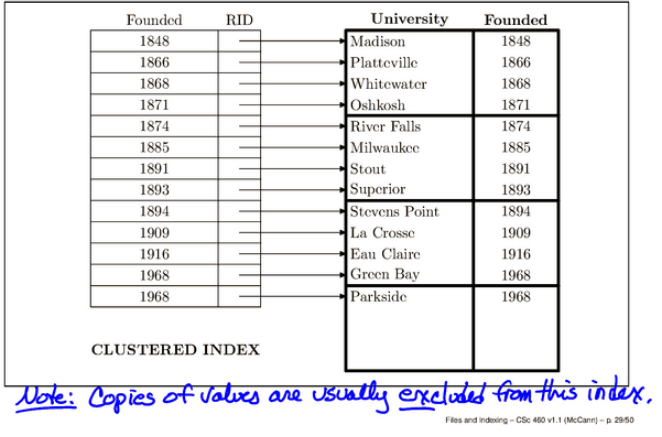
Per file, the # of primary indices + the # of clustered indices cannot _________.
Exceed one
Index-to-file references can be per-record or per-block. What does this mean?
This is saying that indices can point to the exact location of a record, or to the block that it is located within
What is a Secondary Index? (Specifically, what 3 characteristics describe a secondary Index)
The indexed field is any field
The index records are sorted on the key
The DB file records are not sorted on the key
How many secondary indices can you have per file?
As many as you want, but special index construction may be needed
What is an example of a clustered index?
Student records where the clustered index is on the “Name” field (non-CK field, and clusters dusplicate names together when sorted)
What are the other two ways of categorizing indices? Explain both, give a pro for each
Dense Indices
Holds a pointer to every record in the file of interest
Allows existence search w/ index only
Sparse Indices
Holds a pointer to blocks of records in the file of interest
Faster to search the index, since it is smaller than dense

