AP African American Studies Unit 3: The Practice of Freedom
 Studied by 29 people
 Call Kai
 Learn
Learn Practice Test
 Spaced Repetition
 Match
Match Flashcards
 Knowt Play
1/40

Earn XP
Description and Tags
Name | Mastery | Learn | Test | Matching | Spaced | Call with Kai |
|---|
No analytics yet
Send a link to your students to track their progress
41 Terms
Reconstruction goals
Plan for after the Civil War
The rebuilding of the southern society
Replacing a society built completely around slavery
Attempt to integrate 4 mil AAs into Southern Society
Reconstruction Era
1865-1877
Reintegration of former Confederate States
Established and protected rights of free & formerly enslaved AAs
Granted them citizenship, rights & political representation in Governments
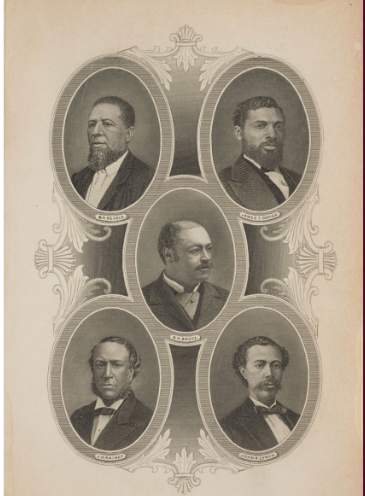
Depicts African American legislators in Congress
13th Amendment
1856
Officially abolished slavery & involuntary servitude EXCEPT AS PUNISHMENT FOR A CRIME
14th Amendment (1868)
Defined the principle of birthright citizenship
Granted equal protection to all people
Overturned Dred Scott v. Sanford (1857) & state level Black codes
Reminder: Dred Scott v. Stanford originally stated African Americans were not citizens
15th Amendment
1870
Gave black men the right to vote
Prevented federal & state governments from denying citizen’s right to vote on the basis of race, color or previous condition of servitude
Impact of 15th Amendment on political participation
Black men’s access to voting rights allowed them to participate in American politics
Participation of thousands of Black Americans (mostly formerly enslaved) in Southern politics was a major part of the Reconstruction era
During the Reconstruction era nearly 2,000 AAs served in public office from the local level to the Senate
Many rights gained for AAs during Reconstruction were blocked during the Jim Crow Era
AAs would fight in the 1960s to reclaim rights they earned in the 1870s
Freedmen’s Bureau
The Bureau of Refugees, Freedmen and Abandoned Lands
AKA the Freedmen’s Bureau
Official US Gov agency
Responsible for managing property abandoned and confiscated during the civil war
Primary purpose was to aid formerly enslaved people
Helped in the transition to be American citizens
Provided clothing/food, legalizing marriages and establishing schools
African American families after the Civil War
Enslavement disrupted family bonds
Relatives were sold, relocated, forcibly changed their names by enslavers through int. and dom. slave trade
Created new kinship bonds and traditions during and after slavery
Relied on newspapers, word of mouth, and help from the Bureau to find lost family and friends
African Americans and their names
Adopted new names that represented their status as free people
Allowed them to shape their own identities
African American Marriages
Not legally binding before abolition
Many “jumped the broom” while enslaved as a symbol of their union
After the Civil War, thousands of AAs sough legal marriage
African American family reunions
Established traditions of family reunion to connect with long-lost relatives and friends
Modern family reunions preserve and celebrate Black families’ history, resilience, music, and culinary traditions
Black Codes
Laws restricting newly gained rights of AAs
Controlled movement and labor
Restricted advancement
Enacted by many states during reconstruction
Black Codes aimed to restore social controls of earlier slave codes
One set of black codes allowed black children to be taken for unpaid apprenticeships without parental consent
Black Code restrictions
Limited property ownership
Required entry into labor contracts
Paid poorly
Escapees of contracts were whipped
Ones w/o contracts could be fined/imprisoned for vagrancy
Special Field Order No.15 (40 acres and a mule)
Redistribution of 40,000 acres of land to AA families
Given in segments of 40 acres
Andrew Jackson revoked the order
Confiscated plantations were returned to past owners/bought by northern investors
Sharecropping
Landowners gave land + equipment to the formerly enslaved and poors
Sharecroppers had to return a large share of the crops to the land owners
Made economic advancement difficult
Circular No.8
Plantations were forbidden to fire freed-people without payment
Done to prevent the exploitation of African American laborers
Crop Liens
Farmers with little resources received food + supplies on credit
Paid it back with their future harvest
Harvested crops often didn’t make enough money to repay debts
Created vicious cycle of debt
Convict leasing
Southern prisons profited by hiring out imprisoned AA men
Imprisoned for debt, false arrest & minor charges to landowners and corporations
Prisoners worked without pay
Conditions very similar to slave labor
De Jure
Systems defined by law
Segregation looked like:
Jim Crow Laws
Plessy V. Ferguson
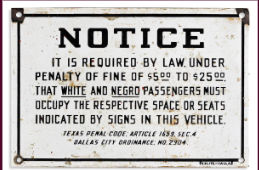
De Jure
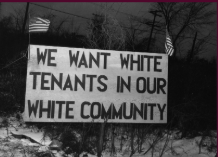
Systems defined by culture, practice etc
Not formally in place
Segregation looked like:
Housing trends
Workplace Segregation
Literacy test
Nonsense test given before voting
Vague questions with many answers
AAs who took the test were failed
Threats to Voting Rights
Black voting rights during reconstruction were not protected/in danger
Black participation in voting was restricted
Literacy Tests
Poll Taxes (fee before voting)
Grandfather Claues
Grandfather clauses
If your grandfather could vote before 1867 so could you
Black men weren’t able to vote until 1870
Beginning of Jim Crow
After the election of 1876 & the Compromise of 1877 some states rewrote their state constitutions to include de jure segregation laws
Election of 1876
EXTREMELY CLOSE!
Hayes won the electoral vote, lost the popular vote
Compromise of 1877
Said that Republicans could have the election as long as they promised to remove military troops from the South
Gave less protection to AAs
Racial Violence after Reconsturction
Endangered AA lives
Lynching
Public executions w/o fair trail
Retaliation from former Confederates
Political terr0rist groups
Klu Klux Klan (KKK): Created in 1865 to spread white supremacy and targeted racial violence
Plessy V. Ferguson
Ruled that “separate but equal” conditions were constitutional
Became legal basis for racial Segregation in much of America
Legalized separate and unequal resources, facilities and rights
Eventually overturned in Brown V. Board of Education (1954)
The Nadir
1877-1938
End of reconstruction to beginning of WW2
Lowest point of Race relations in the US
Some of the most brutal public acts of racism
Lynching
Mob violence
Jim Crow
Originated in 1830s
Thomas Dartmouth (T.D) Rice performed an act in a minstrel show called “Jump, Jim Crow” where he was in blackface
Mocked AAs in speech and dance
Popularity of character led to Jim Crow becoming a common, derogatory term for AAs
Jim Crow Laws
Eventually referred to local and state-level laws for AAs
Mainly in the south
Protected by Plessy v. Ferguson
Limited AAs right to vote
Enforced racial Segregation
Remained until the Civil RIghts Movement
AA resistance of The Nadir
Activists responded with resistance to Segregation
Example: Trolley boycotts
AA journalists and writers highlighted racism of Southern lynch laws
Activists relied on sympathetic writers in the press of publicize mistreatments and murders of AAs
Ida B. Wells Barnett
Journalist, Civil Rights Advocate, Feminist
19th and early 20th century
Writings described how lynching sought to terrorize AAs
Proposed that AAs own a gun to protect themselves
The Color Line
Metaphor for the racial discrimination and legalized Segregation after abolition of slavery
Double Consciousness
Metaphor for how AAs lived with two identities
African identity and “American” status
reflects internal conflict experienced by oppressed groups
Caused by social alienation created through racism and discrimination
Has both positive and negative impacts on society
Also fostered agency adaptation and resistance
Believed AAs had an opportunity to have a unique perspective on American society
The Mask & the Veil
Represent AA’s separation from full participation in American society
Struggle for self-improvement due to discrimination
A metaphor for the survival mechanism during the Nadir
Symbolizes how AAs can see while society but whites cannot truly see Black Americans behind their mask
Booker T. Washington Uplift Strategy
Born into slavery in 1856 in Virginia
Prominent Black activist
Argued that AAs should stay in the south & focus on vocational training (trades/practical skills)
Argued AAs should work their way up to political participation and Liberal Arts
Gradual approach
Preferred by AA for his cautiousness
Preferred by whites because it kept AAs as laborers and out of politics
Du Bois’ uplift strategy
Believed Washington’s approach wouldn’t work
Du Bois demanded immediate civil rights and social change
Focused on Liberal Arts education/higher education, political participation and Civil RIghts
NAACP
Founded in 1909
Goals
Advocate for Civil RIghts
Challenge racial injustices through legal action
Fight discrimination
White Allies helped the org. grow and become popular in mainstream media
Some believed the org should be 100% black
Scared white interests would be prioritized
Nannie Helen Burroughs
Black educator, suffragist, church leader. daughter of enslaved people
Worked in Women’s suffrage movement
Became he president of the the Nation Association of Colored Women
Advocated for the rights of Black Women in health, education and civil rights
Lift Every Voice and Sing
Poem created by James Weldon Johnson
Now known as the Black National Anthem
Purpose is to encourage AAs to take pride in their heritage and Cultural achivments
The Roles of Church Women
Helped to rebuild black communities
Entered workforce
Organized labor unions
Created clubs
Created religious groups
Exemplified black agency, dignity, capacity, beauty, and strength
Mary Church Terrell
Key founder of National Association of Colored Women (NACW)
 Note
Note  Flashcards (81)