3a: Pulmonary Function and VO₂ Max Testing
 Call Kai
 Learn
Learn Practice Test
 Spaced Repetition
 Match
Match Flashcards
 Knowt Play
1/17

There's no tags or description
Looks like no tags are added yet.
Name | Mastery | Learn | Test | Matching | Spaced | Call with Kai |
|---|
No analytics yet
Send a link to your students to track their progress
18 Terms
What is the Respiratory Rate and Minute Volume?
Respiratory Rate (RR): Number of breaths per minute
Rest: ~ 12-16 breaths
Minute Ventilation (MV or VE ): Volume of air breathed each minute
Rest: 6-8 L/min
VE = Respiratory Rate x Tidal Volume
What are the different raspatory volumes?
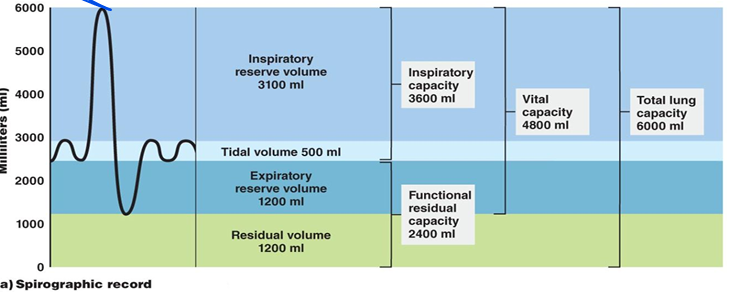
What is tidal volume?
Volume of air moved during inspiration or expiration
Rest: ~ 500 ml
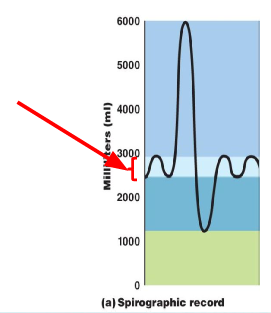
What is Inspiratory Reserve Volume, Expiratory Reserve Volume, & Residual Volume?
Inspiratory Reserve Volume (IRV): Maximum volume of air that can be inspired above TV
About 3 Liters
Expiratory Reserve Volume (ERV): Maximum volume of air that can be expired below TV
About 1.3 Liters
Residual Volume (RV): Volume of air still in lungs after maximum exhalation
Prevents lungs from collapsing
Cannot be directly measured
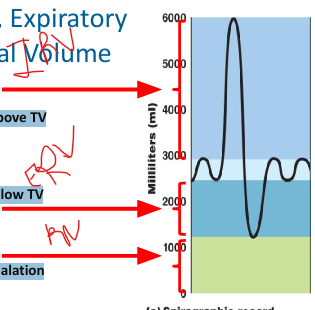
What is Forced Vital Capacity and Total Lung Capacity?
Forced Vital Capacity (FVC): Total Volume of air in one breath from total inspiration to total expiration
FVC = TV + IRV + ERV
Different between sex
Total Lung Capacity: IRV + TV + ERV + RV FVC + R
About 6 Liters
what is Forced Expiratory Volume
Forced Expiratory Volume/1 second (FEV1.0 )
Amount that can be forcibly expired in 1 second-
Can be measured in other time intervals (0.5, 2 , 3 seconds)
FEV1.0 /FVC Ratio: Indication of expiratory power and overall resistance to airflow
Healthy ≥85%
Airway obstruction ≤ 70%
what factors does volumes depend on?
Genetic influences
Body size
Sex differences
Exercise training cannot change static lung volume
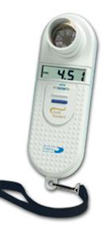
What is a pulmonary function test?
Test Uses a spirometer to measure
Handheld or larger apparatus
Useful in assessing lung function & diagnosing lung disease
Obstructive (asthma) vs. restrictive (fibrosis) lung disease
Pre & Post Exercise
What two factors need to increase to meet increased O2 demands?
VE = Respiratory Rate (RR) x Tidal Volume (TV)
Need to increase both RR and TV to meet increased O2 demand and to expel increased CO2 created from metabolism
What is VE response in the beginning and end of exercise?
Initially, VE increases mildly
To take in more O2
Later, VE increases sharply
To get rid of excess co2
How do you work a handheld Spirometer?
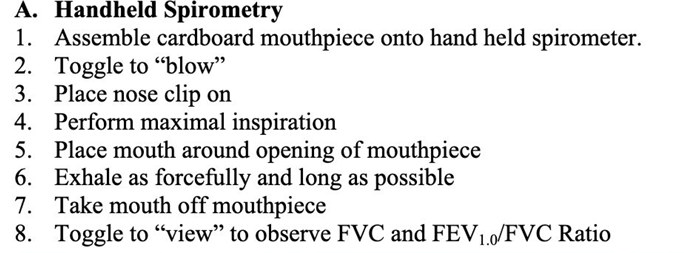
What is VO₂ max?
VO2 = Q x a-vO2diff
Q = SV x HR
a-vO2diff = difference in oxygen content between the arterial and venous blood
VO2 increases with increasing intensity
At MAX, our body cannot utilize any more O₂ for ATP production
Measure of:
Capacity of Aerobic Energy System
Cardiorespiratory Fitness
Purpose of VO₂ Max Test
General Population:
CR fitness is inversely related to CVD
↑VO₂max/CR fitness → ↓risk of mortality and morbidity
Athletes
Good predictor of exercise performance
↑VO₂ max → ↑aerobic performance
Not perfect predictor
Dependent on sport
Limiting Factors of VO2 Maximal consumption of oxygen depends on
Alveolar ventilation
Diffusing capacity of the lungs
O2 transport to the capillaries of the working muscles
Ability of the working muscles to receive and utilize oxygen
what is Respiratory Exchange Ratio (RER)?
Reflects intensity of exercise and fuel being used for ATP production
RER = 0.70, main source of energy is fat
RER = 1.0, main source of energy is carbohydrate
RER >1.0, CO2 produced > O2 consumed
VCO2 /VO2
↑CO₂ production beyond an RER of 1 is a result of buffering of H+ ions (acids) produced solely with anaerobic metabolism
What factors that Influence VO₂ Max?
Mode of exercise: How much muscle mass is involved (contrast bike vs treadmill)
Genetics: 25-50% variation
State of training (fitness level and specificity)
Gender:
Females typically lower (15-20%) ***
Body mass difference***
Lower hematocrit/hemoglobin to carry O2
Body size and composition
How much muscle mass does a person have?
Type I vs Type II muscle fibers
Age Decline can begin after age 30
what re the different modes of VO₂ Max Testing?
Graded Exercise Test (GXT): Various protocols can be used
Various modes:
Treadmill
Cycle
Arm
Stepping
Predicted vs. Measured: Maximal effort required
Criteria for Max vs. Peak test ?
Must achieve at least ¾ to be considered a true VO2 Max
Plateau in O₂ consumption with increasing workload - <0.150 L/min increase in VO2 with last increase in workload
RER > 1.10\
RPE > 17 (GREATER than 17, an RPE of 17 does NOT count)
HR within 10 beats of Age Predicted MHR

