Electronics Information pt 1
 Call Kai
 Learn
Learn Practice Test
 Spaced Repetition
 Match
Match Flashcards
 Knowt Play
1/95

There's no tags or description
Looks like no tags are added yet.
Name | Mastery | Learn | Test | Matching | Spaced | Call with Kai |
|---|
No analytics yet
Send a link to your students to track their progress
96 Terms
Electric charge
a property where electrically charged objects are accelerated by electrical forces
Electricity
the flow of electrons along a conductor
Conductor
an object that allows electrons to pass easily
Elements
most basic materials in the universe
Free electrons
electrons that move from atom to atom at random
A conductor is any material that ___
has many free electrons
Speed of light
186,282 miles per second
Current flow
when a flow of electrons along a conductor occurs
Magnetism
a force that acts between certain objects
Magnetic field
the area around a magnet where the force is felt
Electromagnet
a coil of current carrying wire
Conventional Current flow
positive to negative charges
Electron Current
negative to positive charges
Direct Current (DC)
flows continuously in the same direction
Alternating Current (AC)
flow periodically reverses direction
Circuit
A pathway for the movement of electrons
Electromotive Force
external force on electrons to make them flow through a conductor
Volts
electric pressure
Measurement of Ampere
6.25 quintillion electrons in 1 second
Ampere
electrical current
Coulomb
6.25 quintillion electrons stores on an object
Current Formula
current = charge in coulombs / time in seconds
Milliampere (mA)
1 thousandth of an ampere
Microampere (µA)
1 millionth of an ampere
Ammeter
measures current flow in a circuit
Milliammeter
measures smaller current flow in a circuit
Microammeter
measures very small current flow in a circuit
Voltmeter
measures voltage
Multimeter / volt-ohm-milliameter
measures both voltage and current plus resistance
Silver as a conductor
is better than copper but more expensive
Copper as a conductor
is used more since it is cheaper
Aluminum as a conductor
is used where light weight is important
Electric current
when electrons are made to move in the same direction
Good insulators
plastic, rubber, or cloth material
Smaller gauge wire equals
larger diameter
Semiconductor
materials that have conductive properties between conductors and resistors
Common semiconductor materials
silicon and germanium
Intrinsic
pure
Resistors
opposite of good conductors
Ohms
resistance to electron flow
Power
the rate at which work is done
Watts
power
Joules
energy work
Watt formula
watt = joule per second
Horsepower
moving a certain weight a certain distance in 1 minute
How much watts equals 1 horse power
764 watts of electric power to equal 1 horse power
Power formula
power = volts X amperes
Kilowatt
used to express the amount of electric energy used or available
Kilowatt amount is
1 thousand watts
Milliwatt amount is
1 thousandth of a watt
Larger the wire
the smaller resistance per foot of length
Thermistors
decrease in resistance with an increase in temperature
Resistors provide
measured amount of resistance
Resistance symbol
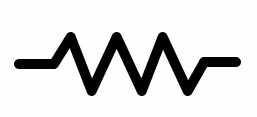
Wirebound resistors
are made of wire that has controlled resistance per unit length
Carbon-composition resistors
are marked according to their ohmic value
Mega
Million
Conductance
the ability of a material to pass electrons
Siemen
unit of conductance
Ohms Law
E = I X R (Voltage = Current X Resistance)
Complete Current is made of
a source of electricity, a conductor, and a consuming device
Open Circuit
no current flows
Batteries negative charge
excess of electrons
Batteries positive charge
deficiency of electrons
Closed/Complete Circuit
a single path for electrons to flow
Series Circuit
two or more resistors or consuming devices are placed on after another
Kirchoffs voltage law
the sum of all voltages across resistors or loads is equal to the applies voltage
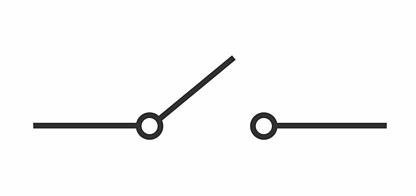
switch symbol
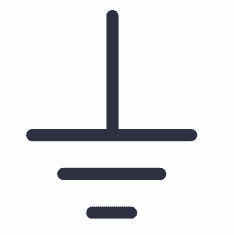
ground symbol
Fuse
used to prevent the damage done by excess current flowing in a circuit
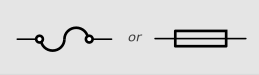
fuse symbol
Inductance
the ability of a coil, choke, or inductor to oppose any change in circuit current
Transformer
changes electricity into a higher or lower voltage
Alternator
coverts mechanical energy into AC electrical energy
Waveform
Pattern
Sine wave
the basic waveform of AC or voltage
One hertz
equal to one cycle per second
Capacitor
device that opposes any change in circuit voltage
Capitance
the property of opposing voltage change
Rectifiers
changing AC to DC
Diode
a device that allows current to flow in one direction
Transistor
used to amplify or switch a signal
Battery
a device in which chemical energy is converted to electrical energy
What makes up a battery
two electrodes and an electrolyte
Electric motor
changes electrical energy into mechanical energy
Voltmeter
checks voltage
Ammeter
checks current
Wattmeter
checks performance of power
Ohmmeter
checks resistance
Transducer
devices that convert pressure, light, heat, and sound to electrical energy
Solder
an alloy metal made from tin and lead
Soldering
the technique of joining electrical connections where solder is melted to form a joint
Flux
a chemical that cleans the area of connection
Contact soldering
uses a soldering iron or soldering pencil

