Population Ecology
 Note
Note Call Kai
 Learn
Learn Practice Test
 Spaced Repetition
 Match
Match Flashcards
 Knowt Play
1/44

Earn XP
Description and Tags
Ecology for Bartons Class
Name | Mastery | Learn | Test | Matching | Spaced | Call with Kai | Chat |
|---|
No analytics yet
Send a link to your students to track their progress
45 Terms
What is a clumped population?
A clumped population is a type of species distribution characterized by individuals grouped in clusters or patches rather than being evenly distributed across a landscape. This pattern often occurs in response to resource availability, social behavior, or environmental conditions.
What is Type II survivorship?
Type II survivorship is a pattern of survival where individuals have a constant probability of dying at any age, often seen in species that experience mortality at equal rates throughout life.
What is Type III survivorship?
Type III survivorship is a pattern of survival characterized by high mortality rates in early life stages, with few individuals surviving to adulthood. This strategy is common in species that produce many offspring, like fish and plants.
What is Type I survivorship?
Type I survivorship is a pattern of survival where individuals have a high probability of surviving until old age, commonly observed in species that invest heavily in parental care, such as humans and many large mammals.
What is population density?
Population density refers to the number of individuals of a species per unit area or volume, reflecting how crowded a population is in a specific habitat.
What is a population? Why should we study them?
A population is a group of individuals of the same species that live in a specific area at a given time. Studying populations helps us understand their dynamics, interactions, and the impact of environmental changes.
What are density dependent factors?
things that affect a population only when its dense (disease, competition for resources, and predation)
What are density independent limiting factors?
Factors that affect a population regardless of its density, such as natural disasters, weather, and human activities.
What are limiting factors?
Limiting factors are environmental conditions that restrict the growth, abundance, or distribution of a population, affecting its size and dynamics.
What is exponential growth in a population size?
The larger the population gets, the faster it grows. This cannot happen for a long time.
What is logistical growth in a population?
Logistical growth occurs when a population's growth slows as it approaches its carrying capacity due to limiting factors, leading to an S-shaped curve in population size over time.
What is linear growth in a population?
Linear growth in a population refers to a constant increase in population size over time, where the number of individuals added is the same in each time interval, resulting in a straight line on a graph.
What is the Boom and Bust Cycle?
The Boom and Bust Cycle refers to the pattern of rapid population growth followed by a dramatic decline, often due to resource depletion or environmental changes, leading to fluctuations in population size.
Describe the random dispersion pattern
The random dispersion pattern describes the spatial distribution of individuals in a population where they are spread out unpredictably and without a distinct pattern, often due to the abundance of resources and minimal competition.
Describe the uniform dispersion pattern
A spatial distribution in which individuals within a population are spread out evenly, often as a result of territorial behavior.
What is carrying capacity (K)?
The maximum population size that an environment can sustain indefinitely without being degraded. It is determined by resource availability, including food, water, and habitat.
What is r-selection?
A reproductive strategy characterized by high growth rates and high offspring numbers with low parental investment, typically in unstable environments.
What is K-selection?
A reproductive strategy where organisms produce fewer offspring but invest more time and resources in raising them, typically in stable environments.
What is Growth Rate (G)?
The rate at which a population increases in size over a specific period of time, typically expressed as a percentage of the existing population.
What is Demography?
The statistical study of populations, including the structure, distribution, and trends in size and growth over time.
What are the 4 age structures?
Rapid Expansion, Slow expansion, Stable, and declining.
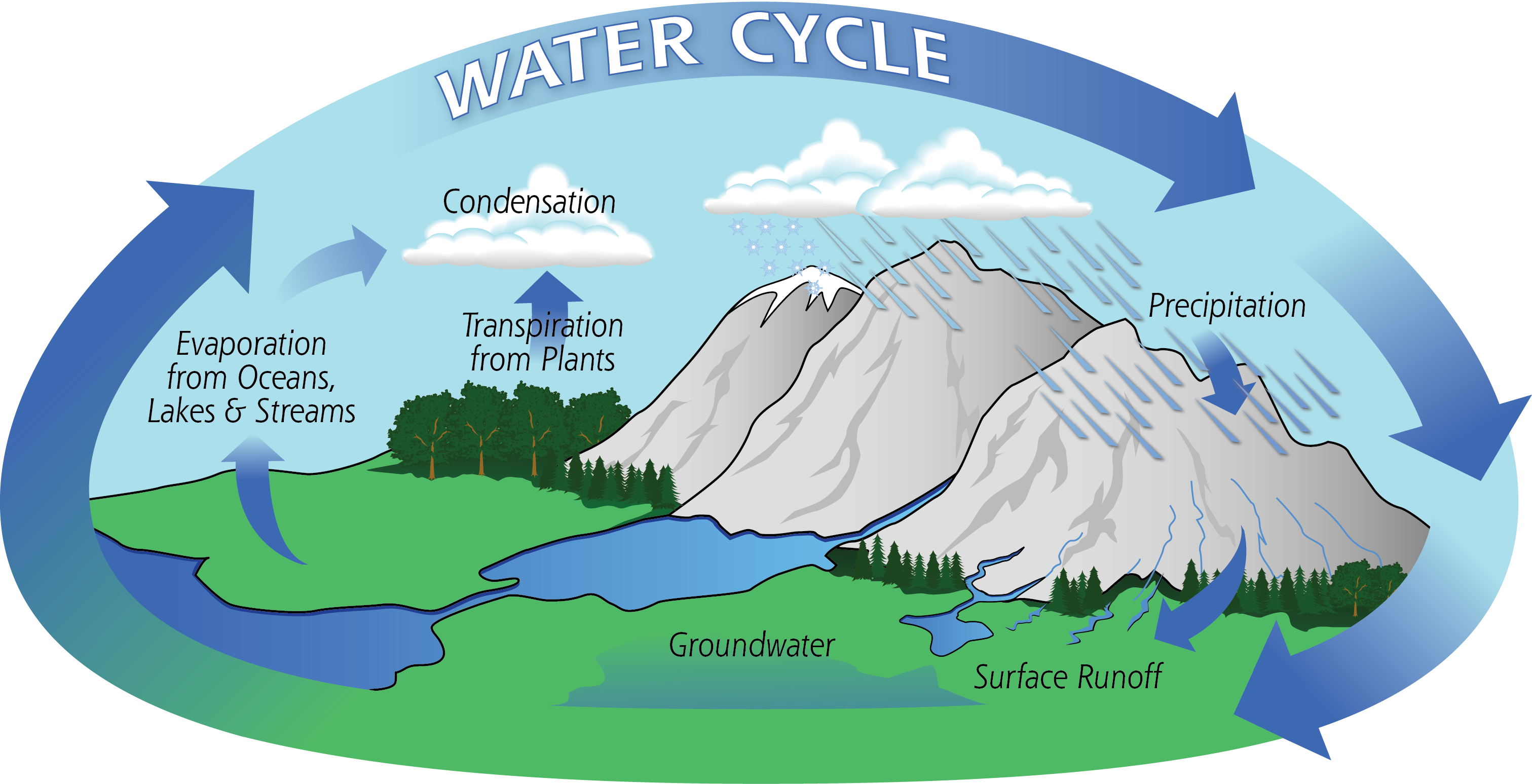
Describe the water cycle
The continuous process by which water evaporates from the Earth's surface, condenses in the atmosphere, and precipitates back to the ground. It involves processes like evaporation, condensation, and precipitation.
What is emigration in population terms?
The process of leaving one country or region to reside in another. It typically decreases the size of the population in the origin area.
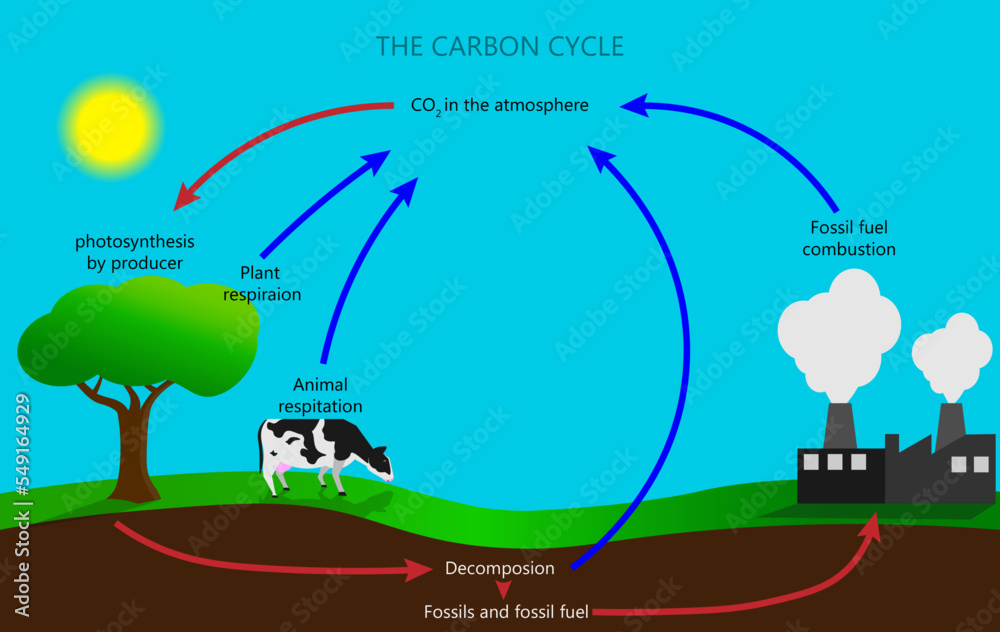
Describe the carbon cycle
The biogeochemical cycle in which carbon atoms move between the Earth's atmosphere, oceans, soil, and living organisms. It involves processes such as photosynthesis, respiration, and decomposition.
Describe the Oxygen Cycle
Photosynthesis, consumtion, combustion
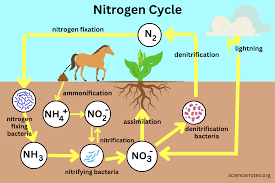
What is the Nitrogen Cycle?
a natural process where nitrogen moves between the atmosphere, soil, plants, and animals, primarily through processes like nitrogen fixation, nitrification, and denitrification.
What is the Law of Conservation?
energy cannot be created or destroyed, but rather it can only be transformed from one form to another or transferred from one object to another
What is the 10% rule?
10% of the energy from each organism is passed up to the next once its eaten.
Where does energy go?
Its lost as heat
What is Eutrophication?
the process where a body of water becomes overly enriched with nutrients, leading to excessive plant and algae growth, which can deplete oxygen and harm aquatic life
What is global warming?
human activities that release greenhouse gases, like carbon dioxide, into the atmosphere, trapping heat and causing the planet to warm
What is an invasive species and why are they so successful?
a non-native organism that, when introduced to a new environment, spreads rapidly and causes ecological, economic, or environmental harm. They often succeed due to a lack of natural predators or competitors in the new environment, allowing them to outcompete native species and disrupt ecosystems
What is global warming and what causes it?
Global warming is increased carbon dioxide and other greenhouse gases that trap the Earth's heat. Some causes are cutting down forests, manufacturing goods, using transportation, and powering buildings.
Bioaccumulation vs. Biomagnification
Bioaccumulation is the buildup of toxins within a single organism over time, while biomagnification is the increasing concentration of toxins as they move up the food chain
What is the ozone and how is it made and broken down?
Ozone (O3) is a molecule composed of three oxygen atoms, naturally occurring in the stratosphere where it forms the ozone layer, which absorbs harmful UV radiation. Ozone is formed when oxygen molecules (O2) are broken down by UV radiation or electrical discharge into oxygen atoms (O), which then combine with other O2 molecules. It is also broken down by combining with other molecules. (DO NOT ASSOCIATE WITH GLOBAL WARMING)
Why are invasive species a threat?
they disrupt the enviornment and alter habitats than can eventually lead to extinctions and reduced biodiversity.
What is biodiversity?
the variety of life on Earth, encompassing everything from genes and species to ecosystems and their functions
What may happen to the earth if global warming continues?
a rise in global temperatures, more frequent and severe extreme weather events, rising sea levels, and disruptions to ecosystems and human societies
What is some data to support global warming?
melting glaciers, permafrost melting, sea levels rising, and loss of biodiversity. (polar bears and coral reefs)
What are the greenhouse gases?
Methane (CH4), C02, Water vapor, Nitrogen gas, and oxygen gas
What are the steps of Eutrophocation?
Nutrient enrichment that occurs due to runoff from agricultural fields etc.
Rapid growth of algae and other planktons resulting in an algal bloom.
Dissolved oxygen depletion and toxin generation.
Aquatic species die as a result of the loss of oxygen and the production of dangerous poisons.
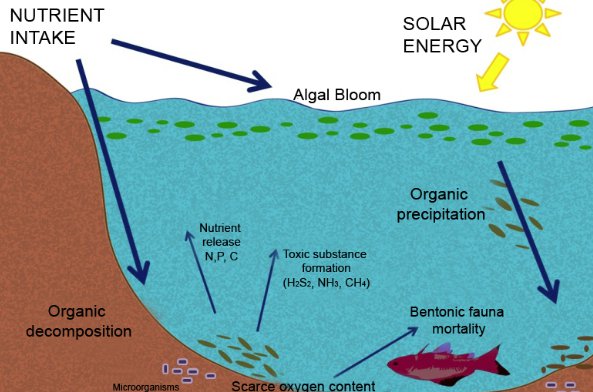
What are the outcomes of Eutrophocation?
Harmful algal blooms, dead zones, and fish kills are the results of a process called eutrophication—which begins with the increased load of nutrients to estuaries and coastal waters.
How is the ozone broken?
primarily by ozone-depleting substances (ODSs), which are human-made chemicals like chlorofluorocarbons (CFCs), HCFCs, halons, and methyl bromide. They release molecules that break down the ozone (O3) like chlorine and bromine.
What caused a hole in the ozone?
human-made chemicals, particularly chlorofluorocarbons (CFCs), which break down ozone molecules in the stratosphere, especially over Antarctica.
What are factors that happen only when a population is dense?
competition, predation, herbivory parasitism disease and stress from overcrowding