female reproductive system

0.0(0)
studied byStudied by 0 people
0.0(0)
call kaiCall Kai
learnLearn
examPractice Test
spaced repetitionSpaced Repetition
heart puzzleMatch
flashcardsFlashcards
GameKnowt Play
Card Sorting

1/13

encourage image

There's no tags or description

Looks like no tags are added yet.

Last updated 10:38 AM on 2/3/26
Name
Mastery
Learn
Test
Matching
Spaced
Call with Kai

No analytics yet

Send a link to your students to track their progress

14 Terms

1
New cards

topography es importante

knowt flashcard image
2
New cards

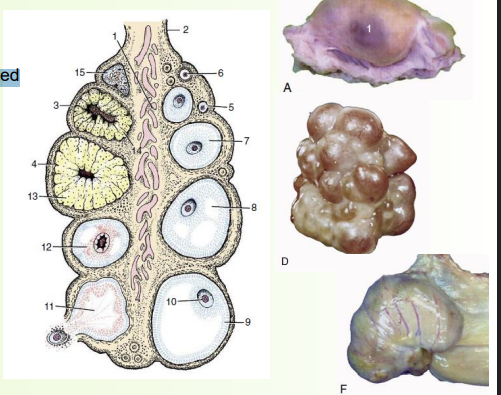
» Solid, ellipsoid organ

• Follicles (each containing a single ovum)

• Projection of follicles can make it irregular-shaped

• More follicles (e.g. polytocous species) = more lumpy

» In cross-section:

• Loose vascular zone/medulla in centre

• Outer dense parenchymatous zone

» Horses slightly different

• More kidney shaped

• Reversed structure (vascular zone outside, parenchymatous zone + follicles inside) F - and single location where they ovulate from - ovulation fossa
<p><strong>» Solid, ellipsoid organ</strong></p><p>• Follicles (each containing a single ovum)</p><p>• Projection of follicles can make it irregular-shaped</p><p>• More follicles (e.g. polytocous species) = more lumpy</p><p></p><p><strong>» In cross-section:</strong></p><p>• Loose vascular zone/medulla in centre</p><p>• Outer dense parenchymatous zone</p><p></p><p><strong>» Horses slightly different</strong></p><p>• More kidney shaped</p><p>• Reversed structure (vascular zone outside, parenchymatous zone + follicles inside) F - and single location where they ovulate from - ovulation fossa</p>
3
New cards
<p>follicle production</p>

follicle production

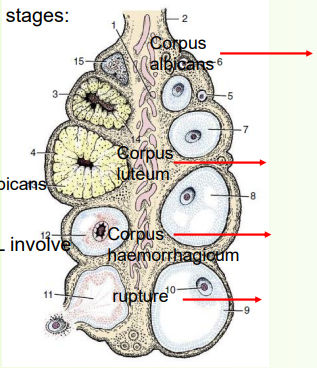
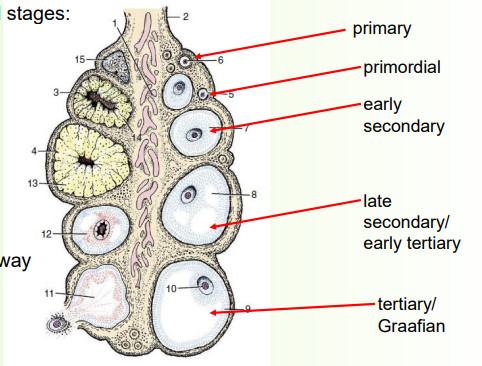
» Follicles develop and progress through several stages:

1) Primordial follicle (smallest)

Single layer of flat granulosa cells

2) Primary follicle

Flat granulosa cells thicken→ cuboidal cells

3) Secondary follicle

Several layers of cells with fluid-filled spaces

4) Tertiary (Graafian) follicle

Mature, fluid spaces joint up

» Only a small number of follicles mature all the way

• There is atresia and regression at every stage

» Follicles develop and progress through several stages:

6) Graafian follicle ruptures (ovulation)

Fluid flushes ovum to uterine tube

7) The remaining follicle tissue bleeds a little

8) Proliferation of tissue to form corpus luteum

If pregnant, CL (corpus luteum-produces progesterone) persists

9) If not pregnant CL regresses

A connective tissue scar forms; the corpus albicans (white body)

» Ovulation and maintenance or regression of CL involve a complex interplay of hormones e.g.

• FSH and LH - ovulation

• Progesterone - persistent corpus luteum

• PGF2α - regression of corpus luteum
<p>» Follicles develop and progress through several stages:</p><p>1) Primordial follicle (smallest)</p><p>Single layer of flat granulosa cells</p><p></p><p>2) Primary follicle</p><p>Flat granulosa cells thicken→ cuboidal cells</p><p></p><p>3) Secondary follicle</p><p>Several layers of cells with fluid-filled spaces</p><p></p><p>4) Tertiary (Graafian) follicle</p><p>Mature, fluid spaces joint up</p><p></p><p>» Only a small number of follicles mature all the way </p><p>• There is atresia and regression at every stage</p><p></p><p>» Follicles develop and progress through several stages:</p><p>6) Graafian follicle ruptures (ovulation)</p><p>Fluid flushes ovum to uterine tube</p><p></p><p>7) The remaining follicle tissue bleeds a little</p><p></p><p>8) Proliferation of tissue to form corpus luteum</p><p>If pregnant, CL (corpus luteum-produces progesterone) persists</p><p></p><p>9) If not pregnant CL regresses</p><p>A connective tissue scar forms; the corpus albicans (white body)</p><p></p><p>» Ovulation and maintenance or regression of CL involve a complex interplay of hormones e.g.</p><p>• FSH and LH - ovulation</p><p>• Progesterone - persistent corpus luteum</p><p>• PGF2α - regression of corpus luteum</p>
4
New cards

uterine tube

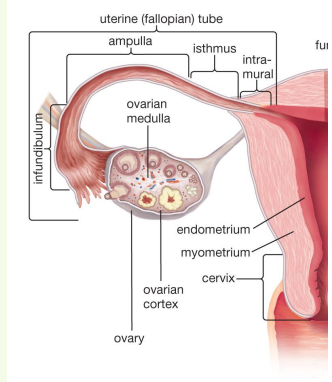
» AKA oviducts, salpinx/uterine tube. Not Fallopian!

» Function: capture and transport ova to the uterus; usually site of fertilisation

» Lined internally by ciliated epithelium

» Expanded near ovary into the infundibulum

• Funnel shaped

Fimbriae on free edge

» Ampulla (‘flask’) makes up middle portion

» Isthmus is the narrower (sometimes convoluted) portion

» Junction with uterine horn can be gradual or abrupt
<p>» AKA oviducts, <strong>salpinx/uterine tube</strong>. Not Fallopian!</p><p></p><p>» Function: capture and transport ova to the uterus; <strong>usually site of fertilisation</strong></p><p></p><p>» Lined internally by ciliated epithelium</p><p></p><p>» Expanded near ovary into the <strong>infundibulum</strong></p><p>• Funnel shaped</p><p>• <strong>Fimbriae </strong>on free edge</p><p></p><p>» <strong>Ampulla </strong>(‘flask’) makes up middle portion</p><p></p><p>» <strong>Isthmus </strong>is the narrower (sometimes convoluted) portion</p><p></p><p>» Junction with uterine horn can be gradual or abrupt</p>
5
New cards

uterus

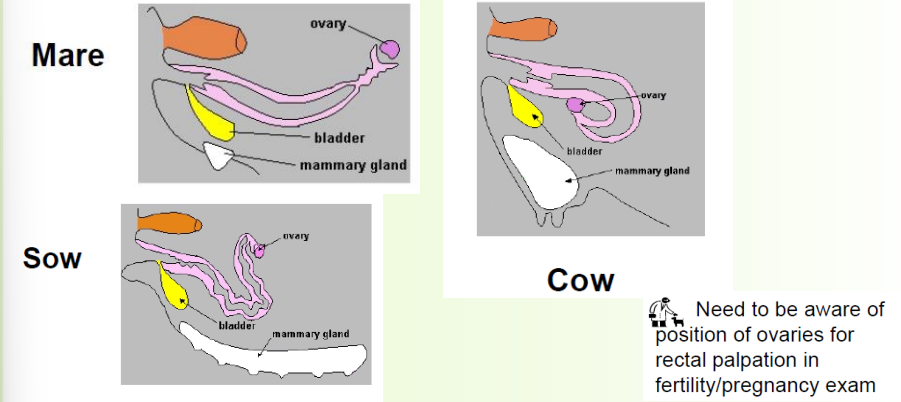
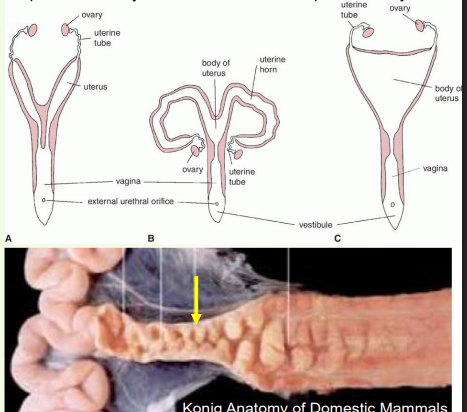
» Appearance varies considerably between species

• Develops from paramesonephric ducts that fuse

» Size, position and anatomy changes with age and physiological activity!

» Comprised of horns, body and cervix

» Cervix limits access from vagina

• Forms sphincter

• Thick mucosal folds interdigitate, can occlude cervical canal

• Cervical mucosa secrete mucus, forming a plug

uterine tube NOT the same as uterine horn
<p>» Appearance varies considerably between species</p><p>• Develops from paramesonephric ducts that fuse</p><p></p><p>» Size, position and anatomy changes with age and physiological activity!</p><p></p><p>» Comprised of horns, body and cervix</p><p></p><p>» Cervix limits access from vagina</p><p>• Forms sphincter</p><p>• Thick mucosal folds interdigitate, can occlude cervical canal</p><p>• Cervical mucosa secrete mucus, forming a plug</p><p></p><p>uterine tube NOT the same as uterine horn</p>
6
New cards
<p>uterus zoomed in - tubular</p>

uterus zoomed in - tubular

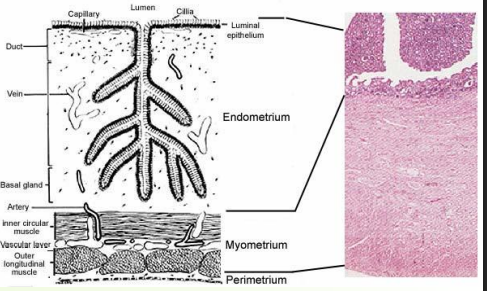
» Uterine wall is three-layered

» Mucosal layer (endometrium) internal lining

• Thickness varies with oestrus cycle

• Numerous tubular glands

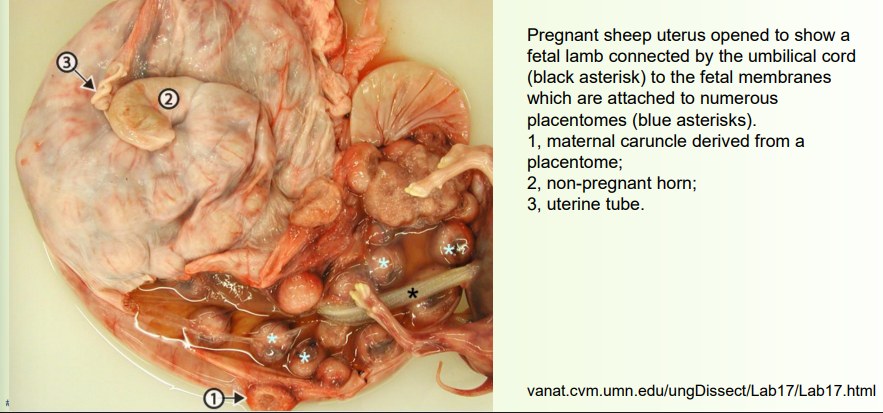
• Ruminants have uterine caruncles (attachment sites of embryonic membranes), attach to foetal cotyledons

» Muscle layer (myometrium)

• External longitudinal muscle layer

• Internal circular muscle layer

• Smooth (involuntary) muscle

• Responsible for uterine contractions

• Coordinated activity: longitudinal contractions ‘shorten utuerus’ while circular contractions push out contents.
<p>» Uterine wall is three-layered</p><p></p><p>» Mucosal layer (<strong>endometrium</strong>) internal lining</p><p>• Thickness varies with oestrus cycle</p><p>• Numerous tubular glands</p><p>• Ruminants have <strong>uterine caruncles</strong> (attachment sites of embryonic membranes), attach to foetal <strong>cotyledons</strong></p><p></p><p>» Muscle layer (<strong>myometrium</strong>)</p><p>• External longitudinal muscle layer</p><p>• Internal circular muscle layer</p><p>• Smooth (involuntary) muscle</p><p>• Responsible for uterine contractions</p><p>• Coordinated activity: longitudinal contractions ‘shorten utuerus’ while circular contractions push out contents.</p>
7
New cards

outer layer of uterus

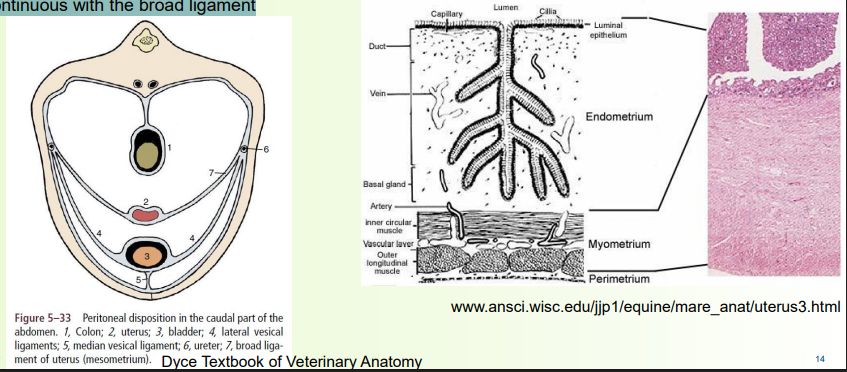
Serosal layer (perimetrium) outer surface

• Continuous with the broad ligament (like a mesentery in gi tract)
<p> Serosal layer (perimetrium) outer surface</p><p>• Continuous with the <strong>broad ligame</strong>nt (like a mesentery in gi tract)</p>
8
New cards

vagina, vestibule and vulva

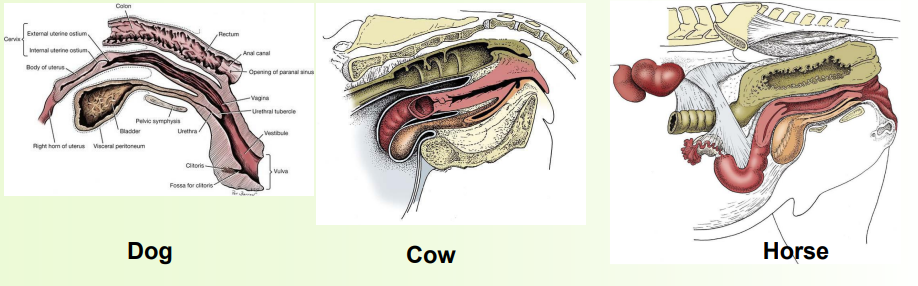
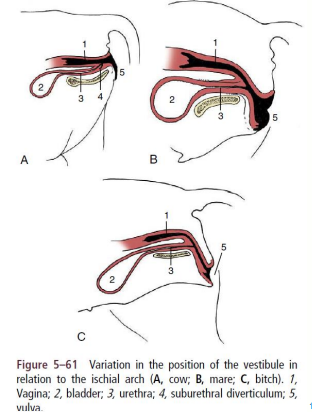
» Vagina and vestibule together form the rest of the internal tract

» Vagina cranially, from cervix to urethra

• Purely reproductive passage

• Mostly retroperitoneal

» Vestibule caudally, from urethra to external vulva

• Combined reproductive and urinary functions

• Caudal to ischial arch, variable slope ventrally to vulva

• Urethral opening ventrally
<p>» Vagina and vestibule together form the rest of the internal tract</p><p></p><p>» Vagina cranially, from cervix to urethra</p><p>• Purely reproductive passage</p><p>• Mostly retroperitoneal</p><p></p><p>» Vestibule caudally, from urethra to external vulva</p><p>• Combined reproductive and urinary functions</p><p>• Caudal to ischial arch, variable slope ventrally to vulva</p><p>• Urethral opening ventrally</p>
9
New cards

vagina, vestibule and vulva opened up

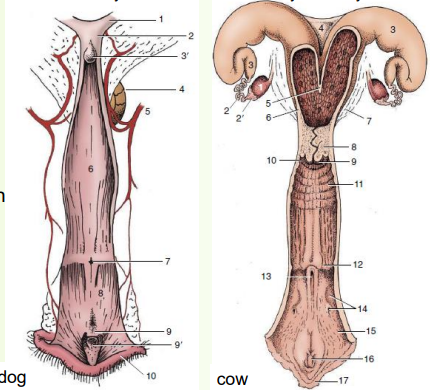
» Urethral opening – features nearby can complicate bladder catheterisation

• E.g. suburethral diverticulum in pig and cow

• E.g. flanked by two grooves in dog

» Vestibular glands

• Varies - small and numerous openings in dogs, large bilateral (on both sides) glandular mass each drained by single duct in cows

• Lubricate vestibule during copulation and parturition (birth)
<p>» Urethral opening – features nearby can complicate bladder catheterisation</p><p>• E.g. suburethral diverticulum in pig and cow</p><p>• E.g. flanked by two grooves in dog</p><p></p><p>» Vestibular glands</p><p>• Varies - small and numerous openings in dogs, large bilateral (on both sides) glandular mass each drained by single duct in cows</p><p>• Lubricate vestibule during copulation and parturition (birth)</p>
10
New cards
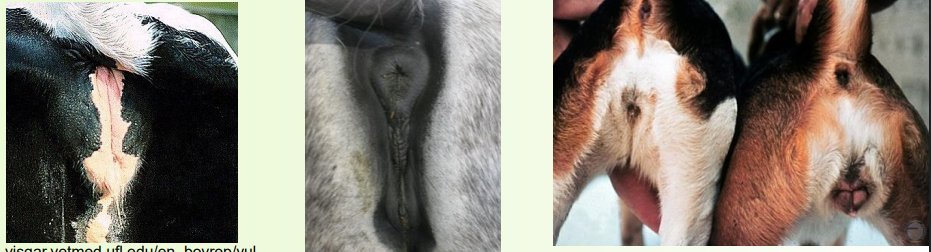
<p>comparing vagigies </p>

comparing vagigies

» Vulva is the external genital opening and tissues

• Labia either side

• Labia meet at dorsal and ventral commissures

• Clitoris, the female homologue of the penis (or vice versa!), lies within ventral commissure, contained within the clitoral fossa
<p>» Vulva is the external genital opening and tissues</p><p>• Labia either side</p><p>• Labia meet at dorsal and ventral commissures</p><p>• Clitoris, the female homologue of the penis (or vice versa!), lies within ventral commissure, contained within the clitoral fossa</p>
11
New cards

ligaments

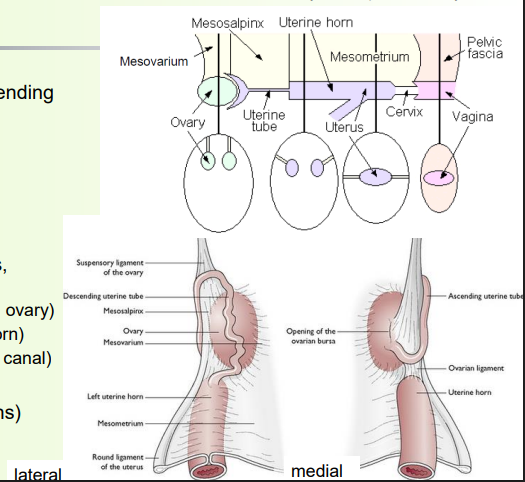
» Broad ligament = folds of peritoneum, suspending tract from dorsal body wall

• Ovary (mesovarium)

• Uterine tube (mesosalpinx)

• Uterine horns and uterus (mesometrium)

• Cervix

» Broad ligament also encloses blood vessels, nerves and some other ligaments

• Suspensory ligament of the ovary (last rib to ovary)

• Ovarian/proper ligament (ovary to uterine horn)

• Round ligament of uterus (uterus to inguinal canal)

» Intercornual ligament (connects uterine horns)

• Well developed in ruminants
<p>» Broad ligament = folds of peritoneum, suspending tract from dorsal body wall</p><p>• Ovary (mesovarium)</p><p>• Uterine tube (mesosalpinx)</p><p>• Uterine horns and uterus (mesometrium)</p><p>• Cervix</p><p></p><p>» Broad ligament also encloses blood vessels, nerves and some other ligaments</p><p>• Suspensory ligament of the ovary (last rib to ovary)</p><p>• Ovarian/proper ligament (ovary to uterine horn)</p><p>• Round ligament of uterus (uterus to inguinal canal)</p><p></p><p>» Intercornual ligament (connects uterine horns)</p><p>• Well developed in ruminants</p>
12
New cards

broad ligament

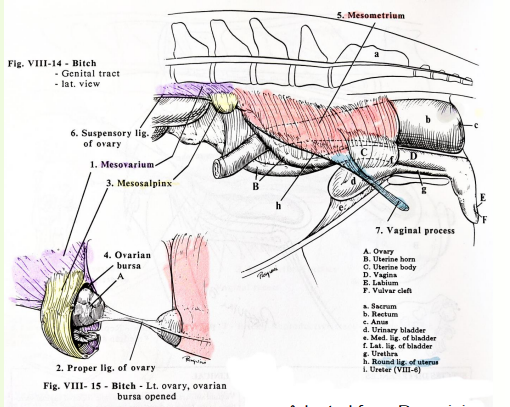
Mesometrium

Mesovarium (and suspensory ligament of ovary)

Mesosalpinx

ovarian bursa = pouch of mesovarium and meosalpinx

Round ligament

Proper ligament
<p>Mesometrium</p><p>Mesovarium (and suspensory ligament of ovary)</p><p>Mesosalpinx</p><p>ovarian bursa = pouch of mesovarium and meosalpinx </p><p>Round ligament</p><p>Proper ligament</p>
13
New cards

ovarian bursa

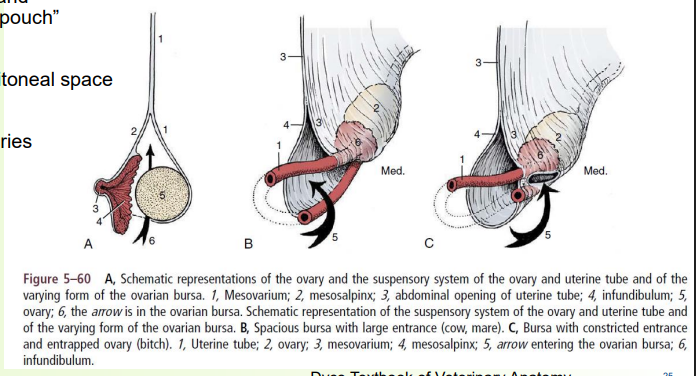
» Folding of mesovarium and mesosalpinx creates a “pouch”

» Communicates with peritoneal space

» Pouch opening width varies

• Species difference

» Can contain fat
<p>» Folding of mesovarium and mesosalpinx creates a “pouch”</p><p>» Communicates with peritoneal space</p><p>» Pouch opening width varies</p><p>• Species difference</p><p>» Can contain fat</p>
14
New cards

blood supply to reproductive tract

1. Ovarian artery

• Direct branch of aorta

• Variably convoluted

2. Internal pudendal arteries

• Supply external genitals

• Branch off to form:

3. Vaginal artery

• Supplies vagina and rectum

4. Uterine artery

• Branch of the vaginal artery

• Anastomoses w/ ovarian and vaginal arteries

» The veins broadly accompany the arteries
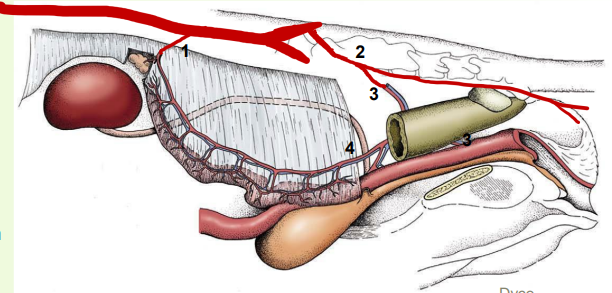
<p>1. Ovarian artery</p><p>• Direct branch of aorta</p><p>• Variably convoluted</p><p></p><p>2. Internal pudendal arteries</p><p>• Supply external genitals</p><p>• Branch off to form:</p><p></p><p>3. Vaginal artery</p><p>• Supplies vagina and rectum</p><p></p><p>4. Uterine artery</p><p>• Branch of the vaginal artery</p><p>• Anastomoses w/ ovarian and vaginal arteries</p><p>» The veins broadly accompany the arteries</p>