Pelvis and Pelvic Wall
 View linked note
 Call Kai
 Learn
Learn Practice Test
 Spaced Repetition
 Match
Match Flashcards
 Knowt Play
1/49

Earn XP
Description and Tags
These flashcards cover key terminology and concepts related to the pelvis and pelvic wall, as discussed in the lecture notes.
Name | Mastery | Learn | Test | Matching | Spaced | Call with Kai |
|---|
No analytics yet
Send a link to your students to track their progress
50 Terms
Pelvic inlet
The boundary between the greater pelvis and lesser pelvis.
Pelvic floor
A fibromuscular structure that separates the pelvic cavity above from the perineum below.
False pelvis
The portion of the pelvis located superior to the pelvic inlet, containing the distal part of the intestines.
True pelvis
The portion of the pelvis located between the pelvic inlet and outlet, including the pelvic cavity.
Sacroiliac joint
Joint connecting the sacrum and ilium, stabilized by anterior, posterior, and interosseous sacroiliac ligaments.
Pubic symphysis
The joint where the two pubic bones meet, allowing minimal movement except during pregnancy.
Levator ani
A group of muscles forming the pelvic diaphragm, important for maintaining fecal continence.
Coccygeus muscle
A small triangular muscle that supports the pelvic viscera and flexes the coccyx.
Obturator internus
A fan-shaped muscle originating around the obturator foramen, leaving the pelvis through the lesser sciatic foramen.
Piriformis
A muscle originating between the anterior sacral foramina, leaving the pelvis through the greater sciatic foramen.
Ischium
The posteroinferior part of the hip bone.
Acetabulum
The articulation point where the ilium, ischium, and pubis meet, forming the hip joint.
Sacrotuberous ligament
A ligament that stabilizes the sacrum on the pelvic bones and converts sciatic notches into foramina.
Pubic arch
The structure formed by the inferior aspects of the pubic bones, which has a different angle in males and females.
Ischial tuberosity
A bony prominence on the ischium that serves as an attachment point for muscles and ligaments.
perineum
inferior to floor of cavity as it forms outlet
pelvic inlet boundaries
are defined by the arcuate line, the pectineal line, and the pubic symphysis.
pelvic outlet boundaries
are defined by the sacrum, coccyx, ischial tuberosities, and pubic arch.
false pelvis
is the portion of the pelvis above the pelvic brim, which supports abdominal organs and is not involved in childbirth.
true pelvis
the portion of the pelvis below the pelvic brim, containing the pelvic cavity and related structures important for childbirth and the passage of the fetus.
pelvic gurdle
ilium, ischium, and pubis that form the hip bones.
pelvic spine
sacrum and coccyx
acetabulum
the cup-shaped socket in the hip bone that receives the head of the femur, allowing for joint mobility.
arcuate line
the boundary between the greater and lesser pelvis.
below is true above is false
ilium has 4 protrusions
anterior superior iliac spine
anterior inferior iliac spine
posterior superior iliac spine
posterior inferior iliac spine
greater sciatic foramen
7 nerves 3 pairs of vessels and 1 muscle
ischium
a bone that forms the lower part of the pelvis and contributes to the hip joint.
lesser sciatic notch
anterior of lesser sciatic foramen
passage for pudundal nerves and vessels to obturator internes
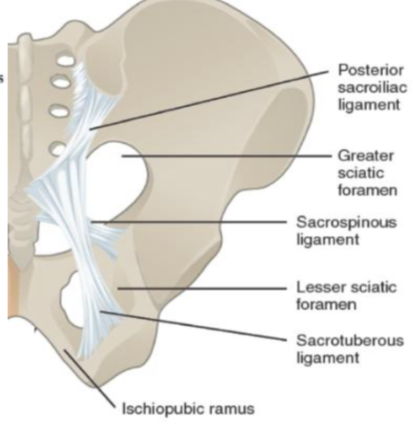
sacrotuberours and sacrospinal ligaments
ligaments that connect the sacrum to the ischial tuberosity and spine, respectively, providing pelvic stability.
pubis
small body ahh bone with two rami
articulate at symphysis pubis
sacrum
5 fused sacral bones forming the posterior part of the pelvis, connecting the spine to the iliac bones.
joints of sacrum
lumbosacral joint
sacroiliac joint
sacrococcygeal joint
pubic symphysis
muscles of hips
obturator internus
piriformis
obturator internus
fan shaped muscle originating from the arch of a the obturator foramen and leaving through lesser sciatic foramen
pisiforms
between anterior sacral foramina leaving through the greater sciatic foramen
male pelvis
heart inlet
acute arch angle
more sacral concavity
narrow ischial spine projection
female pelvis
oval inlet
obtuse arch angle
less sacral concavity
wide ischial spine projection
pelvic floor
structure of muscles and fascia that support pelvic organs such as the bladder and uterus.
pelvic diaphragm
made of levator ani and coccygeus muscles and fascia
two gaps in pelvic floor
urogenital hiatus and rectal hiatus
perineal body
fibrous node connecting pelvic floor to perineum
levator ani muscles
pubococcygeus, puborectalis and iliococcygeus
puborectalis
a muscle of the levator ani that forms a sling around the rectum, helping to maintain fecal continence.
pubococcygeus
a muscle of the levator ani that supports pelvic organs and contributes to pelvic floor strength.
iliococcygeus
a muscle of the levator ani that helps support pelvic organs and maintain pelvic floor integrity.
coccygeus muscle
posterior to levator ani group
from ischial spines to inferior sacrum
supports pelvic viscera and flexes coccyx
innervated by S45
levator ani innervations
all are pudundal nerve innervations