Full coverage restorations principles, materials and preparation philosophies
 Studied by 0 people
 Call Kai
 Learn
Learn Practice Test
 Spaced Repetition
 Match
Match Flashcards
 Knowt Play
1/50

There's no tags or description
Looks like no tags are added yet.
Name | Mastery | Learn | Test | Matching | Spaced | Call with Kai |
|---|
No analytics yet
Send a link to your students to track their progress
51 Terms
What are the 5 principles of tooth preparation?
in addition to aesthetics as well
Preservation of tooth structure
Retention and resistance
Preservation of periodontium
Marginal integrity - no gaps
Structure durability - strength of tooth and restoration e.g amalgam resto is at least 2mm
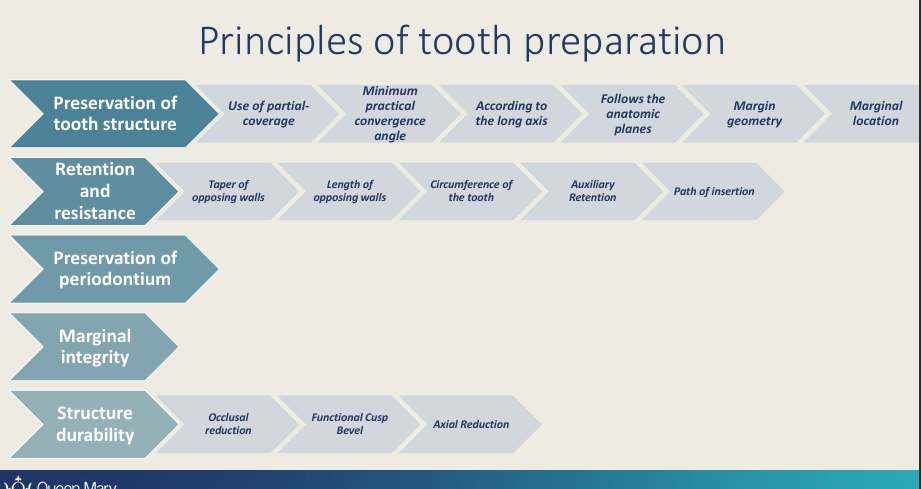
6 principles of preservation of tooth structure?
Partial coverage rather than full coverage - full coverage removes more of the tooth tissue
Minimal convergence angle - (better to do parallel than convergence but convergence is needed for retention and resistance so kept minimal)
Follow anatomical contour/planes - cusp and grooves in tooth so follow the contour as some areas may need more tx removal e.g cusp than others
Margin geometry - shoulder - thicker so more tooth tx removed - minimum thickness depends on the material e.g 0.5 mm using chamfer for metal ceramic which is less invasive compared to a ceramic
Margin location - the finishing line is in a specific area, the deeper/closer to the gingiva - you are removing more tooth tissue (some situations the margin is sub or supra gingival)
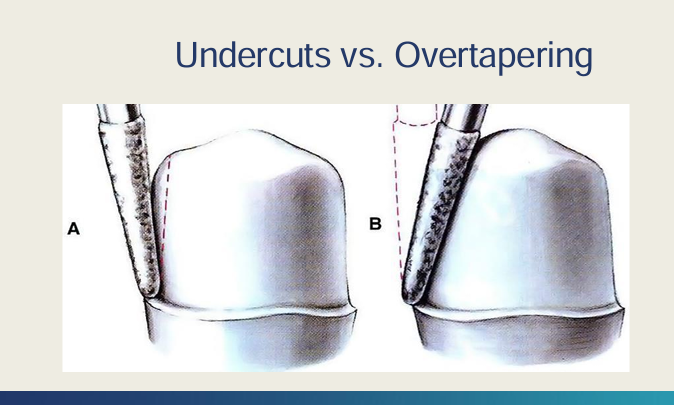
According to the long axis of the tooth - when preparing with a bur to prevent over tapering and undercut formation which would both lead to more tissue removal
over preparing - closer to pulp may cause irritation, could cause damage to pulp that later would require RCT, exposing more dentine - sensitivity, tooth become sweaker
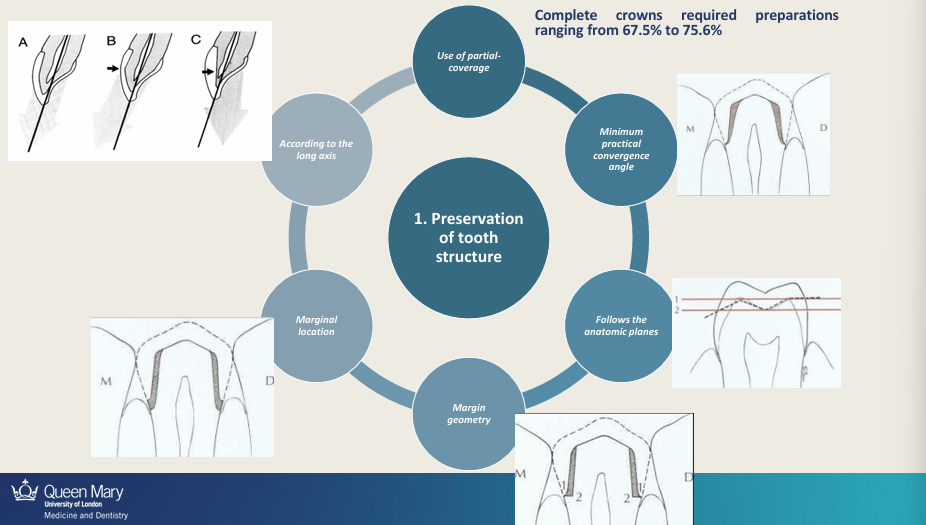
5 things included in retention and resistance?

What is the path of insertion?
What is is determined by? (1)
Affected by? (2)
What is it essential for?
The direction in which the crown is placed and removed
Determined by the long axis of the tooth (Preservation of tooth)
Affected by the taper and axial wall alignment
Essential for proper seating and retention
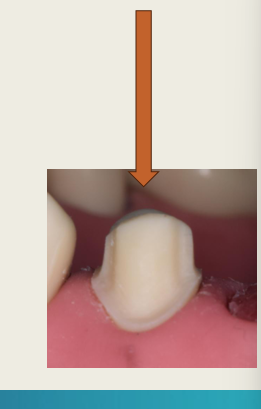
What is the Taper and Convergence angle?
Angulation between the long axis and the walls is the taper
Buccal and lingual come together to give a convergence angle of 6-10 degrees (more taper you loose the retention)
*you hold the bur according to the long axis - as the bur has the taper that you need built into it
Describe:
Length of opposing walls
Auxiliary retention
Circumference of the tooth
Length of opposing walls - if tooth is too short - less surface area for friction, can easily dislodge the crown - Don’t shorten the tooth, also if you have a margin that is higher so might need to drop the margin to make tooth longer: [Occlusal reduction and margin location]
Circumference of the tooth - Keep the shape of the tooth, premolar is ovoid don’t make circular - want to keep line angles and keep shape of tooth, otherwise the resistance form is weak - could build up tooth if pt has a crown that keeps falling - might adjust the axial walls and make them more parallel or add grooves (auxiliary retention)
Auxiliary retention - defining one path of insertion
![<ul><li><p><strong>Length of opposing walls </strong>- if tooth is too short - less surface area for friction, can easily dislodge the crown - Don’t shorten the tooth, also if you have a margin that is higher so might need to drop the margin to make tooth longer: [Occlusal reduction and margin location]</p></li><li><p><strong>Circumference of the tooth </strong>- Keep the shape of the tooth, premolar is ovoid don’t make circular - want to keep line angles and keep shape of tooth, otherwise the resistance form is weak - could build up tooth if pt has a crown that keeps falling - might adjust the axial walls and make them more parallel or add grooves (auxiliary retention)</p></li><li><p><strong>Auxiliary retention </strong>- defining one path of insertion</p></li></ul><p></p>](https://knowt-user-attachments.s3.amazonaws.com/6e07624a-3894-4115-924e-ea24a85366c6.png)
What is an undercut, do we want an undercut?
An undercut is defined as divergence between opposing axial walls in a cervical-occlusal direction
Crown won’t sit
unfavourable
when you make a temp crown and try to take it off, it will fracture
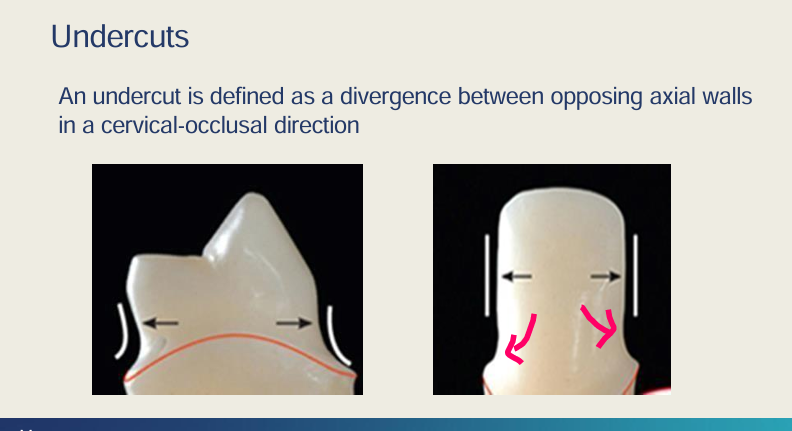
How are undercuts made?
Hold bur parallel
over-taper - less retention and loss of tissue (buccal wall could expose the pulp in anterior and premolars)
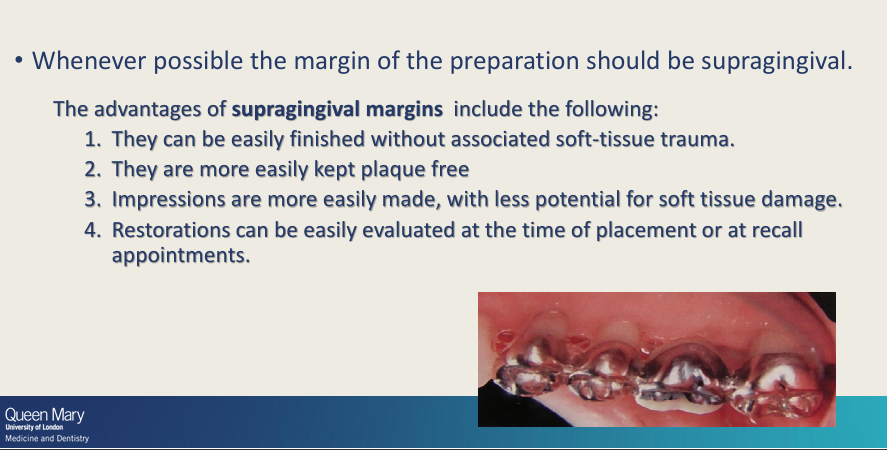
Preservation of periodontium - Wherever possible, the margin of the preparation should be where?
[Supragingival]
Preservation of tooth structure as you are preparing less from the tooth
Adv of supragingival margins?
Can be easily finished without associated soft-tissue trauma
more easily kept plaque free
impressions are more easy to take
restorations can be easily evaluated at the time of placement or at recall appointments
(better visibility when supragingival margin)
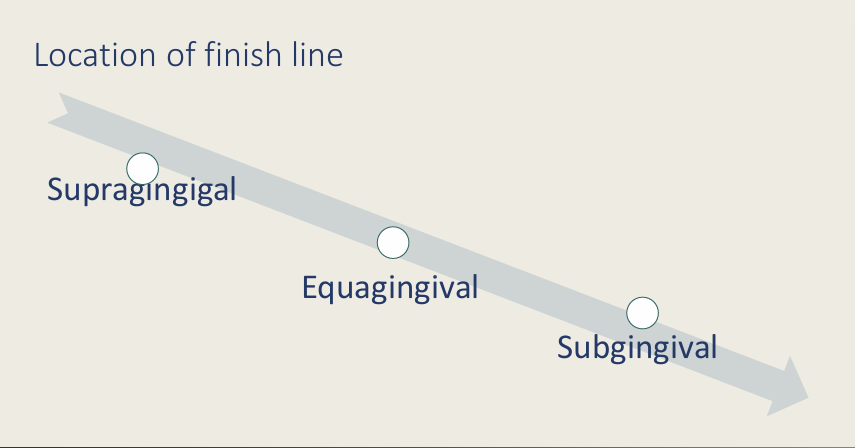
Where can the locations of the finish line be?
Supra gingival
Equa gingival
Sub ginigval (short tooth to increase retention, hide the margin for aesthetics)
within the same tooth, the margin doesn’t have to be sub or supra everywhere - this can vary within the same tooth
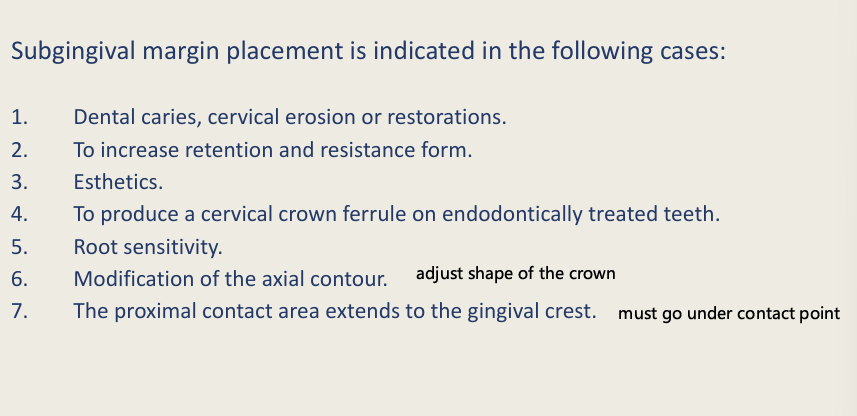
Sub gingival margin placement is indicated in what cases?
Dental caries, cervical erosion or restoration (and you need to reach sound tissue)
To increase retention and resistance form (e.g tooth is too short)
Esthetics
To produce a cervical crown ferrule on endo treated teeth
Root sensitivity
Modification of the axial contour (adjusting shape of the crown)
The proximal contact area extends to the gingival crest (the crown must go under the contact point)
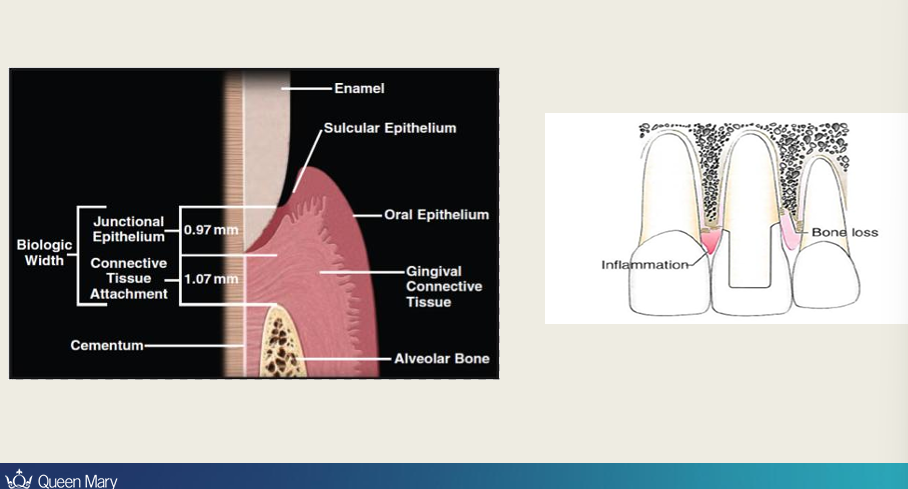
What is the significance of the biological width?
Keep away from the biological width, kept within the depth of the sulcus, any margin going deeper than that would cause inflammation and bone loss damaging the biological width
Can use a retraction cord to get subgingival margin
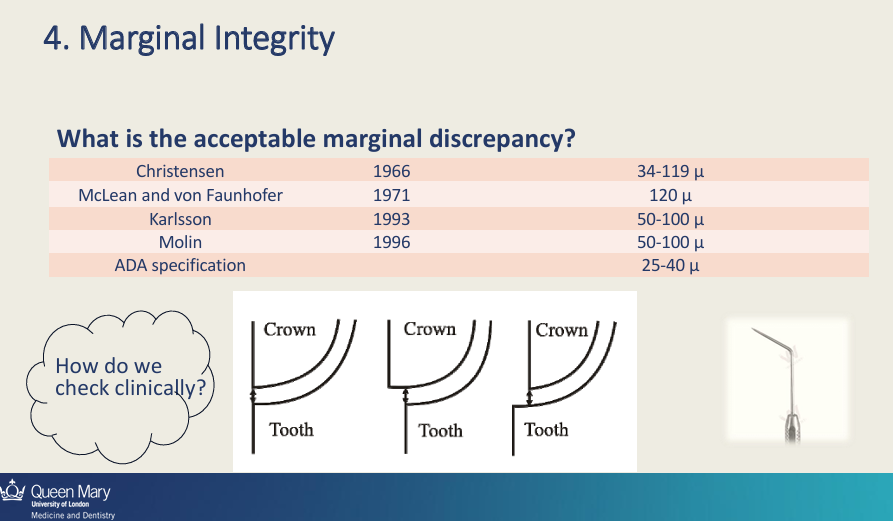
Marginal integrity
Try the crown, assess the fit - the margin of the crown should be well fitting almost perfect - 25-40 microns
cement can be rough, and wear off overtime, gap can be plaque retentive, in an aesthetic area the margin becomes more visible, could affect the gum as well
Can be assessed using a straight probe tip, up and down, tip is around 3 microns as well, if the tip get stuck
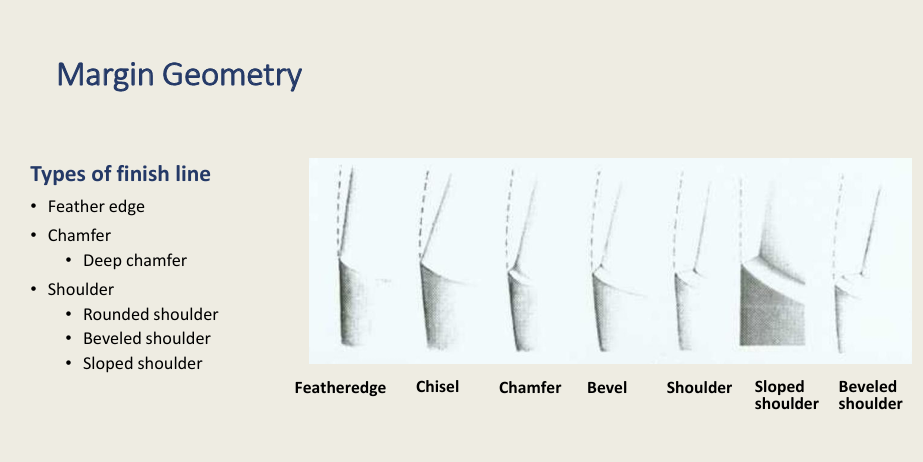
Margin geometry (3)
Finishing line - prepared and unprepared junction
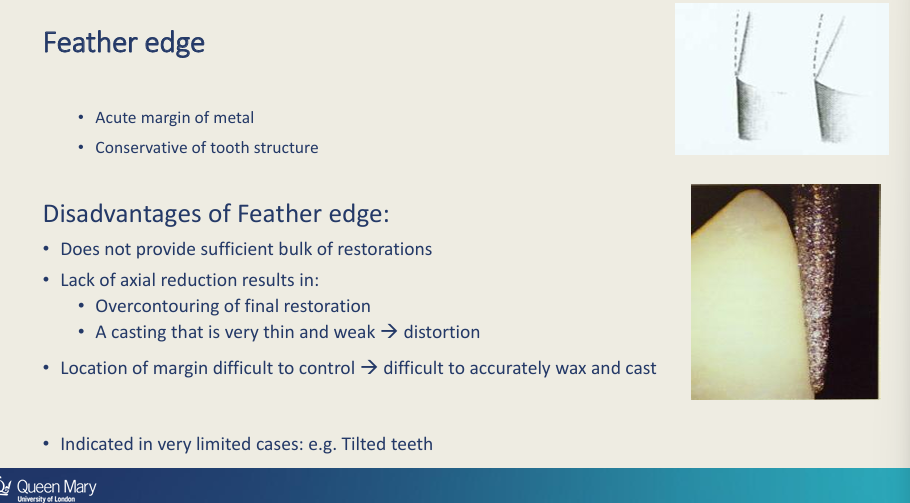
Feather edge - very thin edge
Chamfer
Shoulder
Feather edge:
Adv
Used with what material?
Dis (3)
what case might you use this?
Conservative of the tooth structure
Acute margin of metal
Dis:
Does not provide sufficient bulk of restoration
Lack of axial reduction results in:
- over contouring of final restoration
-A casting that is very thin and weak that can easily distort on occlusal loading
Location of the margin difficult to control - difficult to accurately wax and cast
Tilted teeth
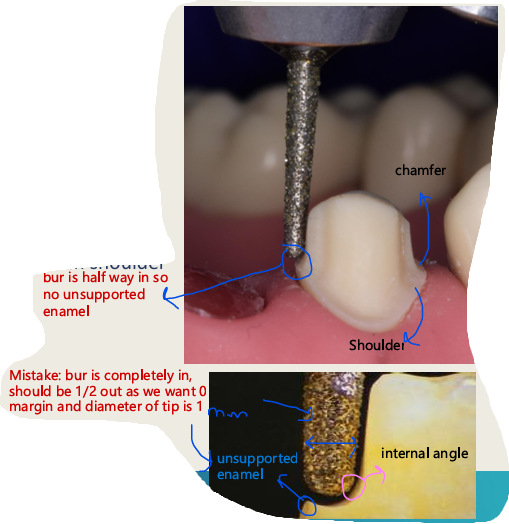
Chamfer finishing line:
The cavo-surface angle surface?
Internal angle?
Thickness of the finishing line and bur tip so how should you hold bur?
Tapered and rounded at the end, with 1 mm diameter so hold the bur tip half way in to not create a curve which results in unsupported enamel
90 degrees
Rounded internal angle
Avg - 0.5 mm (0.3-0.7mm)
Adv of using chamfer? (5)
Conservative type compared to shoulder finish line
Distinct margin (unlike the feather edge, lab will guess ending of the preparation)
Adequate bulk
Easier to control
Exhibit least stress to the underlying cement
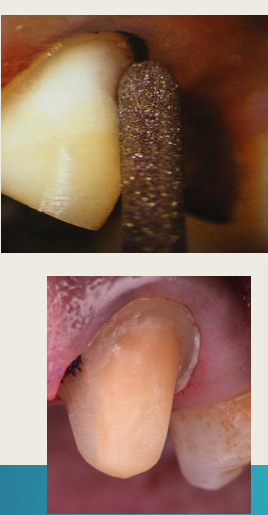
What is the heavy chamfer?
Thicker bur (large-radius rounded internal angle) giving 1-1.2 mm thickness
Same as chamfer - 90 degree cavosurface angle
Adv of heavy chamfer? (2)
provides sufficient bulk for a ceramic crown
Support of the ceramic with a stress reducing
Dis of heavy chamfer?
It can create a lip of enamel at the cavosurface
Less conservative of tooth structre
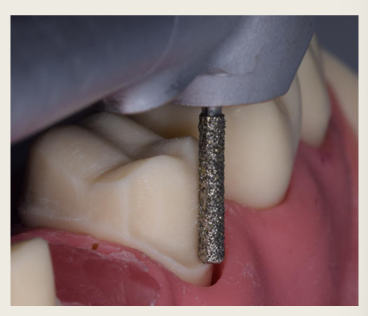
Shoulder:
Angle at cavosurface and internal angle?
depth?
shape of the bur?
90 degrees
1.0-1.2 mm
prepared with a flat ended bur
Dis of Shoulder? (4)
Stress concentration at the 90 degrees internal line angle
Les conservative of tooth structure
Not for all metal restos
Not for all ceramic restos
What is a shoulder finishing line used for?
Facial of PFM crowns
Metal inlays/onlays
Rounded shoulder?
internal angle?
cavoangle?
depth?
Small rounded internal angle, 90 degrees, 1.0-1.2 mm (flat bur)
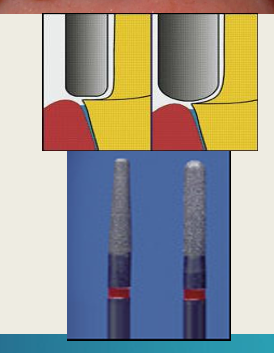
ID which bur it is?
Left: rounded shoulder (flat)
Right - heavy chamfer (rounded tip)
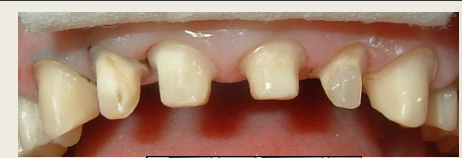
adv of rounded shoulder? (3)
dis (1)
Less stress than conventional shoulder (internal angle)
Good support for all ceramic crowns
Wide ledge provides resistance to occlusal forces
less conservative of tooth structure
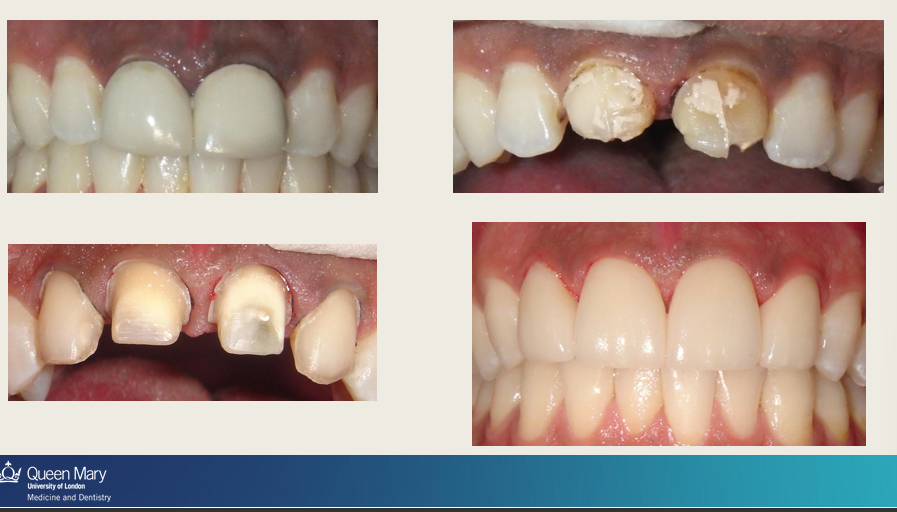
What is the problem?
Marginal fit not great so catching with probe as lab overbuilt crown due to no distinct margin, overbuilt crown - plaque retentive - inflammation of gingiva

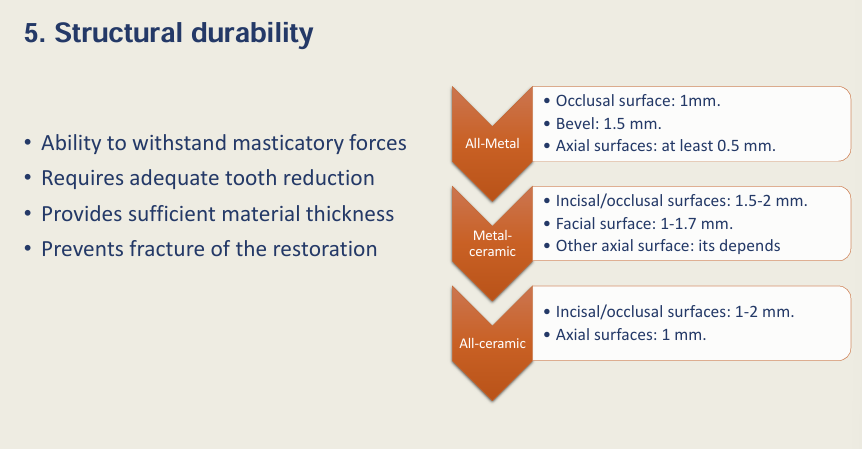
Structural durability:
Why is it important? (4)
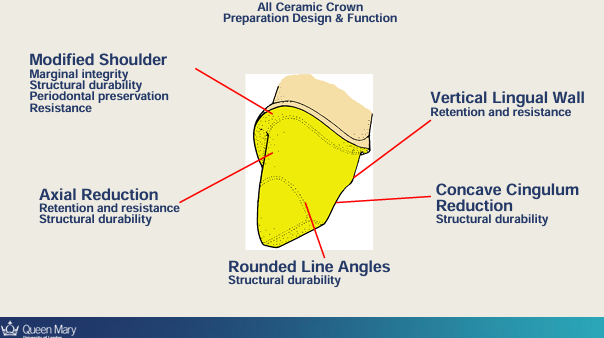
Required adequate tooth reduction
Provide sufficient material thickness
Prevents fractures of the restoration
Ability to withstand masticatory forces
Sharp edges/line angles need to be what?
Smoothened and rounded
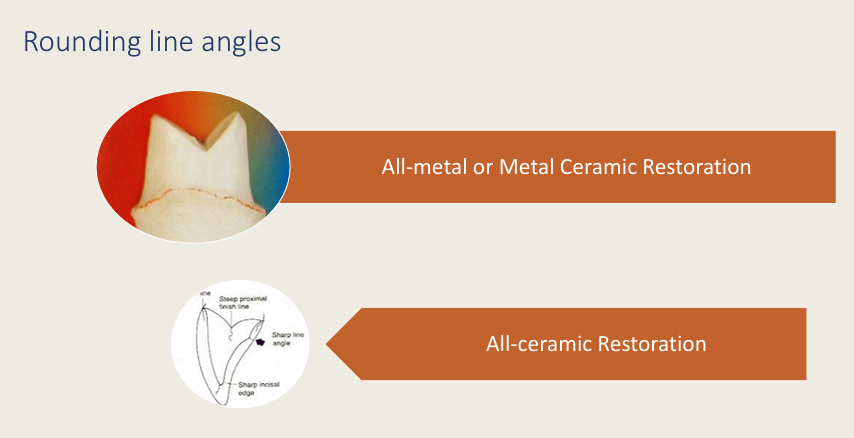
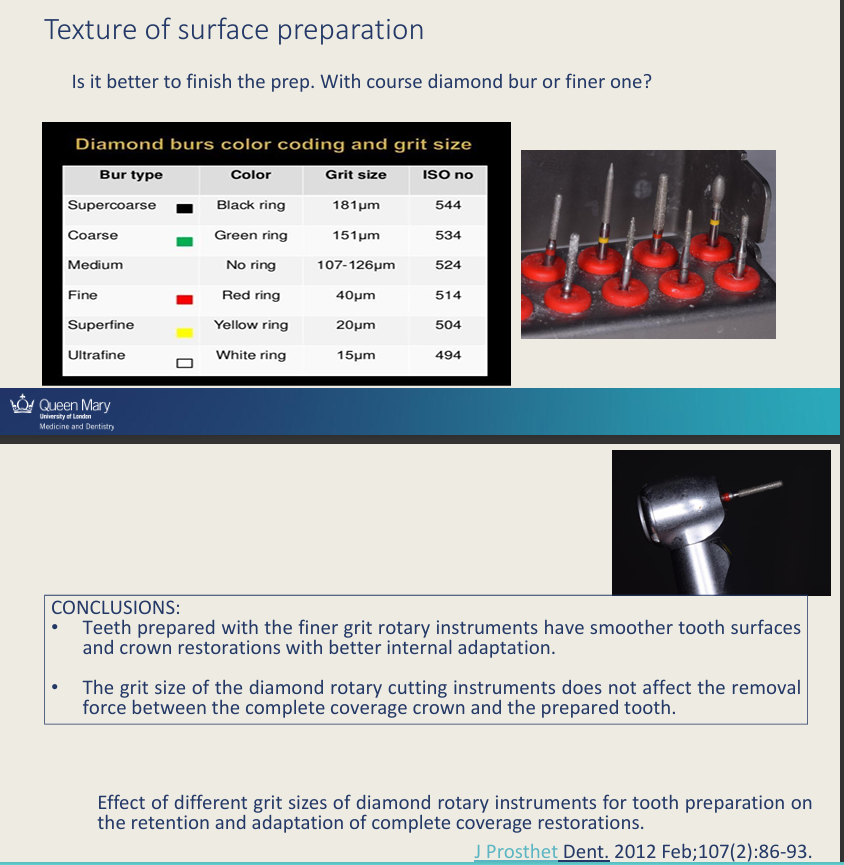
What do you do to the preparation after?
Red - smoothening the preparation - allows for better seating
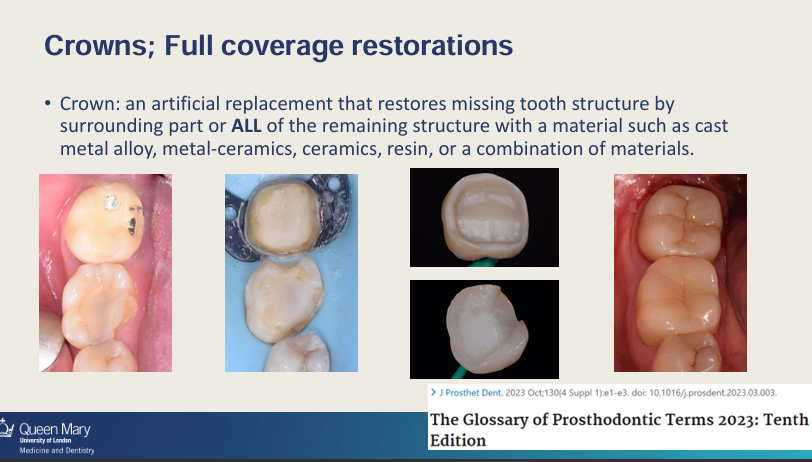
What is a crown?
An artificial replacement that restores missing tooth structure by surrounding part or all of the remaining structure with a material such as cast metal alloy, metal-ceramics, ceramics, resin, or a combination of materials
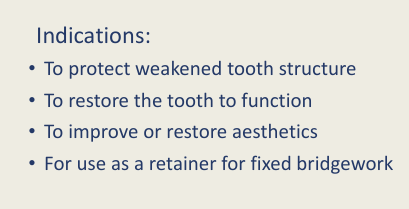
Indications for a full coverage restoration? (4)
protect weak
to function (wear)
aesthetics
bridge
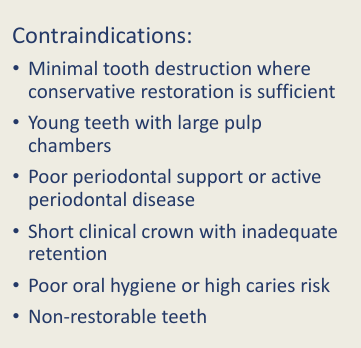
Contraindication of full coverage restoration (6)
partial coverage is possible
young teeth
perio support (stabilise before)
short clinical crown
poor OH
non restorable
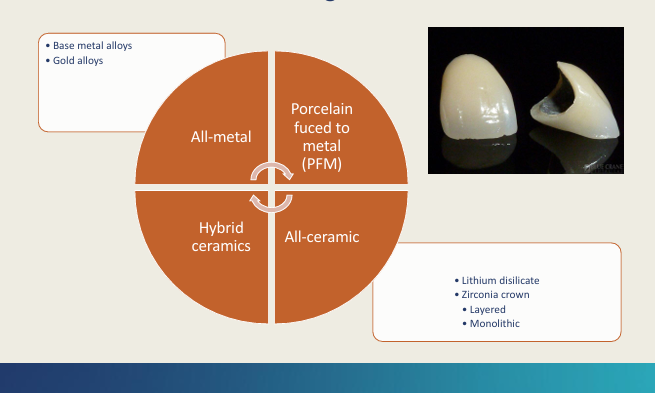
Material chouse for full coverage restoration? (4)
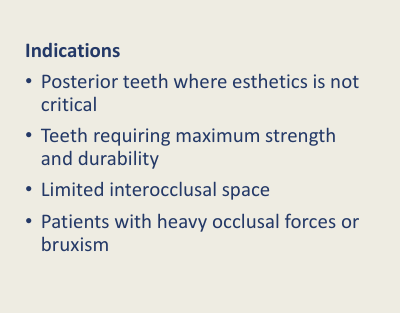
Indications for All-metal crown? (4)
Aesthetic not a concern
Limited interocclusal space (remember how it can be used with the feather edge)
teeth requiring maximum strength
heavy occlusal forces or bruxism
bruxism - ceramic can chip off
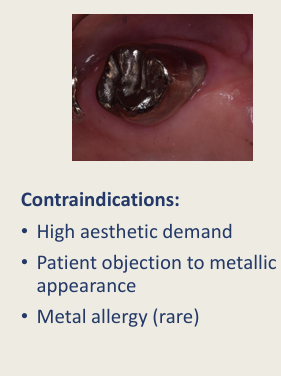
Contraindications of all-metal crowns? (2
aesthetics
metal allergy
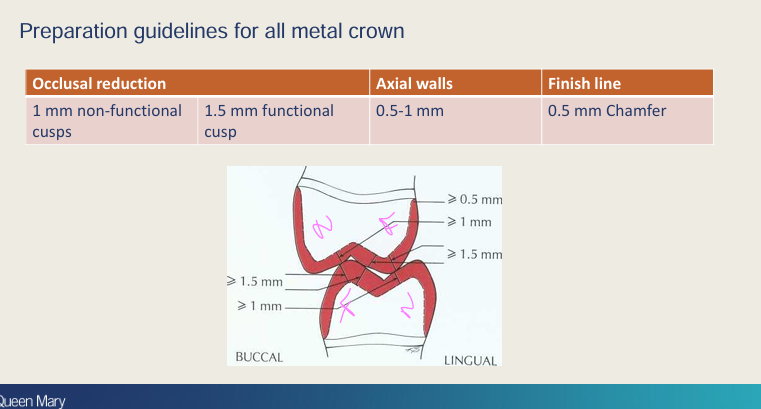
All metal crown:
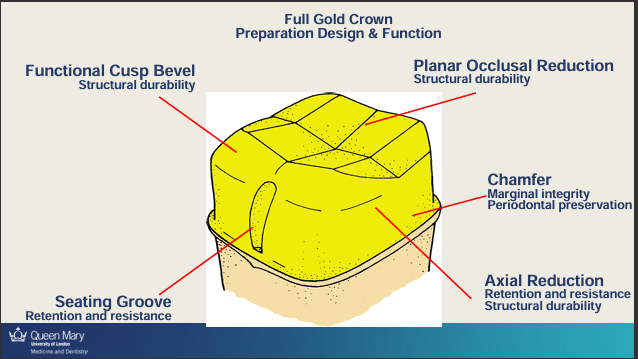
Occlusal reductions
axial walls
finish line
Palatal on the upper is functional - it is occluding on both sides - greater loads
Also bevel the functional cusp
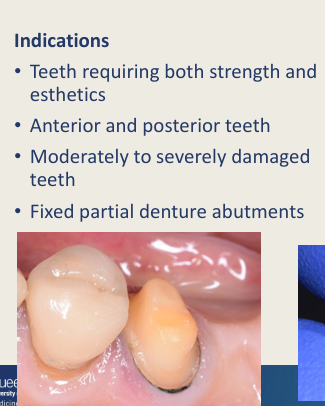
Indications of PFM crowns (4)
Strength + aesthetics
Ant and post teeth (all metal for posterior)
Moderately to severely damaged teeth
fixed partial denture abutments
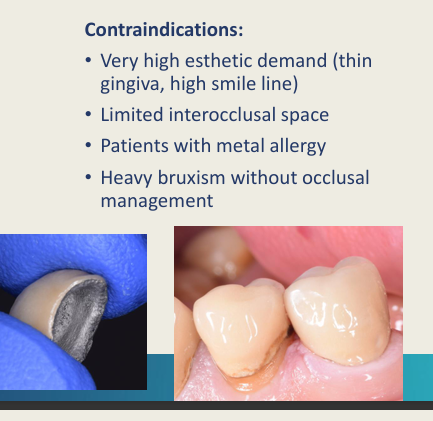
Contraindications of PFM? (4)
very high aesthetics demands
limited interocclusal space
metal allergy
heavy bruxism without occlusal management
Ceramic covering metal - metal on the inside - reduced translucency overall but still more aesthetic
thinner ceramic on the cervical area - high smile line - metal starts to show through more
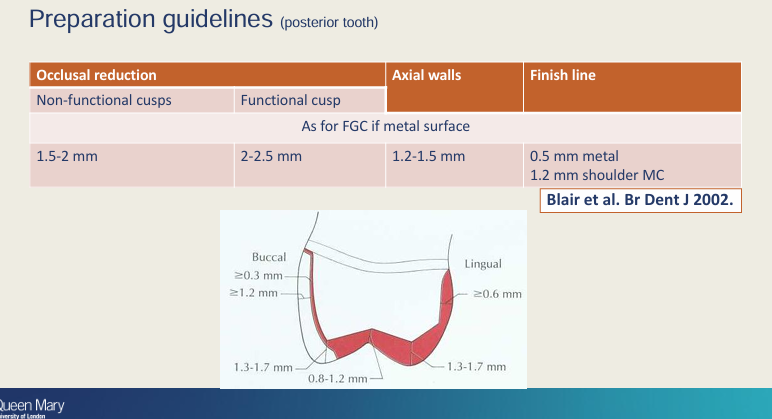
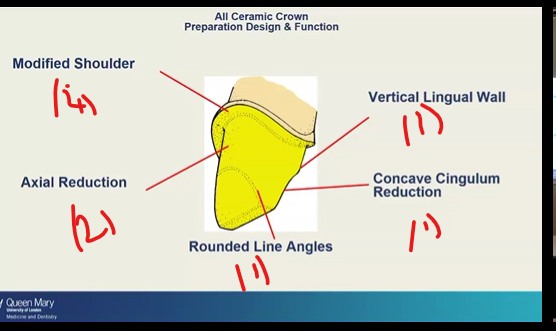
Preparation of posterior teeth for PFM crown?
Occlusal reduction
Axial walls
Finish line?
more tooth removed to create more space
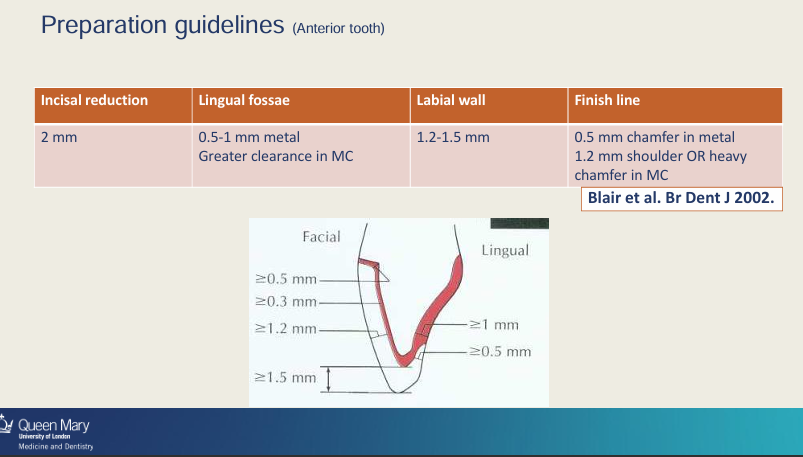
Preparation of anterioir teeth for PFM crown?
ceramic is not covering the whole crown, just the labial and incisor aspect
don’t prepare palatal because aesthetic not a concern unless pt insists - more conservative
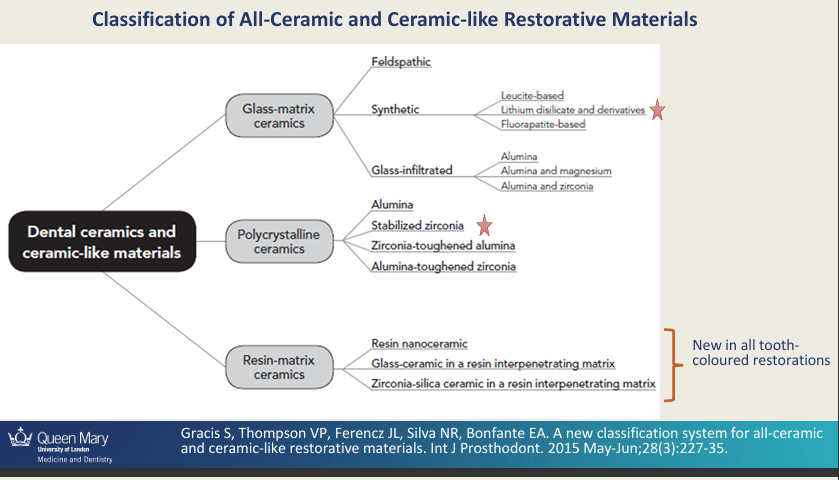
Classification of all-ceramic material
3rd = hybrid
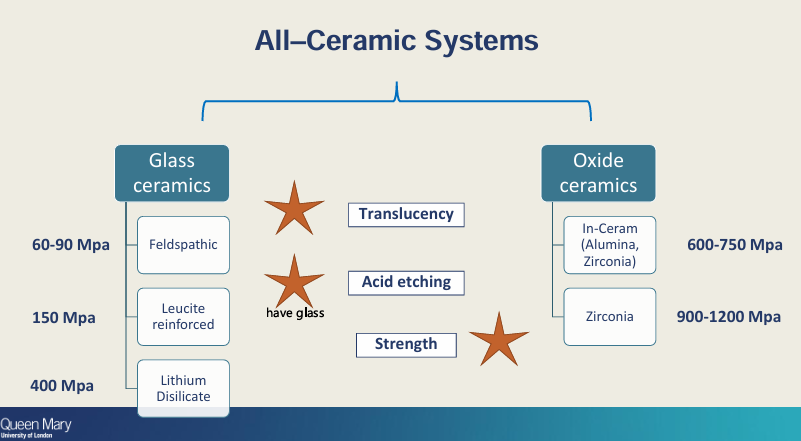
Glass ceramics vs oxide ceramics (3 properties)
better translucent and acid etching in glass ceramics
better strength in oxide ceramics - close to metals
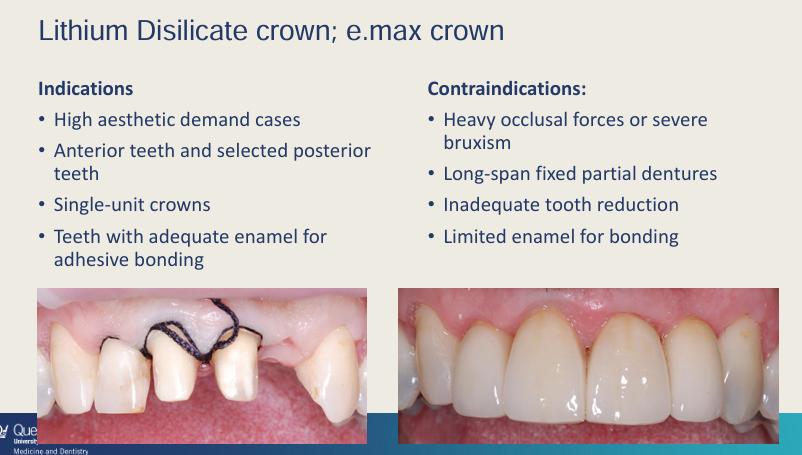
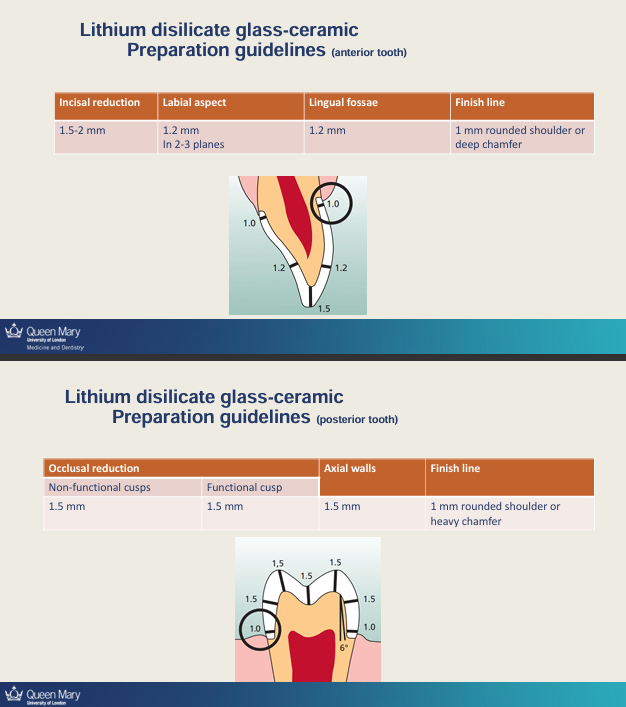
Lithium disilicate crown, e max crown indications (4) and contraindications (4)
Preparation for posterior and anterioir tooth
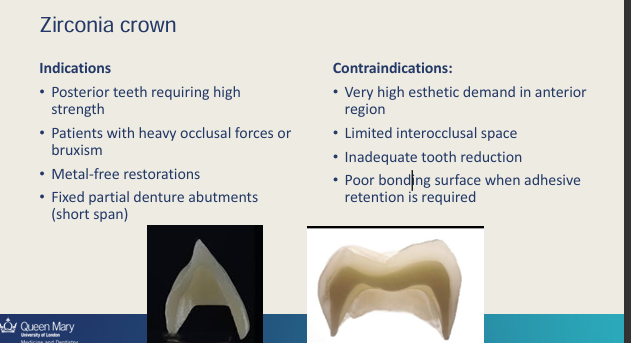
indications and contraindications for zirconia crown ()
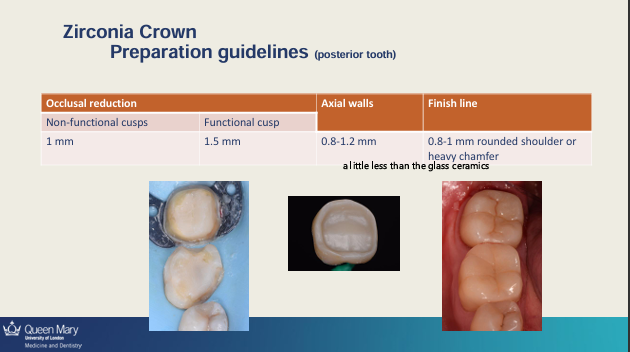
zirconia posterior preparation
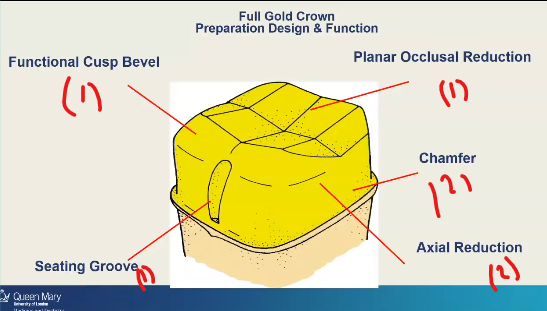
could include other principles like tooth preservation
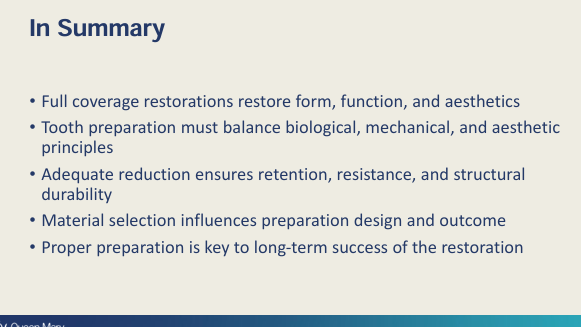
If you find the temporary crown very thin, then this means you have not provided enough thickness for durability of the crown
 Note
Note  Flashcards (46)