physics electricity- only up to iv characteristics graphs
 Call Kai
 Learn
Learn Practice Test
 Spaced Repetition
 Match
Match Flashcards
 Knowt Play
1/29

There's no tags or description
Looks like no tags are added yet.
Name | Mastery | Learn | Test | Matching | Spaced | Call with Kai |
|---|
No analytics yet
Send a link to your students to track their progress
30 Terms
what is an ion
a charged atom that has a different number of protons and electrons. they can be positively or negatively charged.
atoms
they have the same number of protons and electrons and are neutrally charged.
what is charge
a property of matter (just like mass), objects can be positively, negatively charged or neutral.
like charges ,
opposite charges
like charges repel
opposite charges attract
electric field
a region in which a charged object experiences a force.
what are electric field lines?
arrows that show the electric field around an object
what would a diagram of the electrical field lines around a positive particle look like?
the arrows are perpendicular to the surface of the particle
the arrows point away form the particle

what would a diagram of the electrical field lines around a negative particle look like?
the arrows are perpendicular to the surface of the particle
the arrows point towards form the particle

what would a diagram of the electrical field lines between a positive and a negative particle look like?
arrows point form positive to negative

what would a diagram of the electrical field lines between a two of the same charged particles look like?
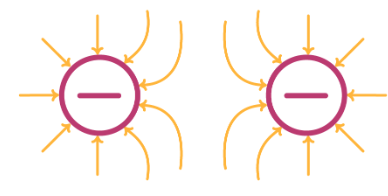
rules for drawing field line diagrams
arrows always point toward a negative charge/ away from a positive charge
field lines never cross
the closer the field lines are the stronger the field around the object is.
if an object electrons it becomes positively charged.
if an object electrons it becomes negatively charged.
if an object loses electrons it becomes positively charged.
if an object gains electrons it becomes negatively charged.
static charge
the charge that an object acquires due to the transfer of electrons (NOT the protons/neutrons)
if an object has more electrons than protons, what is its charge?
it is negatively charged
if an object has less electrons than protons, what is its charge?
it is positively charged
what is current
the rate of flow of electrical charge
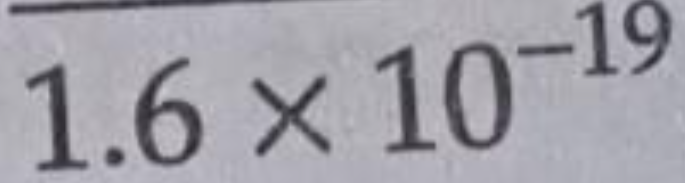
charge of a single electron
how do we measure current
ammeter
resistance of ammeters
ammeters have very low resistance so as to not affect the rate of flow of electrons around the circuit.
where do you put an ammeter to measure current?
in series
current in the circuit
current is the same everywhere in the circuit.
what is potential difference
the energy transferred to the component or the work done on it by each coulomb of charge that passes through it.
how do we measure potential difference
using a voltmeter
where do we put voltmeters in the circuit
in parallel
resistance of voltmeters
voltmeters have a very high resistance
what is resisitance
a measure of how difficult it is for current to flow through a circuit
whats the point of IV graphs
some components have a resistance that changes when the current changes. by plotting the current-potential difference (I-V) graph for a component, you can see how it behaves when the current changes.
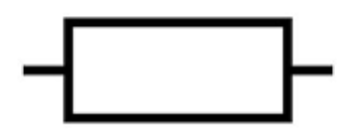
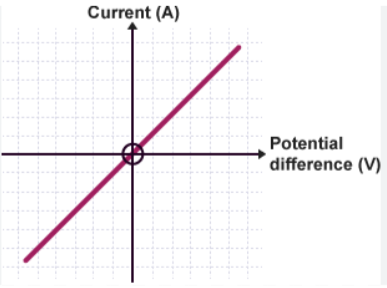
IV graph for a fixed resistor
current is directly proportional to p.d
linear graph
it is an ohmic conductor-
ohms law- ”the current..is directly proportional to p.d across resistor”
has a straight line through the origin

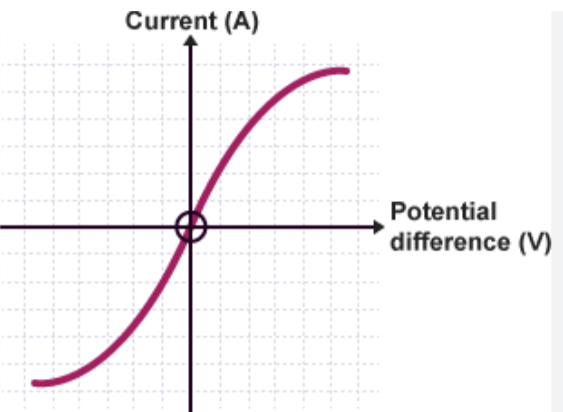
IV graph for a filament lamp
curves away from the y axis
non linear
current is not directly proportional
non ohmic conductor

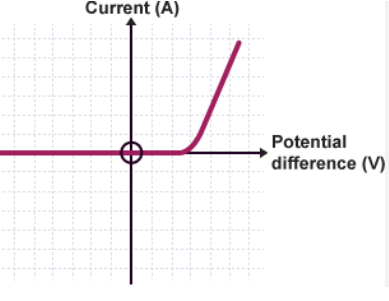
IV graph for a diode
non linear
curves towards y-axis
current is not directly proportional to p.d
non ohmic conductor
in the negative direction, the diode has very high resistance
the current only flows one way through a diode