AHIS Key Works: 1st in-class writing (copy)

0.0(0)
studied byStudied by 1 person
call kaiCall Kai
learnLearn
examPractice Test
spaced repetitionSpaced Repetition
heart puzzleMatch
flashcardsFlashcards
GameKnowt Play
Card Sorting

1/58

flashcard set

Earn XP

Description and Tags

Majesty, Epic Humanity, The Truth of Art, A Usable Architectural Past, Sacred Art, Imperial Space, Chinese Painting

Last updated 7:23 PM on 2/18/26
Name
Mastery
Learn
Test
Matching
Spaced
Call with Kai

No analytics yet

Send a link to your students to track their progress

59 Terms
1
New cards
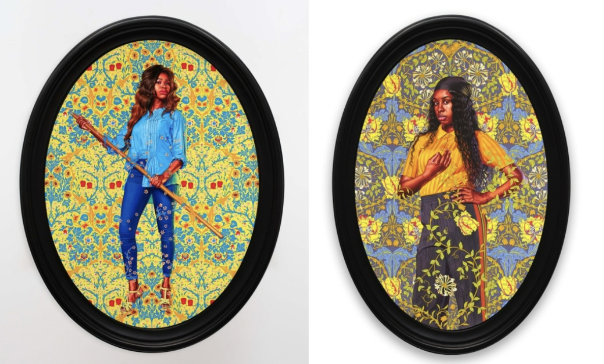
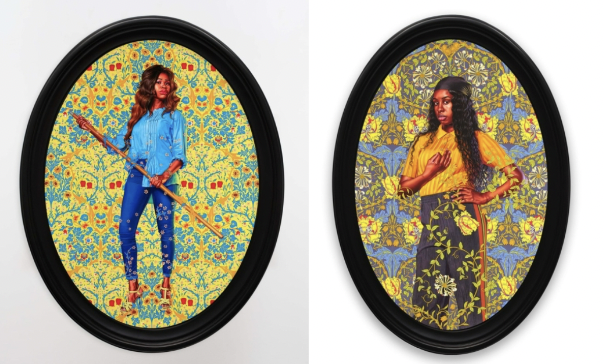
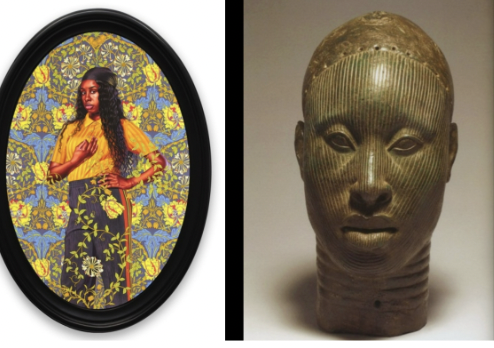
<p>Portrait of Savannah Essah Identifiers</p>

Portrait of Savannah Essah Identifiers

Kehinde wiley, 2020, (mother & daughter), oil paint on canvas
<p>Kehinde wiley, 2020, (mother &amp; daughter), oil paint on canvas</p>
2
New cards
<p>Portrait of Savannah Essah Notes</p>

Portrait of Savannah Essah Notes

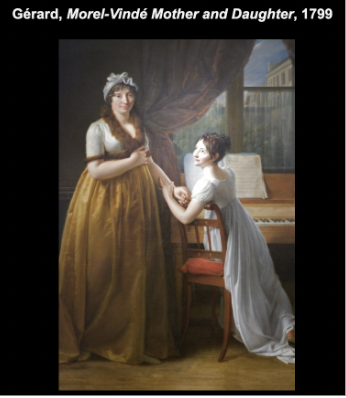
  • Kehinde Wiley: makes real look superficial, we have access to seeing a multitude of surfaces (clothes, face, hair, flowers), the superficial elements look like “real life.”

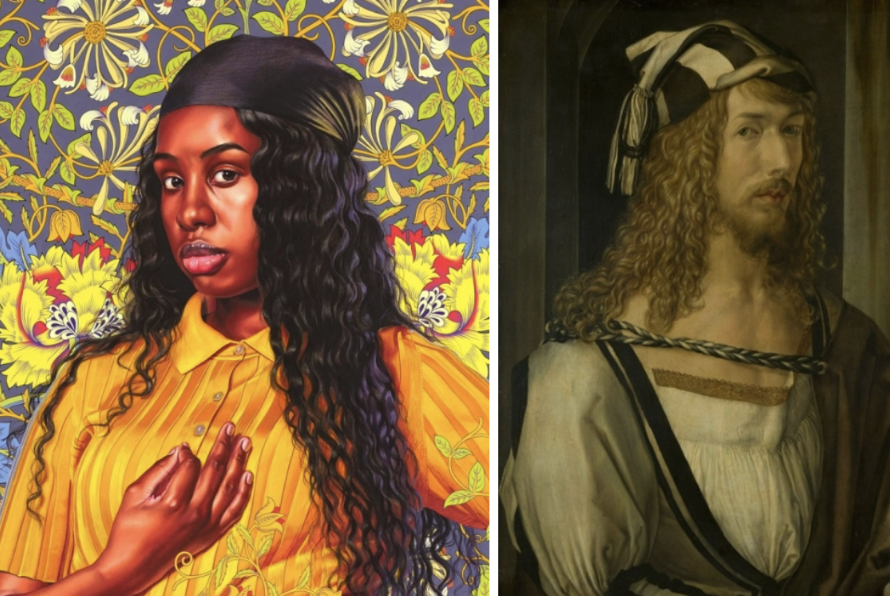
  • Wiley has expansive knowledge of art history, and knows that by having a pair of portraits like this, he is tapping into a tradition of painting 2 people in a familial connection.

    • Quoting Gerard 1739 mohter-daughter dynamic, and Durers Self-Portrait 1498 in the daughter

      • A mother and daughter who have a newly casual relationship, especially regarding the clothes that they wear

    • Point of view: Wiley’s positionshaves the figures in the paintings looking slightly down on us, so that we feel that these people are important and have real presence in the world

    • Through this citation, Wiley is telling us he is the Durer of our time, that he is setting the standard for realism.

    • Background: Background is a remake of the greatest wallpaper ever made: Morris designed wallpaper that instantly became acclaimed for the way in which he adjudicated between the 3D realism of flowers and the 2D usefulness of a flat wall.

      • Morris realized there was a realism dial that he could modulate, rendering a wallpaper that looked both truly flat and floral.

        • Designed a paper with a regular repeat

        • Designed a wallpaper that was very symmetrical (not found in nature)

    • Demonstrating the artist’s ability to combine flatness and realism: the degree of abstraction and realism is within the artist’s arsenal
<ul><li><p><span style="background-color: transparent;"><span>Kehinde Wiley: makes real look superficial, we have access to seeing a multitude of surfaces (clothes, face, hair, flowers), the superficial elements look like “real life.”</span></span></p></li><li><p><span style="background-color: transparent;"><span>Wiley has expansive knowledge of art history, and knows that by having a pair of portraits like this, he is tapping into a tradition of painting 2 people in a familial connection.</span></span></p><ul><li><p>Quoting Gerard 1739 mohter-daughter dynamic, and Durers Self-Portrait 1498 in the daughter</p><ul><li><p><span style="background-color: transparent;"><span>A mother and daughter who have a newly casual relationship, especially regarding the clothes that they wear</span></span></p></li></ul></li><li><p><span style="background-color: transparent;"><strong><span>Point of view:</span></strong><span> Wiley’s positionshaves the figures in the paintings looking slightly down on us, so that we feel that these people are important and have real presence in the world</span></span></p></li><li><p><span style="background-color: transparent;"><span>Through this citation, Wiley is telling us he is the Durer of our time, </span><u><span>that he is setting the standard for realism.</span></u></span></p></li><li><p><span style="background-color: transparent;"><strong><u><span>Background: </span></u></strong><span>Background is a remake of the greatest wallpaper ever made: Morris designed wallpaper that instantly became acclaimed for the way in which he adjudicated between the 3D realism of flowers and the 2D usefulness of a flat wall.</span></span></p><ul><li><p><span style="background-color: transparent;"><span>Morris realized there was a realism dial that he could modulate, rendering a wallpaper that looked both truly flat and floral.</span></span></p><ul><li><p><span style="background-color: transparent;"><span>Designed a paper with a regular repeat</span></span></p></li><li><p><span style="background-color: transparent;"><span>Designed a wallpaper that was very symmetrical (not found in nature)</span></span></p></li></ul></li></ul></li><li><p><span style="background-color: transparent;"><strong><span>Demonstrating the artist’s ability to combine flatness and realism: the degree of abstraction and realism is within the artist’s arsenal</span></strong></span></p></li></ul></li></ul><p></p>
3
New cards
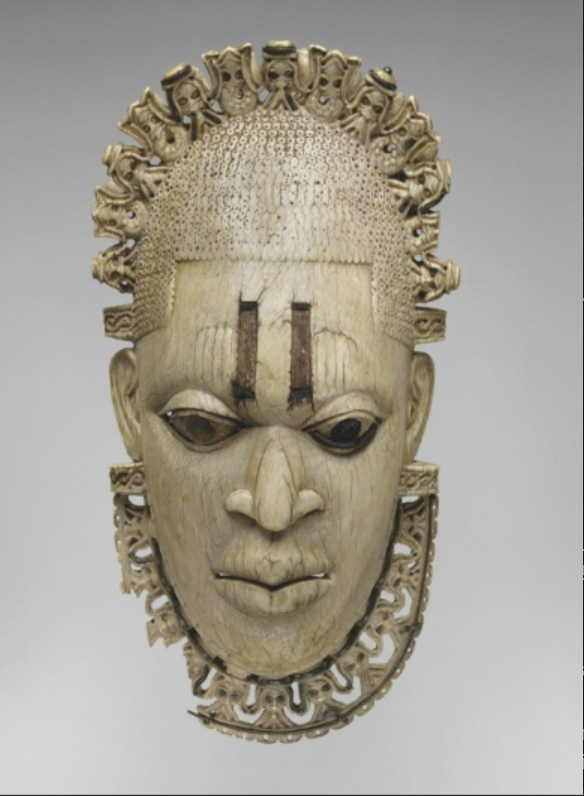
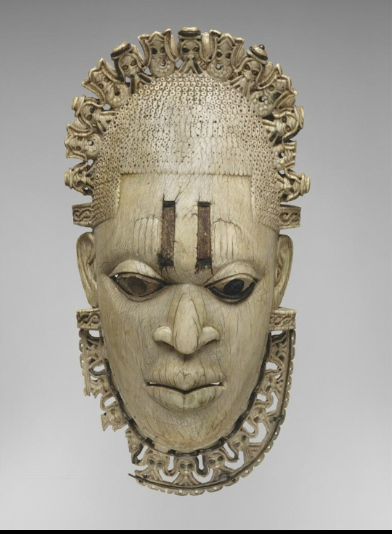
<p>Pendant mask of Iyoba Idia Identifiers</p>

Pendant mask of Iyoba Idia Identifiers

ivory + wood carving guild, 16th century
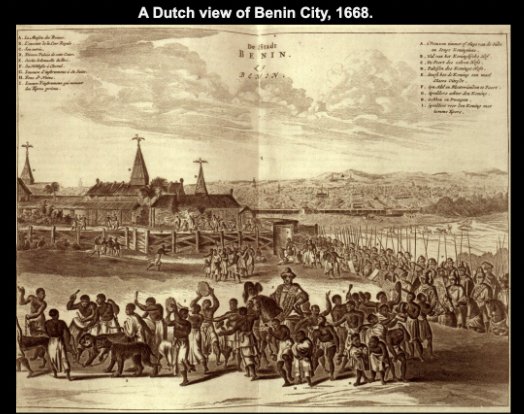
<p>ivory + wood carving guild, 16th century</p>
4
New cards
<p>Pendant mask of Iyoba Idia Notes</p>

Pendant mask of Iyoba Idia Notes

  • Represents a particular, was the queen mother of a king of Benin (called an Oba) called Esigie

    • There is still an Oba in Benin - 40th ruler.

  • Esigie was always leaving home to go and conquer other places and fight abroad. He was able to do so because he had total confidence that his mother could run the kingdom → she was someone who was extraordinary and an exceptional ruler of a very commercially thriving kingdom

    • Worthy of artwork

  • Context: The Kingdom of Benin was involved in the lucrative trade of many sorts, including with Europeans (Dutch)

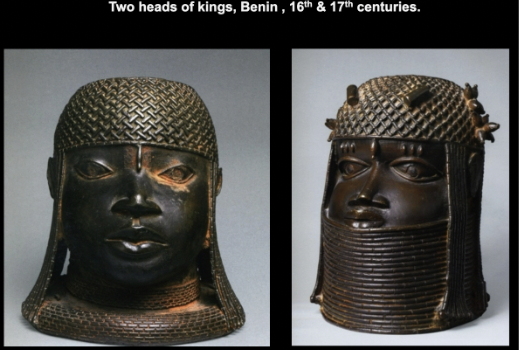
  • Significance: If you take heads of kings of Benin and line them up chronologically → you will see portraits get more and more abstract rather than realistic.

    • Gets rid of the idea that realism is something that is cumulatively acquired

    • Entire people - not just artists - decide where they want the line between realism and abstraction to be

  • Details: Queen Idia has this rough around her neck and a crown that symbolizes the mudfish, that indicate she can oscillate between 2 realms.

  • The mudfish are tussling with European traders

    • Represents what the queen was doing when her son was at war

  • Showing how she controls the land & sea & economy → THE ULTIMATE RULER

  • Crown is surrounding her head as a ring of power, which is why this recognizable queen is acknowledged to wield

  • Compared to Portrait of Savannah Essah: play between abstraction and realism to make them both work

    • A way to demonstrate mastery

<ul><li><p><span style="background-color: transparent;"><span>Represents a particular, was the queen mother of a king of Benin (called an Oba) called </span><strong><span>Esigie</span></strong></span></p><ul><li><p><span style="background-color: transparent;"><span>There is still an Oba in Benin - 40th ruler.</span></span></p></li></ul></li><li><p><span style="background-color: transparent;"><span>Esigie was always leaving home to go and conquer other places and fight abroad. He was able to do so because </span><u><span>he had total confidence that his mother could run the kingdom → she was someone who was extraordinary and an exceptional ruler of a very commercially thriving kingdom</span></u></span></p><ul><li><p><span style="background-color: transparent;"><span>Worthy of artwork</span></span></p></li></ul></li><li><p><strong><em><u>Context: </u></em></strong><span style="background-color: transparent;"><span>The Kingdom of Benin was involved in the lucrative trade of many sorts, including with Europeans (Dutch)</span></span></p></li><li><p><span style="background-color: transparent;"><strong><em><u><span>Significance: </span></u></em></strong><span>If you take heads of kings of Benin and line them up chronologically → you will see portraits get more and more abstract rather than realistic.</span></span></p><ul><li><p><span style="background-color: transparent;"><span>Gets rid of the idea that realism is something that is cumulatively acquired</span></span></p></li><li><p><span style="background-color: transparent;"><span>Entire people - not just artists - decide where they want the line between realism and abstraction to be</span></span></p></li></ul></li><li><p><strong><em><u>Details:</u></em></strong> <span style="background-color: transparent;"><span>Queen Idia has this rough around her neck and a crown that symbolizes the mudfish, that indicate she can oscillate between 2 realms.</span></span></p></li><li><p><span style="background-color: transparent;"><span>The mudfish are tussling with European traders</span></span></p><ul><li><p><span style="background-color: transparent;"><span>Represents what the queen was doing when her son was at war</span></span></p></li></ul></li><li><p><span style="background-color: transparent;"><span>Showing how she controls the land &amp; sea &amp; economy → </span><strong><span>THE ULTIMATE RULER</span></strong></span></p></li></ul><ul><li><p><span style="background-color: transparent;"><strong><span>Crown is surrounding her head as a ring of power, </span></strong><span>which is why this recognizable queen is acknowledged to wield</span></span></p></li><li><p><span style="background-color: transparent;"><strong><span>Compared to Portrait of Savannah Essah: </span></strong><span>play between abstraction and realism to make them both work</span></span></p><ul><li><p><span style="background-color: transparent;"><span>A way to demonstrate mastery</span></span></p></li></ul></li></ul><p></p>
5
New cards
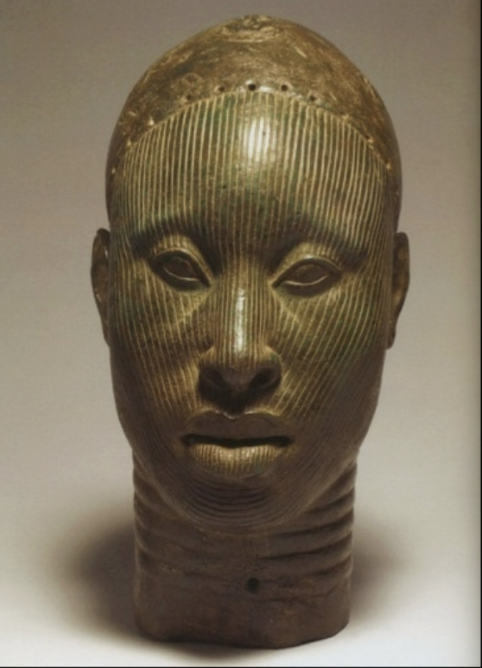
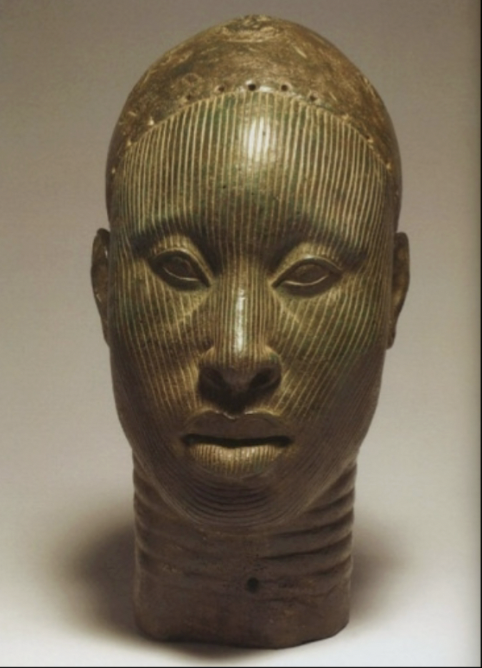
<p>Ife Head Identifiers</p>

Ife Head Identifiers

from Ife (now Nigeria) 14th - early 15th century
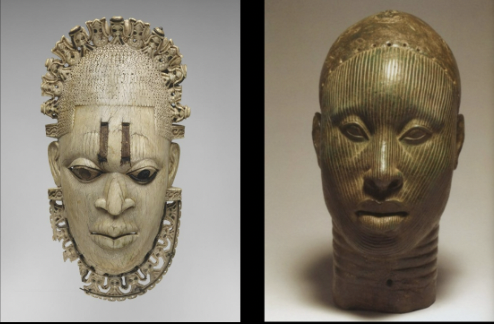
<p>from Ife (now Nigeria) 14th - early 15th century</p>
6
New cards
<p>Ife Head Notes</p>

Ife Head Notes

  • Brilliant balance between abstraction and realism that can be associated with the idea of majesty

  • The head is extremely symmetrical, far more than any other human would be

  • Particularly to the shape of the eyes, the width of the nose, the set of the mouth, the shape of the ears, the way in which the forehead is rounded, and overall proportions

    • Speaks to a tension within one person

  • Why are there all these striations on the face that are perfectly equally spaced apart from each other?

    • Equilibrium between the delicate reality of the features and the rigorous geometric design that almost contradicts the realism of the face

    • One possibility: actual practice of scarification that did actually produce perfectly geometric lines on the skin of this ruler

      • If one wants to look superhuman, one may be willing to have one's face look geometric and have these marks on it.

    • One possibility: maybe these lines are reminders of something that was attached to the holes in his hairline
<ul><li><p><span style="background-color: transparent;"><span>Brilliant balance between abstraction and realism that can be associated with the idea of majesty</span></span></p></li><li><p><span style="background-color: transparent;"><span>The head is extremely symmetrical, far more than any other human would be</span></span></p></li><li><p><span style="background-color: transparent;"><span>Particularly to the shape of the eyes, the width of the nose, the set of the mouth, the shape of the ears, the way in which the forehead is rounded, and overall proportions</span></span></p><ul><li><p><span style="background-color: transparent;"><span>Speaks to a tension within one person</span></span></p></li></ul></li><li><p><span style="background-color: transparent;"><strong><span>Why are there all these striations on the face that are perfectly equally spaced apart from each other?</span></strong></span></p><ul><li><p><span style="background-color: transparent;"><span>Equilibrium between the delicate reality of the features and the rigorous geometric design that almost contradicts the realism of the face</span></span></p></li><li><p><span style="background-color: transparent;"><span>One possibility: actual practice of scarification that did actually produce perfectly geometric lines on the skin of this ruler</span></span></p><ul><li><p><span style="background-color: transparent;"><span>If one wants to look superhuman, one may be willing to have one's face look geometric and have these marks on it.</span></span></p></li></ul></li><li><p><span style="background-color: transparent;"><span>One possibility: maybe these lines are reminders of something that was attached to the holes in his hairline</span></span></p></li></ul></li></ul><p></p>
7
New cards
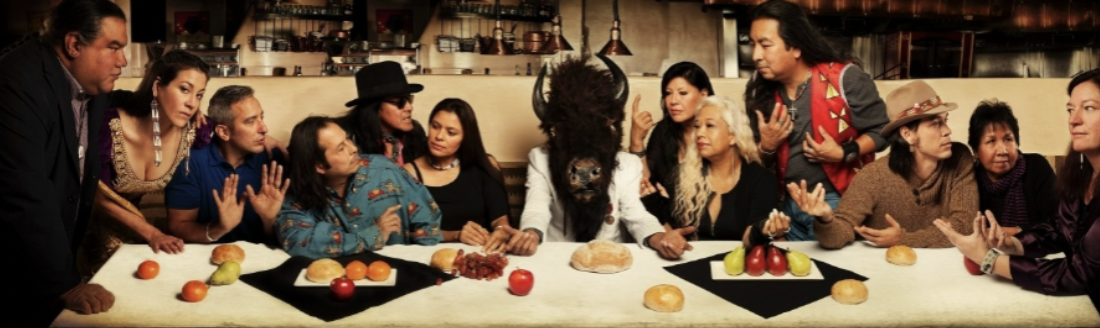
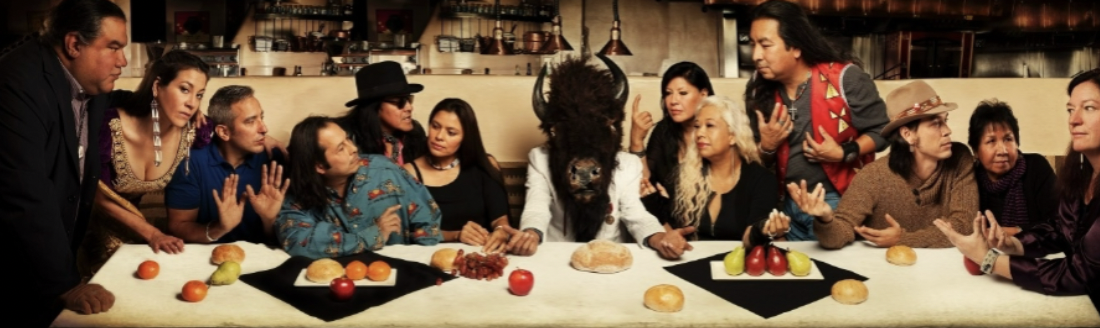
<p><span style="background-color: transparent;"><span>Last Indian Market Identifiers</span></span></p>

Last Indian Market Identifiers

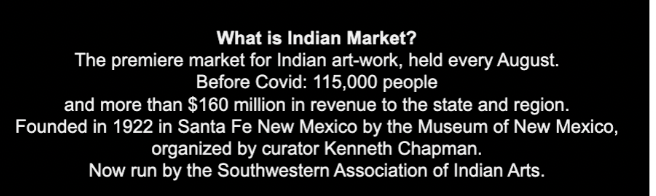
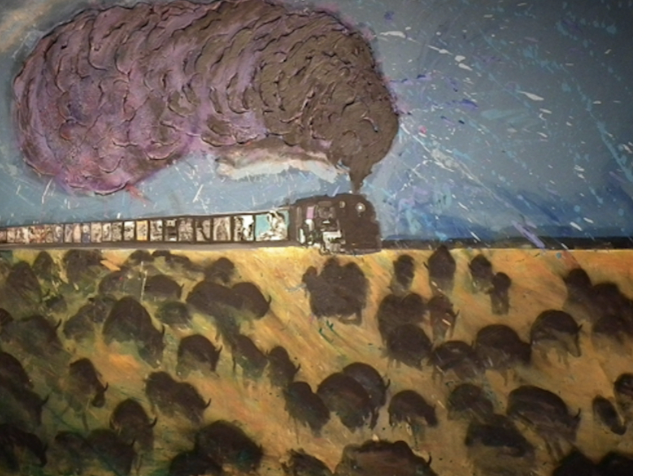
Cara Romero & Amerman/Buffalo Man, 2015. Archival pigment photograph
<p><span style="background-color: transparent;"><strong><span>Cara Romero &amp; Amerman/Buffalo Man, </span><em><span>2015. </span></em><span>Archival pigment photograph</span></strong></span></p>
8
New cards
<p><span style="background-color: transparent;"><span>Last Indian Market Notes</span></span></p>

Last Indian Market Notes

  • ara Romero is the photographer, Buffalo Man is featured in the center

  • A group of people who are all clearly involved in a conversation with each other, interacting with each other (looking and gesturing), each of their postures is individual

    • Overall symmetric composition surrounds the man wearing a buffalo mask → iconography

  • Indian market: one of the premier markets for art made by indigenous people

    • “Last Indian Market” → The setting of the photograph is very separate from the setting of Indian markets

    • Originally founded in Santa Fe by the Museum of New Mexico → enabling indigenous artists by selling their art directly

  • Showing a meal after the Indian market that takes place in the Coyote cafe

    • A way for Romero and Amerman to work against old stereotypes about “passive” and “less-sophisticated” indigenous artists → doing their exchange in elevated settings

  • Purpose: The buffalo mask has a long lineage of being used in indigenous dance practices

    • Quite a wide geographic range of buffalo mask dancing (immense cultural importance)

    • The Buffalo mask is an assertion that indigenous culture won’t disappear

  • An intentional layering onto itself: associations of genius and religious faith that go along with The Last Supper 

    • Christ & Buffalo man are the ones who give us life
<ul><li><p><span style="background-color: transparent;"><span>ara Romero is the photographer, Buffalo Man is featured in the center</span></span></p></li><li><p><span style="background-color: transparent;"><span>A group of people who are all clearly involved in a conversation with each other, interacting with each other (looking and gesturing), each of their postures is individual</span></span></p><ul><li><p><span style="background-color: transparent;"><span>Overall symmetric composition surrounds the man wearing a buffalo mask → iconography</span></span></p></li></ul></li><li><p><span style="background-color: transparent;"><span>Indian market: one of the premier markets for art made by indigenous people</span></span></p><ul><li><p><span style="background-color: transparent;"><span>“Last Indian Market” → The setting of the photograph is very separate from the setting of Indian markets</span></span></p></li><li><p><span style="background-color: transparent;"><span>Originally founded in Santa Fe by the Museum of New Mexico → enabling indigenous artists by selling their art directly</span></span></p></li></ul></li><li><p><span style="background-color: transparent;"><span>Showing a meal after the Indian market that takes place in the Coyote cafe</span></span></p><ul><li><p><span style="background-color: transparent;"><u><span>A way for Romero and Amerman to work against old stereotypes about “passive” and “less-sophisticated” indigenous artists → doing their exchange in elevated settings</span></u></span></p></li></ul></li><li><p><u>P</u><span style="background-color: transparent;"><u><span>urpose:</span></u><span> The buffalo mask has a long lineage of being used in indigenous dance practices</span></span></p><ul><li><p><span style="background-color: transparent;"><span>Quite a wide geographic range of buffalo mask dancing (immense cultural importance)</span></span></p></li><li><p><span style="background-color: transparent;"><strong><span>The Buffalo mask is an assertion that indigenous culture won’t disappear</span></strong></span></p></li></ul></li><li><p><span style="background-color: transparent;"><span>An intentional layering onto itself: associations of genius and religious faith that go along with </span><em><span>The Last Supper&nbsp;</span></em></span></p><ul><li><p><span style="background-color: transparent;"><strong><span>Christ &amp; Buffalo man are the ones who give us life</span></strong></span><br></p></li></ul></li></ul><p></p>
9
New cards
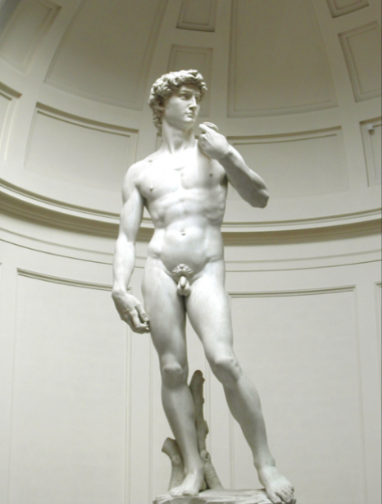
<p>Michelangelo Identifiers</p>

Michelangelo Identifiers

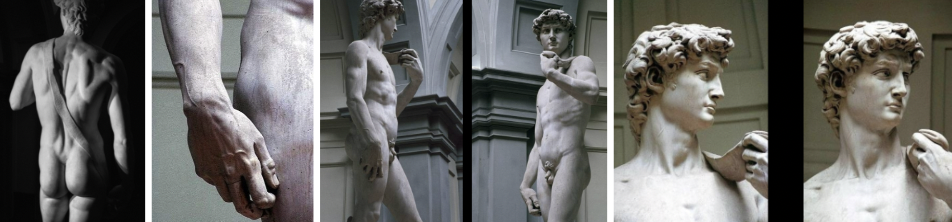
Michelangelo Buonarroti, David, c. 1501-04, marble, 169 inches
<p><span style="background-color: transparent;"><strong><span>Michelangelo Buonarroti, David, c. 1501-04, marble, 169 inches</span></strong></span></p>
10
New cards
<p>Michelangelo Notes</p>

Michelangelo Notes

  • Represented as the ideal male human body: putting the aspects of many human bodies and putting them together into one perfect conception

    • Managed a genius invocation of movement and actions

  • David and Goliath: 2 armies face each other, 1 has a giant, the other army is frightened, one boy is not frightened, tries with a stone and a sling to slay the giant

Michelangelo picks the moment where David tries to do this impossible thing: how is he representing this??

  • Back: (standing in front of a big government building): the arc of the band on the back of David is inclining us to start thinking about moving around to the right, where we see his hand

  • Right hand: expression of the supernatural calm (seen in the seemingly relaxed hand) david holds the stone, with which he hopes to accomplish something that no ordinary human being can dare to do

  • Torso: twisted, forcing you to look for his face

  • Face: we've been moved around towards what makes it possible for him to imagine what makes it possible for him to do such a heroic thing

    • Perfect profile, intense resolve, psychological preparedness
<ul><li><p><span style="background-color: transparent;"><span>Represented as the </span><strong><span>ideal male human body: </span></strong><span>putting the aspects of many human bodies and putting them together into one perfect conception</span></span></p><ul><li><p><span style="background-color: transparent;"><span>Managed a genius invocation of movement and actions</span></span></p></li></ul></li><li><p><span style="background-color: transparent;"><span>David and Goliath: 2 armies face each other, 1 has a giant, the other army is frightened, one boy is not frightened, tries with a stone and a sling to slay the giant</span></span></p></li></ul><p><span style="background-color: transparent;"><u><span>Michelangelo picks the moment where David tries to do this impossible thing: </span></u><span>how is he representing this??</span></span></p><ul><li><p><span style="background-color: transparent;"><span>Back: (standing in front of a big government building): the arc of the band on the back of David is inclining us to start thinking about moving around to the right, where we see his hand</span></span></p></li><li><p><span style="background-color: transparent;"><span>Right hand: expression of the supernatural calm (seen in the seemingly relaxed hand) david holds the stone, with which he hopes to accomplish something that no ordinary human being can dare to do</span></span></p></li><li><p><span style="background-color: transparent;"><span>Torso: twisted, forcing you to look for his face</span></span></p></li><li><p><span style="background-color: transparent;"><span>Face: we've been moved around towards what makes it possible for him to imagine what makes it possible for him to do such a heroic thing</span></span></p><ul><li><p><span style="background-color: transparent;"><span>Perfect profile, intense resolve, psychological preparedness</span></span></p></li></ul></li></ul><p></p>
11
New cards
<p>School of Athens Identifiers</p>

School of Athens Identifiers

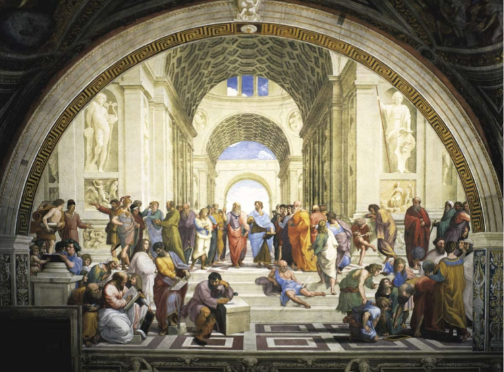
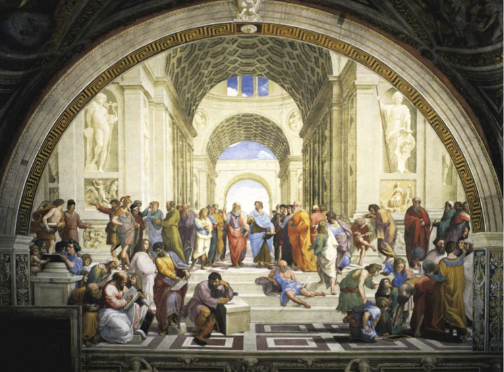
Raphael, School of Athens, 1509-10, fresco on wall
12
New cards
<p>School of Athens Notes</p>

School of Athens Notes

  • Raphael was summoned by the pope for his talents to paint a part of the same Vatican that Michelangelo was painting

    • A microcosm of creative competition

  • Raphael’s wager is that he can compete with the intricacies of the space by painting an epic scene, and by competing with himself

    • One side of the room is a wall painting he made, showing catholic theological thought, and on the other side, he is representing classical thought

      • Putting these opposites together, in conversation with each other, at the heart of the Vatican

  • Prepares this epic work with a massive preparatory drawing

  • Had to make all these figures relate to each other, yet remain subordinate to something else going on

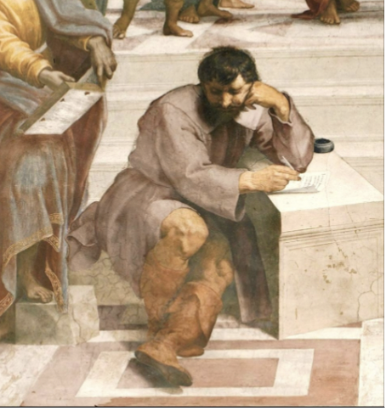
    • A figure so marvelously composed, he seems to be draping himself over the steps that lead upward, meant to be a representation of Heiroklites (and maybe Michelangelo)

      • Acknowledging the genius of Michelangelo

  • Perspective: All converging on the place that is expressively the most important to him, all converging to the figures of Plato and Aristotle, locking into a conversation of binary symmetry

  • Raphael is opposing secular thought, and debates over 2 people (people who have shared but different ideas)

    • Saying there could be 2 ways to understand. This dialogue and agreement of the 2 (skeptical testing of the 2) that Raphael is saying is going to threaten Christianity, the unified divine dogma

      • The idea that there can be spillover and discussion from this discourse that can feed some of the greatest ideas and discoveries
<ul><li><p><span style="background-color: transparent;"><span>Raphael was summoned by the pope for his talents to paint a part of the same Vatican that Michelangelo was painting</span></span></p><ul><li><p><span style="background-color: transparent;"><span>A microcosm of creative competition</span></span></p></li></ul></li><li><p><span style="background-color: transparent;"><span>Raphael’s wager is that he can compete with the intricacies of the space by painting an epic scene, and by competing with himself</span></span></p><ul><li><p><span style="background-color: transparent;"><span>One side of the room is a wall painting he made, showing catholic theological thought, and on the other side, he is representing classical thought</span></span></p><ul><li><p><span style="background-color: transparent;"><span>Putting these opposites together, in conversation with each other, at the heart of the Vatican</span></span></p></li></ul></li></ul></li><li><p><span style="background-color: transparent;"><span>Prepares this epic work with a massive preparatory drawing</span></span></p></li><li><p><span style="background-color: transparent;"><span>Had to make all these figures relate to each other, yet remain subordinate to something else going on</span></span></p><ul><li><p><span style="background-color: transparent;"><span>A figure so marvelously composed, he seems to be draping himself over the steps that lead upward, meant to be a representation of Heiroklites (and maybe Michelangelo)</span></span></p><ul><li><p><span style="background-color: transparent;"><span>Acknowledging the genius of Michelangelo</span></span></p></li></ul></li></ul></li><li><p><strong><em><u>Perspective: </u></em></strong><span style="background-color: transparent;"><u><span>All converging on the place that is expressively the most important to him, all converging to the figures of Plato and Aristotle, locking into a conversation of binary symmetry</span></u></span></p></li><li><p><span style="background-color: transparent;"><span>Raphael is opposing secular thought, and debates over 2 people (people who have shared but different ideas)</span></span></p><ul><li><p><span style="background-color: transparent;"><span>Saying there could be 2 ways to understand. This dialogue and agreement of the 2 (skeptical testing of the 2) that Raphael is saying is going to threaten Christianity, the unified divine dogma</span></span></p><ul><li><p><span style="background-color: transparent;"><span>The idea that there can be spillover and discussion from this discourse that can feed some of the greatest ideas and discoveries</span></span></p></li></ul></li></ul></li></ul><p></p>
13
New cards
<p>Infinity Room Identifiers</p>

Infinity Room Identifiers

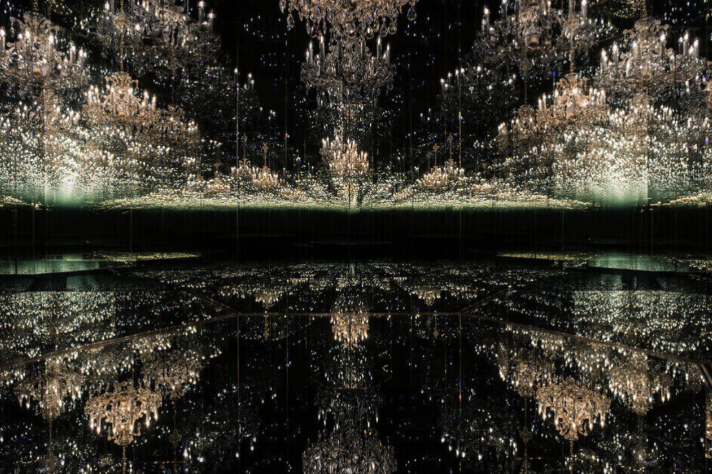
Yayoi Kusama, 2021
14
New cards
<p>Infinity Room Notes</p>

Infinity Room Notes

  • The work of art is completed by the addition of your image in a multitude of different ways

    • Participatory art, the share of the beholder:

      • A great work of art doesn’t complete its significance until you are looking at it. The point of view from which the viewer looks at the work of art adds another layer of meaning that is crucial to understanding the piece

    • Participatory art helps us realize that a work of art is not complete until you have adequately engaged with it

  • A room lined with mirrors

    • Mirrors are meant to be looked at - a visual image on the surface

    • Lights: the way in which we comprehend the world optically

      • Lights are also how we aim to apprehend the divine world - we can barely imagine seeing anything except through light

    • You feel like you are seeing into infinity, even if your rationality suggests otherwise

  • We deal with the same big ideas over and over again in humankind, on the condition of time and place

    • Yayoi Kusama always plays with the idea of time and place

  • Why would you send this photograph to someone else?
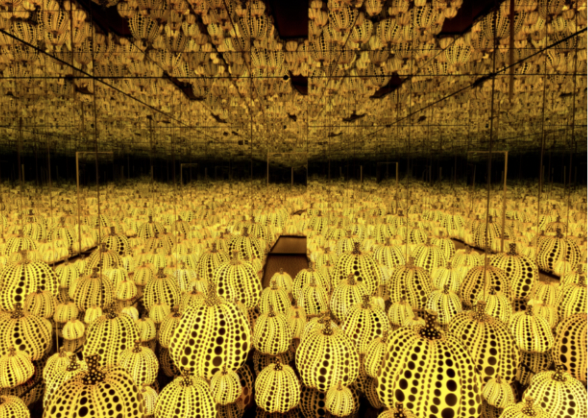
<ul><li><p><span style="background-color: transparent;"><span>The work of art is completed by the addition of your image in a multitude of different ways</span></span></p><ul><li><p><span style="background-color: transparent;"><span>Participatory art, </span><strong><span>the share of the beholder:</span></strong></span></p><ul><li><p><span style="background-color: transparent;"><span>A great work of art doesn’t complete its significance until you are looking at it. The point of view from which the viewer looks at the work of art adds another layer of meaning that is crucial to understanding the piece</span></span></p></li></ul></li><li><p><span style="background-color: transparent;"><span>Participatory art helps us realize that a work of art is not complete until you have adequately engaged with it</span></span></p></li></ul></li><li><p><span style="background-color: transparent;"><span>A room lined with mirrors</span></span></p><ul><li><p><span style="background-color: transparent;"><span>Mirrors are meant to be looked at - a visual image on the surface</span></span></p></li><li><p><span style="background-color: transparent;"><span>Lights: the way in which we comprehend the world optically</span></span></p><ul><li><p><span style="background-color: transparent;"><span>Lights are also how we aim to apprehend the divine world - we can barely imagine seeing anything except through light</span></span></p></li></ul></li><li><p><span style="background-color: transparent;"><span>You feel like you are seeing into infinity, even if your rationality suggests otherwise</span></span></p></li></ul></li><li><p><span style="background-color: transparent;"><span>We deal with the same big ideas over and over again in humankind, on the condition of time and place</span></span></p><ul><li><p><span style="background-color: transparent;"><span>Yayoi Kusama always plays with the idea of time and place</span></span></p></li></ul></li><li><p><span style="background-color: transparent;"><span>Why would you send this photograph to someone else?</span></span></p></li></ul><p></p>
15
New cards
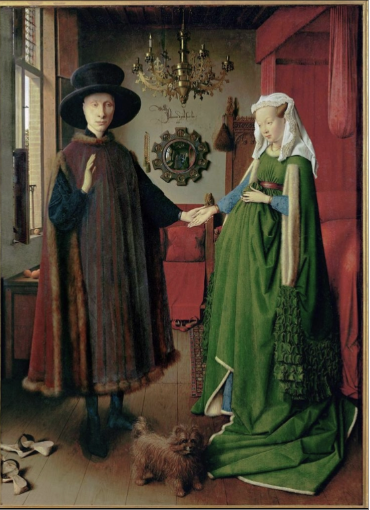
<p>Arnolfini Portrait Identifiers</p>

Arnolfini Portrait Identifiers

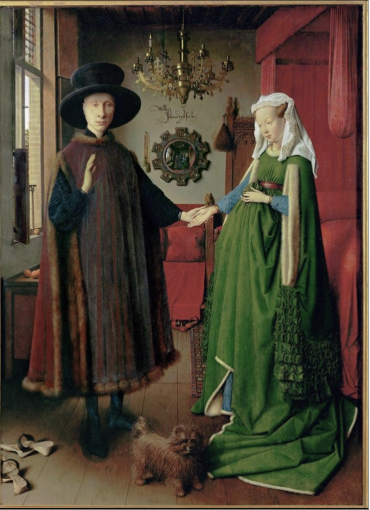
Van Eyck. 1434, oil painting on oak panel
16
New cards
<p>Arnolfini Portrait Notes</p>

Arnolfini Portrait Notes

  • The Arnolfinis were Italian, but were up north to do business

    • Italians created modern banking and finance as we know it - the ideas of bookkeeping and capitalist finance

  • We know the Arnolfinis are very wealthy, and would like a portrait of themselves to represent that

    • Had the means to live an extremely comfortable material life

  • Van Eyck understood that you can push oil painting so that it can render the tangible things of this world

    • Being able to reflect light, in a wya that the wall portraits made out of fresco will never be able to

  • The majority of the surface of this painting is occupied by material possessions (shopping list)

  • DETAILS:

    • 35 yards of prime green wool + 600-2000 winter white belly minever squirrel fur

      • Green dye is very expensive

      • Can only get fur this white when you travel in the winter 

      • Silk velvet + 100 pine marten

        • Far more expensive than his wife

        • Pine marten pelts are so much more valuable than minever pelts

          • Pine marten pelts and velvet are softer

      • A banking, pricing mentality - complete wonderment at how great things could look

        • A celebration of things and their pricing, an artist showing us the depth of his skills, representing each of these things so we can see them in a certain way

      • Oranges are imported from Valencia - signs of great sophistication and affluence.

      • How would we believe in the difference between the orange/ledge, minever vs. pine marte

        • All in the way Van Eyck paints the light

      • Van Eyck is an artist who is bathing his subject in a light that is so fantastically real that it brings us equally fantastic joy.

      • The complexity, the spatially complicated presence, of something’s function that is to provide light at the top of the painting, a chandelier providing light at the top of the portrait
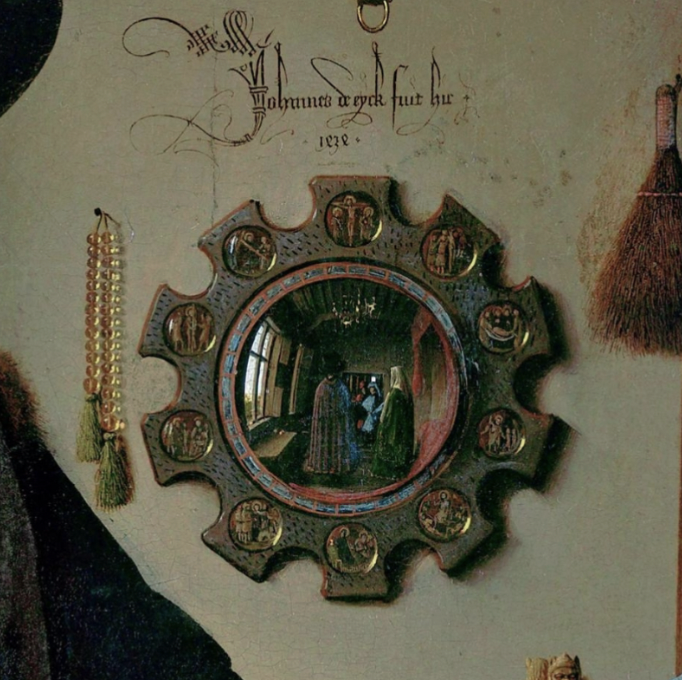
<ul><li><p><span style="background-color: transparent;"><span>The Arnolfinis were Italian, but were up north to do business</span></span></p><ul><li><p><span style="background-color: transparent;"><span>Italians created modern banking and finance as we know it - the ideas of bookkeeping and capitalist finance</span></span></p></li></ul></li><li><p><span style="background-color: transparent;"><span>We know the Arnolfinis are very wealthy, and would like a portrait of themselves to represent that</span></span></p><ul><li><p><span style="background-color: transparent;"><span>Had the means to live an extremely comfortable material life</span></span></p></li></ul></li><li><p><span style="background-color: transparent;"><span>Van Eyck understood that you can push oil painting so that it can render the tangible things of this world</span></span></p><ul><li><p><span style="background-color: transparent;"><span>Being able to reflect light, in a wya that the wall portraits made out of fresco will never be able to</span></span></p></li></ul></li><li><p><span style="background-color: transparent;"><span>The majority of the surface of this painting is occupied by material possessions (shopping list)</span></span></p></li><li><p><span style="background-color: transparent;"><strong><em><u><span>DETAILS: </span></u></em></strong></span></p><ul><li><p><span style="background-color: transparent;"><span>35 yards of prime green wool + 600-2000 winter white belly minever squirrel fur</span></span></p><ul><li><p><span style="background-color: transparent;"><span>Green dye is very expensive</span></span></p></li><li><p><span style="background-color: transparent;"><span>Can only get fur this white when you travel in the winter&nbsp;</span></span></p></li><li><p><span style="background-color: transparent;"><span>Silk velvet + 100 pine marten</span></span></p><ul><li><p><span style="background-color: transparent;"><span>Far more expensive than his wife</span></span></p></li><li><p><span style="background-color: transparent;"><span>Pine marten pelts are so much more valuable than minever pelts</span></span></p><ul><li><p><span style="background-color: transparent;"><span>Pine marten pelts and velvet are softer</span></span></p></li></ul></li></ul></li></ul><ul><li><p><span style="background-color: transparent;"><strong><span>A banking, pricing mentality - complete wonderment at how great things could look</span></strong></span></p><ul><li><p><span style="background-color: transparent;"><span>A celebration of things and their pricing, an artist showing us the depth of his skills, representing each of these things so we can see them in a certain way</span></span></p></li></ul></li><li><p><span style="background-color: transparent;"><span>Oranges are imported from Valencia - signs of great sophistication and affluence.</span></span></p></li><li><p><span style="background-color: transparent;"><span>How would we believe in the difference between the orange/ledge, minever vs. pine marte</span></span></p><ul><li><p><span style="background-color: transparent;"><strong><span>All in the way Van Eyck paints the light</span></strong></span></p></li></ul></li><li><p><span style="background-color: transparent;"><span>Van Eyck is an artist who is bathing his subject in a light that is so fantastically real that it brings us equally fantastic joy.</span></span></p></li><li><p><span style="background-color: transparent;"><span>The complexity, the spatially complicated presence, of something’s function that is to provide light at the top of the painting, a chandelier providing light at the top of the portrait</span></span></p></li></ul></li></ul></li></ul><p></p>
17
New cards
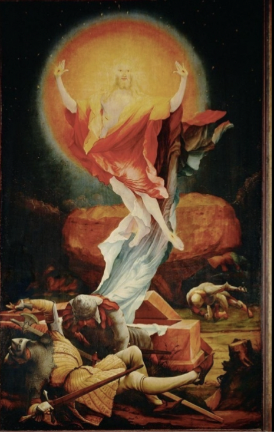
<p>Isenheim Altarpiece, resurrection panel Identifiers</p>

Isenheim Altarpiece, resurrection panel Identifiers

Grunewald, 1506-15.
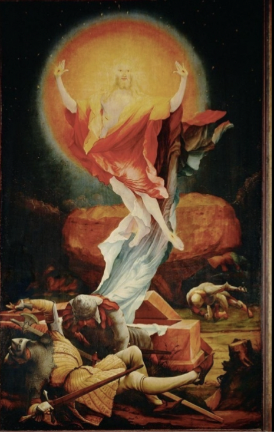
18
New cards
<p>Isenheim Altarpiece, resurrection panel Notes</p>

Isenheim Altarpiece, resurrection panel Notes

  • Tender beginnings of his life + joyous announcement from the angels, especially on the right, the image of the miracle of resurrection

  • Though he seems to still be in his human form ascends to God.

  • Shifts from his downtrodden life on earth to something more radiant and beautiful

  • Form of the guards jumbled and confused, almost senseless

    • As humans often are

  • Out of this jumble of the earthly forms comes the swirling ethereal trace that is both fabric and light 

    • Animated and rippling with divine energy

Extremely kinetic, totally weightless, fabric starts to go in hue of colro changing around his body, turning into this golden orb of heavenly light

  • Christ’s face has become divine light.
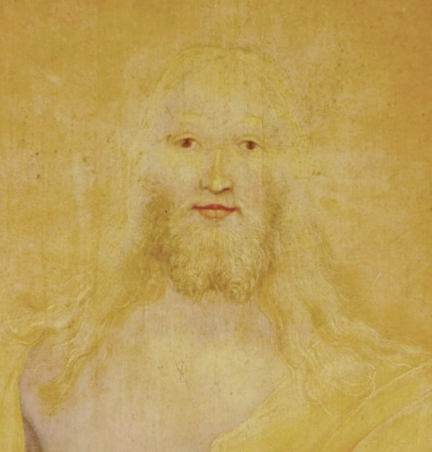
<ul><li><p><span style="background-color: transparent;"><span>Tender beginnings of his life + joyous announcement from the angels, especially on the right, the image of the miracle of resurrection</span></span></p></li><li><p><span style="background-color: transparent;"><span>Though he seems to still be in his human form ascends to God.</span></span></p></li><li><p><span style="background-color: transparent;"><span>Shifts from his downtrodden life on earth to something more radiant and beautiful</span></span></p></li><li><p><span style="background-color: transparent;"><span>Form of the guards jumbled and confused, almost senseless</span></span></p><ul><li><p><span style="background-color: transparent;"><span>As humans often are</span></span></p></li></ul></li><li><p><span style="background-color: transparent;"><span>Out of this jumble of the earthly forms comes the swirling ethereal trace that is both fabric and light&nbsp;</span></span></p><ul><li><p><span style="background-color: transparent;"><span>Animated and rippling with divine energy</span></span></p></li></ul></li></ul><p><span style="background-color: transparent;"><span>Extremely kinetic, totally weightless, fabric starts to go in hue of colro changing around his body, turning into </span><strong><span>this golden orb of heavenly light</span></strong></span></p><ul><li><p><span style="background-color: transparent;"><strong><span>Christ’s face has become divine light.</span></strong></span></p></li></ul><p></p>
19
New cards
<p>The Ambassadors Identifiers</p>

The Ambassadors Identifiers

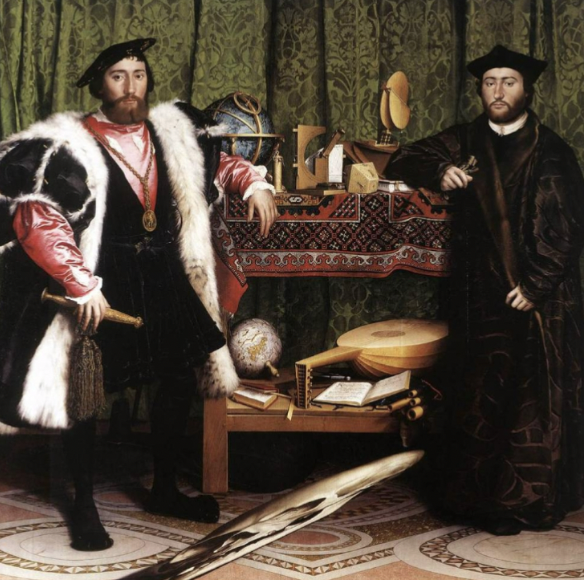
Holbein, 1533
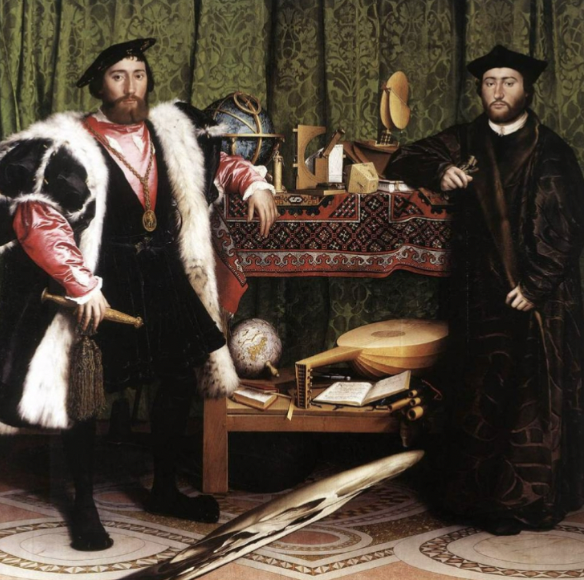
20
New cards
<p>The Ambassadors Notes</p>

The Ambassadors Notes

  • Represent both secular and clerical power

  • Representing French ambassadors to the royal court of England, a very important job for very important people

  • Left: secular man, all of the texture and social exuberance, has been sent to impress the king with his style and evident riches

Marker of time, golden dagger he is holding, as the date on it

  • Table: covered in 2 levels with all types of instruments that can measure the earth, time, and space

    • Rendered meticulously as a type of sumptuousness, men are putting their elbows on what gives human beings all they know in forms of knowledge.

    • The book opens a particular cage; the handle is open to us, inviting us to grasp these instruments of art, ways to control the world, marking time and knowing space.

    • (bottom shield)

      • A way of showing - with the globe - the worldliness of the ambassadors and the power of ambassadorship, power on this earth

  • Reminds us of death again in a subtle way: painting is a perfect geometry until you add this strip → if you look at the painting from where you're supposed to, and look past the skull, you see a crucifixion

    • Life after death that the crucifixion promises us

  • Redemption & resurrection: Also showing off his skill - Holbein is- in being able to convey this earth, life is eternal.
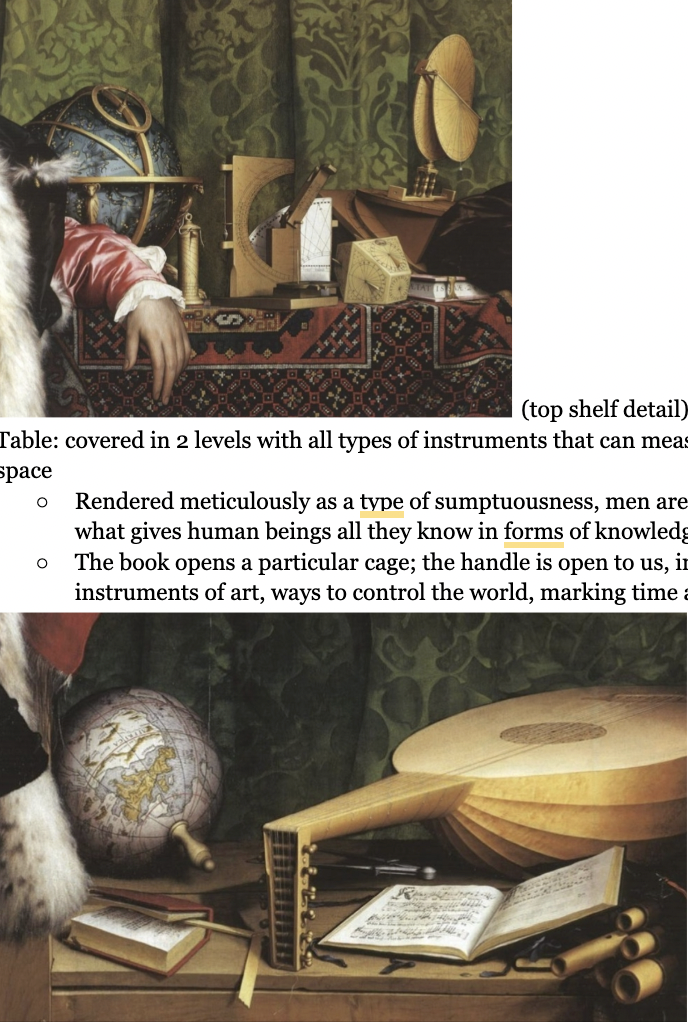
<ul><li><p><span style="background-color: transparent;"><span>Represent both secular and clerical power</span></span></p></li><li><p><span style="background-color: transparent;"><span>Representing French ambassadors to the royal court of England, a very important job for very important people</span></span></p></li><li><p><span style="background-color: transparent;"><strong><span>Left:</span></strong><span> secular man, all of the texture and social exuberance, has been sent to impress the king with his style and evident riches</span></span></p></li></ul><p><span style="background-color: transparent;"><span>Marker of time, </span><u><span>golden dagger </span></u><span>he is holding, as the date on it</span></span></p><ul><li><p><span style="background-color: transparent;"><span>Table: covered in 2 levels with all types of instruments that can measure the earth, time, and space</span></span></p><ul><li><p><span style="background-color: transparent;"><span>Rendered meticulously as a type of sumptuousness, men are putting their elbows on what gives human beings all they know in forms of knowledge.</span></span></p></li><li><p><span style="background-color: transparent;"><span>The book opens a particular cage; the handle is open to us, inviting us to grasp these instruments of art, ways to control the world, marking time and knowing space.</span></span></p></li><li><p><span style="background-color: transparent;"><span>(bottom shield)</span></span></p><ul><li><p><span style="background-color: transparent;"><span>A way of showing - with the globe - the worldliness of the ambassadors and the power of ambassadorship, power on this earth</span></span></p></li></ul></li></ul></li><li><p><span style="background-color: transparent;"><span>Reminds us of death again in a subtle way: </span><strong><span>painting is a perfect geometry until you add this strip → </span></strong><span>if you look at the painting from where you're supposed to, and look past the skull, you see a crucifixion</span></span></p><ul><li><p><span style="background-color: transparent;"><strong><span>Life after death that the crucifixion promises us</span></strong></span></p></li></ul></li><li><p><span style="background-color: transparent;"><strong><span>Redemption &amp; resurrection:</span><em><u><span> Also showing off his skill - Holbein is- in being able to convey this earth, life is eternal.</span></u></em></strong></span></p></li></ul><p></p>
21
New cards
<p>Klein A45 Identifiers</p>

Klein A45 Identifiers

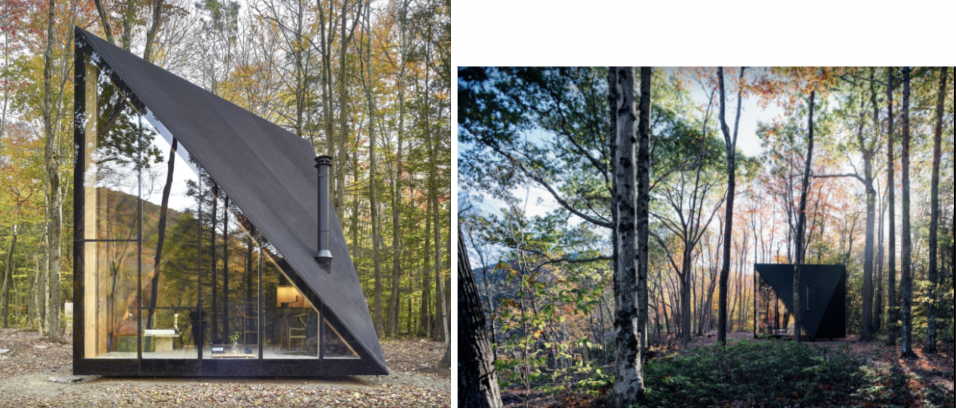
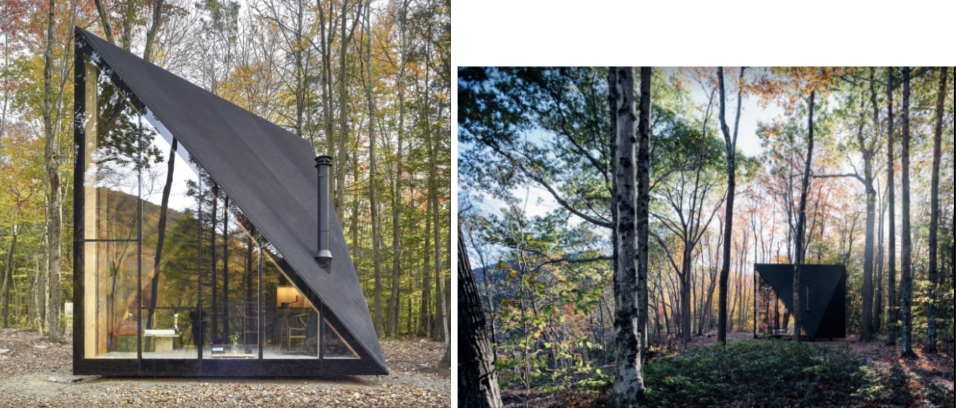
Bjarke Ingels/BIG,, 2018
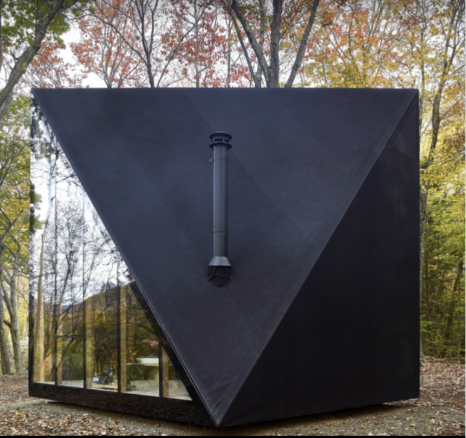
<p><span style="background-color: transparent;"><strong><em><span>Bjarke Ingels/BIG,, 2018</span></em></strong></span></p>
22
New cards
<p>Klein A45 Notes</p>

Klein A45 Notes

  • A one-room house that has a very striking yet simple shape that is meant to reflect the environment it's in - the woods

  • The Idea: to subordinate oneself to the site and to impose as little as possible on it by sticking to basics

    • Can be 50,000 - 300,000

  • The idea that anybody can put it on any similar site

  • This is a design that evolves out of an architectural tradition

  • Made out of 100% recyclable materials

    • Deeply embedded in a long architectural tradition, still very much of the early 21st century

    • Baxandall: makes the point that great art is about timeless themes, and in many ways a very particular conception of time and place

  • A perfect square: wanting to distill this into one of the most perfect geometric shapes

    • Not a triangle as we would imagine

    • Shows us what would happen if the building sank through the ground

  • Reinforced to want to be a perfect geometric plan

  • Long tradition of these houses: A =-frame houses (has a triangle root at the top) - most common type of houses in the united states + europe

    • Traingular roof shape can be done in a variety of ways

      • Not uncommon to emphasize the a-frame roof by having it be most of the house, and making the surrounding walls glass

<ul><li><p><span style="background-color: transparent;"><span>A one-room house that has a very striking yet simple shape that is meant to reflect the environment it's in - the woods</span></span></p></li><li><p><span style="background-color: transparent;"><span>The Idea: to subordinate oneself to the site and to impose as little as possible on it by sticking to basics</span></span></p><ul><li><p><span style="background-color: transparent;"><span>Can be 50,000 - 300,000</span></span></p></li></ul></li><li><p><span style="background-color: transparent;"><span>The idea that anybody can put it on any similar site</span></span></p></li><li><p><span style="background-color: transparent;"><span>This is a design that evolves out of an architectural tradition</span></span></p></li><li><p><span style="background-color: transparent;"><span>Made out of 100% recyclable materials</span></span></p><ul><li><p><span style="background-color: transparent;"><span>Deeply embedded in a long architectural tradition, still very much of the early 21st century</span></span></p></li><li><p><span style="background-color: transparent;"><strong><span>Baxandall: </span></strong><span>makes the point that great art is about timeless themes, and in many ways a very particular conception of time and place</span></span></p></li></ul></li><li><p><span style="background-color: transparent;"><strong><span>A perfect square:</span></strong><span> wanting to distill this into one of the most perfect geometric shapes</span></span></p><ul><li><p><span style="background-color: transparent;"><span>Not a triangle as we would imagine</span></span></p></li><li><p><span style="background-color: transparent;"><span>Shows us what would happen if the building sank through the ground</span></span></p></li></ul></li><li><p><span style="background-color: transparent;"><span>Reinforced to want to be a perfect geometric plan</span></span></p></li></ul><ul><li><p><span style="background-color: transparent;"><span>Long tradition of these houses: A =-frame houses (has a triangle root at the top) - most common type of houses in the united states + europe</span></span></p><ul><li><p><span style="background-color: transparent;"><span>Traingular roof shape can be done in a variety of ways</span></span></p><ul><li><p><span style="background-color: transparent;"><span>Not uncommon to emphasize the a-frame roof by having it be most of the house, and making the surrounding walls glass</span></span></p></li></ul></li></ul></li></ul><p></p>
23
New cards
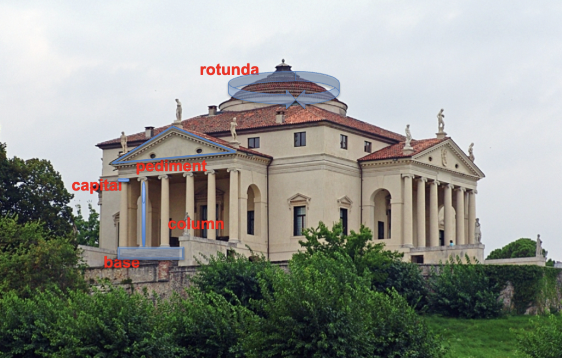
<p>Villa Rotunda Identifiers</p>

Villa Rotunda Identifiers

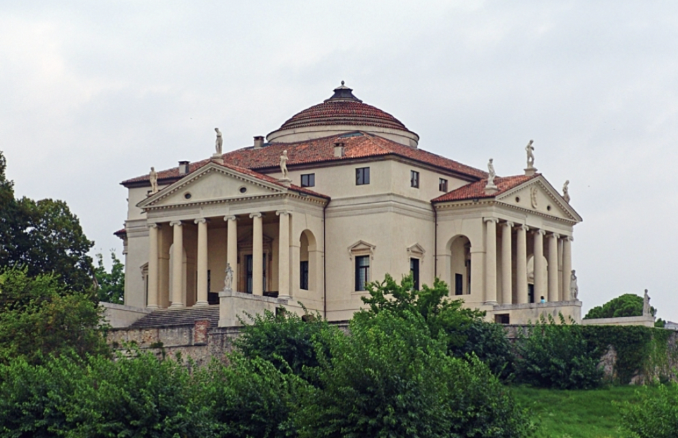
Palladio, 1566-71
<p><span style="background-color: transparent;"><strong><span>Palladio,</span><em><span> 1566-71</span></em></strong></span></p>
24
New cards
<p>Villa Rotunda Notes</p>

Villa Rotunda Notes

  • In the most basic conception of a jewel of a small house → the Ingels house is reference to one of the greatest points of western architecture

  • A small geometric house intended to communicate with the setting

  • Displays a classical arhcitetcure vocabulary, that Palladio wanted to serve as a reference point for architecture going forward, and that was deeply rooted in the past

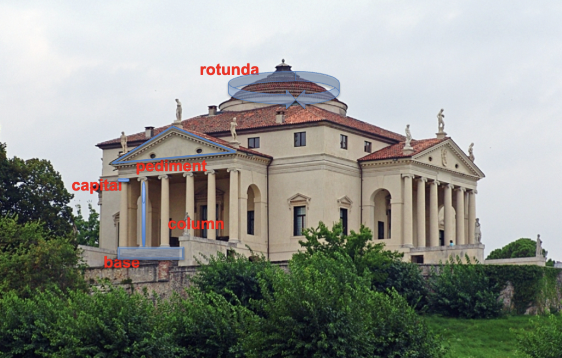
  • Architectural vocabulary: rotunda, pediment, capital columns, base

  • Playfulness is having a building that has pediments on all 4 sides, with ionic capitals on the columns

    • Doesn’t feel obliged to copy the parthenon, turning the columns into 4 porches that wrap around the building

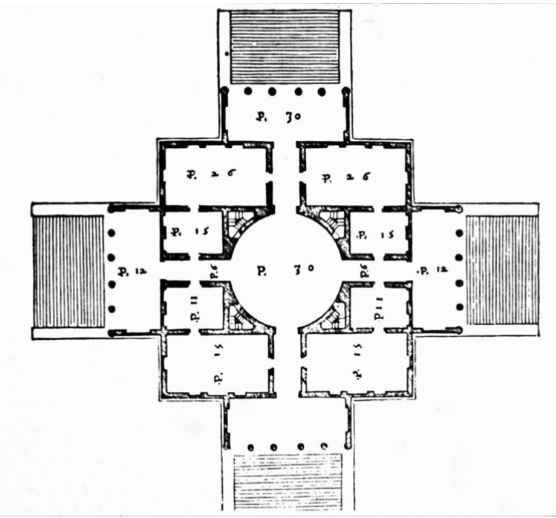
  • Plan: perfect circle in the middle, each of these squares is a perfect square interrupted by the rotunda, 4 equidistance entrances/exist from the center og the building

    • Building has immense emphasis on symmetry

  • The importance of the rotunda (coming from ancient rome): palladio is clearly also very fascinated with the capitals of columns

    • Site: The idea of the villa is that it was in the midst of a landscape → whats of value is an agriculturally transformed landscape (specifically in the renaissance)

      • Even if you’ve made your money it a a capitalist way, this is still the idea

    • Landscape today conveys that the villa rotunda is on a hill, a sweeping view of whta was once a thriving farm

    • Commanding the landscape, and being able to look all around you is expressed to having 4 symmetrical sides to the villa rotunda, very connected to the cult of designing houses in part so that their views will be great

    How was this country ideal brought into the city? How did it become the vocabulary for modern cities? PALLADIAN URBAN IDEAL —> carried through into covent garden england
<ul><li><p><span style="background-color: transparent;"><span>In the most basic conception of a jewel of a small house → the Ingels house is reference to one of the greatest points of western architecture</span></span></p></li><li><p><span style="background-color: transparent;"><span>A small geometric house intended to communicate with the setting</span></span></p></li><li><p><span style="background-color: transparent;"><span>Displays a classical arhcitetcure vocabulary, that Palladio wanted to serve as a reference point for architecture going forward, and that was deeply rooted in the past</span></span></p></li><li><p><span style="background-color: transparent;"><span>Architectural vocabulary: rotunda, pediment, capital columns, base</span></span></p></li><li><p><span style="background-color: transparent;"><span>Playfulness is having a building that has pediments on all 4 sides, with ionic capitals on the columns</span></span></p><ul><li><p><span style="background-color: transparent;"><span>Doesn’t feel obliged to copy the parthenon, turning the columns into 4 porches that wrap around the building</span></span></p></li></ul></li><li><p><span style="background-color: transparent;"><strong><em><u><span>Plan:</span></u></em><span> </span></strong><span>perfect circle in the middle, each of these squares is a perfect square interrupted by the rotunda, 4 equidistance entrances/exist from the center og the building</span></span></p><ul><li><p><span style="background-color: transparent;"><span>Building has immense emphasis on symmetry</span></span></p></li></ul></li><li><p><span style="background-color: transparent;"><span>The importance of the rotunda (coming from ancient rome): palladio is clearly also very fascinated with the capitals of columns</span></span></p><ul><li><p><span style="background-color: transparent;"><strong><em><u><span>Site:</span></u></em></strong><span> The idea of the villa is that it was in the midst of a landscape → whats of value is an agriculturally transformed landscape (specifically in the renaissance)</span></span></p><ul><li><p><span style="background-color: transparent;"><span>Even if you’ve made your money it a a capitalist way, this is still the idea</span></span></p></li></ul></li><li><p>Landscape today <span style="background-color: transparent;"><span>conveys that the villa rotunda is on a hill, a sweeping view of whta was once a thriving farm</span></span></p></li><li><p><span style="background-color: transparent;"><span>Commanding the landscape, and being able to look all around you is expressed to having 4 symmetrical sides to the villa rotunda, very connected to the cult of designing houses in part so that their views will be great</span></span></p></li></ul><p><span style="background-color: transparent;"><span>How was this country ideal brought into the city? How did it become the vocabulary for modern cities? </span><strong><span>PALLADIAN URBAN IDEAL —&gt; carried through into covent garden england</span></strong></span></p></li></ul><p></p>
25
New cards
<p>Demons, Tlazoteotl ‘Eater of Filth,’ Identifiers</p>

Demons, Tlazoteotl ‘Eater of Filth,’ Identifiers

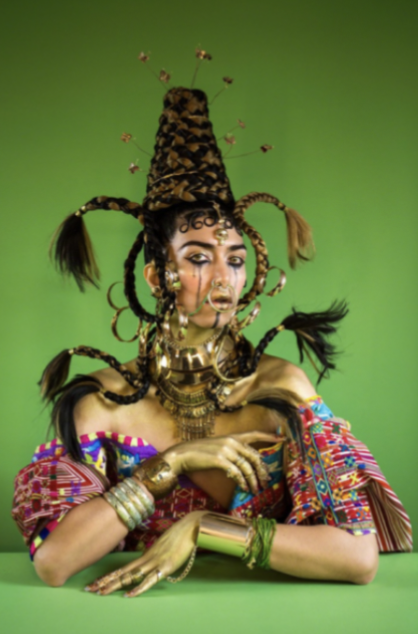
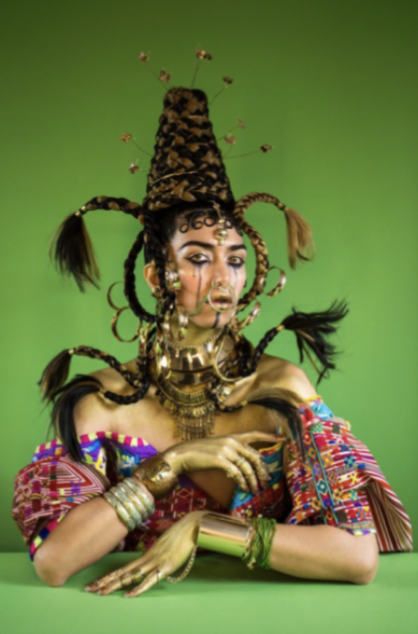
Martine Gutierrez, 2018, p. 92 from Indigenous Woman, 2018, C-print, edition of 18
26
New cards
<p>Demons, Tlazoteotl ‘Eater of Filth,’  Notes</p>

Demons, Tlazoteotl ‘Eater of Filth,’ Notes

  • Name for an Aztec goddess, a self-image as part of a larger project

  • This is a large photographic print; in person, there is a striking mirror-image effect.

    • Self-portrait in its material presence opposite the viewer

  • A glamorous image, making you feel good when you are looking at it → face is beautifully made up to emphasize the eyes and mouth, beautifully composed, clothes and jewelry are incredibly striking

  • This can’t be some simple glamorous cosmetic self-image, the strangeness of these meandering braids and the density of ornament around the neck, around her wrists, he fingers, and including the markings in her face all point to something deeper going on in our natural idea of a self-image

  • In the Aztec pantheon of gods and goddesses, there was a goddess whose purview was one of filth

    • Goddess of forbidden sexuality, as well as being the forgiver of forbidden sexuality

      • Judge, jury, and executioner

  • A lot of what is going on in the Gutierrez is a reference to the oldest surviving images we have of this goddess

  • History: When Europeans conquered what is now Mexico, the conquerors both very much wanted to record the culture they encountered before they destroyed it, and they also wanted to liberate it, through cultural encounters that were violent and destructive

    • Signs being sent in the Gutierrez image about another culture is meso-america, weaving tradition, that has adopted the fabrics and cultures that we can see in the lower right

  • Gutierrez seems to be referring to not only an Aztec goddess with taboos and contradictions involved, but wanting to refer to more than one culture in order to make sure the viewer gets the point. Referring to ancient American cultures

    • Explicit about there being  a lot of contradictions or at least tension between very modern, Western, and cosmetic features of femininity and its superficial glitter, and its contrast with a seemingly childish, simple doll that she holds, repeating a lot of the image herself

    • Doll is condescendingly a fold doll, stark contrast with the powerful femininity the rest of the image invokes

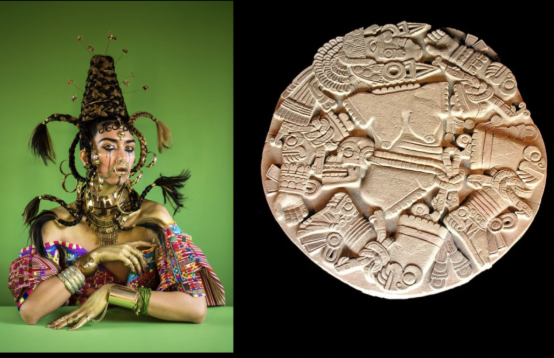
  • STONE: This is a very important stone that was incredibly heavy -> meant to be seen on the ground, 3D and very flat looking, representing another Goddess, Coyolxauhqui

    • A younger goddess who betrayed her mother goddess and was tossed to death by her btoyher, the sotne represents the violent and mortal punishments inflicted among the gods and goddesses in this pantheon
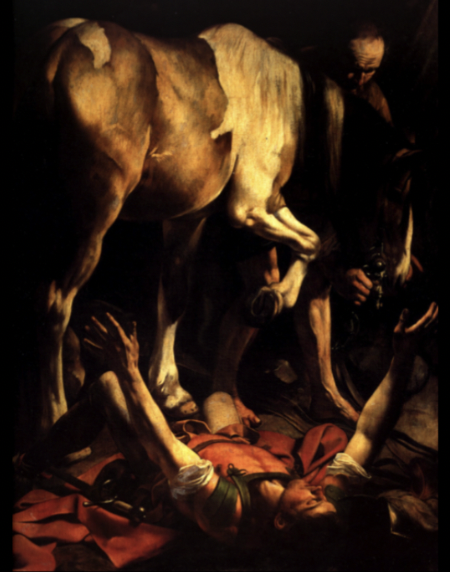
<ul><li><p><span style="background-color: transparent;"><span>Name for an Aztec goddess, a self-image as part of a larger project</span></span></p></li><li><p><span style="background-color: transparent;"><span>This is a large photographic print; in person, there is a striking mirror-image effect.</span></span></p><ul><li><p><span style="background-color: transparent;"><span>Self-portrait in its material presence opposite the viewer</span></span></p></li></ul></li><li><p><span style="background-color: transparent;"><span>A glamorous image, making you feel good when you are looking at it → face is beautifully made up to emphasize the eyes and mouth, beautifully composed, clothes and jewelry are incredibly striking</span></span></p></li><li><p><span style="background-color: transparent;"><span>This can’t be some simple glamorous cosmetic self-image, the strangeness of these meandering braids and the density of ornament around the neck, around her wrists, he fingers, and including the markings in her face all point to something deeper going on in our natural idea of a self-image</span></span></p></li><li><p><span style="background-color: transparent;"><span>In the Aztec pantheon of gods and goddesses, there was a goddess whose purview was one of filth</span></span></p><ul><li><p><span style="background-color: transparent;"><span>Goddess of forbidden sexuality, as well as being the forgiver of forbidden sexuality</span></span></p><ul><li><p><span style="background-color: transparent;"><span>Judge, jury, and executioner</span></span></p></li></ul></li></ul></li><li><p><span style="background-color: transparent;"><span>A lot of what is going on in the Gutierrez is a reference to the oldest surviving images we have of this goddess</span></span></p></li><li><p><span style="background-color: transparent;"><span>History: When Europeans conquered what is now Mexico, the conquerors both very much wanted to record the culture they encountered before they destroyed it, and they also wanted to liberate it, through cultural encounters that were violent and destructive</span></span></p><ul><li><p><span style="background-color: transparent;"><span>Signs being sent in the Gutierrez image about another culture is meso-america, weaving tradition, that has adopted the fabrics and cultures that we can see in the lower right</span></span></p></li></ul></li><li><p><span style="background-color: transparent;"><span>Gutierrez seems to be referring to not only an Aztec goddess with taboos and contradictions involved, but wanting to refer to more than one culture in order to make sure the viewer gets the point. Referring to ancient American cultures</span></span></p><ul><li><p><span style="background-color: transparent;"><em><u><span>Explicit about there being&nbsp; a lot of contradictions or at least tension between very modern, Western, and cosmetic features of femininity and its superficial glitter, and its contrast with a seemingly childish, simple doll that she holds, repeating a lot of the image herself</span></u></em></span></p></li><li><p><span style="background-color: transparent;"><em><u><span>Doll is condescendingly a fold doll, stark contrast with the powerful femininity the rest of the image invokes</span></u></em></span></p></li></ul></li><li><p><strong><em><u>STONE:</u></em></strong> <span style="background-color: transparent;"><span>This is a very important stone that was incredibly heavy -&gt; meant to be seen on the ground, 3D and very flat looking, representing another Goddess, Coyolxauhqui</span></span></p><ul><li><p><span style="background-color: transparent;"><span>A younger goddess who betrayed her mother goddess and was tossed to death by her btoyher, the sotne represents the violent and mortal punishments inflicted among the gods and goddesses in this pantheon</span></span></p></li></ul></li></ul><p></p>
27
New cards
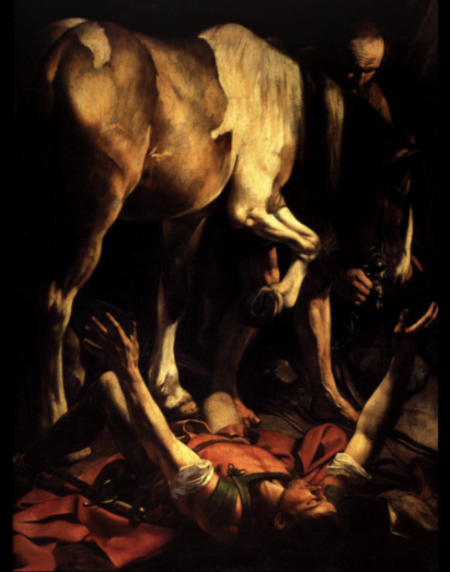
<p>Conversion of Paul Identifiers</p>

Conversion of Paul Identifiers

Caravaggio, 1600-01
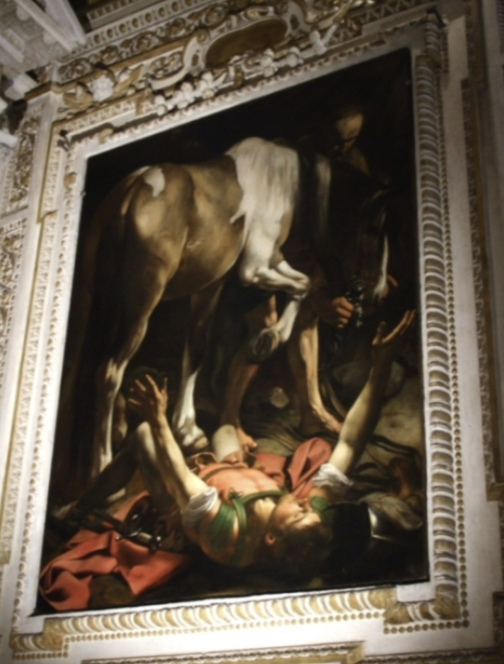
<p>Caravaggio, 1600-01</p>
28
New cards
<p>Conversion of Paul Notes</p>

Conversion of Paul Notes

Context: Catholicism doubled down by becoming far more strict about the role of images and the way in which images mediated Catholic lessons about what was sacred and what was forbidden, the rules about what is in this world to achieve salvation in the next

  • Catholic Church decided to examine works to decide whether they were effective or not

  • Caravaggio just could’t keep himself from making powerful images about faith, if not disturbing

    • Went so far beyond the pale of what the catholic church could accept; entire works of art were rejected

  • Story: A powerful Roman is on his way to a city called Damascus. While he is on his way on horseback, God strikes him down off his horse, and he has a vision that he has to renounce his pagan religion and embrace christiantiy

    • A typical biblical subject at this time: God himself tells us to be catholic, hurling us to the ground to convince us to be Christian

  • Contrast between light and dark: the light that strikes the figure of Saul → Paul is so strong that we can believe that the light could hurl him from his horse to the ground

    • There are times in very different religions where violations of faith, breaking the rules of faith, conversion to faith, across different religions, are so important that they are violent

    • Caravaggio plotted very carefully where his photo would be installed
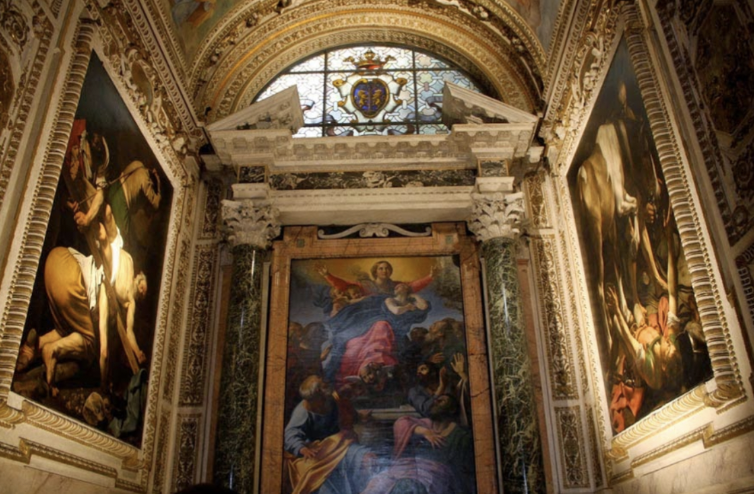
<p><strong>Context: </strong><span style="background-color: transparent;"><span>Catholicism doubled down by becoming far more strict about the role of images and the way in which images mediated Catholic lessons about what was sacred and what was forbidden, the rules about what is in this world to achieve salvation in the next</span></span></p><ul><li><p><span style="background-color: transparent;"><span>Catholic Church decided to examine works to decide whether they were effective or not</span></span></p></li><li><p><span style="background-color: transparent;"><span>Caravaggio just could’t keep himself from making powerful images about faith, if not disturbing</span></span></p><ul><li><p><span style="background-color: transparent;"><span>Went so far beyond the pale of what the catholic church could accept; entire works of art were rejected</span></span></p></li></ul></li><li><p><span style="background-color: transparent;"><span>Story: A powerful Roman is on his way to a city called Damascus. While he is on his way on horseback, God strikes him down off his horse, and he has a vision that he has to renounce his pagan religion and embrace christiantiy</span></span></p><ul><li><p><span style="background-color: transparent;"><span>A typical biblical subject at this time: God himself tells us to be catholic, hurling us to the ground to convince us to be Christian</span></span></p></li></ul></li><li><p><span style="background-color: transparent;"><span>Contrast between light and dark: the light that strikes the figure of Saul → Paul is so strong that we can believe that the light could hurl him from his horse to the ground</span></span></p><ul><li><p><span style="background-color: transparent;"><strong><span>There are times in very different religions where violations of faith, breaking the rules of faith, conversion to faith, across different religions, are so important that they are violent</span></strong></span></p></li></ul><ul><li><p><span style="background-color: transparent;"><strong><span>Caravaggio plotted very carefully where his photo would be installed</span></strong></span></p></li></ul></li></ul><p></p>
29
New cards
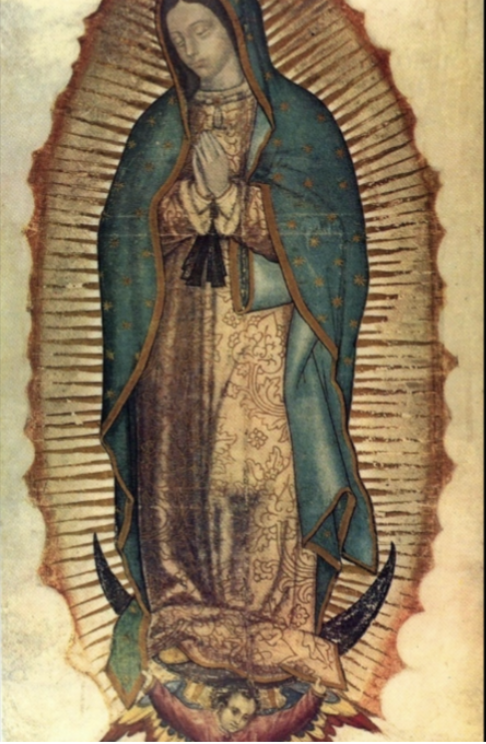
<p>Virgin of Guadalupe Identifiers</p>

Virgin of Guadalupe Identifiers

Painting of Virgin of Guadalupe from Basilica of Guadalupe in Tepeyac, early 16th century, Tempera painted on linen-cactus hemp cloth, possibly an acheiropoeita (image created by divine will) with human additions.
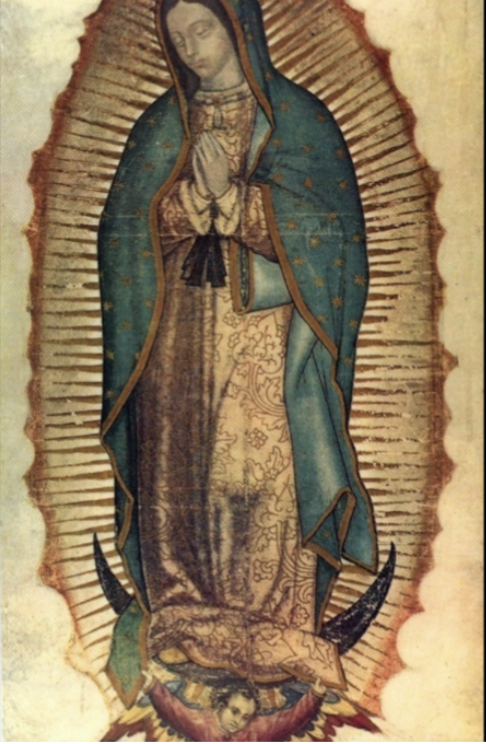
30
New cards
<p>Virgin of Guadalupe Notes</p>

Virgin of Guadalupe Notes

Context: Juan Diego feels as though the catholic mother of god has spoken to him in his native tongue, relays his message to the Catholic bishop

  • Goes back to the bishop and shows him his cloak

  • Juan Diego becomes the first saint in the Mexican Catholic Church

However this image began, it has countless manifestations in numerous forms of media

  • One of the most common ways in which prisoners in Mexico have themselves tattooed is with the image of guadalupe o their back

    • This image of divinity is on their spine

      • The spine carries our nervous system, literally holds us up, holding up these men who are living extremely difficult lives

These gradiations of divine imagery are radiating from their back, so when they move, the Virgin of Guadalupe is moving with them → a genius form of prison art
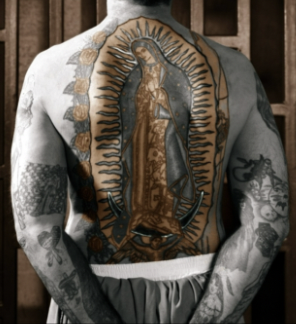
<p><strong><em><u>Context: </u></em></strong><span style="background-color: transparent;"><span>Juan Diego feels as though the catholic mother of god has spoken to him in his native tongue, relays his message to the Catholic bishop</span></span></p><ul><li><p><span style="background-color: transparent;"><span>Goes back to the bishop and shows him his cloak</span></span></p></li></ul><ul><li><p><span style="background-color: transparent;"><span>Juan Diego becomes the first saint in the Mexican Catholic Church</span></span></p></li></ul><p><span style="background-color: transparent;"><span>However this image began, it has countless manifestations in numerous forms of media</span></span></p><ul><li><p><span style="background-color: transparent;"><span>One of the most common ways in which prisoners in Mexico have themselves tattooed is with the image of guadalupe o their back</span></span></p><ul><li><p><span style="background-color: transparent;"><span>This image of divinity is on their spine</span></span></p><ul><li><p><span style="background-color: transparent;"><span>The spine carries our nervous system, literally holds us up, holding up these men who are living extremely difficult lives</span></span></p></li></ul></li></ul></li></ul><p><span style="background-color: transparent;"><span>These gradiations of divine imagery are radiating from their back, so when they move, the Virgin of Guadalupe is moving with them → a </span><strong><span>genius form of prison art</span></strong></span></p>
31
New cards
<p><span style="background-color: transparent;"><strong><span>The Coyolxauhqui Stone Identifiers</span></strong></span></p>

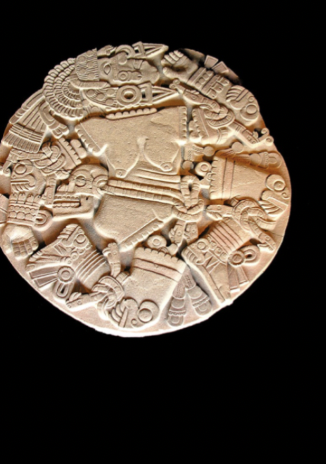
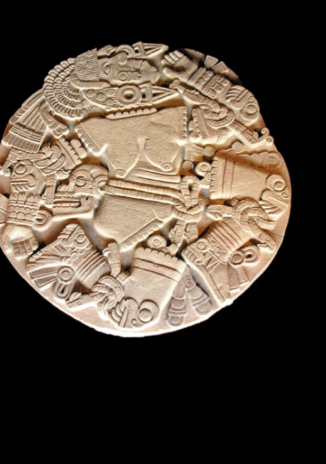
The Coyolxauhqui Stone Identifiers

Mexico (Aztec), late 15th c.
32
New cards
<p><span style="background-color: transparent;"><strong><span>The Coyolxauhqui Stone Notes</span></strong></span></p>

The Coyolxauhqui Stone Notes

  • Using the stones of the temple complex

    • Digging was done in the square in 1978, where the Coyolxauhqui stone, this ancient Aztec image, had been buried in the ground to remove it from circulation

    • At this time, the ideas about the relationship between catholicism and Mexico's relationship to gender, ideas about disobedient daughters had all modernized

  • The stone had been visible - several successive stones - had been placed at the foot of an aztec templed

  • When human sacrifices were hurled to their death at the top of these temples, they were thrown onto the stone, becoming the base for which the violence against humans was continuously reenacted
33
New cards
<p>Take Me, take Me, take Me, to the Palace of Love Identifiers</p>

Take Me, take Me, take Me, to the Palace of Love Identifiers

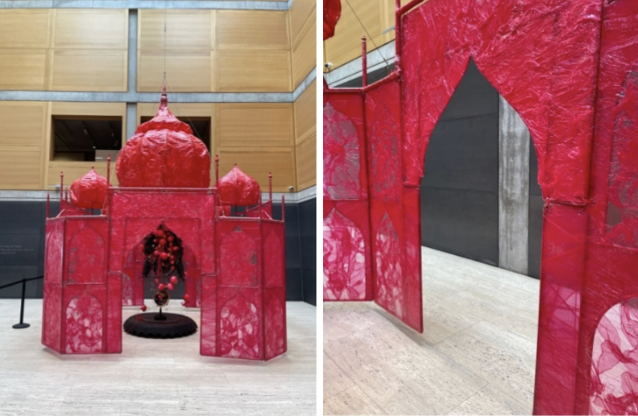
Rina Banerjee, 2003/2026
34
New cards
<p>Take Me, take Me, take Me, to the Palace of Love Notes</p>

Take Me, take Me, take Me, to the Palace of Love Notes

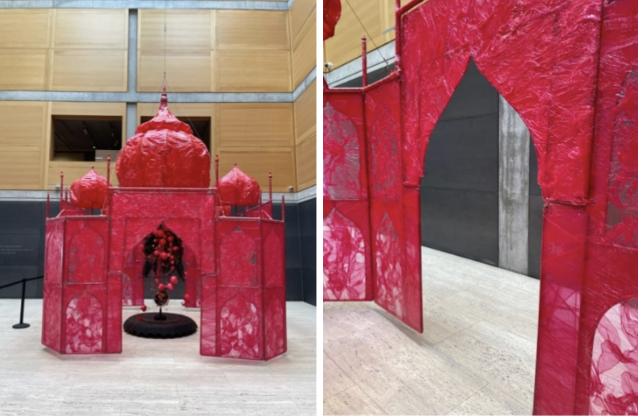
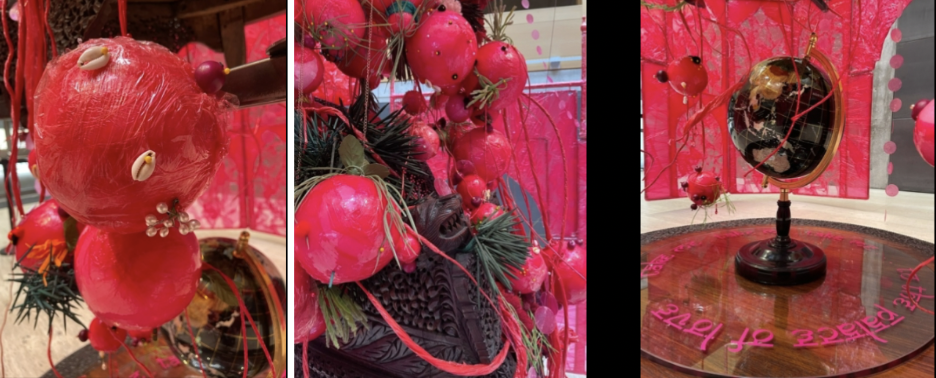
Plastic, antique Anglo-Indian Bombay dark wood chair; steel and copper framework; floral picks, foam balls, cowrie shells; quilting pins; red colored moss, antique stone globe, glass, synthetic fabric, shells; fake birds.

Installation now at the Yale British Art Center, New Haven, CT

  • Pink plastic recreation of the Taj Mahal

  • Down below, there is a black globe

  • As you move inside, the double-edged genius of the material becomes apparent; the pink plastic is fanciful and delightful, also serves as a reminder that we do consume a lot of plastic, and it would be nice if we reused this plastic in nicer ways, such as this

  • At the same time, this is sucha savvy choice formally, as when inside the pink plastic turns out to be transparent, we are treated to many different marvelous shades of pink that we associate with romance

  • Gives the whole remake of the Taj Mahal a timeless, lacey, and delicate feeling

  • These baubles are beautifully composed and so charming, a compare and contrast going on  between modern industrial materials and forms found in nature, like cowrie shells (sometimes used like currency)

  • Feels like one visual delight after another

  • Black Globe: reminders to audiences of some kind of larger stake involved with this composition, the Taj Mahal has become so iconic that we can recognize something as being a reference to the Taj Mahal on any scale, material, or color

    • The Taj Mahal became such a world icon and has reached such an unprecedented level of recognition, in large part due to the story that circulates about the reputation of the Taj Mahal
<p><span style="background-color: transparent;"><span>Plastic, antique Anglo-Indian Bombay dark wood chair; steel and copper framework; floral picks, foam balls, cowrie shells; quilting pins; red colored moss, antique stone globe, glass, synthetic fabric, shells; fake birds.</span></span></p><p><span style="background-color: transparent;"><span>Installation now at the Yale British Art Center, New Haven, CT</span></span></p><ul><li><p><span style="background-color: transparent;"><span>P</span><strong><span>ink plastic recreation of the Taj Mahal</span></strong></span></p></li><li><p><span style="background-color: transparent;"><span>Down below, there is a black globe</span></span></p></li><li><p><span style="background-color: transparent;"><span>As you move inside, the double-edged genius of the material becomes apparent; the pink plastic is fanciful and delightful, also serves as a reminder that we do consume a lot of plastic, and it would be nice if we reused this plastic in nicer ways, such as this</span></span></p></li><li><p><span style="background-color: transparent;"><span>At the same time, this is sucha savvy choice formally, as when inside the pink plastic turns out to be transparent, we are treated to many different marvelous shades of pink that we associate with romance</span></span></p></li><li><p><span style="background-color: transparent;"><u><span>Gives the whole remake of the Taj Mahal a timeless, lacey, and delicate feeling</span></u></span></p></li><li><p><span style="background-color: transparent;"><u><span>These baubles are beautifully composed and so charming, a compare and contrast going on&nbsp; between modern industrial materials and forms found in nature, like cowrie shells (sometimes used like currency)</span></u></span></p></li><li><p><span style="background-color: transparent;"><strong><span>Feels like one visual delight after another</span></strong></span></p></li><li><p><span style="background-color: transparent;"><span>Black Globe: reminders to audiences of some kind of larger stake involved with this composition, the Taj Mahal has become so iconic that we can recognize something as being a reference to the Taj Mahal on any scale, material, or color</span></span></p><ul><li><p><span style="background-color: transparent;"><strong><u><span>The Taj Mahal became such a world icon and has reached such an unprecedented level of recognition, in large part due to the story that circulates about the reputation of the Taj Mahal</span></u></strong></span></p></li></ul></li></ul><p></p>
35
New cards
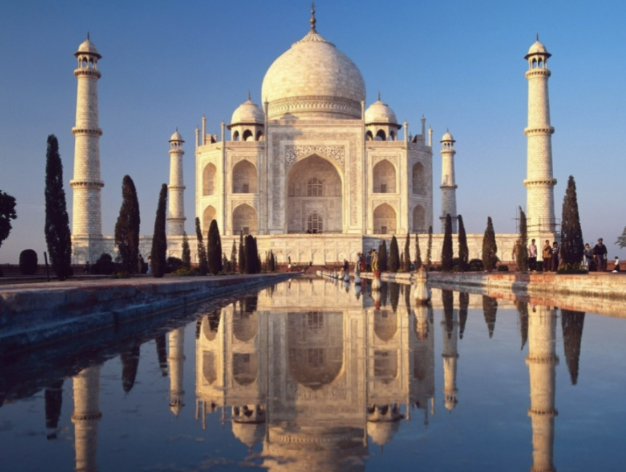
<p>Taj Mahal Identifiers</p>

Taj Mahal Identifiers

Patron: Shah Jahan; Architect: Ustad Ahmed Lahori, 1632-48
<p>Patron: Shah Jahan; Architect: Ustad Ahmed Lahori, 1632-48</p>
36
New cards
<p>Taj Mahal Notes</p>

Taj Mahal Notes

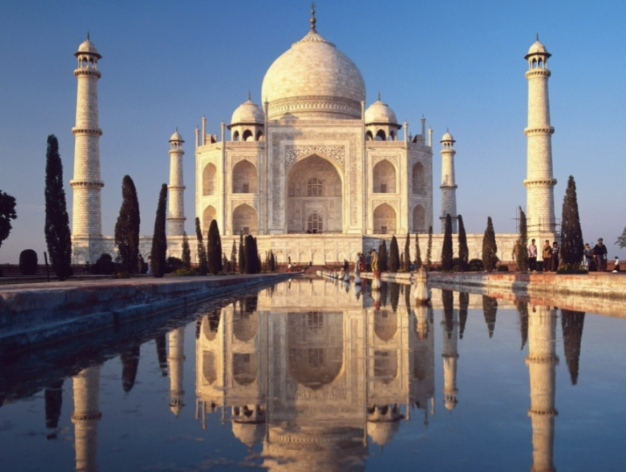
  • Romantic Story: The Taj Mahal was built by the collaboration between patron Jahad and architect Lahori, as a memorial to Jahad’s beloved wife, whose last name is Mahal.

    • She was not his only wife, died having their 14th child, Jahan’s deep love for this woman kept him going for a long time, as seen by the time spent on this enormous Mausoleum

      • Contains Mahal’s tomb

    • Mahal asked Jahan to be close to their children on her deathbed. It was said that after he was imprisoned by one of his children he would look through a diamond to see the progress of the Taj Mahal

  • Energy helps us see how, over time, the Taj Mahal has become a romantic story

    • For a very long time, the area that we refer to as India was controlled by the invading imperial forces of GB, creating a power imbalance between Britain and India, which led Paul Mellon to collect a giant art collection of what he dubbed British Art, consisting of nothing but what was made in the British part of the empire.

  • Taj Mahal is like a teardrop on history, the idea of the Taj Mahal  as a dematerialized building that is an idealized teardrop

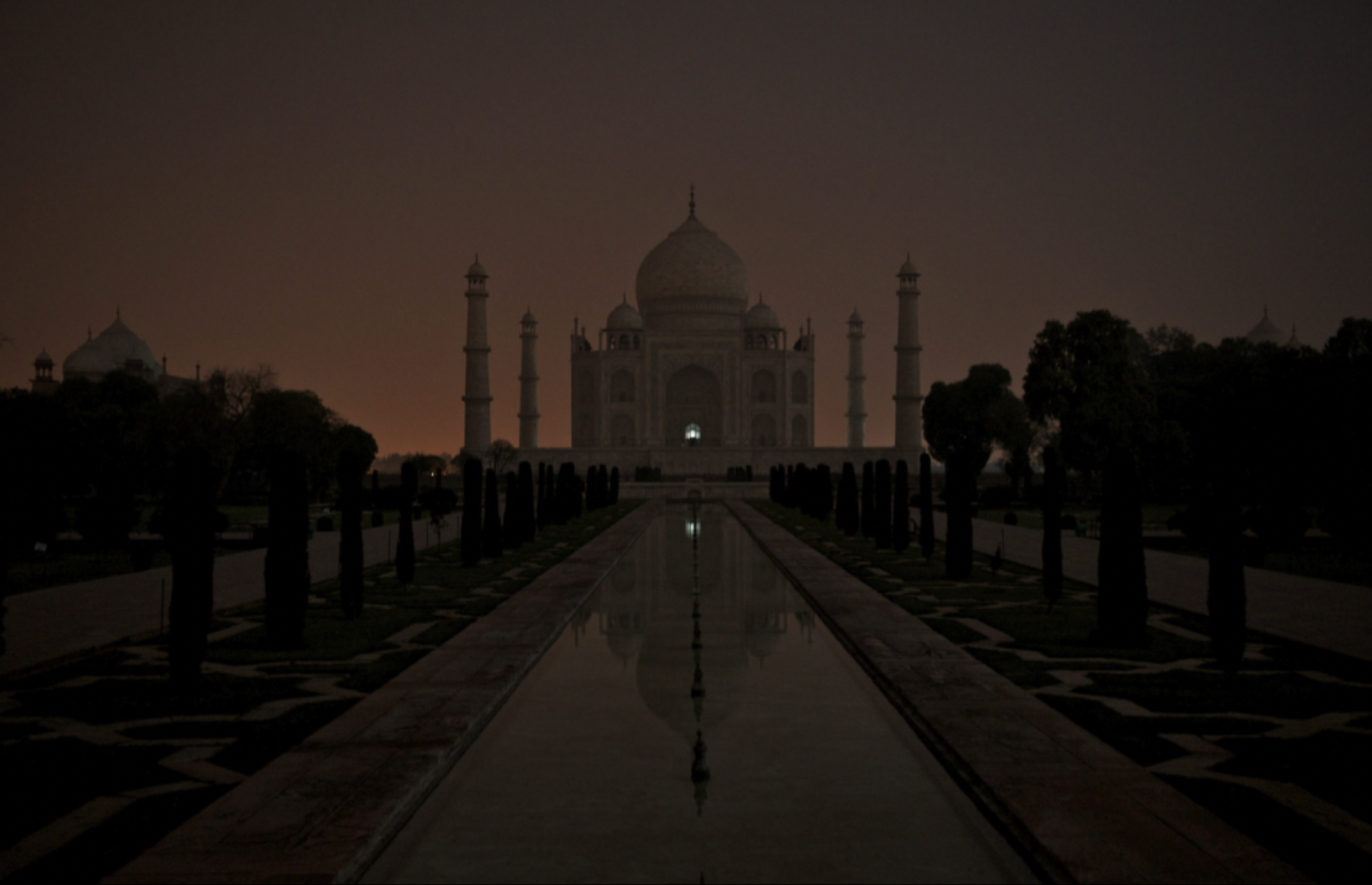
    • Most sought after visits of the Taj Mahal are even more dematerializing: visited under moonlight, it looks like its own reflection in a central lane of water → building itself is a reflection of a watery romantic truth

    • There is a Hindu-Muslim battle going on over the religious origins of the building, something that is easily tampered with in the story of the romance

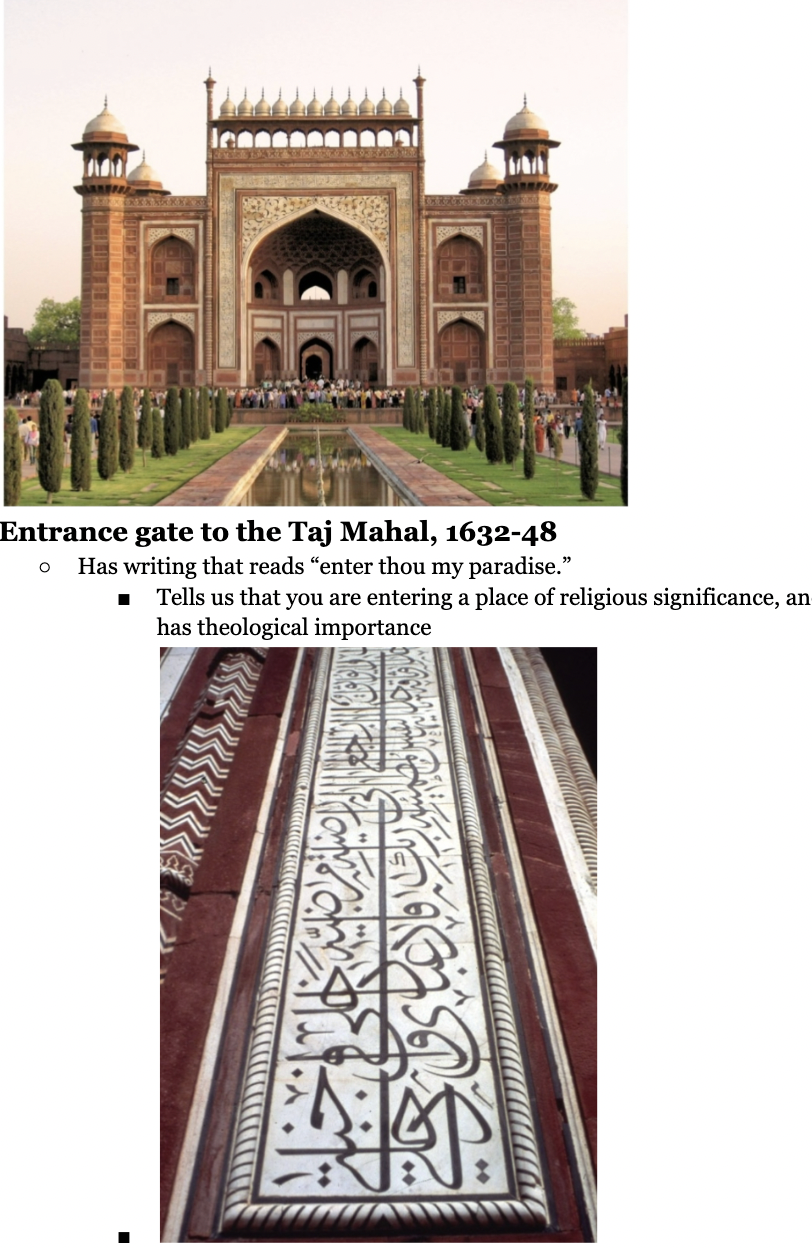
  • Entrance gate to the Taj Mahal, 1632-48

    • Has writing that reads “enter thou my paradise.”

      • Tells us that you are entering a place of religious significance, and the building complex has theological importance

    • The building is not pure white, beocmes clearer the more you keep looking at it: a combination of religious text, abstract geometric ornament, and lavish flower ornaments

      • semi-precious stones (72 pieces) that are inlaid in each of the flowers

    • Taj Mahal is a muslim building that is open to cultural influences from elsewhere → was one of several splendid complexes that were built along a river of trade arteries

      • Some of the earliest representations of the Taj Mahal were from the back → backed up on this trade artery
<ul><li><p><span style="background-color: transparent;"><span>Romantic Story: The Taj Mahal was built by the collaboration between patron Jahad and architect Lahori, as a memorial to Jahad’s beloved wife, whose last name is Mahal.</span></span></p><ul><li><p><span style="background-color: transparent;"><span>She was not his only wife, died having their 14th child, Jahan’s deep love for this woman kept him going for a long time, as seen by the time spent on this enormous Mausoleum</span></span></p><ul><li><p><span style="background-color: transparent;"><span>Contains Mahal’s tomb</span></span></p></li></ul></li><li><p><span style="background-color: transparent;"><span>Mahal asked Jahan to be close to their children on her deathbed. It was said that after he was imprisoned by one of his children he would look through a diamond to see the progress of the Taj Mahal</span></span></p></li></ul></li><li><p><span style="background-color: transparent;"><span>Energy helps us see how, over time, the Taj Mahal has become a romantic story</span></span></p><ul><li><p><span style="background-color: transparent;"><span>For a very long time, the area that we refer to as India was controlled by the invading imperial forces of GB, creating a power imbalance between Britain and India, which led Paul Mellon to collect a giant art collection of what he dubbed British Art, consisting of nothing but what was made in the British part of the empire.</span></span></p></li></ul></li><li><p><span style="background-color: transparent;"><span>Taj Mahal is like a teardrop on history, the idea of the Taj Mahal&nbsp; as a dematerialized building that is an idealized teardrop</span></span></p><ul><li><p><span style="background-color: transparent;"><span>Most sought after visits of the Taj Mahal are even more dematerializing: visited under moonlight, it looks like its own reflection in a central lane of water → building itself is a reflection of a watery romantic truth</span></span></p></li></ul><ul><li><p><span style="background-color: transparent;"><span>There is a Hindu-Muslim battle going on over the religious origins of the building, something that is easily tampered with in the story of the romance</span></span></p></li></ul></li><li><p><span style="background-color: transparent;"><strong><span>Entrance gate to the Taj Mahal, 1632-48</span></strong></span></p><ul><li><p><span style="background-color: transparent;"><span>Has writing that reads “enter thou my paradise.”</span></span></p><ul><li><p><span style="background-color: transparent;"><span>Tells us that you are entering a place of religious significance, and the building complex has theological importance</span></span></p></li></ul></li><li><p><span style="background-color: transparent;"><span>The building is not pure white, beocmes clearer the more you keep looking at it: a combination of religious text, abstract geometric ornament, and lavish flower ornaments</span></span></p><ul><li><p><span style="background-color: transparent;"><span>semi-precious stones (72 pieces) that are inlaid in each of the flowers</span></span></p></li></ul></li><li><p><span style="background-color: transparent;"><strong><span>Taj Mahal is a muslim building that is open to cultural influences from elsewhere </span></strong><span>→ was one of several splendid complexes that were built along a river of trade arteries</span></span></p><ul><li><p><span style="background-color: transparent;"><span>Some of the earliest representations of the Taj Mahal were from the back → backed up on this trade artery</span></span></p></li></ul></li></ul></li></ul><p></p>
37
New cards
<p><span style="background-color: transparent;"><strong><span>The Shah’s Wise Men Approve of Zal’s Marriage Identifiers</span></strong></span></p>

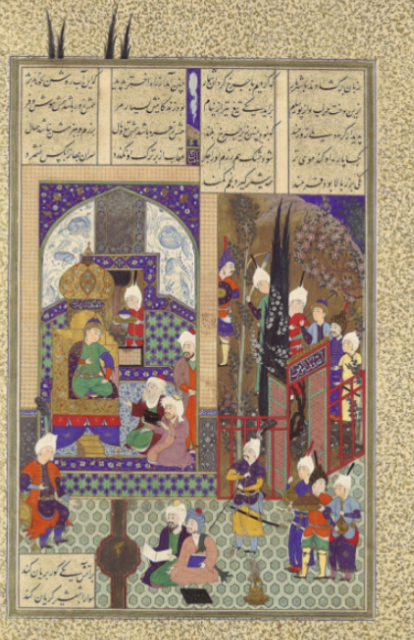
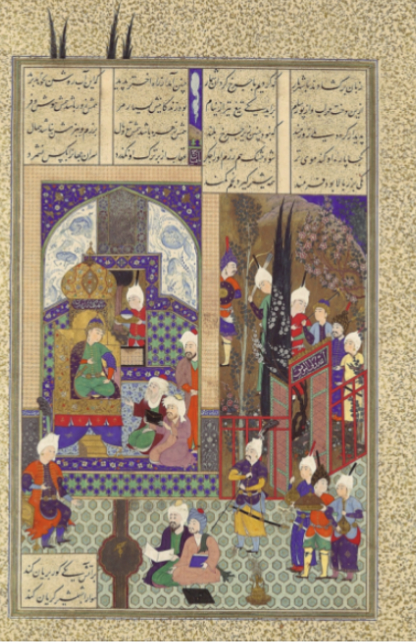
The Shah’s Wise Men Approve of Zal’s Marriage Identifiers

‘Abd al-’Aziz, ca. 1525-30. Page from an illustrated manuscript from the Shanama (Book of Kings) of Shah Tahmasp, poem by Abu’l Qasim Firdausi (935-1020). 31.8 x 18.3 cm
38
New cards
<p><span style="background-color: transparent;"><strong><span>The Shah’s Wise Men Approve of Zal’s Marriage Notes</span></strong></span></p>

The Shah’s Wise Men Approve of Zal’s Marriage Notes

  • Includes really old writing → a poem, preference for poetry over prose

  • How many zones of meaning are in this painting? → like a kaleidoscope, so many facets of meaning that are interlocked/overlayed to create a composite of word, image, figural representation, and pattern

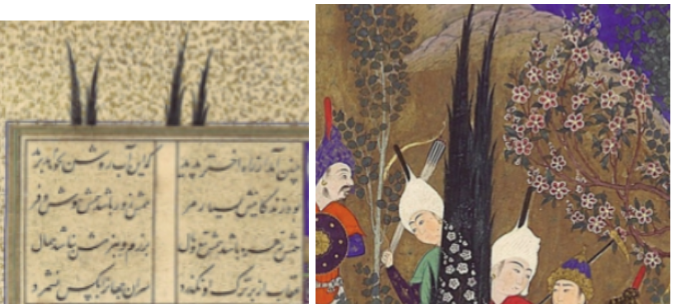
The subconscious by which this is done is summarized in the Tree-tops extending into the hashiya border

  • You have 4 little tops of trees that are somehow extending in front of and behind flat forms of representation

    • Tells us there is extreme self-consciousness at work here

  • Like the other kind of image in the garden, there is a great sense of exclusion, a whole other cluster of people around the portal to garden

    • Even once you are inside the place, there are so many different zones and barriers you need to cross to reach the barrier that holds the king
<ul><li><p><span style="background-color: transparent;"><span>Includes really old writing → a poem, preference for poetry over prose</span></span></p></li><li><p><span style="background-color: transparent;"><span>How many zones of meaning are in this painting? → like a kaleidoscope, so many facets of meaning that are interlocked/overlayed to create a composite of word, image, figural representation, and pattern</span></span></p></li></ul><p><span style="background-color: transparent;"><span>The subconscious by which this is done is summarized in the </span><strong><span>Tree-tops extending into the hashiya border</span></strong></span></p><ul><li><p><span style="background-color: transparent;"><span>You have 4 little tops of trees that are somehow extending in front of and behind flat forms of representation</span></span></p><ul><li><p><span style="background-color: transparent;"><span>Tells us there is extreme self-consciousness at work here</span></span></p></li></ul></li></ul><ul><li><p><span style="background-color: transparent;"><span>Like the other kind of image in the garden, there is a great sense of </span><strong><span>exclusion,</span></strong><span> a whole other cluster of people around the portal to garden</span></span></p><ul><li><p><span style="background-color: transparent;"><span>Even once you are inside the place, there are so many different zones and barriers you need to cross to reach the barrier that holds the king</span></span></p></li></ul></li></ul><p></p>
39
New cards
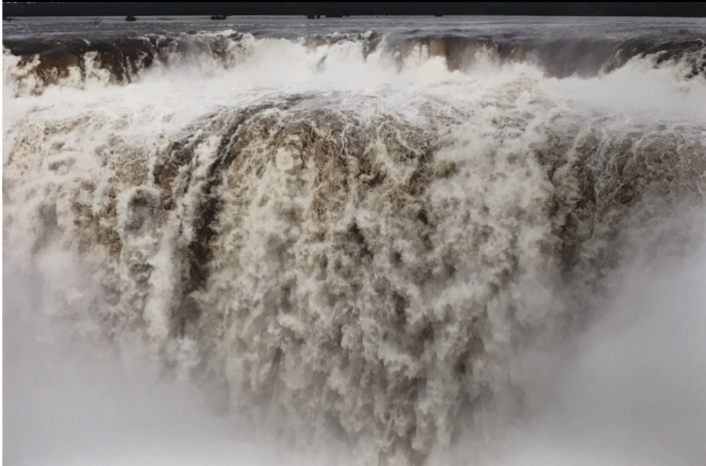
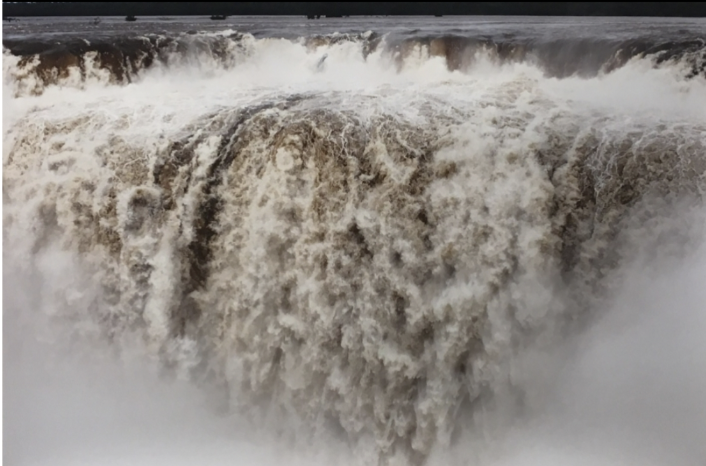
<p><span><strong><span>Iguazú Identifiers</span></strong></span></p>

Iguazú Identifiers

Wolfgang Tillmans, 2010.C-print mounted on aluminum, huge + veryyyyyy expensive
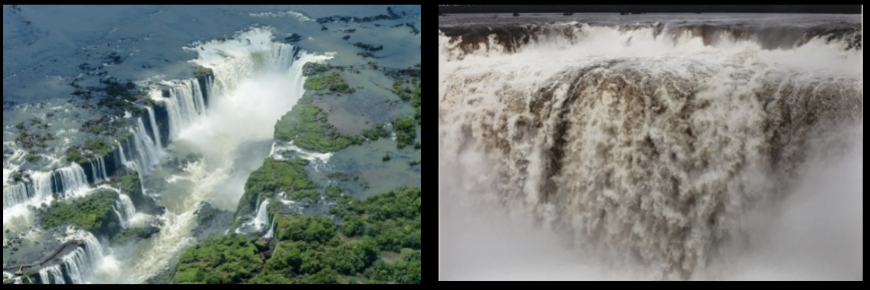
<p><span><strong><span>Wolfgang Tillmans, 2010.C-print mounted on aluminum, huge + veryyyyyy expensive</span></strong></span></p>
40
New cards
<p><strong><span>Iguazú Notes</span></strong></p>

Iguazú Notes

  • Extremely large and mounted on aluminum

  • The subject is so simple at first glance: a waterfall

    • Subtly: Takes us to the precipice, so that we understand the whole drama of how a waterfall happens out of nowhere

    • As the water falls, this mist gets created just by the force of the water and its impact → composing the not-so-symmetrical foreground of the image

      • Foreground: made up of something so insubstantial that it’s close to nothing

      • A subtle curve towards the top of the image indicates a nest made for the viewer → we are hovering in the middle of the air, magically suspended above the ground, away from the waterfall, so we are not in danger, feeling the dull force of an aquatic rush, but we still feel safe

  • Part of the border between Argentina and Brazil, so much water is pouring over that it seems to be another world

  • So many dramatic points along the cleft where the water is rushing. The depth of the falls is what makes them so geographically striking, 

    • The larger photo gives us a sense of tremendous power, and also makes us feel tremendously small when faced with the forces of nature

  • Tillmans is determined that photography operates on the same level as what we define as fine art

    • Making his photographs huge about subjects that have huge philosophical inquiry to them is a very conscious move, inserting photography into a lineage of art that deals with serious issues
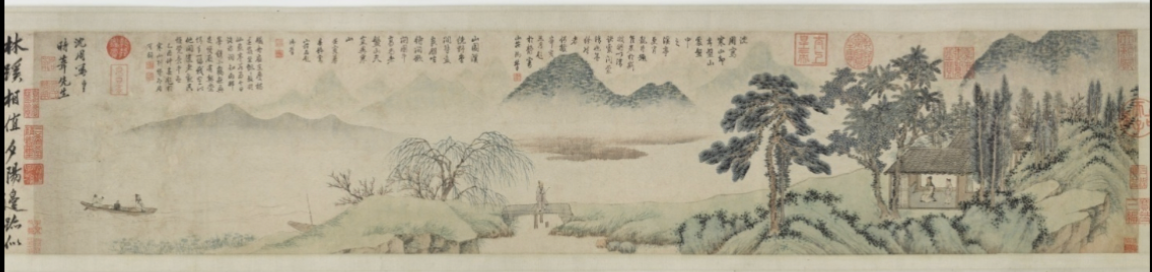
41
New cards
<p><span><strong><span>A Spring Gathering Identifiers</span></strong></span></p>

A Spring Gathering Identifiers

Shen Zhou, 1491.
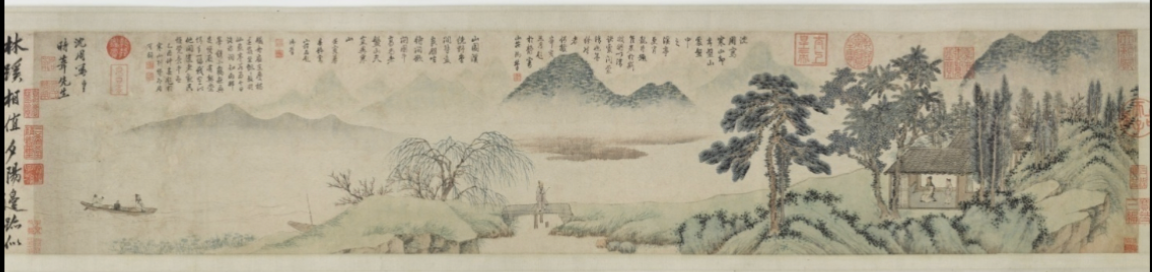
42
New cards
<p><span><strong><span>A Spring Gathering Notes</span></strong></span></p>

A Spring Gathering Notes

  • Right to Left: Scenes of mountains and trees that make a nest for a small dwelling on the right, in which 2 isolated human beings direct their attention to the trees - contemplating - then contemplate the magically space that we understand to be a lake (mountains, mist, more trees, more mountains, larger body of water) arrival of 2 more figures into a space that has been contemplated

    • As this is happening, there is writing around the image

  • All you need is a few kindred souls: 

    • How much Wen Zhengming agrees with Zhou’s view of the world as written on the art

  • “It is a pity when painting eclipses poetry” to help us understand the largest share of surface area in the totality of the artwork that contains a spring gathering, consists of

  • There are 5 inscriptions on Spring Gathering by the Qianlong emperor: generations would come back to this painting and join in this community of painting and writing, so crucial to understand why some works in Chinese art history are more important for students to know about than other

    • Not just about the picture: about the tangible marks of how people have looked at this picture and found something they identify with

  • People open this scroll by unrolling it: experiencing the scroll in a long continuous session of contemplation and admiration, unfolding fo the scene is natural

    • Rhythm of image and appreciation is crucial to the whole experience
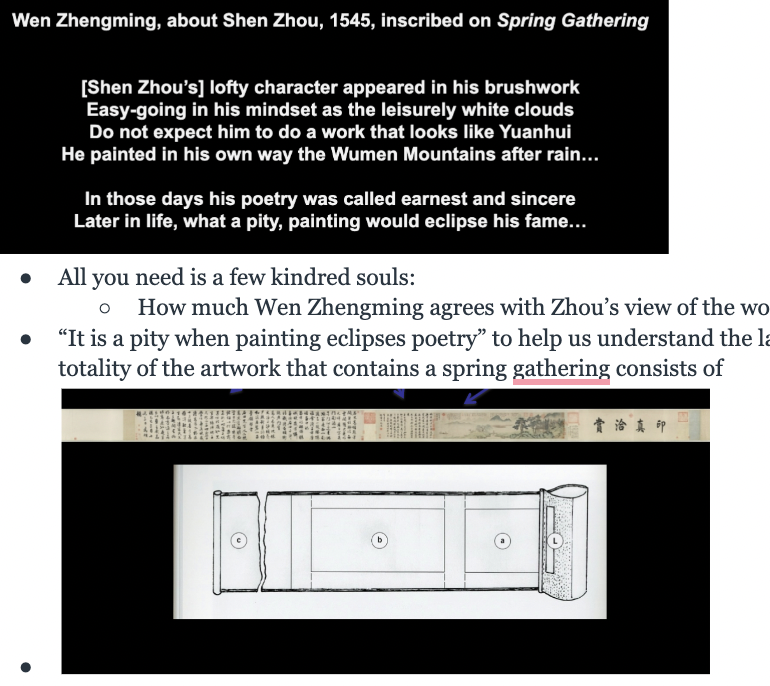
<ul><li><p><span><strong><span>Right to Left:</span></strong><span> Scenes of mountains and trees that make a nest for a small dwelling on the right, in which 2 isolated human beings direct their attention to the trees - contemplating - then contemplate the magically space that we understand to be a lake (mountains, mist, more trees, more mountains, larger body of water) arrival of 2 more figures into a space that has been contemplated</span></span></p><ul><li><p><span><span>As this is happening, there is writing around the image</span></span></p></li></ul></li><li><p><span><span>All you need is a few kindred souls:&nbsp;</span></span></p><ul><li><p><span><span>How much Wen Zhengming agrees with Zhou’s view of the world as written on the art</span></span></p></li></ul></li><li><p><span><span>“It is a pity when painting eclipses poetry” to help us understand the largest share of surface area in the totality of the artwork that contains a spring gathering, consists of</span></span></p></li><li><p><span><span>There are 5 inscriptions on Spring Gathering by the Qianlong emperor: generations would come back to this painting and join in this community of painting and writing, </span><strong><span>so crucial to understand why some works in Chinese art history are more important for students to know about than other</span></strong></span></p><ul><li><p><span><span>Not just about the picture: about the tangible marks of how people have looked at this picture and found something they identify with</span></span></p></li></ul></li><li><p><span><span>People open this scroll by unrolling it: experiencing the scroll in a long continuous session of contemplation and admiration, unfolding fo the scene is natural</span></span></p><ul><li><p><span><strong><span>Rhythm of image and appreciation is crucial to the whole experience</span></strong></span></p></li></ul></li></ul><p></p>
43
New cards
<p><span><strong><span>The Waterfall at Mount Lu Identifiers</span></strong></span></p>

The Waterfall at Mount Lu Identifiers

Shitao, ca. 1699-1702.
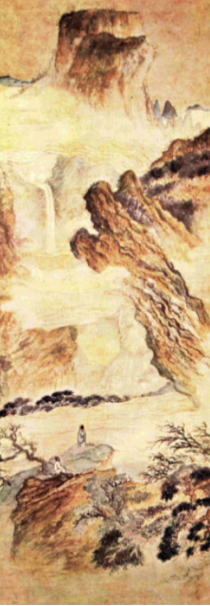
44
New cards
<p><span><strong><span>The Waterfall at Mount Lu Notes</span></strong></span></p>

The Waterfall at Mount Lu Notes

  • Not just copying Shen Zhou, many artists came back to make images of Mount Lu, about the persistence of tradition

  •  Shows us the importance of the importance between the tiny figures and the immensity of the scenes they contemplate

    • All of these artists - centuries apart - are helping us understand that the relationship between the individual and landscape is an issue of understanding where and how we belong in the world, which transcends time

      • Forces us to question who we are in the immensity of nature. How does one express their relationship to the forces of nature?

        • How can we accept that we are small when it is just an important human thing to confront this question and represent it over and over again?x

    • This is a question we have to keep coming back to, but we can never answer it the same way

    • Tillman goes back to this question to try to answer who we are in the immensity of nature
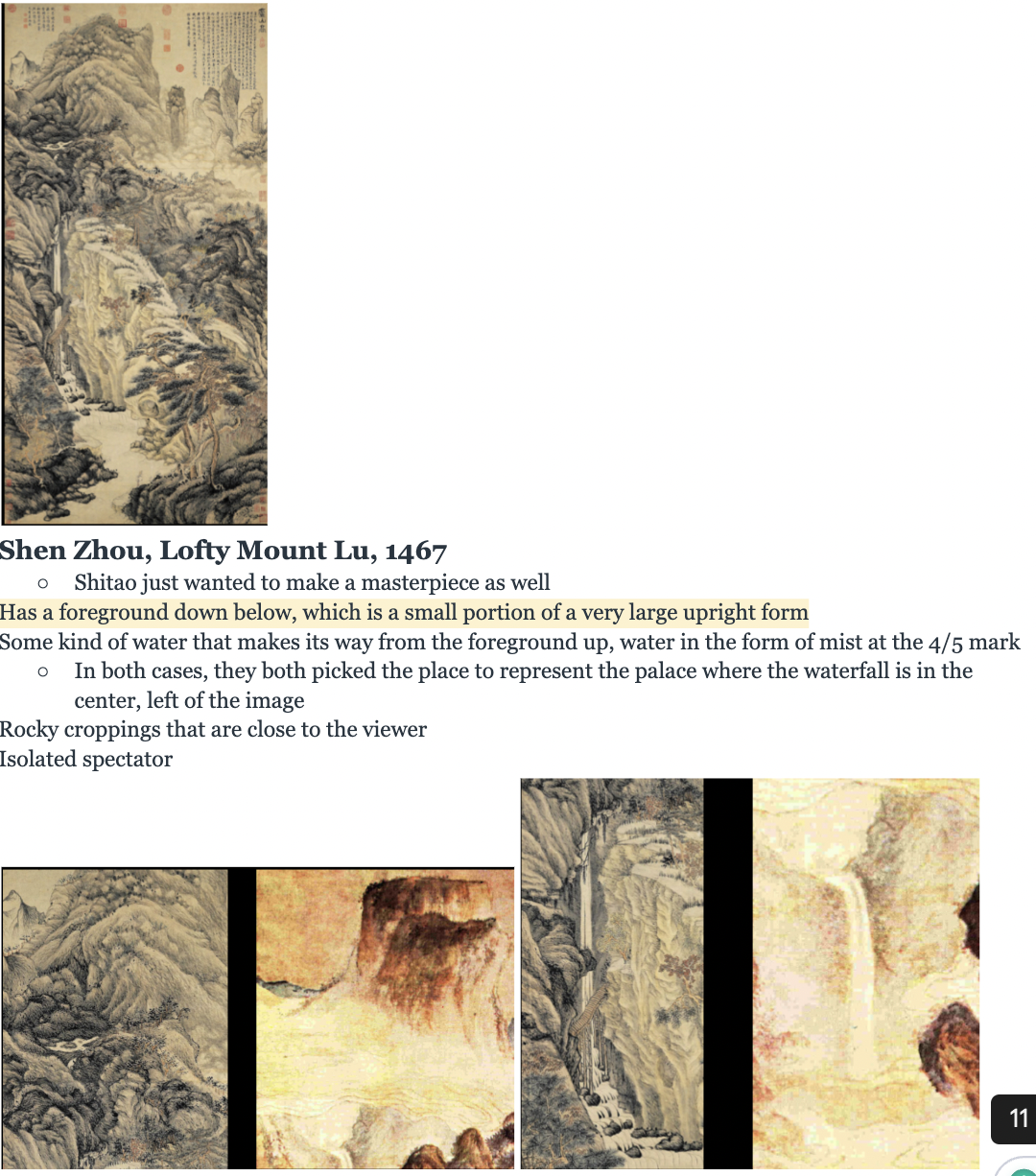
<ul><li><p><span><span>Not just copying Shen Zhou, many artists came back to make images of Mount Lu, about </span><strong><span> the persistence of tradition</span></strong></span></p></li><li><p><span><span>&nbsp;Shows us the importance of the importance between the tiny figures and the immensity of the scenes they contemplate</span></span></p><ul><li><p><span><span>All of these artists - centuries apart - are helping us understand that the relationship between the individual and landscape is an issue of understanding where and how we belong in the world, which transcends time</span></span></p><ul><li><p><span><span>Forces us to question who we are in the immensity of nature. How does one express their relationship to the forces of nature?</span></span></p><ul><li><p><span><span>How can we accept that we are small when it is just an important human thing to confront this question and represent it over and over again?x</span></span></p></li></ul></li></ul></li><li><p><span><span>This is a question we have to keep coming back to, but we can never answer it the same way</span></span></p></li><li><p><span><strong><span>Tillman goes back to this question to try to answer who we are in the immensity of nature</span></strong></span></p></li><li><p></p></li></ul></li></ul><p></p>
45
New cards
<p><span style="background-color: transparent;"><strong><span>Rashid Johnson, </span><em><span>Or Down You Fall</span></em><span>, from the Bruise series, 2021.Oil on linen, NOTES</span></strong></span></p>

Rashid Johnson, Or Down You Fall, from the Bruise series, 2021.Oil on linen, NOTES

  • Oil painting: a classic medium of painting

  • Very substantially large –. Conscious that he is making something monumental

  • A painting that is very close to being abstract, and yet invokes many interlocking meanings

  • The whole series is called Bruise: an injury that manifests itself as being black and blue, pairs of ovals are references to black eyes and brusing

  • Or down you fall: initially, a very innocent statement of fact → refers to African-American history

    • The Bluest Eye by Toni Morrison

  • Despite the installations that have garnered critical acclaim, the star of the whole show at the guggenheim were Johnson’s paintings → mostly paintings from the Bruise series

  • Reason 1: In choosing a modular repetition as  part of the tactics of the bruise series, Johnson allowed himself to make many paintings in the series that are distinguished by the number of modular units → malleability of scale

    • All important personal freedom that oil painting, brushed on canvas gives an artist

    • In a purely painterly way, each of these modules gives Johnson a license to express himself

    • Painting allows him to brush very thinly, to barely scrape the surface, to produce the impression of a stain of color that is magically different every time

      • Emphasizes the dynamism of his hand and the nimbleness of his mind
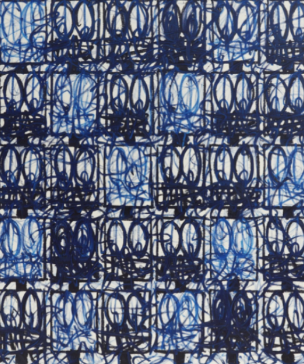
<ul><li><p><span style="background-color: transparent;"><span>Oil painting: a classic medium of painting</span></span></p></li><li><p><span style="background-color: transparent;"><span>Very substantially large –. Conscious that he is making something monumental</span></span></p></li><li><p><span style="background-color: transparent;"><span>A painting that is very close to being abstract, and yet invokes many interlocking meanings</span></span></p></li><li><p><span style="background-color: transparent;"><span>The whole series is called Bruise: an injury that manifests itself as being black and blue, pairs of ovals are references to black eyes and brusing</span></span></p></li><li><p><span style="background-color: transparent;"><span>Or down you fall: initially, a very innocent statement of fact → </span><strong><span>refers to African-American history</span></strong></span></p><ul><li><p><span style="background-color: transparent;"><strong><span>The Bluest Eye by Toni Morrison</span></strong></span></p></li></ul></li><li><p><span style="background-color: transparent;"><span>Despite the installations that have garnered critical acclaim, the star of the whole show at the guggenheim were Johnson’s paintings → mostly paintings from the Bruise series</span></span></p></li><li><p><span style="background-color: transparent;"><strong><span>Reason 1:</span></strong><span> In choosing a modular repetition as&nbsp; part of the tactics of the bruise series, Johnson allowed himself to make many paintings in the series that are distinguished by the number of modular units → malleability of scale</span></span></p><ul><li><p><span style="background-color: transparent;"><strong><span>All important personal freedom that oil painting, brushed on canvas gives an artist</span></strong></span></p></li><li><p><span style="background-color: transparent;"><span>In a purely painterly way, each of these modules gives Johnson a license to express himself</span></span></p></li><li><p><span style="background-color: transparent;"><span>Painting allows him to brush very thinly, to barely scrape the surface, to produce the impression of a stain of color that is magically different every time</span></span></p><ul><li><p><span style="background-color: transparent;"><span>Emphasizes the dynamism of his hand and the nimbleness of his mind</span></span></p></li></ul></li></ul></li></ul><p></p>
46
New cards
<p><span style="background-color: transparent;"><strong><span>Poussin, Self-Portrait, 1650 IDENTIFIERS</span></strong></span></p>

Poussin, Self-Portrait, 1650 IDENTIFIERS

  • Examine how, in his self-image, Poussin creates a background of paintings

    • Paintings within paintings

    • Even the doorway looks like a heavenly framed painting as Poussin presents it

  • Holding a drawing folder in his hand, extreme identification ot the folder is made clear with his alignment with his signet ring down the edge of the folder (my ring, my folder)

  • The painting within the painting are remarkably devoid of things, very blank, writing on one of them

    • Playing between word and image

  • There is something represented in the left painting: the embodiment of the idea of painting in the form of a woman with her profile with her crown → being embraced by an unseen figure that is likely Poussin himself

    • Paradoxically: most austere kind of painting you could be doing in the 17th century

  • We know what Poussin is refusing

  • Louis the 14th found out that Poussin was  a talented painter, invited him to coem to the royal court for his paintings to become royal tapestries

    • Poussin wasn’t interested revered te subject matter of painting, royal patrons made it so he didn’t need to take the job → they were largely protestant

  • With Poussin, patrons didn't have to compromise, and could have austerity with simplicity

  • Poussin and his intellectual circle looked back to italian renaissance art to realzie they doul never be better that what is already done, they can only be better

    • Though Raphael was the best

  • 17th century artist led by Poussin thought that drawing was the essential foundation for this superior form of painting
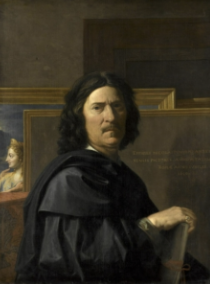
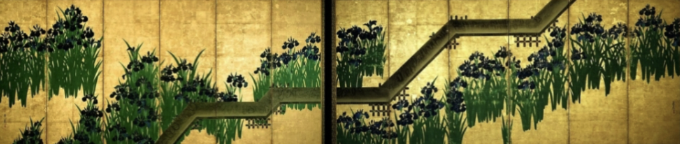
<ul><li><p><span style="background-color: transparent;"><span>Examine how, in his self-image, Poussin creates a background of paintings</span></span></p><ul><li><p><span style="background-color: transparent;"><span>Paintings within paintings</span></span></p></li><li><p><span style="background-color: transparent;"><span>Even the doorway looks like a heavenly framed painting as Poussin presents it</span></span></p></li></ul></li><li><p><span style="background-color: transparent;"><span>Holding a drawing folder in his hand, extreme identification ot the folder is made clear with his alignment with his signet ring down the edge of the folder (my ring, my folder)</span></span></p></li><li><p><span style="background-color: transparent;"><span>The painting within the painting are remarkably devoid of things, very blank, writing on one of them</span></span></p><ul><li><p><span style="background-color: transparent;"><span>Playing between word and image</span></span></p></li></ul></li><li><p><span style="background-color: transparent;"><span>There is something represented in the left painting: the embodiment of the idea of painting in the form of a woman with her profile with her crown → being embraced by an unseen figure that is likely Poussin himself</span></span></p><ul><li><p><span style="background-color: transparent;"><span>Paradoxically: most austere kind of painting you could be doing in the 17th century</span></span></p></li></ul></li><li><p><span style="background-color: transparent;"><span>We know what Poussin is refusing</span></span></p></li><li><p><span style="background-color: transparent;"><span>Louis the 14th found out that Poussin was&nbsp; a talented painter, invited him to coem to the royal court for his paintings to become royal tapestries</span></span></p><ul><li><p><span style="background-color: transparent;"><strong><span>Poussin wasn’t interested revered te subject matter of painting, royal patrons made it so he didn’t need to take the job → they were largely protestant</span></strong></span></p></li></ul></li></ul><ul><li><p><span style="background-color: transparent;"><span>With Poussin, patrons didn't have to compromise, and could have austerity with simplicity</span></span></p></li><li><p><span style="background-color: transparent;"><span>Poussin and his intellectual circle looked back to italian renaissance art to realzie they doul never be better that what is already done, they can only be better</span></span></p><ul><li><p><span style="background-color: transparent;"><span>Though Raphael was the best</span></span></p></li></ul></li><li><p><span style="background-color: transparent;"><span>17th century artist led by Poussin thought that drawing was the essential foundation for this superior form of painting</span></span></p></li></ul><p></p>
47
New cards
<p>Ogata Kōrin, Irises at 8 Bridges, ca. 1710. Pair of six-panel folding screens; ink and color on gold leaf on paper. NOTES</p>

Ogata Kōrin, Irises at 8 Bridges, ca. 1710. Pair of six-panel folding screens; ink and color on gold leaf on paper. NOTES

  • The bridge is seen from a totally different vantage point from above, the whole thing is against the surreal goldspace of the background

  • We are hinted that each of the 2 screen swifts, each of their 6 parts are meant to be put together, as when examined together, they look like a belt put together (when the border is taken out)

  • The painter does the composition in his mind, imagining an infinite number of permutations in which the composition can survive

  • Level of confidence in these paintings to rival the greatest poems, all pushing forward a part of the 12-part panel

    • An acrostic poem: first syllables of the lines of the poem make the word Irises

    • Created a whole other level of  wit and play → managed to make an acrostic screen, translating the acrostic poem onto pege

    • Kakitsubata = irises

48
New cards

Baxandall, The Period Eye

  • Cognitive style

    • If someone who is educated or knows about the subject matter and the way that it is portrayed, one is more likely to be able to interpret it 

      • Period Eye: Something we are equipped with, culturally situated, historically specific

        • taste: often what is considered taste is associated with the viewer’s ability to feel like they can self-assert a sort of profession by using their set of interpretive skills

        • Social institutions: 

          • Individuals’s class and cultural positioning changing their perspective and interpetaive skills 

          • Patrons can permeate style (secondary to individual perspective)

  • Our vision is stereoscopic: Complex ocular data, broken down into patterns you will recognize

  • Requires the viewer entering the “game” (willing suspension of disbelief)

    • Not physically possible for one to be deceived by a picture and think it’s something real… cuz our vision is stereoscopic 

49
New cards

Anderson, David’s Ankles

  • David’s ankles are cracked; the center of gravity at the base doesn’t align with the center of gravity of the figure, putting pressure on his narrowest part: his ankles

    • The idea of perfection can be conveyed through a very powerful and commanding presence → hides miniature imperfections

  • The perfection of David started with a mistake, an imperfection: a discolored piece of marble his assistant chose that no one else wanted → Michelangelo’s genius

50
New cards

MacGregor, Durer’s Rhino

  • Dürer never actually saw a Rhino, solely based on a written description → became the standard image of rhinos in Europe for text and image

    • Perceived as a true likeness, even though an inaccurate representation → what constitutes a canon, what defines realism, what is realistic? 

      • Images trusted as information: 15th 16th Northern Europe Realism

51
New cards

Svetlana Alpers: the Art of Describing – Dutch Art in the Seventeeth Century

  • Reflecting your world, not meant to be offering a window into the world

    • Van Eyck: leaves no room for the viewer in the Arnolfini, literally and figuratively → an inventory of things, descriptive (art of describing), overseeing every little detail

  • Camera obscura: Closest art can ever get to a photograph: artists project an image and trace it, lots of controversy on if Jan Vermeer ever used this

    • Vs. Italian Renaissance paintings: Dutch paintings are more about recording, and Italian paintings are more about romantic narratives

      • Italian painters deliberately sought to “trick” the viewer’s vision with perspective and such 

    • Dutch believed that representation CAN be objective and the painting is a substitute for your eye, literally descriptive, painting as image

52
New cards

De Button, In What Style Shall We Build?

  • Breaking down classical architecture, as such strong limitations led to a local architectural language that allowed people to be unrestrained, especially when building private residences

    • Palladio, Villa Rotunda, 1556-71.

      • Classical architectural vocabulary that becomes the reference point going forward, an exercise to demonstrate the use of the simplest geometric forms

        • Rotunda, pediment (ancestor of A-frame), capitals, columns, base….

        • 4 equidistance entrances and exits

  • Throughout this chaos male-dominated field of engineering at the time decided that engineering should take the forefront in architecture rather than aesthetic language

    • Still generated a distinct architectural style, giving way to modernism, a new aesthetic that highlights the beauty of restraint and clean design in architecture

    • Architectural value that we should embody the values we want to live by, rather than merely how we want things to look → Makes sense when transporting designs to constructions

      • Ex. beautiful building, but does it have proper irrigation

53
New cards

Wittkower, Principles of Palladio’s Architecture

  • Palladio loved a variation of symmetry of geometric shapes

    • Intersecting temple fronts were unconventional, but still fulfilled all the ideas of classical architecture, and were still symmetrical

      • Interpretations of the classics don’t need to be stagnant

    • He is measured and respects the tenets of architectural classics, while bringing a systematic approach to symmetrical ground plans… 

  • Big on architectural education to be informed and have the vocabulary to innovate, and the print of the plans to show and explain architectural history

54
New cards

Hyman, Inventing Painting

  • Inventor: situates an artist in the invention and the notion of the performance of having invented

    • Utilising European pictorial motifs to crystallize their aspirations in the world of art, being defined by the accreditation of invention

    • Wrote (printing) “By his hand” → signature of invention, and bold claim of originality

    • Prints and copies were used to transport the accepted Catholic church’s painting canons to “New Spain,” did this colonial traffic of art in print collapse the distance between the New World and Europe?

55
New cards


Juneja, On the Margins of Utopia: one more look at mughal painting

  • Utopia is an ideal located in the present, constituted by the present

  • Art is conceptualized in spaces where the force of ideal visions could be undermined, though art claims to explore these ideal visions

  • Creation of utopia: tension between the ideal and the possibility of the failure of that vision

  • Paintings in Mughal Court: these were emotive things, conceptualized as a medium of recording history

    • Magical qualities: power to create through the sheer force of imagination, a vision that can become omnipresent → displayed monarchical power of patronage

    • Narratives formed part of a present day that was eternalized, utopian ideal could be realized in the present with representation

    • Not a site for bodily perversion/representing the other → the margins of painting became a place of self-inscription/insertion for the medieval artist

      • What creates utopia takes it away, because it exists in reality, that isn’t Utopia

        • Making painterly presence known is the only way to turn vision into representation

  • Royal portraiture was where a lot of utopian ideals were located

    • Darshan: sight, vision, beholding (sanskrit), these images were located at the intersection of sacrality and mysticism, eternalizing people that were once with us - and once so important - but no longer are → past rulers

      • Animated by a ritual of viewing

56
New cards

Farago, Jason, What a Tiny Masterpiece Reveals About Power and Beauty

  • The MAN; Shah Jahan, the Mughal emperor – King of the World

    • His bearing

    • An incandescent beauty: the clouds part to let him shine

    • Painted as an icon of stability, formal, stiff, stands apart from the world

    • Court art, tightly controlled by the King himself

    • Political meaning: here, I am king

  • Four centuries ago, religion and culture flowed to make a new Indian art

    • Courtly, refined, but also eye-poppingly luxurious 

    • The Mughal Empire was very rich, a powerhouse of global trade, and reached its peak under Shah Jahan, and he dropped some bands on architecture, gardens, jewelry, and paintings

  • Scale

    • Small yet delicate, showing off skill and value

  • Cosmopolitanism and cultural hybridity

    • Hindu, Islamic, and Christian motifs all blended into images of the highest prestige

    • Persia:

      • 14th-15th: Artists and scribes crafted intricate manuscripts expressing their patrons’ religious piety and earthly wealth

      • 16th century Mughal Empire got richer and more stable, artists wed Persian line to Indian color → liveliness, and more refined compositions

57
New cards


Ledderose, Freedom of the Brush

  • In China, architecture belonged to the domain of the civil engineer, and calligraphy was the highest artistic position

    • Everything that we would retroactively consider art now, wasn’t necessarily at the time

    • They chronicled things that would be considered art: painting and script 

  • Many treat pieces from China in accordance with the modern Western concept of aesthetic purpose being the most important feature of a piece

    • The Aesthetic Ambition of Calligraphy

      • Calligrapher: has an elevated social status and more aesthetic ambition than a scribe.

    • The literati have a broad stylistic range, emphasizing social cohesion → became a class

    • A Chinese calligrapher can hardly ever invent his own abbreviations

      • Script: was collected for its aesthetic value, the quality of handwriting itself

    • The Aesthetic Ambition of Painting

      • Not as strict as for calligraphers, still must render objects in composition with legibility

      • Modular Paintings:  modular systems (brush strokes, compositions, motifs) + individuality are 2 sides of the same coin that work together to create creativity

Painting: paintings with literary quality were given preference by collectors. Ultimately, the scope of what was collected in China broadened over time + notion that not everything beautiful can be considered art

58
New cards

Clunas, Superfluous Things, Material Culture, and Social Status in Early Modern China

  • This worldwide explosion of luxurious things, and the Chinese reaction to it

  • Objects owned by the elites in China may actually function as reflections of the systems of the higher society

  • Superfluous doesn’t mean meaningless

  • Even items as non-essential can shape cultural values → reveal consumption as a cultural practice

    • Consumption isn’t random, taste isn’t garnered arbitrarily

  • Shows the systems by which all items gain value, with the historical context of late imperial China (a time of urban growth and commerce, introducing the habit of collection)

    • Brought attention to objects and material culture\

  • The document argues that superfluous objects are essential to understanding and reflecting cultural context

59
New cards

MacGregor, Jade Bi

  • For enlightened Europe, China was a model state, governed by learned emperors

    • Emperor Qianlong: China’s population doubled, economy boomed

      • Qianlong was a shrewd intellectual with a passion for collecting art pieces

  • Bi: strange and intriguing object, pale beige disc of jade that is the size of a small dinner plate with a hole in the middle and a raised edge around it

    • Was moved to write a poem about the bi

  • The Emperor has ensured that the bi fulfilled its aesthetic destiny by combining it with a much later object

    • Very 18th-century way of addressing the past in China: internalzing the work to create new art, typically with the addition of calligraphy

  • Greatest act: complete library of the four treasuries, largest anthology of writing in human history, encompassing the whole canon of Chinese writing

  • Reflecting the cultural authority of China’s imperial past