DAT BIOLOGY SECTION
 Studied by 1 person
 Call Kai
 Learn
Learn Practice Test
 Spaced Repetition
 Match
Match Flashcards
 Knowt Play
1/105

There's no tags or description
Looks like no tags are added yet.
Name | Mastery | Learn | Test | Matching | Spaced | Call with Kai |
|---|
No analytics yet
Send a link to your students to track their progress
106 Terms
Matter
Anything that takes up space and has mass
Element
pure substance that has specific physical/chemical properties and cannot be broken down into a simpler substance
Intramolecular forces
attractive forces that act on atoms within a molecule
Intermolecular forces
forces that exist between molecules and affect physical properties of the substance
Monomers
single molecules that can potentially polymerize
polymers
substances made up of many monomers joined together in chains
Carbohydrates contain:
carbon, hydrogen, and oxygen atoms (CHO)
monosaccharides
carbohydrate monomers with empirical formula of (CH2O)n. “n” is the number of carbons
disaccharides
contain 2 monosaccharides joined together by glycosidic bond.
What is the result of a dehydration (condensation) reaction?
a disaccharide
Hydrolysis reaction
covalent bond is broken by the addition of water
Sucrose
disaccharide made of glucose and fructose
Lactose
disaccharide made of galactose and glucose
Maltose
Disaccharide made of glucose and glucose
Polysaccharides
contain multiple monosaccharides connected by glycosidic bonds to form long polymers
Starch
form of energy storage for plants and is an alpha bonded polysaccharide
Linear starch
Amylose
Branched starch
Amylopectin
Glycogen
form of energy storage in animals and is an alpha bonded polysaccharide. Has much more branching than starch
Cellulose
structural component in plant cell walls, and is a beta bonded polysaccharide. linear strands packed rigidly in parallel
Chitin
structural component in fungi cell walls and insect exoskeletons. It is a beta bonded polysaccharide with nitrogen added to each monomer
What do proteins contain?
Carbon, hydrogen, oxygen and nitrogen atoms (CHON)
What do atoms in proteins combine to form?
Amino acids
Amino acids link together to build what?
Polypeptides (or proteins)
Proteome
all the proteins expressed by one type of cell under one set of conditions
Amino acids
monomers of proteins and have this structure:
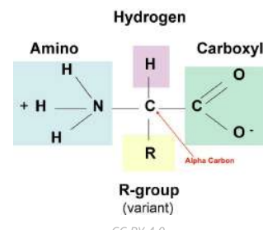
How many different kinds of amino acids are there?
20, each have a different R-group
Polypeptides
polymers of amino acids and are joined by peptide bonds through dehydration condensation reactions. Hydrolysis reactions break peptide bonds
N-terminus (amino terminus) of polypeptide
side that ends with the last amino acid’s amino group
C-terminus (carboxyl terminus)
side that ends with the last amino acid’s carboxyl group
conjugated proteins
proteins composed of amino acids and non-protein components. Includes: metalloproteins and glycoproteins
Metalloproteins
(ex: hemoglobin) proteins that contain a metal ion cofactor
Glycoproteins
(ex mucin) proteins that contain a carbohydrate group
Primary protein structure
sequence of amino acids connected through peptide bonds
Secondary protein structure
intermolecular forces between the polypeptide backbone (not R-groups) due to hydrogen bonding. Forms alpha helices or beta pleated sheets
Tertiary protein structure
3D structure due to interactions between R groups. Can cause hydrophobic interactions based on R groups
Disulfide bonds
created by covalent bonding between the R groups of 2 cysteine amino acids. Hydrogen bonding and ionic bonding between R groups also hold together the tertiary structure
Quaternary protein structure
multiple polypeptide chains come together to form one protein
protein denaturation
Describes loss of protein function and higher order structures. Only primary structure is unaffected
What causes denature of proteins?
result of high or low temperatures, pH changes, and salt concentrations
Protein function— Storage:
Reserve of amino acids
Protein functions— Hormones:
Signaling molecules that regulate psychological processes
Receptors
proteins in cell membranes which bind to signal molecules
Protein function— structure:
Provide strength and support to tissues
Protein function— immunity
antibodies that protect against foreign substances
Enzymes
regulate rate of chemical reactions
How do catalysts increase reaction rates?
lowers activation energy of reaction, they reduce the energy of the transition rate. They DO NOT shift a chemical reaction or affect spontaneity
transition state
unstable conformation between the reactants and the products
active site
specific for the substrate that it acts upon
specificity constant
measures how efficient and enzyme is at binding to the substrate and converting it to a product
induced fit theory
describes how the active site molds itself and changes shape to fit the substrate when it binds
Ribozyme
RNA molecule that can act as an enzyme (non-protein enzyme)
cofactor
a non-protein molecule that helps enzymes perform reactions
coenzyme
organic cofactor (i.e. vitamins)
Holoenzymes
enzymes bound to their cofactors
Apoenzymes
enzymes that are not bound to their cofactors
Prosthetic groups
cofactors that are tightly or covalently bonded to their enzymes
How do enzymes catalyze reactions?
conformational changes, presence of acid or base groups, induced fit, electrostatic attractions
Phosphatase
cleaves phosphate group off a substrate molecule
Phosphorylase
directly adds a phosphate group to a substrate molecule by breaking bonds within a substrate molecule
Kinase
indirectly adds phosphate group to a substrate molecule by transferring a phosphate group from an ATP molecule. These enzymes do not break bonds to add phosphate group
Feedback regulation of enzymes
end product of enzyme-catalyzed reaction inhibits enzymes activity by binding to allosteric site
Competitive inhibition
occurs when competitive inhibitor competes directly with the substrate for active site binding. Adding more substrate can increase enzyme action
Noncompetitive inhibition
occurs when noncompetitive inhibitor binds to allosteric site that modifies active site. Rate of enzyme action cannot be increased by adding more substrate
Lipids
contain carbon, hydrogen and oxygen atoms (CHO). Have long hydrocarbon tails that make them very hydrophobic
triacylglycerol (triglyceride)
lipid molecule with glycerol back bone (3 carbons and 3 hydroxyl groups) and 3 fatty acids (long hydrocarbon tails)
Saturated fatty acids
have no double bonds and as a result pack tightly (solid at room temp)
Unsaturated fatty acids
have double bonds, can be divided into monounsaturated (1 double bond) and polyunsaturated fatty acids (2 or more double bonds)
Cis-unsaturated fatty acids
have kinks that cause the hydrocarbon tails to bend, they do not pack tightly
Trans-unsaturated fatty acids
have straighter hydrocarbon tails. they pack tightly
phospholipids
lipids with a glycerol backbone, one phosphate groups, and 2 fatty acid tails
What group is polar in phospholipids? which is non-polar?
phosphate group is polar, fatty acids are nonpolar
amphipathic
both hydrophobic and hydrophillic
What lipid molecule is amphipathic?
cholesterol
What factors influence membrane fluidity?
temperature (high temp increase fluidity, low decreases), cholesterol (holds membrane together at high temps, keeps membrane fluid at low temps), and degrees of unsaturation (sat. fatty acids pack more tight than un sat.)
Lipoproteins
allow transport of lipid molecules in bloodstream due to outer coat of phospholipids, cholesterol and proteins
Low-density lipoproteins (LDLs)
low protein density, work to deliver cholesterol to peripheral tissues. sometimes considered “bad cholesterol”— can cause hear disease, vessel blockage
High density lipoproteins (HDLs)
high protein density and take cholesterol away from peripheral tissues. “good cholesterol”— delivers cholesterol to liver to make bile, reducing blood lipid levels
 Note
Note  Flashcards (100)