Psych- UNIT 3 AOS 2 1/2: Learning
 Call Kai
 Learn
Learn Practice Test
 Spaced Repetition
 Match
Match Flashcards
 Knowt Play
1/68

There's no tags or description
Looks like no tags are added yet.
Name | Mastery | Learn | Test | Matching | Spaced | Call with Kai |
|---|
No analytics yet
Send a link to your students to track their progress
69 Terms
Learning
a relatively permanent change in behaviour that occurs as a result of experience
Change is an important part of learning because something must be different about the organism the opportunity to demonstrate. delayed. Or perhaps not after learning has has taken place place. It may be immediate, or not evident if not given the
It lasting effect, but not necessarily lifelong. It is also also the the case because because learned behaviours can be modified. is relatively permanent because it must have a
Class talk: Think of something you've learned that you recall really easily - must be different to the next to you. Then think of something you have learned that you've really struggled with - why
Learning can occur..
Intentionally (eg. taking singing lessons)
Unintentionally (eg. when listening to someone taking singing lessons)
Learning can be..
Active (eg. when reciting multiplication facts)
Passive (eg. when hearing about learning)
Conditioning
Conditioning is the process of of learning associations between a stimulus in the environment (one event) and a behavioural response (another event).
For example, associating a smile with friendly behaviour and associating working at a supermarket with getting paid involve learning through conditioning by linking events that occur together.
The term 'conditioning' is often used interchangeably with 'learning', but conditioning is more to do with the learning process, that is, how the learning occurs
Classical Conditioning
Do you get a feeling of excitement when you smell newly cut grass at the beginning of spring? Stimulation of any of our senses can cause a result of classical conditioning. reflexive response (an association); this is the
Any time a stimulus that was originally neutral (that is, had no effect) or emotional reaction, classical conditioning has occurred. now causes a behavioural
The conditioned responses may be physical (for example, sneezing) or emotional (for example, excitement).
Ivan Pavlov
Pavlov, a Russian physiologist, first described classical conditioning in 1899 while conducting research into the digestive system of dogs. He was particularly interested in the role of salivary secretions in the digestion of food and was awarded the Nobel Prize for Medicine or Physiology in 1904.
Pavlov's work
measure the Pavlov used an apparatus to amount of saliva produced when a dog ate.
as The flow of saliva occurred naturally whenever food was placed in the dog's mouth, salivation is an involuntary, reflex response.
The dog was restrained in a harness to avoid confounding variables.
Meat powder was placed directly on the dog's tongue or in the bowl.
A tube was surgically attached to the dog's cheek s cheek near one of he salivary glands and the saliva drained straight out into a measuring device. of
Further er on, more sop sophisticated measuring devices to measure the speed of saliva flow.
Stimulus
any event that elicits a response from response an organism.
Response
a reaction by an organism to a stimulus. In Pavlov's experiment, the stimulus of food initially produced the response of salivation.
Eventually the sight or sound of the tech became the stimulus.
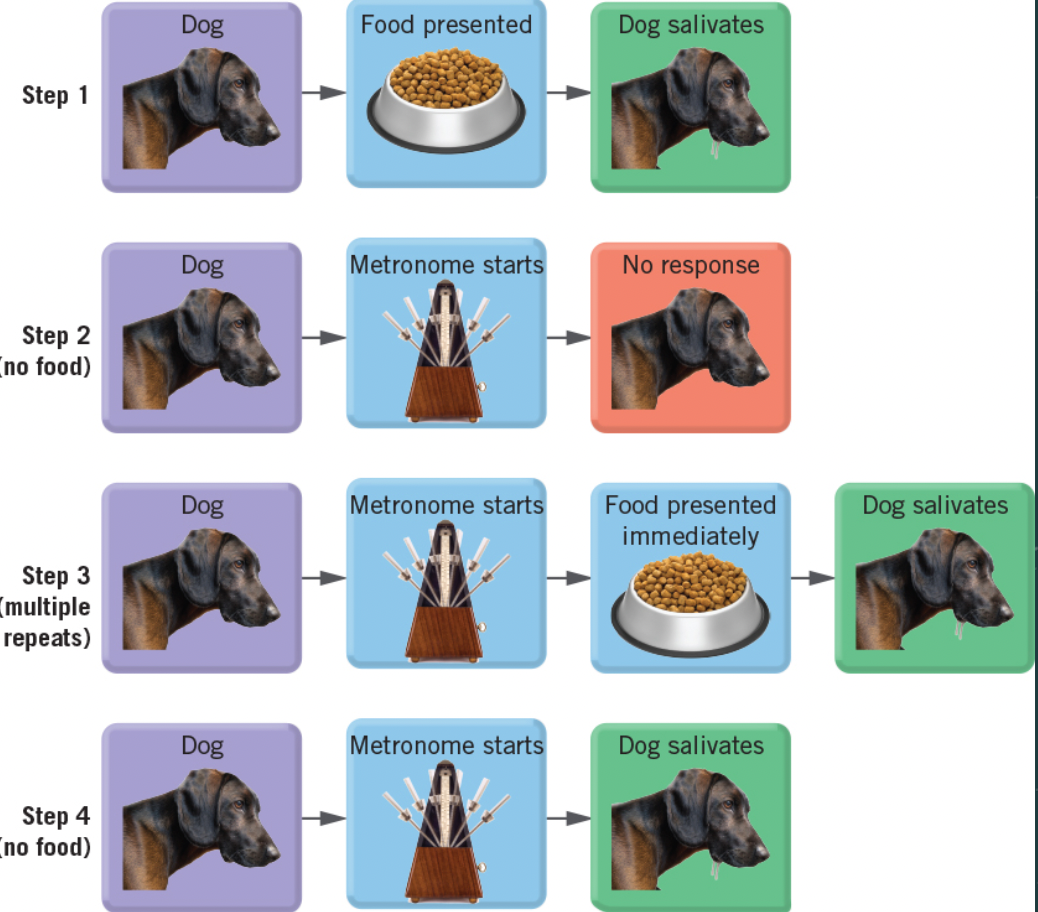
How is this response explained?
The salivation response is controlled by the autonomic division of the PNS
It is involuntary
The salivation had become associated with, and conditioned to, a new stimulus stimulus - the lab tech.
Classical conditioning
A form of learning that occurs through the REPEATED association of 2 or more different. stimuli.
Learning is only said to have occurred when a particular stimulus consistently produces a response that it did not previously produce.
In classical conditioning, a response that is automatically produced by one stimulus becomes associated, or linked, with another stimulus that would not normally produce this response.
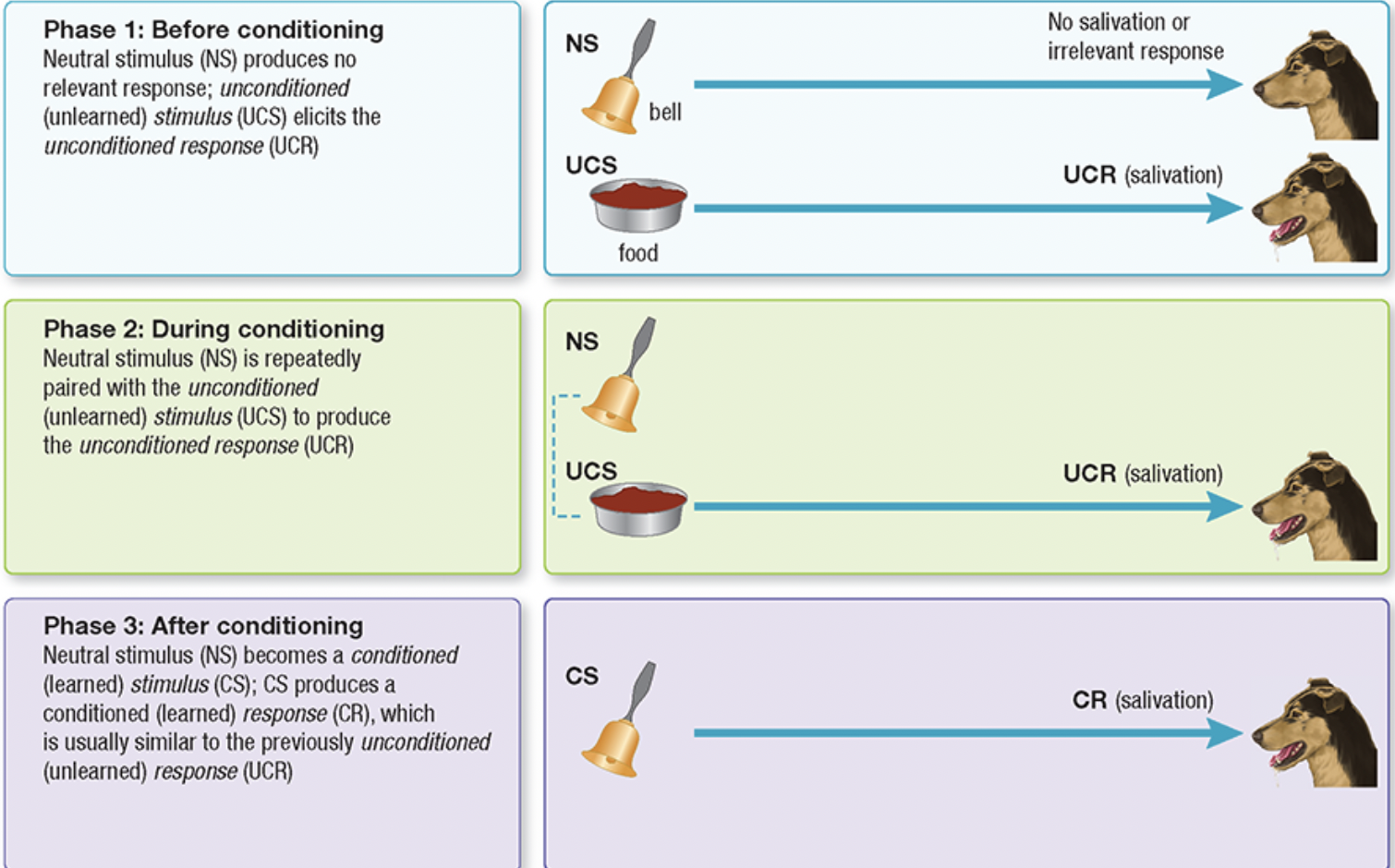
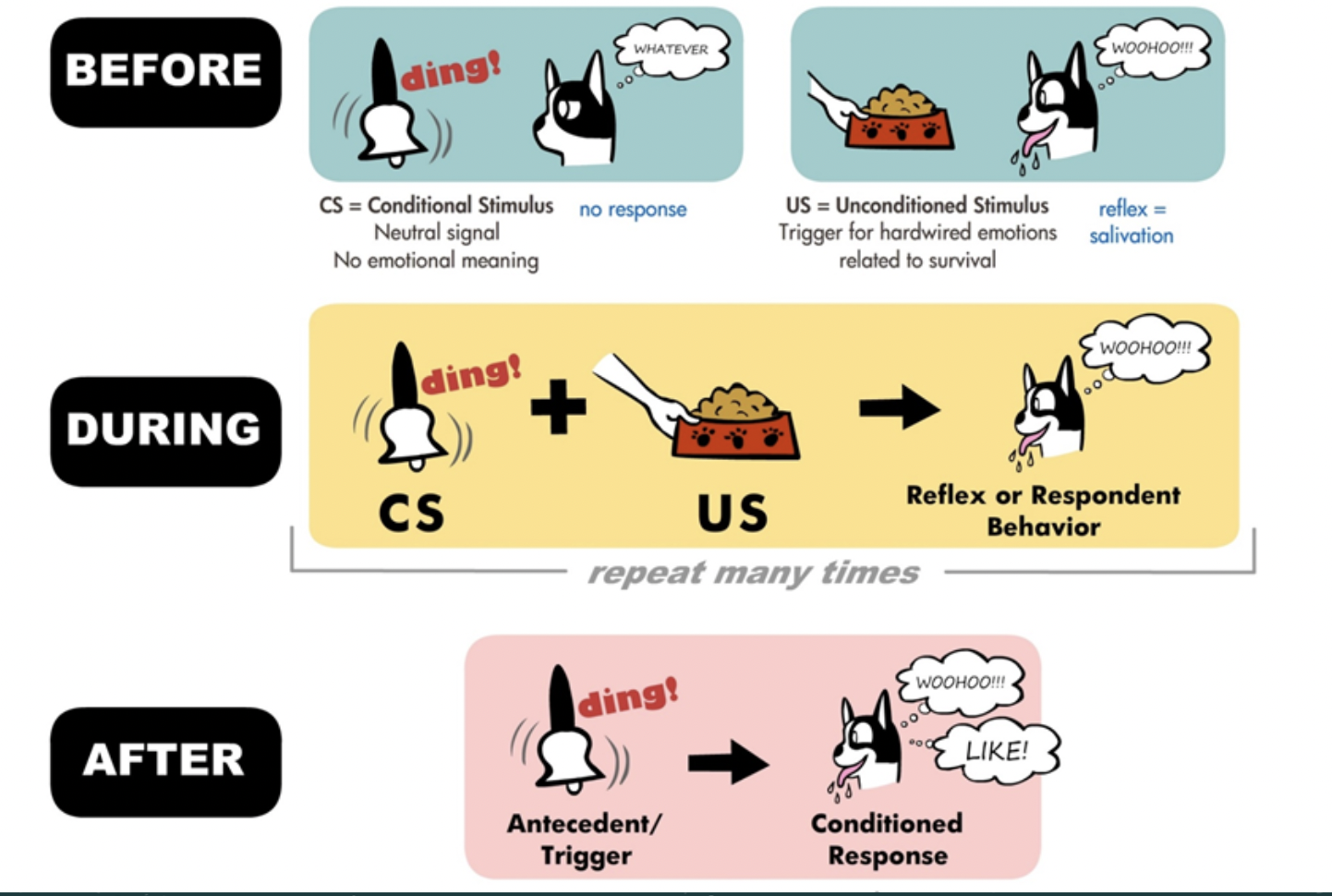
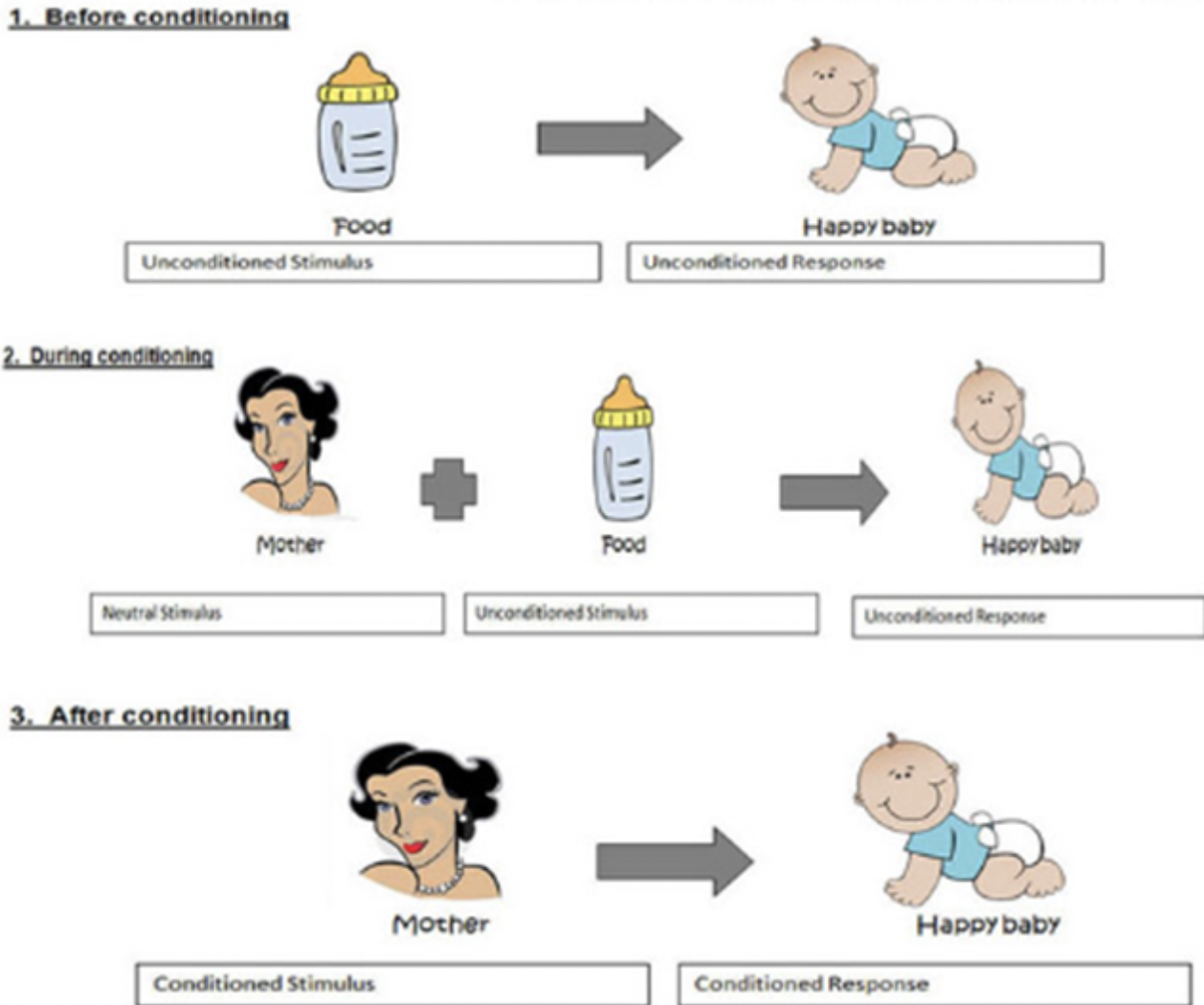
3-phase process of Classical conditioning
BEFORE CONDITIONING; Unconditioned Stimulus (UCS) & Unconditioned Response (UCR)
DURING CONDITIONING- Neutral Stimulus (NS)
AFTER CONDITIONING- Conditioned Stimulus (CS) & Conditioned Response (CR)
Unconditioned Stimulus (UCS)
any stimulus that consistently produces a particular, naturally occurring, automatic response.
In Pavlov's experiment, the UCS was the food (meat powder)
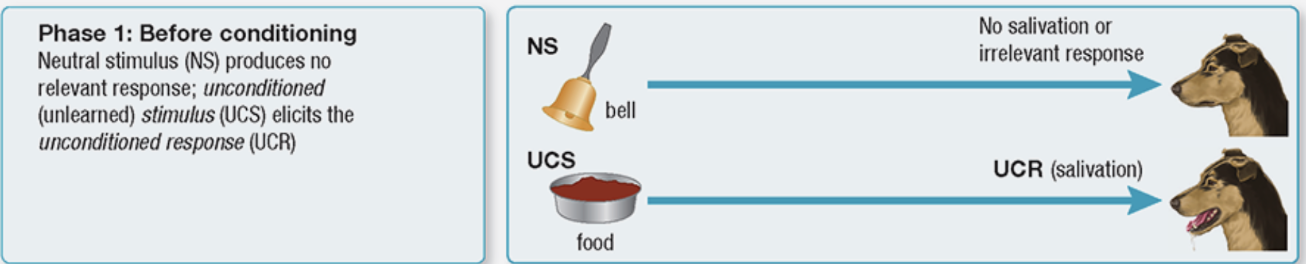
Unconditioned Response (UCR)
is the The unconditioned response that occurs automatically when the UCS is presented.
A UCR is reflexive, involuntary response that is predictably caused by a UCS.
In Pavlov's experiments, the UCR was the salivation
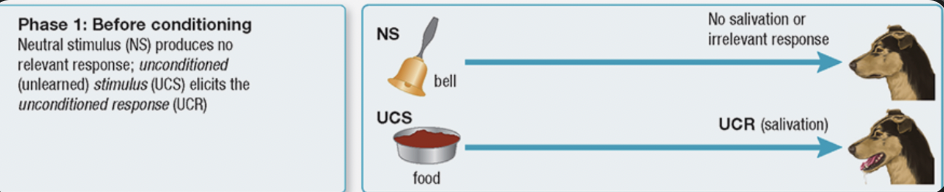
Neutral stimulus (NS)
Any stimulus that does not automatically produce a predictable response.
Is neutral to the UCR.
eg. dogs do not usually salivate as a response to a bell ringing.
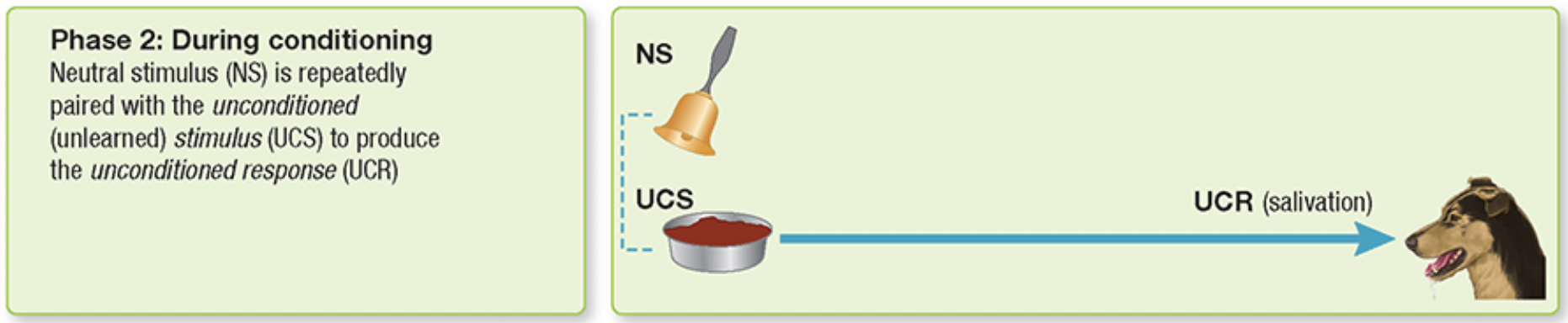
Conditioned Stimulus (CS)
The stimulus that is neutral at the start of the conditioning process and does not normally produce the UCR
Yet, through repeated association with the UCS, the CS triggers a very similar response to that caused used by the UCS
Once conditioning has occurred and the originally neutral stimulus produces the response of salivating, then it is called the CS
eg. In Pavlov's experiments, the bell and subsequently other stimuli were initially neutral, but each time became associated with the meat powder.

Conditioned Response (CR)
This is a learned response that is produced by the CS
It occurs after the CS has been associated with the UCS
The behaviour of the CR is very alone. similar to that of the UCR, but it is triggered by the CS
Pavlov's dogs displayed a CR (salivation) only when they began to salivate to a CS

All together
Operant conditioning as a 3 phase model
Operant conditioning
A form of lea form of learning where the likelihood of a particular response occurring is determined by the consequences of that response:
A response that has a desirable consequence will tend to be repeated
&
A response that has an undesirable consequence will tend not to be repeated/will will be stopped.
Operant conditioning
Operant- any response (or set of responses) that acts ('operates') on the environment to produce Some kind of consequence.
Operant conditioning is similar to classical conditioning as they are both learning but they are also very different
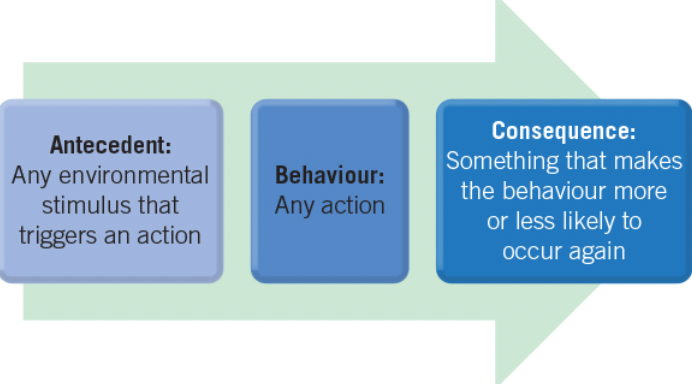
Operant conditioning as a 3 phase model (ABC)
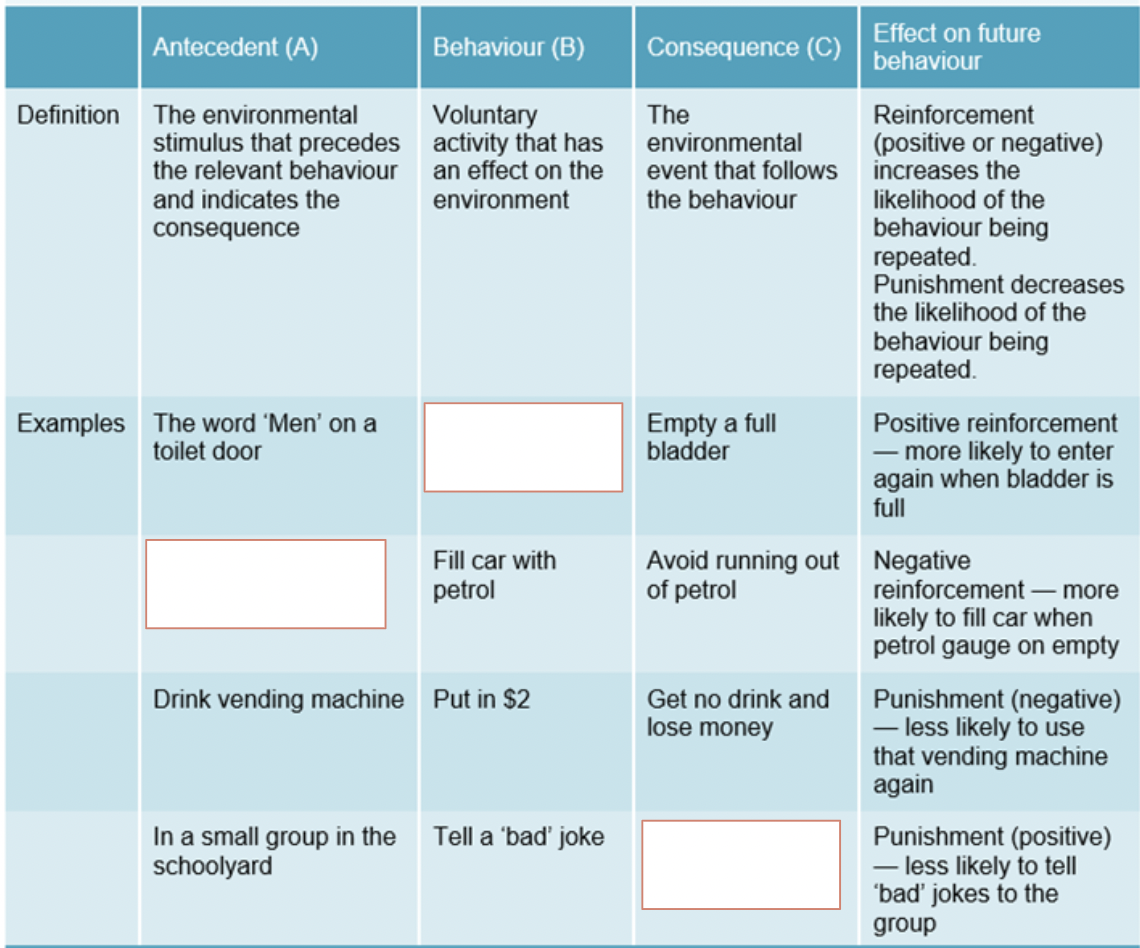
ANTECEDENT (A): A stimulus that occurs before the behaviour
BEHAVIOUR (B): Occurs due to the antecedent.
CONSEQUENCE (C): To the behaviour.
This is usually expressed as antecedent (A)>behaviour (B> consequence (C) and is therefore sometimes called the A-B-C model of operant conditioning.
Basically, a specific antecedent prompts relevant behaviour that is followed by a specific consequence
Antecedent (A)
the stimulus (object or event) that precedes a specific behaviour, signals the probable consequence for the behaviour and therefore influences the occurrence of the behaviour.
eg: phone ringing
Behaviour (B)
the voluntary action that the presence of the antecedent stimulus.
eg: answer phone
Consequence. (C)
the environmental event that occurs immediately after the behaviour and has an effect on the occurrence of the behaviour.
eg: you get to talk to your friend on the phone = desirable and likely to repeat it
Examples of ABC model
2 Types Of Consequences
REINFORCERS: occurs when a stimulus STRENGTHENS or INCREASES the frequency or likelihood of a response that it follows.
PUINISHMENTS: WEAKENS or DECREASES the probability of a response occurring again over time again.
REINFORCERS
occurs when a stimulus STRENGTHENS or INCREASES the frequency or likelihood of a response that it follows.
PUINISHMENTS:
WEAKENS or DECREASES the probability of a response occurring again over time again.
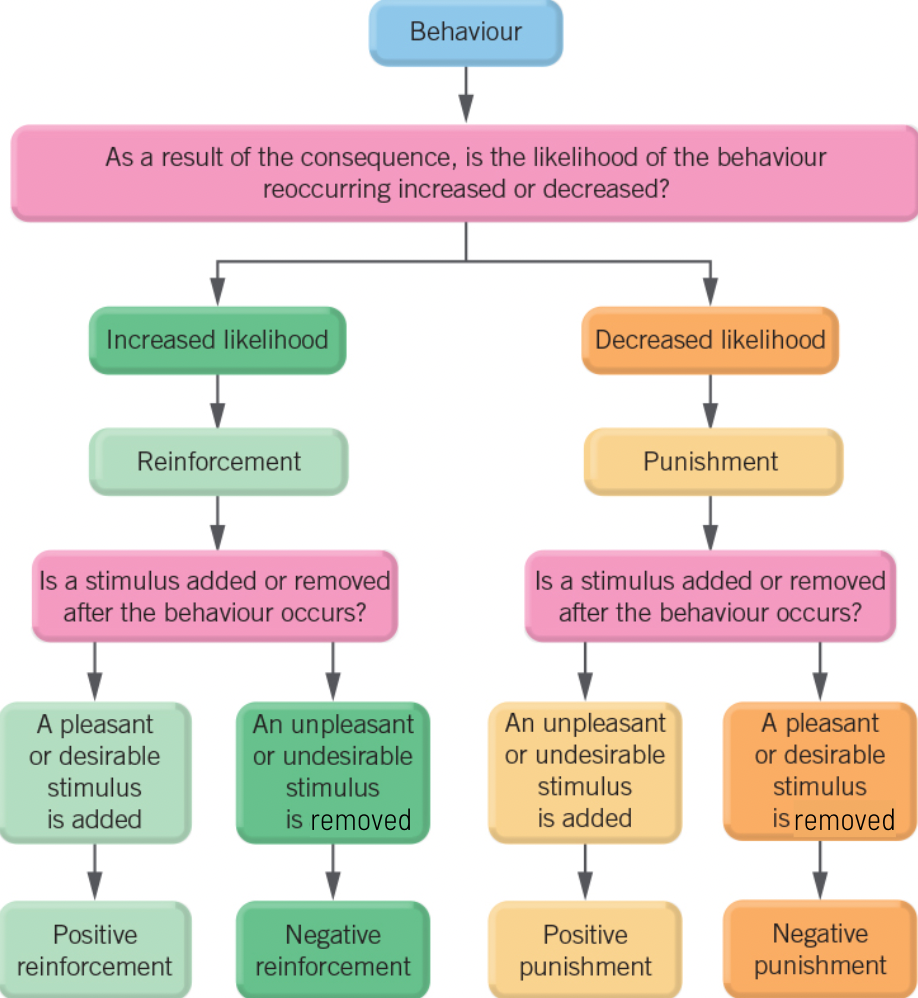
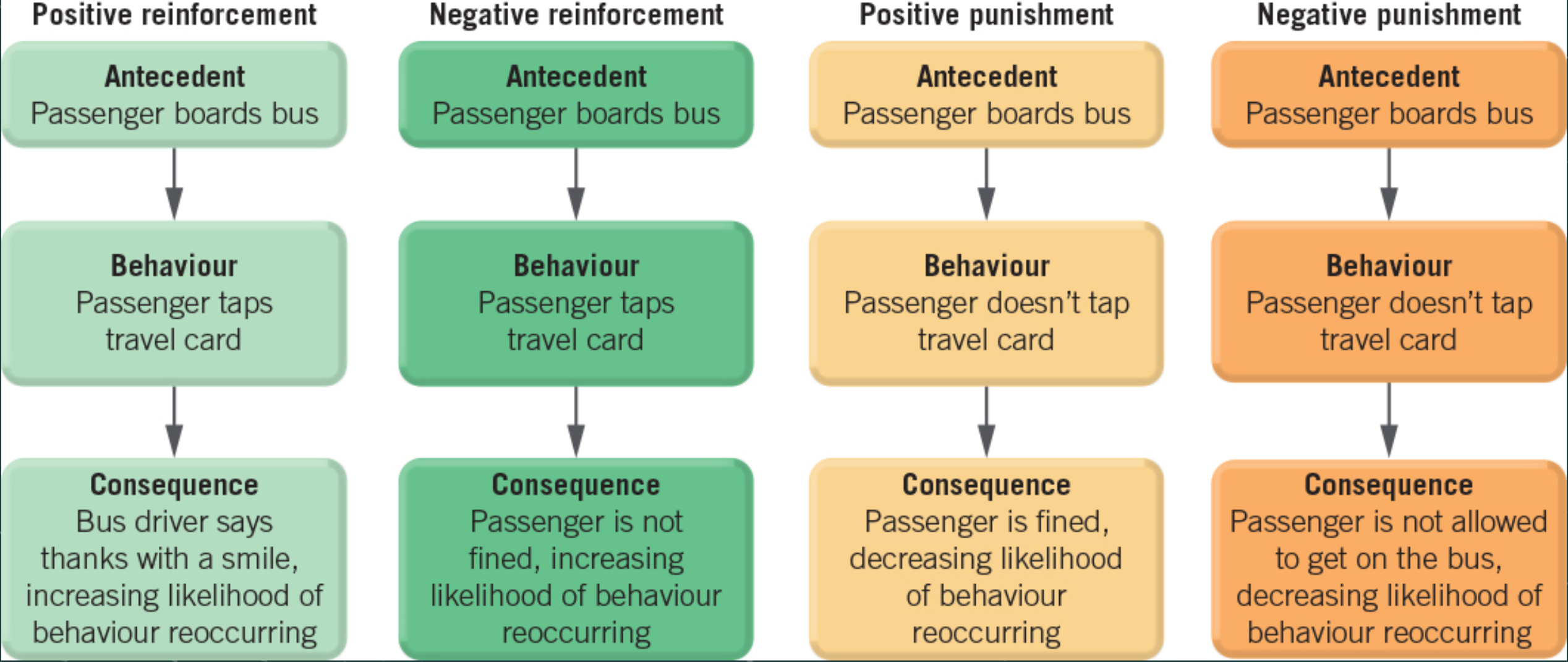
Positive reinforcement
positive reinforcer- a stimulus that strengthens or increases the frequency or likelihood of a desired response by providing a satisfying consequence.
Involves giving or applying a positive ve reinforcer after the desired response has been made.
Negative reinforcement
A negative reinforcer- any unpleasant stimulus that, when removed or avoided, strengthens frequency or likelihood of a desired response.
Involves the removal or avoidance of an unpleasant stimulus
Key things to remember
Positive reinforcers are GIVEN
Negative reinforcers are REMOVED/AVOIDED
Reinforcers both lead to DESIRABLE SATISFYING consequences, therefore STRENGTHENING the behaviour that produced the consequence.
Positive punishment
Involves the presentation (or introduction) of a stimulus, thereby decreasing (weakening) the likelihood of a response occurring again.
Negative punishment
Involves the removal or loss of a stimulus, thereby decreasing the chance of a response occurring again.
Often referred to as RESPONSE COST - because it is removing something valuable, there is a 'cost' for making a 'response'. This does not necessarily involve something of monetary value.
Key things to remember
Positive punishments are GIVEN
Negative punishments are REMOVED/AVOIDED
Punishments both lead to UNPLEASANT consequences, therefore WEAKENING the behaviour that produced the consequence
Summary of operant conditioning
Application of operant conditioning
Observational learning
when a person learns by watching or listening to others.
Learning occurs when a person uses observations of another persons actions and their consequences to guide their future actions.
This allows us to acquire acquire new behaviours without personally experiencing them and it guides the way think and feel, and shows us how to interact with others.
Many of our attitudes, values and beliefs are the result of observing others. This is also known as modelling (the model is who/what being observed)
Albert Bandura's observational work with children led him to develop social learning theory.
This emphasises the importance of the environment (or social context) in which learning occurs.
He proposed that from birth we are surrounded by the behaviours of others, providing us with lots of information about our environment.
We are more likely to model, learn and reproduce responses that are observed to be desirable and reinforcing.
Vicarious (Through others)
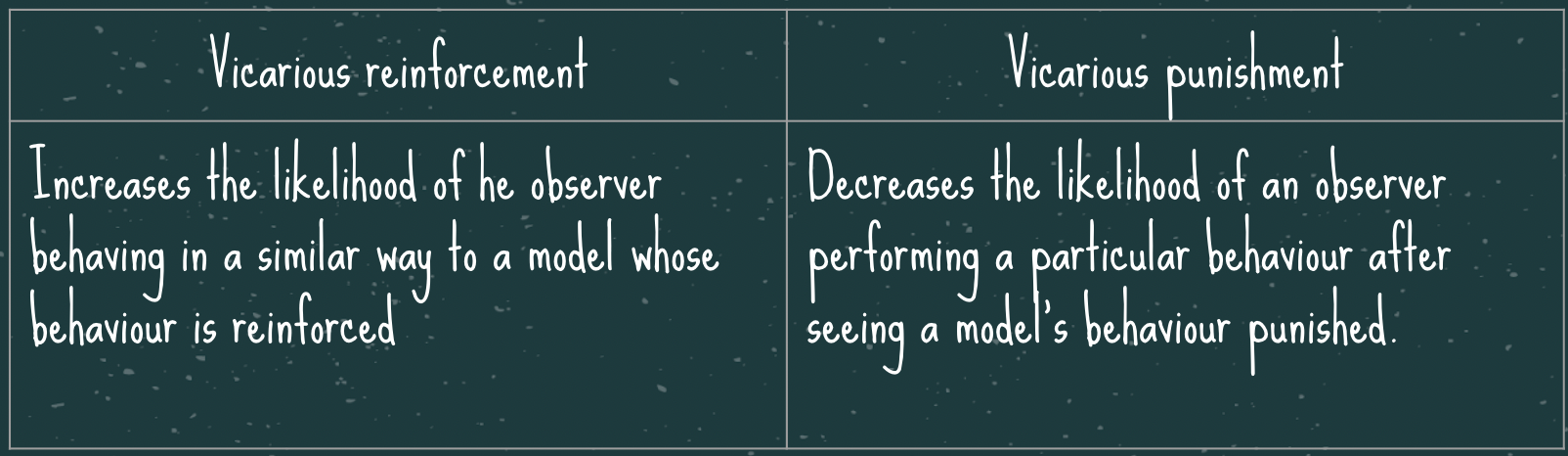
Bandura's experiments have shown that both classical and operant conditioning can occur vicariously through observational learning (being conditioned indirectly by observing someone else's conditioning).
Vicarious conditioning: The individual watches a model's behaviour being either reinforced or punished, then behaves in exactly the same way, or refrains from the behaviour. ALL as a result of what they have observed.
Vicarious reinforcement VS Vicarious punishment
The 5 sequence of processes according to Bandura's social learning theory: (ARRMR)
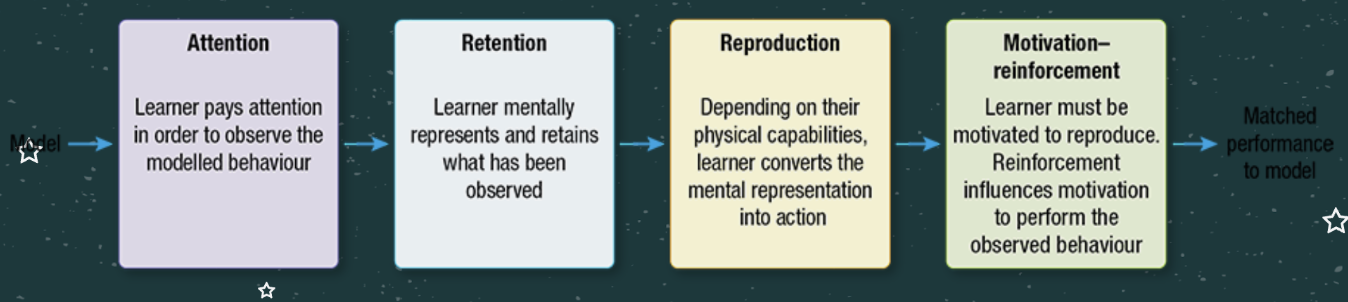
AttentionRetentionReproductionMotivationReinforcement
Attention
The learner must actively watch the models behaviour and their consequences in order to learn through observation.
If we do not, we will not recognise the distinctive features of the observed behaviour (and may fail to notice the consequences).
Attention may be influenced by several factors: the perceptual capabilities of the observer, the motivation and interest level of the observer, the distractors present, and characteristics of the model.
Level of attention may be influenced by the importance of the behaviour (is it necessary?), its distinctiveness, and the effect it might have on us
According to Bandura people are more likely to imitate models who have the following characteristics:
The model is perceived positively, is liked, and has a high status.
There are perceived similarities between the traits of the model and the observer (age, sex)
The model is familiar
The model's behaviour is visible and stands out against competing models
The model is demonstrating behaviour that the observer perceives as being able to imitate
Retention
The learner must retain a mental representation of the models behaviour for future use, after observation.
Sometimes this is not needed until some time after it has been acquired.
We need to store a mental representation of what we have observed - the more meaningful this is, the more accurately we will be able to replicate the behaviour when needed.
Visualising is a useful strategy to support this.
Reproduction- imitating
The learner must have the physical and mental capabilities to reproduce the behaviour.
We MUST have the ability to put this into practice.
We must also have the potential to be competent enough to develop the necessary skills to imitate the behaviour.
eg. you may attend to and remember activity, but not be able to reproduce it with the same skill, as the model may have attributes that cannot be learned (or easily learned).
Motivation- desire
The learner must have the desire to perform the behaviour.
The observer must have the desire to want to reproduce what was observed.
Unless the response is useful, or provides an incentive, it is unlikely they will want to learn it, let alone perform it or continue to perform it.
Reinforcement
The consequence of the behaviour influences the learners’ likelihood of reproducing the behaviour in the future.
This influences the motivation to reproduce the observed behaviour and increases the likelihood of reproduction.
External reinforcement - learning by consequences
Vicarious reinforcement - learning by watching others
Self reinforcement - by meeting our own standards
Observational learning (individual differences)
Certain personal characteristics of the observer can influence each of the observational learning processes.
Our perceptions can be influenced by our perceptions of self. We model's behaviour if we have low self-confidence or low self-esteem, compared with people who do not.
Self-confidence and self-esteem influence our level of self-efficacy (our belief in our ability).
According to Bandura - high self efficacy = belief of doing well = view challenges as something to master (rather than avoid)
ARRMR in an example
Attention- Ben must actively watch someone else give their seat to an elderly person.
Retention- Ben must store a mental representation of the steps taken to give up the seat to the elderly person.
Reproduction- Ben must have the physical and mental capabilities to give up his seat to an elderly person.
Motivation- Ben must have the desire to give up his seat to an elderly person.
Reinforcement- Ben saw the vicarious reinforcement of getting a lolly and a praise, which is positive reinforcement, making Ben more likely to replicate the behaviour.
Indigenous Australians or First Nations Peoples
Historic barriers dating back to colonisation have eroded trust between Indigenous communities and Western communities, which has resulted in a lack of exchanging knowledge between communities.
Historically, research involving Indigenous communities has been inappropriate because the researchers rarely obtain informed consent.
As well as the power imbalance between researchers and participants meaning that participants were often exploited and the aims of research often served purposes of colonial control.
Aboriginal culture has been around somewhere between 50,000-65,000 years
There were over 250 languages, with around 600 dialects, spoken, however less than 20 are around today
Indigenous culture is built around respect for their land and their elders.
History - The Stolen Generations: The 'taking away' of Indigenous children from their families.
This happened in every Australian State from the late 1800s until 1969, when the practice officially ended.
As many as 100,000 children were taken from their families. However, no one knows the true figure, as proper records were not kept.
Children were placed into government-run institutions, adopted by white families, and fostered into white families.
The aim was to sever children from their culture and to raise them to think and act 'white'.
Indigenous Community Systems
Indigenous communities exist in 90 countries around the world that all have their own systematic way of knowing and learning.
For Australia's First Nations people, this is their 'knowledge framework'.
Each community has their own personalised system of thinking, doing and knowing based on years of sharing, community and life with the environment around them.
Sharing knowledge historically
In the establishing years of Australian colonisation, people in charge of learning about the Indigenous communities often focussed more on 'classifying and labelling' in an attempt to manage the communities.
There is a perpetuating belief that Indigenous peoples embody a 'problem' to be solved and that they are 'passive objects that require assistance from external experts'.
Non-Indigenous leaders used to believe that their understanding of community integration was superior - resulting in the Stolen Generations.
In order for non-Indigenous Australians to learn and appreciate ways of knowing, they need to build on the relationships and complexity of Indigenous ways of knowing.
Connection to Country
'Indigenous ways of knowing' is a useful term that displays the beautiful intricacies and diversity of Indigenous ways of learning and teaching.
The practice of learning and knowing concepts and construct for each Indigenous community is heavily based on the specific location of the land.
The the importance of land is also the language, the protocols and the culture surrounding each way of knowing. Hence, the concepts and constructs may look very different from one First Nations community to another.
Indigenous ways of knowing are rooted in deep respect for the ecology and an -understanding of the importance of the connected relationship with the land - this is known as connection to Country.
Connection to Country
First Nations peoples believe that their connection and use of the land today will have a significant impact on the next generations, so they are respectful of how they walk on the earth and interact with all living things.
They believe that when there is an offering of respect, then earning can move forward.
An example of an Indigenous framework of learning: 8 Ways (SLNSCDNL)
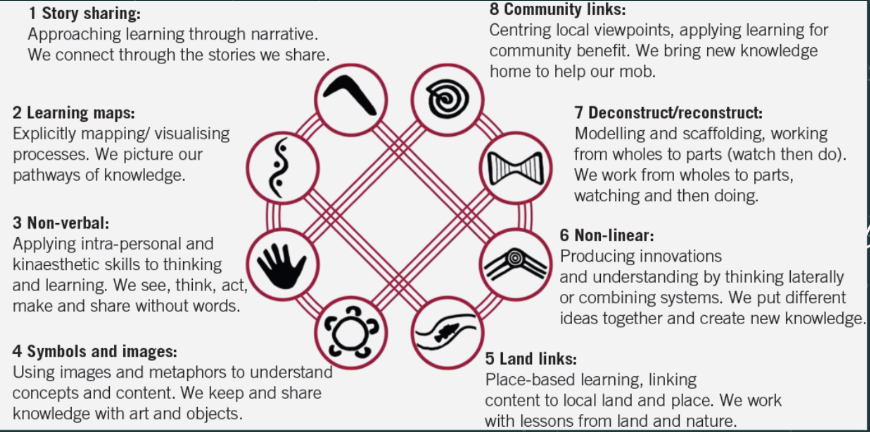
Important to remember that this example comes out of a particular Indigenous community.
While some principles may be shared by other Indigenous ways of knowing, it would be a mistake to assume it has broad acceptance and usage.
8 Ways is a framework for Indigenous learning techniques created by a NSW Department of Education project.
Story Sharing: learning knowing through narrative
This system of learning takes place by continually sharing stories (including stories told in song) and connecting through shared personal stories of past, present and future.
Commonly known as 'yarning' within First Nations culture and community and is expressed as a way to gain knowledge or to learn.
Yarning allows for learning to be built upon real-world experiences rather than through print-based text and screens.
Story telling isn't only about yarning; it is more importantly about listening - to Elders past, present and future, to each other within the community and to individual stories.
Learning maps: visualising and mapping processes
a process of picturing a pathway and creating a deliberate visual plan for learners to follow.
It usually follows a story and will be a discussion-based procedure to create a map, to indicate the direction to take in that learning sequence.
Images are at the forefront of of these plans and make up most of the maps.
eg. maps could be created for curriculum plans at schools, directions to a location, plans for a family's future or even to tell a story.
Non-verbal: see, think, act, create, move without words
Instead of using words, people use dance, facial expressions, gestures and kinaesthetic skills to help them to think and learn. It is important for learning that these skills are used repeatedly, to frequently use similar rhythms, tones or movements.
eg. a dance could be created and performed to help learn about the way in which animals grow and develop in the wild.
Symbols and images: understanding concepts through art and metaphor.
This system of learning is said to be kept and shared through symbols and images in the form of art and drawings.
Some drawings can take moments to create, others can take days. Some only exist for moments before being rubbed away and never drawn again.
Land links: place based learning
This system of learning is said to take place when land links are made with nature.
Ecological and place based learning is drawn from the living landscape within a framework of profound ancestral and personal relationships with place.
Linking content to local land and place.
Non-linear: indirect, innovative and interdisciplinary approaches
In non-linear learning, there are different phases of learning that can be learned in the order that best suits that moment.
eg. when learning about grammar in an English class, the learner may share jokes about grammar, practice writing grammar, sing a song about grammar, discuss the history of grammar, share some more jokes about the culture of grammar, and then have a deeper discussion around the meaning of grammar.
The lesson on grammar has an indirect, innovative and interdisciplinary approach to learning.
Deconstruct/reconstruct: modelling and scaffolding
This way of learning takes place when the learner looks at a whole process of a concept before looking at its parts in detail.
Learners may watch a complete process to understand its purpose and what it produces, and only then learn the individual steps or skills that make it up.
8 Community links: connecting learning to local values and needs
This system of learning is said to take place when the learner brings new knowledge to help their mob, otherwise known as their community. The knowledge that is being learned is based on local viewpoints and will benefit the community.
This connection to community benefits both the community and the learner because their learning is given real life purpose.
eg. a class could do a research project on the local lake and its significance to the land and area, and then share this at their school assembly with the school community.
Similarities between CC and OC
There is an acquisition process, where a response is conditioned/learned through repeated association:
CC: learning by association of two stimuli (UCS and NS)
OC: behaviour is associated with consequences that follow it.
Conditioning as a single learning process
The similarities between CC and OC have led some psychologists to logists to propose propose that they are variants of single learning process. a
eg. Little Albert learned fear through classical conditioning. When he learned to avoid the rat by crawling away (to reduce his fear), the that was an example of operant conditioning.
Psychologists use CC to account for acquisition of the response and OC for the perpetuation of the response - what do these words mean??!
Differences
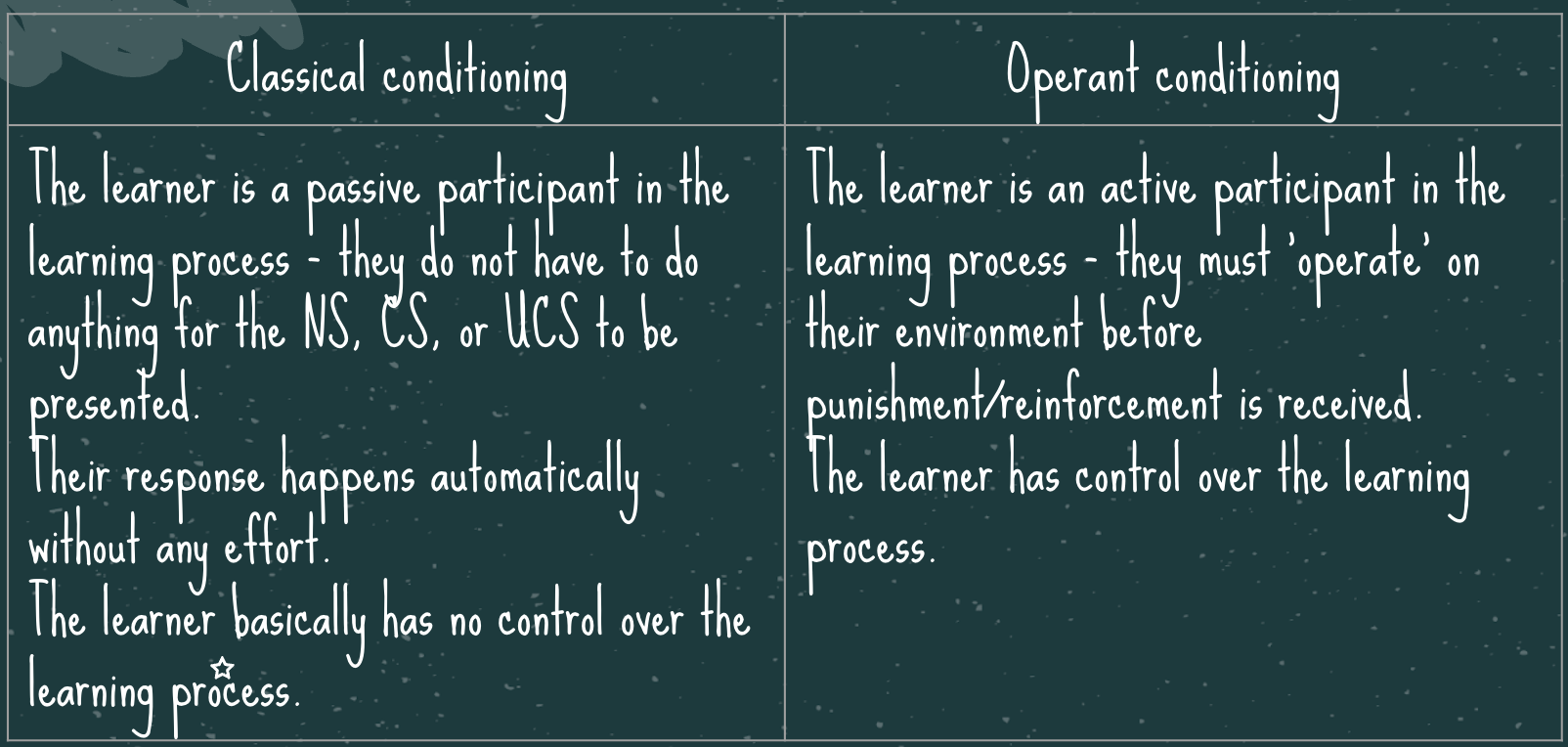
In OC, the consequence of the response is a vital component of the learning process.
In CC, the behaviour of the organism does not have have any consequence.
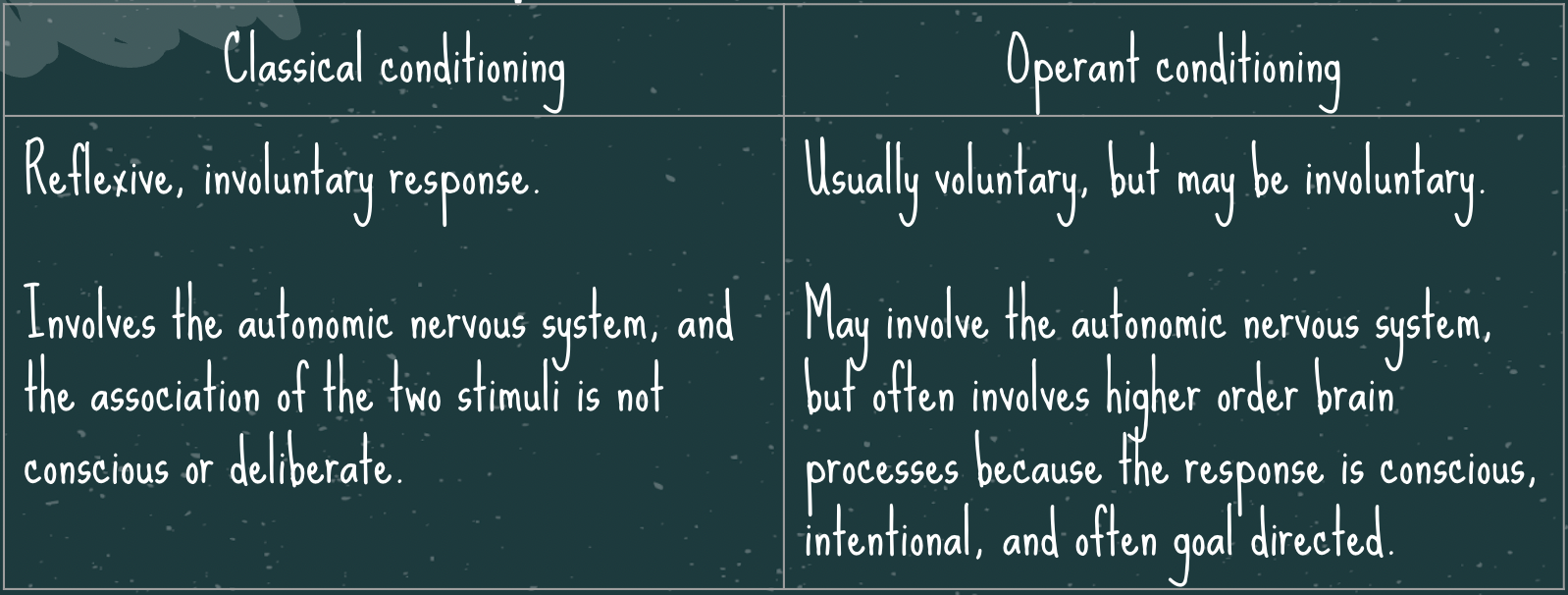
In CC, the response is involuntary- an automatic response to something happening environment.
OC involves voluntary responses that are initiated by the organism, as well as involuntary responses.
The role of the learner
Timing of the stimulus and response
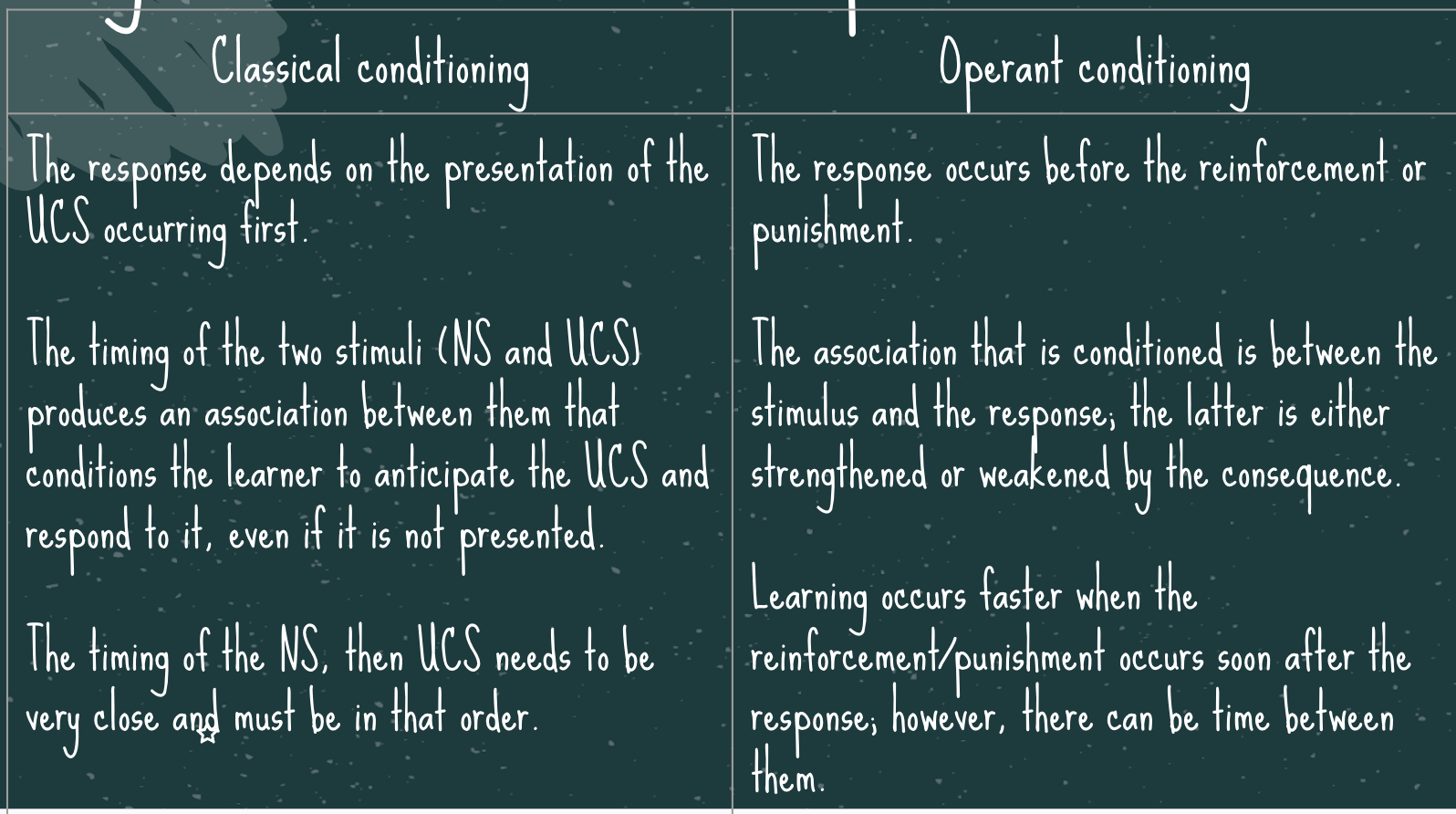
Nature of the response
Explore top notes

