Legal Studies UNIT 1 AOS 1 REVISION
 Studied by 1 person
 Call Kai
 Learn
Learn Practice Test
 Spaced Repetition
 Match
Match Flashcards
 Knowt Play
1/67

There's no tags or description
Looks like no tags are added yet.
Name | Mastery | Learn | Test | Matching | Spaced | Call with Kai |
|---|
No analytics yet
Send a link to your students to track their progress
68 Terms
Legal Rules
Made by a legal authority (I.e. the parliament or courts) that are enforceable by police and other law enforcements
Non-legal Rules
Rules made by private individuals or groups in society, such as parents and schools, that are not enforceable by the courts
Legal rules vs Non-legal rules
Legal rules are enforceable by courts and the parliament whereas non-legal rules are enforced by private institutions. The punishments for breaking a legal rule are generally more severe whereas non-legal rules may result in minor punishments.
Example of a non-legal rule
Wearing your blazer to and from school
Example of legal rules
Following traffic signals
Why are laws needed?
Laws help resolve the conflicts that are inevitable when people live and interact in groups and help people live by morals. For example, laws create suitable punishments for theft to help prevent it from happening again.
Criminal Law
An area of law that defines behaviours and conduct that are prohibited and outlines sanctions for people who commit them
Civil Law
An area of law that defines the rights and responsibilities of individuals, groups and organisations in society and regulates private disputes.
Criminal Law vs Civil Law
The main aims of criminal law are to protect society and to sanction offenders who have committed a crime. On the other hand, the aims of civil law are to regulate the conduct between parties to a dispute and to remedy a wrong that has occurred.
Sanction
A penalty imposed by court on a person guilty of a criminal offence
Tort
A term that literally means ‘wrong’; a wrong that interferes with a person’s legally protected interests
Remedy
A remedy is the legal solution a court provides to fix a wrong or enforce a right
Injunction
A civil remedy in the form of a court order requiring the defendant to do something or not to do something.
Civil law arguers
Plaintiff, Defendant
Criminal Law Arguers
Prosecution, Accused
Why laws need to change
Laws need to reflect society’s values. If a law is in line with society’s current values, then people are more inclined to follow the law. This means laws need to change when the society’s values change.
5 characteristics of an effective law
Reflect society’s values
Be enforceable (must be able to be applied and upheld with real consequences)
Be known
Be clear and understood
Be stable
A law must reflect society’s values
If a law reflects society’s current values, members of society are more likely to obey it rather than ignore it.
For example, in 2021 Victoria passed spent convictions legislation after many people argued that a criminal history can unfairly disadvantage individuals who committed an offence in the past but have since reformed.
A law must be enforceable
If people break a law it must be possible to catch them, punish or sue them.
For example, imagine if there was a law that it was an offence to dream about being on vacation, how could the police find out the law has been broken. Whereas laws for following traffic signals are enforceable because there are cameras.
A law must be known
People must know a law exists in order to follow it, it is the law-makers duty to inform the public about a law.
For example, if the government makes a law about immigration, they must inform the public so immigration agents can follow the laws.
A law must be clear and understood
It is important for a law to be written clearly, if a law is ambiguous, unclear, or written in language or jargon that people do not understand, it will be difficult to follow it.
For example, there have been calls to change laws about neighbourhood tree disputes as there are a number of relevant laws that are difficult to understand, this is important because if people don’t understand the laws, they cannot follow them.
Laws must be stable
A law must be stable, if it is constantly changing, people may be unsure as to what the law actually is.
For example, imagine that the law regarding employment conditions- like sick leaves- are changed every year. Employers would have difficulties to work out how much sick leave each employee is entitled to and could be breaking a law without knowing or intending to.
Commonwealth Parliament Structure
Governor General+House of Representatives+Senate
Victorian Parliament Structure
Governor+Legislative Assembly (Lower House)+Legislative Council (Upper House)
Role of Parliament
To make law. Each parliament is a supreme law-making body within its area of law-making power.
Government vs Parliament
The parliament makes up seats and the political party with the majority of seats in the House of Representatives forms the government.
Relationship of Parliament and the Courts
There are 4 main features of the relationship between parliament and the courts:
The interpretation of statutes by courts (statutory interpretation)
The codification of common law
The abrogation of common law
The ability of courts to influence parliament
Statutory Interpretation
Courts must apply statutes to the case before them. To do this sometimes it is necessary for a court to interpret the meaning of the words in a statue or a secondary legislation.
Codification of common law
Parliaments can make laws to confirm precedents and parliament passes an Act of Parliament that reinforces the principal established by a court
Precedent→Statute
Abrogation of common law
Parliament, as the supreme law-making power, can change or override common law by passing an act that specifically abolishes the particular common law principle
Precedent Cancelled
Ability of courts to influence parliament
Courts can influence changes in laws through comments that judges make during court cases. A statement made by a judge within a court decision may influence parliaments to change a law
Explain the role of the Constitution
A set of rules and principles that guide the way Australia is governed. It includes basic laws rules on law-making for the parliament.
Principals of Justice
Fairness
Access
Equality
Fairness
‘All people can participate in the legal system and it’s processes should be impartial and open’
-Impartial Processes
-Open Processes
-Participation
Equality
‘All people engaging with the justice system and its processes should be treated in the same way; if the same treatment creates disparity or disadvantage, adequate measures should be implemented to allow all to engage with the justice system without disparity or disadvantage.’
-Same treatment
-Different treatment
Access
‘All people should be able to engage with the justice system and its processes on an informed basis’
-Engagement
-Informed Basis
Rule of Law
The principle that everyone in the society is bound by law and must obey the law, and that laws should be fair and clear, so people are willing and able to obey them.
Principles of the rule of law
The law must be clear, understood, known and enforceable 
The law must uphold the right to be pressured innocent unless proven otherwise
Hearings and trials must be heard by independent and impartial adjudicators
The law must be applied equally and fairly
Social Cohesion
A term used to describe the willingness of members of a society to cooperate with each other in order to survive and prosper
Benefits of a society with social cohesion social cohesion
A sense of belonging
A sense of worth
Social justice and equity
Political participation
Acceptance (or rejection)
The role of laws in achieving social cohesion
Laws set boundaries on what behaviour is acceptable and what is not acceptable, they protect rights and help prevent discrimination.
The rule of individuals in achieving social cohesion
The role of individuals is to follow and abide by the laws and respect individual rights by assisting the police with their investigations, by reporting crime, and by using the legal system to solve problems.
The rule of legal system in achieving social cohesion
To update laws so that social cohesion is maintained and rights are protected. They apply the law and enforce the law, this helps achieve social cohesion and protect the rights of individuals when dispute arises.
The role of courts
The court system provides a means of resolving disputes and enforcing the law peacefully and without resorting to violence.
Developing Precedents
When a court decides a case that is the first of it’s kind-and in doing so, establishes or creates a legal principal- the court is said to be setting a precedent.
Ratio Decidendi
A Latin term meaning ‘the reason’; the legal reasoning behind a judge’s decision. Ratio decendi forms the binding part of a precedent.
Stare decisis
A Latin term meaning ‘let the decision stand’. The basic principle underlying the doctrine of precedent.
Statutory Interpretation
Where the judge clarifies or interprets laws written by parliament.
Example of Statutory Interpretation
The studded belt case is a well known case where the judge decided that a studded belt is not a regulated weapon and the police had to return a belt back to it’s owner. The judge therefore interpreted the meaning of a regulated weapon.
Example of Binding Precedent
The Snail in the bottle case occurred when a women went to restauraunt and ordered a bottle of beer and the beer contained a decomposed snail, she sued the manufacturer for negligence and the judge found that the manufacturer owed a duty of care to their clients. This case developed the precedent of negligence which developed multiple common laws relevant in Australia.
Obiter Dictum
A Latin term meaning ‘by the way’; comments made by the judge in a particular case that may be persuasive in future cases, though it isn’t binding.
Binding precedent
The legal reasoning for a decision of a higher court that must be followed by a lower court in the same jurisdiction in cases where the material facts are similar.
Persuasive precedent
The legal reasoning behind a decision of a lower (or equal) court within the same jurisdiction, or a court in a different jurisdiction, that may be considered (and used as a source of influence) even though it isn’t binding.
RODD
Reversing, Overruling, Dissaproving, Distingushing
Reversing
When the same case is taken on a higher court for appeal
Overruling
A precedent can be overruled by a higher court in a different case.
Disapproving
In some cases, a court is bound by precedent and can only disapprove it
Distinguishing
If the material facts are sufficiently different, you can distinguish them.
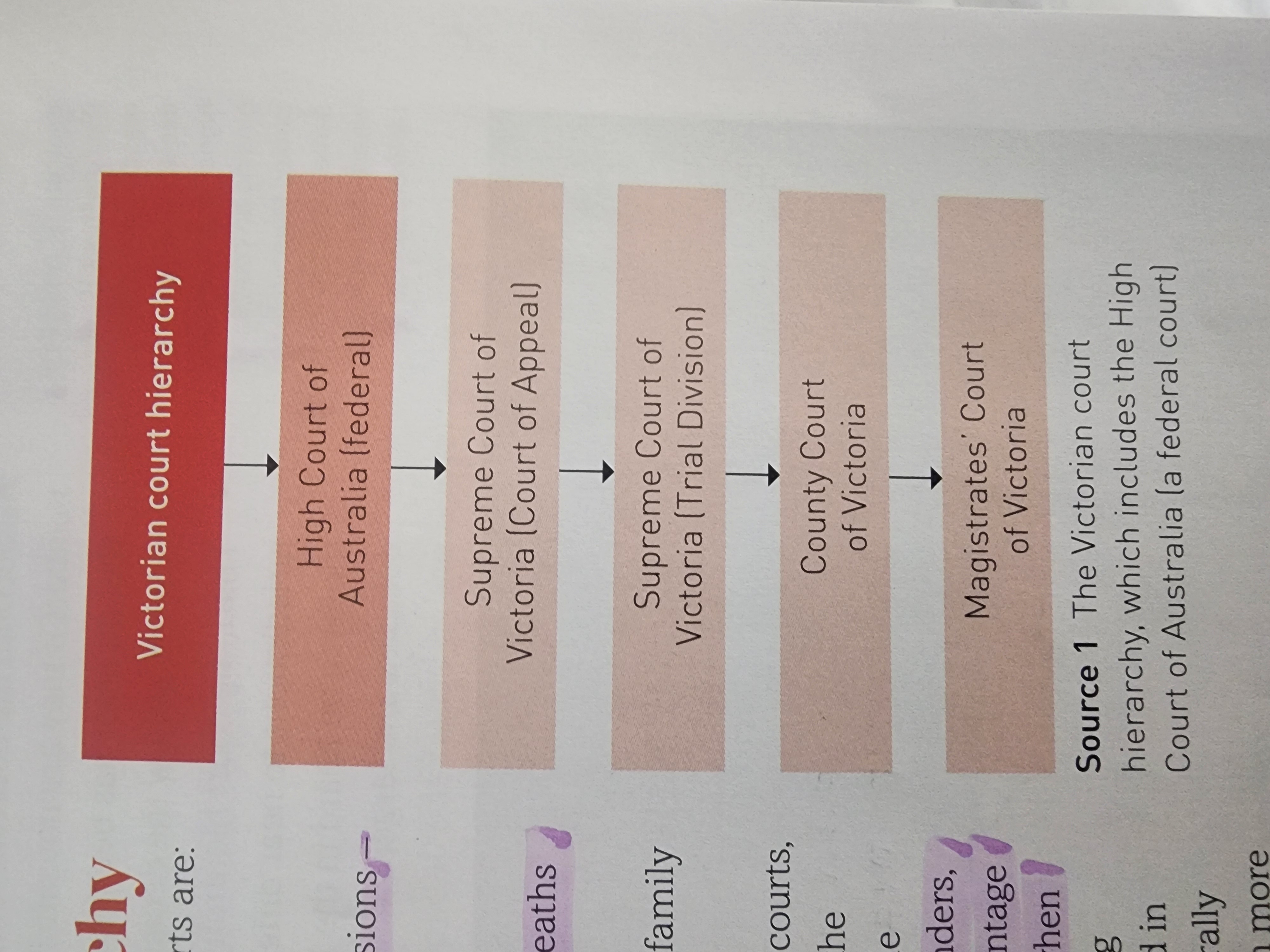
Court Hierarchy
MCSSH
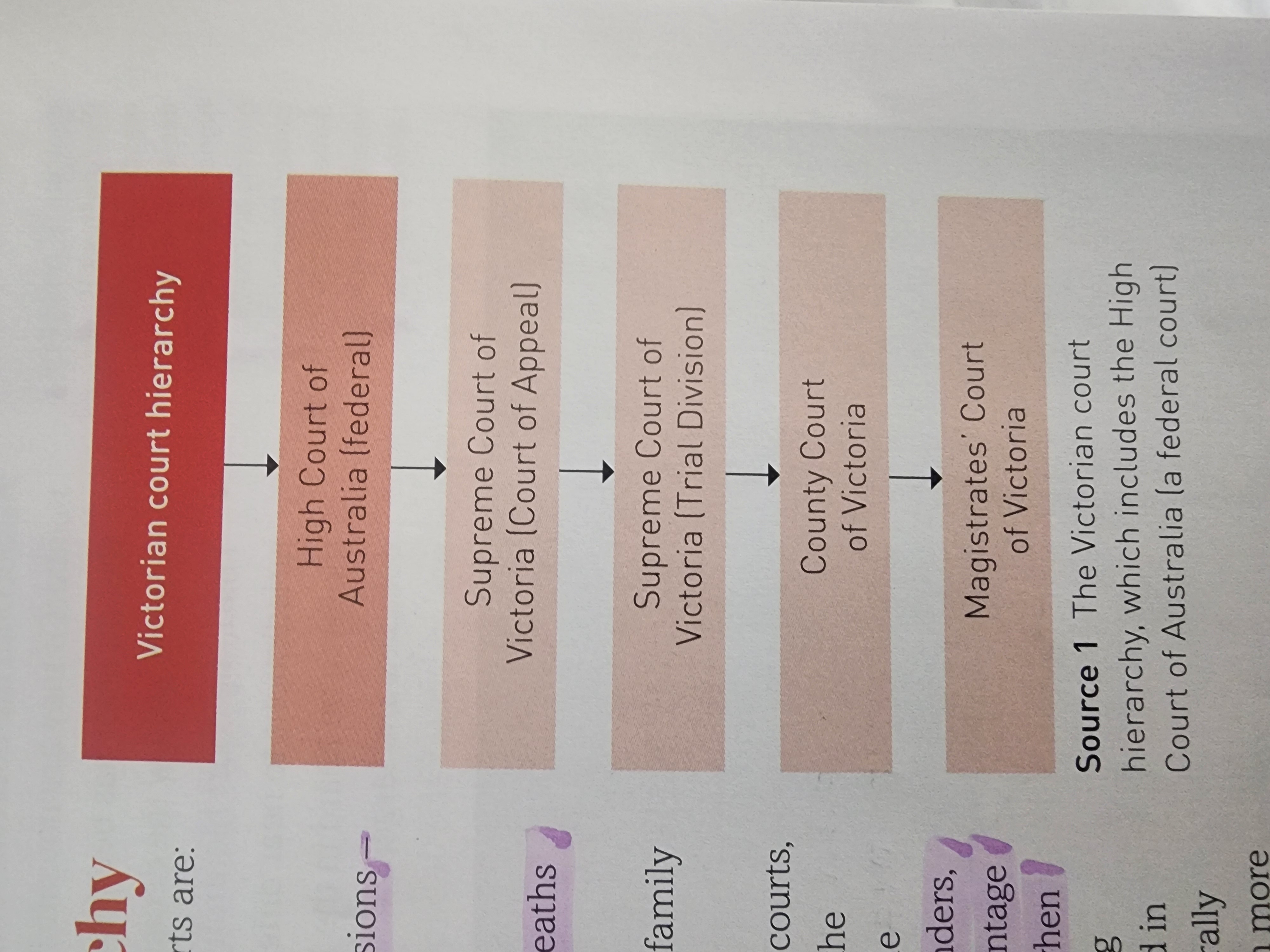
Reasons for court heirarchy
1- Allows for specialisation and expertise
2- Enables parties to lodge and appeal
3- Allows for administration convenience, complex cases, one area, simple cases, one area
4- Necessary part of the doctrine of precedent
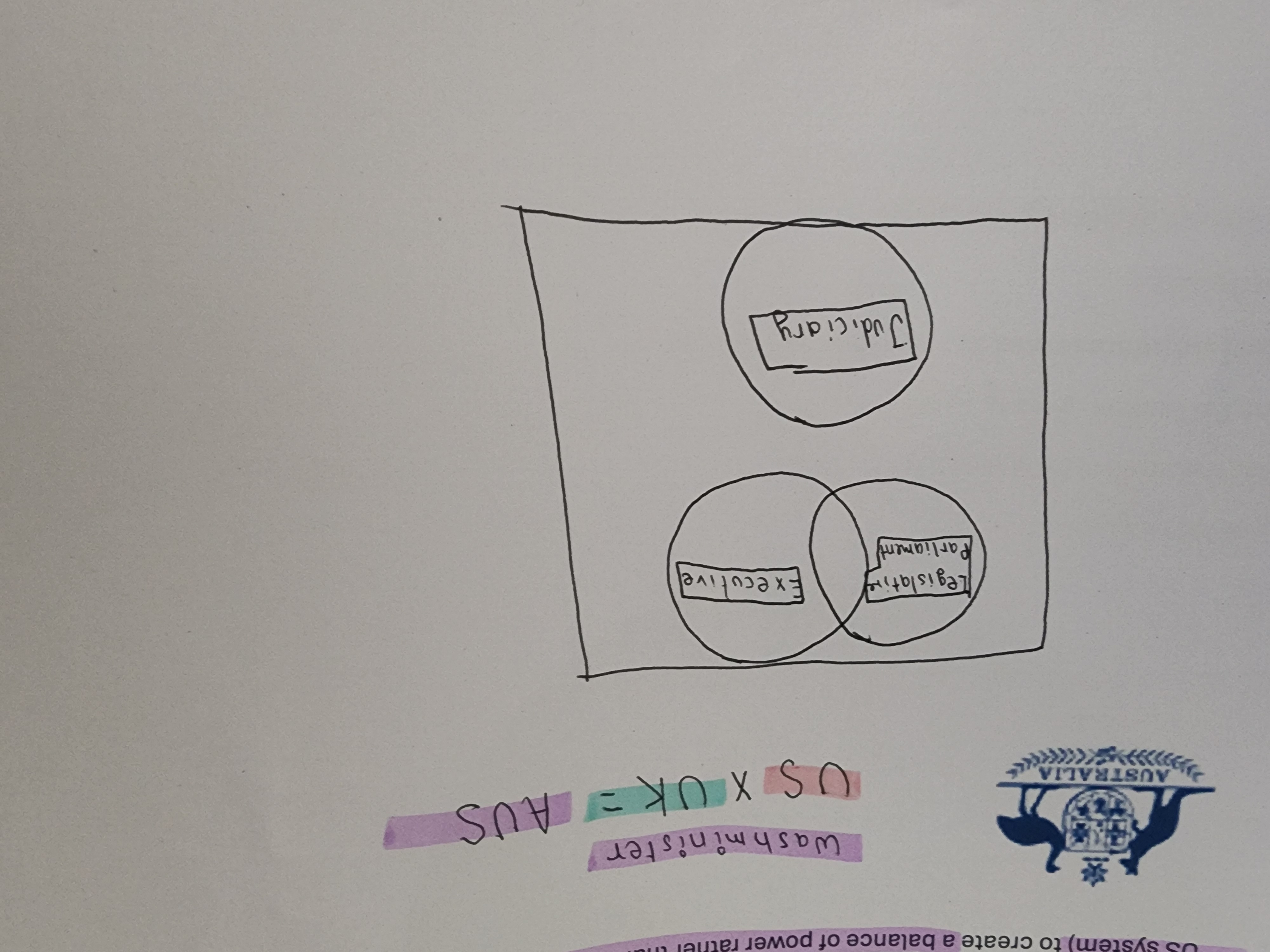
Separation of Powers
The separation of powers distributes the power to govern between the Parliament, the Executive and the Judiciary. To prevent the concentration of authority in one person or group, thereby protecting individual liberty and preventing tyranny.
How the Separation of Powers works
It is divided into three groups
Parliament, power to make and change laws
Executive, power law into action (gov general, pm, minister)
Judiciary, make judgements about law
Statutory Interpretation Example
In the smart phone case, the court had to decide whether a smart phone was a computer or a data storage device, the judge came to a conclusion that it was a computer because it had the functionality of a computer and can perform similar tasks. Therefore, the police could search through a phone as part of a search warrant, showing how judges can interpret statutes.
Codification Example
In the self-defence codification, defence could not be raised as a criminal charge through common law. This law relating to self-defence was later codified where all relative rules were stored in a statute.
Abrogation Example
In the Richard Pusey cases, Richard took offensive photos of a car crash, contrary to community standard behaviour, he could not be punished as the statutes were unclear about maximum penalties. In response, the Parliament created ‘grossly offensive public conduct’ into the crimes act with maximum of 5 years of jail and he was punished.
Ability of courts to influence parliaments Example
In the Sheep-Car Crash case, a vehicle collided with a car after it hit two sheep, the owner sued the driver of the other car and the sheep’s owner for damages but the sheep's owner couldn’t be punished as the judge had to follow an old British rule that said landstock could roam wild. The judge commented that the rule should be modified for modern circumstances and it was.
Persuasive Precedent Example
In the itchy underpants case, a man purchased two pairs of underpants and two singlets and wore them. He developed itchy skin and this eventually led to him to being confined to bed for 17 weeks. He went to court saying that the underpants were in improper condition and the judge used the snail in the bottle case and reference to the fact that the manufacturer did owe a duty of care to the consumers. This later became the legal principal of negligence.
Relationship between parliament and the courts
The interpretation of statutes by courts (statutory interpretation)
The codification of common law
The abrogation of common law
The ability of courts to influence parliament
 Note
Note  Flashcards (169)