Noun Gender & Case
 Studied by 0 people
 Call Kai
 Learn
Learn Practice Test
 Spaced Repetition
 Match
Match Flashcards
 Knowt Play
1/12

Earn XP
Description and Tags
Flashcards for studying the 3 German noun genders & the four German noun cases.
Name | Mastery | Learn | Test | Matching | Spaced | Call with Kai |
|---|
No analytics yet
Send a link to your students to track their progress
13 Terms
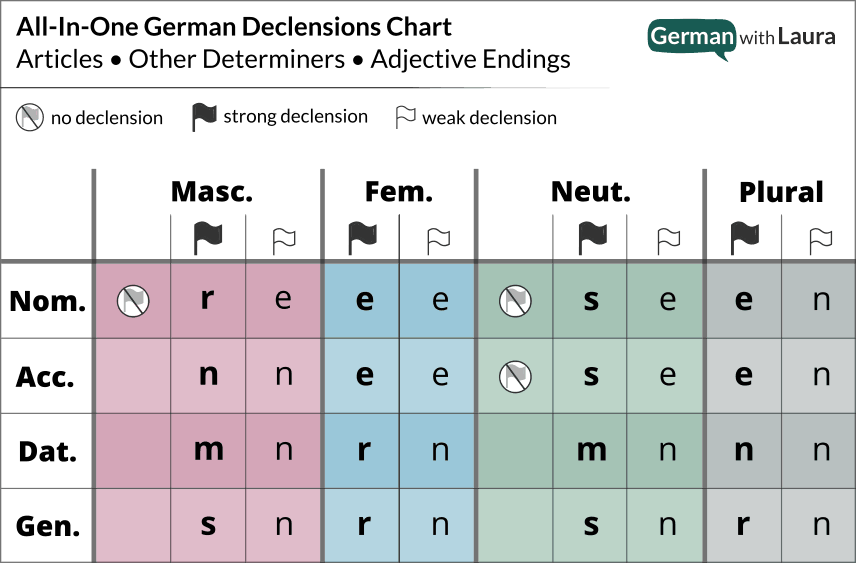
All-in-one declension chart
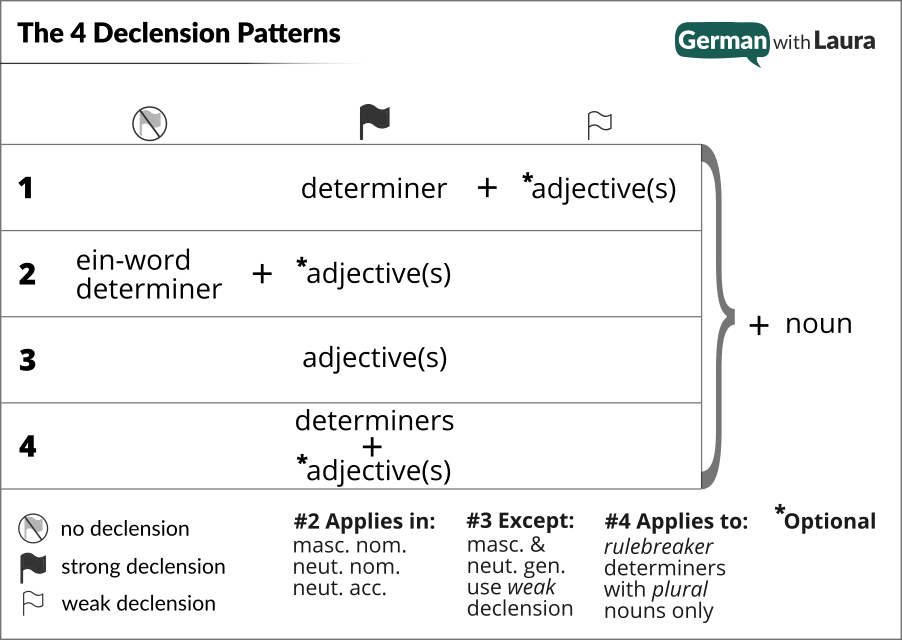
The 4 declension patterns chart
What are the der die das rules?
Rule #1: Know the gender of your noun.
Rule #2: Know the case of your noun.
What are the 4 German cases and what are their roles & descriptions?
Nominative (subject; performs action).
Accusative (direct object; receives action).
Dative (indirect object; to/for whom action is performed).
Genitive (possession).
What are all the ways to say “the” in German?
der die das den dem des
Noun Group
A category of noun which helps determine the gender of various nouns (e.g., days of the week & months of the year are usually masculine nouns).
Noun Form
Specific spelling patterns (particularly, the ending or suffix of the word) of nouns are associated with particular genders of the noun, and thus helps determine the gender of various nouns (e.g., all nouns ending in -ung are feminine).
Masculine Noun Groups
Male persons and animals.
Days of the week, months of the year, and seasons.
Monetary units (currency).
Car makes.
Most weather elements.
Non-German river names.
Mountains and mountain ranges.
Rocks and minerals.
Outer space.
Alcoholic and plant-based drinks.
Feminine Noun Groups
Female persons and animals.
Airplane, motorcycle, and ship models/makes/names.
Rivers within Germany, Austria, Switzerland.
Trees, fruits, and flowers.
Numbers used as nouns.
Nouns formed from measurement or size adjectives.
Neuter Noun Groups
Young persons and baby animals.
Hotels, cafes, restaurants, and movie theaters.
Names of continents, cities, provinces, and most countries.
Metals and chemical elements.
Scientific units & measurements.
Letters of the alphabet and music notes.
Other parts of speech used as nouns (gerunds, colors, languages, English -ing forms).
Masculine Noun Forms
-ant, -ast, -ich, -ig, -ismus, -ling, -or, -us.
Nouns formed from strong verbs.
~60% of nouns ending in -en, -el, -er.
Feminine Noun Forms
-a, -anz, -enz, -ei, -ie, -heit, -keit, -ik, -sion, -tion, -sis, -tät, -ung, -ur, -schaft.
90% of nouns ending in -e.
most nouns (coming from verbs) ending in -t.
-in OR -frau denoting the female counterpart to a male person.
Neuter Noun Forms
-chen, -lein, -icht, -il, -it, -ma, -ment, -tel, -tum, -um.
~70% of nouns ending with -nis and -sal.
-al, -an, -ar, -är, -at, -ent, -ett, -ier, -iv, -o, -on (foreign loan words for objects).
most nouns that start with the prefix Ge-.
 Note
Note  Flashcards (30)