Resit astro
 Call Kai
 Learn
Learn Practice Test
 Spaced Repetition
 Match
Match Flashcards
 Knowt Play
1/230

Earn XP
Description and Tags
come on ur never gonna see this again
Name | Mastery | Learn | Test | Matching | Spaced | Call with Kai |
|---|
No analytics yet
Send a link to your students to track their progress
231 Terms
Distance ladder
Series of methods one building on the other to measure distances in the universe.
Parallax formula + triangle
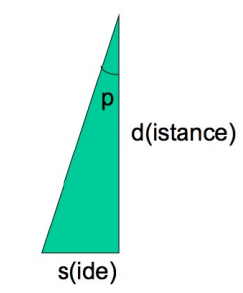
\tan\left(p\right)=\frac{s}{d}
for a small p —> small angle formula tan(p) = p. (radians)
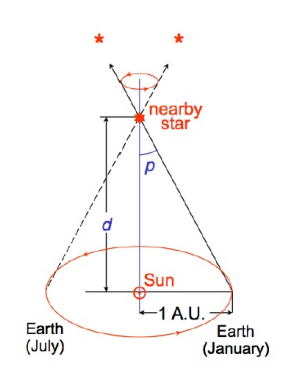
Parallax angle
the opening angle relative tto a position
Parallax for AU
d=\frac{1}{p} for 1 AU (distance earth sun). d in PC and p in arcsecons.
Parsec
Distance of an object that has a parallax angle of one arcsecond.
Use of parsec triangle
Luminosity
Total energy emitted per second by a star.
Light is emitted
Isotropically: the same amount in all directions
Flux
Energy per second that an observer on earth measures.
flux equation
f=\frac{L}{4\pi d^2} [w/m²]
Inverse square law
Force of gravity between two objects< is inversely proportional to the square of the distance between them.
Standard candles
star or object with known luminosity, it doesn’t vary with distance.
eg. cephids
Cephids
supergiant stars
vary periodically in brightness
pulsation period and luminosity —> related —> we know the flux
Magnitudes
logarithm based scale for flux
m_1-m_2=-2.5\log_{10}\left(\frac{f_1}{f_2}\right)=-2.5\log_{10}\left(\frac{L_1}{L_2}\right)
lower magnitude - brighter star
Absolute magnitudes
m = apparent magnitude (depends on distance)
M = absolute magnitude (apparant magnitude at distance 10 pc)
m-M=5\log_{10}\left(\frac{d}{10psc}\right)
This is called distance modulus
Blackbody
Emits radiation at the same rate it absorbs in thermodynamic equilibrium with surrounding
Doppler effect
Wavelength of the observer depends on the relative motion between source and us
toards —> blue shifted
away —> redshifted
Doppler effect equation
\frac{\Delta\lambda}{\lambda}=\frac{\upsilon}{c} where \Delta\lambda=\lambda_{}-\lambda_0
radial velocity
relative speed along the line of sight of source observer
radial velocity equation
Binary star systems
visual binaries: see 2 stars moving together in space
close binaries: too close to see separately
Spectroscopic: 2 stars with doppler shifts in opposite directions
Eclipsing binaries: very rares
Binaries mass radius equation
m_1r_1=m_2r_2 since the centre of mass between them is 0
Two stars in mutual grav attraction orbiting a common centre of mass
Orbital periods for binary sistem eq
P_1=P_2
\frac{r_1}{v_1}=\frac{r_2}{v_2}
\frac{v_1}{v_2}=\frac{r_1}{r_2}=\frac{m_2}{m_1}
Kepler’s 3rd law
Newton’s law of grav = force that keeps the star in orbit (ma)
\frac{4\pi^2R^3}{G}=\left(m_1+m_2\right)P^2 (SI)
a^3=M_{T}P^2 where it’s AU, years and solar masses
what do wavelength and intenisty of radiation depend on?
Temperature
Planck function
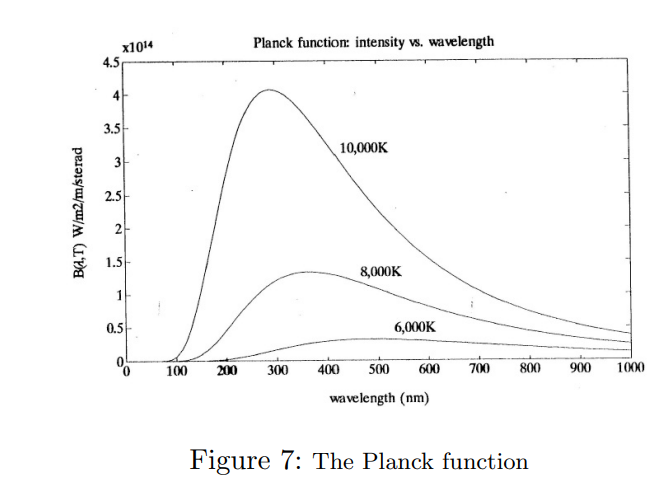
At any wavelength the body at the higher temp will always emit more.
These lines never cross
Wien’s law
\lambda_{\max}T=0.0029mK
balckbody ay constant temp
It must radiate energy at the same rate its absorbs it
Effective temperature
The temoerature that a perfect blackbody would need to have to emit the same amount of energy as the real object/star in question
Color of the star (placks function)
depends on where where most of the rad leans towards
Stefan - Noltzmann law equation
E\left(t\right)=\sigma T^4 (w/m²)
Total energy emitted by the blackbody over all wavelengths
Luminosity stefan boltzmann equation
L=4\pi R^2\sigma T_{ef}^4 (w)
L-R^2T^4
Multicolor photometrey
Used to determine color by measuring mag in regions of spectrum can be used to estimate T
multicolor photoetry equations
B-V=2.5\log_{10}\left(\frac{I\lambda_{V}}{I\lambda_{B}}\right) + constant
B - V < 0
Bright in blue so mb is small
B - V > 0
faint in blue so mb is large
Spectral types from hottest to coldest
O B A F G K M
40000, 20000, 10000, 7500, 5500, 4500, 3000
hot/cold colors
hot —> blue
cool —> red
Dwarf stars
L.-type, T-type, Y-type
HR diagrams + where is the sun
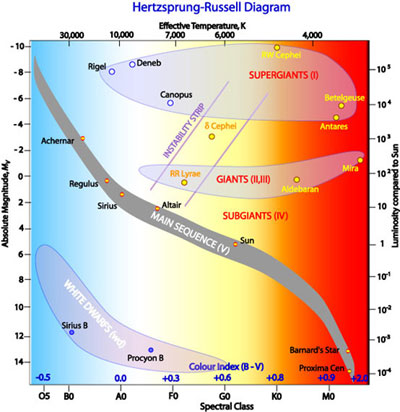
Theory: luminosity and Teff
Observation: Magnitude and color
spectral types in smaller groups
each types is divided into 10 subtypes (O, O1, O2, …, O9
Spectral lines hydrogen
Balmer: any transition from/to 2nd level - UV
Lyman: any transition from/to 1st level - Visible
Rydberg equation
\frac{1}{\lambda}=R\left(\frac{1}{n_{l}^2}-\frac{1}{n_{u}^2}\right)
where R is rydberg constant, nl is lower quantum number, nu is upper quantum number
Hot stars spectrum look
more energy - they ionize
too much energy to allow molecules to form
types of gas for temperaruers in stars
hot stars - ionized gas
medium - more neutral gas: metals, hydrogen
cool stars - molecule lines: oxide, methane, water
Refractor Teelscopes
lenses to focus the light
aren’t build anymore
lenses too heavy
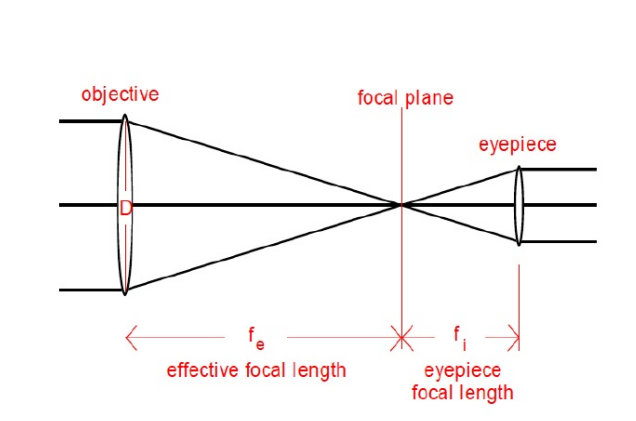
focal ration
The focal ratio describes how fast the beam converges to the focal plane.
F=\frac{f}{D} where f = focal length and d D = diameter of lens mirror
Written as F/x
Types of reflectors
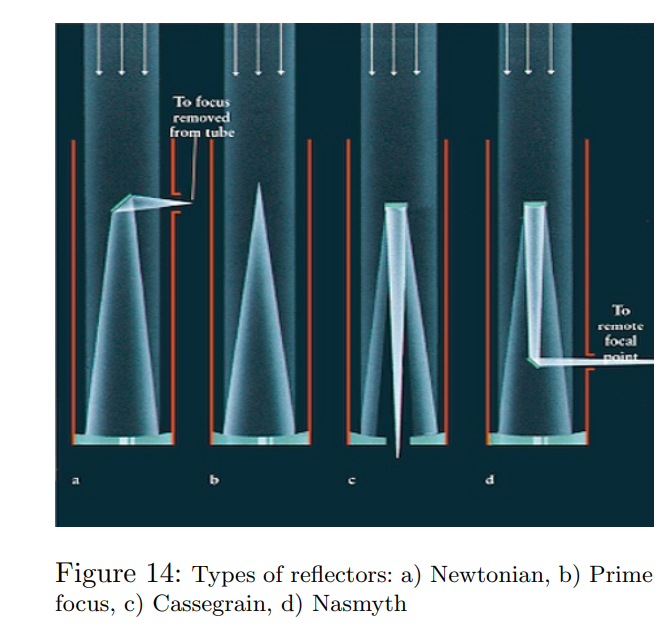
Refecltor telescope
Use mirrors (at least one, usually more than one) to focus the light
Aperure of a telescop e
How much light can a telescope collect
smaller/bigger focal ratios
Smaller: converges quicker, better picture of a faint star
wide feild images, small image scale, good for surveys
larger: better details, takes longer, longer exposure rratio
small images, large image scale
Resolving power of a tekescope
How much detail can be seen
Minimum angular separation of two sources on sky
Diffraction limit of telescope
\alpha=\frac{1.22\lambda}{D}\left(rad\right)
where:
D= diameter of aperure
Extinction of telescopes
loss of light via absorption and scattering by molecules in the atmosphere
Airmass
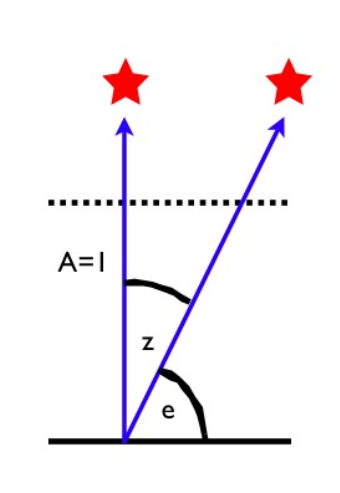
The airmass A is a measure of the path the light has to take through the atmosphere
z = zenith, e = 90 - z
A=\frac{1}{\cos\left(z\right)}
airmass doesn’t change with altitude
Atmospheric trasnmision
T=\frac{F}{F_{o}}=e^{-\tau A}
F = measured flux
Fo = flux above atmosphere
tau = opacity (%)
A = airmass
Ideal telescope location
above cloud layer
number of clear nights should be high
very low rainfall
light pollution
Spectral resolution
R=\frac{\lambda}{\Delta\lambda}=\frac{v}{c}
R depends upon width of entrance slits, dispersion of grating, seeing, etc.
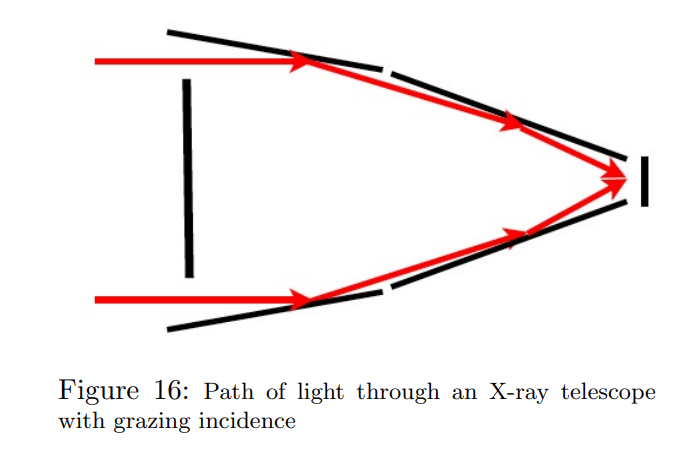
Problem with x ray teelscopes and solution
lamda is comparable to the distance between atoms, so photons “see” a smooth surface
solution: grazing, use nested mirrors
Problem with infrared telescopes and solution
everything that is warm emits infrared radiation
so the cooling becomes extremly important
xray telescope use
see through hot gases
IR telescope use
used to see through dust and colder objects
radio telescope problem and solution
Problem: At long wavelengths the diffraction limit is very large
The solution is interferometry. In short, interferometers combine the power of multiple telescopes
\theta=\frac{\lambda}{b} where b is the separation
Kirchoff’s laws
there are three types of spectra:
continuous spectrum (all wavelengths) produced by a hot opaque body - hot, dense, gas
continuous spectrim with dark absorption lines is produced by a hpt opaque body seen through a trasparent layer of cool gas whuch absorvs some light
emission line spectrum is produced by hot transparent gas. Here light is only specific wavelengths. This can occur. when clouds of gas are heated by nearby hot stars.
radial velocity
observed as doppler effect
\frac{\Delta\lambda}{\lambda}=\frac{v_{rad}}{c}
proper motion
The proper motion µ is the motion of the star in the plane of the sky
separated into:
t_{a,}t_{\delta}
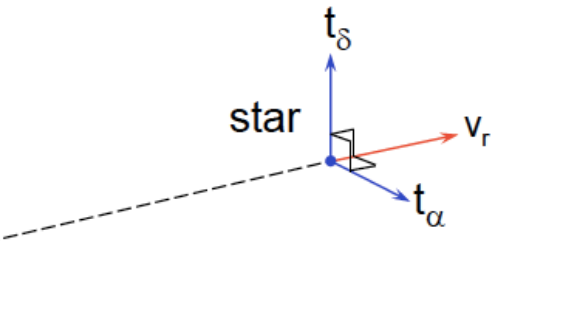
proper motion equation
\mu=\sqrt{\left(\mu_{a}\cos\left(\delta\right)\right)^2+\mu_{\delta^{^{}}}^{^2}} (arcsec/year)
transverse velocity equation
t = 4.74 mu *d
full space motion
s=\sqrt{v_{r}^2+t^2} +9
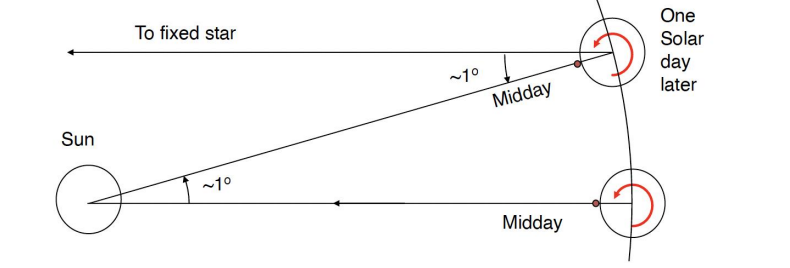
solar day
time it takes earth to rotate around its axis
sideral day
time earth takes for axis rotation so that distant stars appear in the same position
equation relation between periods days
\frac{1}{P_{Rot}}=\frac{1}{P_{day}}+\frac{1}{P_{0rb}}
P rot is sideral period
The orbital plane of the earth around the sun
ecliptical
what causes seasons?
The tilt of the Earth’s rotation relative to the ecplitic
Flux winter
since the angle is small, it reduces flux felt by the earth
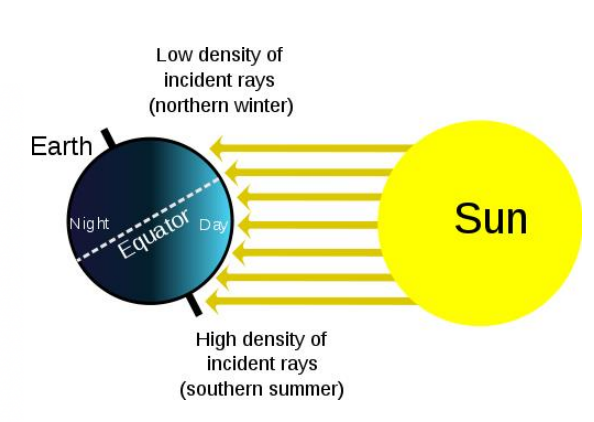
flux summer
since the angle is large, there’s greater flux of light that hits the earth
Rotation of the earth
The Earth rotates anticlockwise as viewed from above the North Celestial pole So, stars appear to rotate clockwise (rise in East, set in West) around the North celestial pole.
Synchronous rotation of the moon
Same face always towards earth at all points of the rotation
infirior conjugation
E-P-S
Greatest elongation
Maximum separation from the sun 90º angle at planet
superior conjugatiion
other side of the sun
conjunction
E-S-P
Quadrature
90º angle at earth
Opposition
P-E-S
perihelion
closer
d_{per}=a\left(1-e\right)
aphelion
further
d_{aph}=a\left(1+e\right)
Planetary velocity
Fgrav = ma
v=\sqrt{\frac{GM}{r}}
retorgrade motion
appparent motion opposite to that of the direct motions of members of the solar system
Sideral and solar days drawing
Sidereal period
true orbital period measured relative to the stars
Synodic period:
time for planet, Earth and Sun to come back to a particular configuration (planets lap each other)
Equation periods
\frac{1}{P_{syn}}=\frac{1}{P_{i}}-\frac{1}{P_{o}}
where Pi is the inner planet’s period
and Po is the inner planet’s
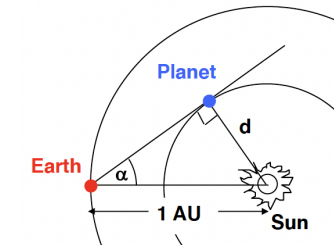
Relative distances to inner planets
when inner is at max elongation
d=\left(1AU\right)\sin\left(\alpha\right)
Relative distances to outer planets
Copernicu’s method
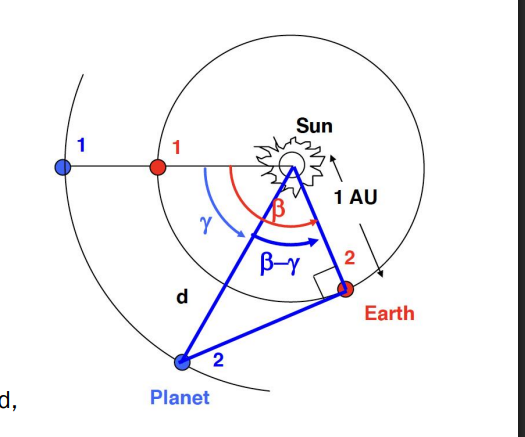
d=\frac{1}{\cos\left(\beta-\gamma\right)}AU
\beta=\omega_{ear}t ,\gamma=\omega_{planet}t
Calculate planet radii
At oposition:
R=\tan\left(\alpha\right)d
d = distance earth-planet
eclipse equation
f/a = e (eccentricity)
a² = f² +b²
b=a\sqrt{1-e^2}
Kepler’s first law
Planets move in an elliptical orbit around the Sun, with the Sun at one focus of the ellipse.
Kepler’s second law
The straight line drawn from the Sun to a planet sweeps out equal areas during equal intervals of time.
Mercury (5)
Lots of craters
Primordial lava flows
No plate tectonics
Scarps (cliffs)
very weak magnetic field
Venus (7)
very thick cloud coverege in the atmosphere
young —> nor many craters
Volcanic plains, lava flows
No plate tectonics
High density, sluggish atmosphere
a lot of greenhouse effect
no magnetic field

