2700 chapter 2 and 3
0.0(0)
 Studied by 2 people
 Call Kai
 Learn
Learn Practice Test
 Spaced Repetition
 Match
Match Flashcards
 Knowt Play
Card Sorting
1/140

Earn XP
Description and Tags
Last updated 10:22 PM on 10/3/22
Name | Mastery | Learn | Test | Matching | Spaced | Call with Kai |
|---|
No analytics yet
Send a link to your students to track their progress
141 Terms
1
New cards
The Lamaze method
A method of "prepared" childbirth involving relaxation and controlled breathing.
2
New cards
The Leboyer method
A method of childbirth where delivery occurs in a quiet, dimly lit room and the infant's head is not pulled, minimizing the trauma for the newborn and allowing for immediate bonding between mother and child
3
New cards
Dick-Read Method
natural child birth;
focuses on fear reduction and abdominal breathing to make sure the mother is relaxed
focuses on fear reduction and abdominal breathing to make sure the mother is relaxed
4
New cards
Bradley method of childbirth
Designed to promote natural and healthy childbirth without medication or surgery. Classes focus on nutrition, relaxation, and breathing exercises and instructing fathers as labor coaches.
5
New cards
Alexander Technique
a technique used during child birth that involves training to stop habitual reactions to pain such as tensing muscles and increase conscious awareness and control over posture and free movement during labor. using body positioning that is beneficial to the labor.
6
New cards
water birth
relaxes mother, shortens labor, and reduces complications
7
New cards
lotus birth
Leaving placenta attached to infant until umbilical cord dries & separates naturally, which generally happens 3-10 days after birth
8
New cards
Silent Birth
Sometimes known as quiet birth, is a birthing procedure advised by L. Ron Hubbard and advocated by Scientologists in which "everyone attending the birth should refrain from spoken words as much as possible."
9
New cards
medicated childbirth
Relieves pain typically through an epidural
10
New cards
how many women in Canada have epidurals
71%
11
New cards
canada has experienced a steady increase in non-hospital births from 2005 to 2015
by 113%
12
New cards
how many midwives does Canada have per 10 000
0.51
13
New cards
fertility treatment
causing rates of multiple babies to go up
14
New cards
Cryopreservation
freezing eggs or sperm for later use
15
New cards
antenatal
conception to postpartum
16
New cards
pregnancy
Condition in a female of having a developing embryo and fetus in her uterus for about 40 weeks
17
New cards
prenatal
process that transforms a zygote into a newborn
18
New cards
why do we see malnutrition in women in the first trimester in Canada
because of morning sickness
19
New cards
hyperanysis
consistent vomiting throughout the entire pregnancy, 1 in 50 women get this
20
New cards
first trimester
zygote to implantation, 1-12 weeks
21
New cards
second trimester
12-24 weeks, can feel fetus moving
22
New cards
third trimester
25+ weeks, increased emotional attachment to the fetus
23
New cards
Preeclampsia and eclampsia
Most common hypertensive disorder; develops during pregnancy and is characterized by elevated blood pressure, edema and proteinuria; characterized by an increase BP of 30mmHg systolic and/or diastolic increase of 15mmHg diastolic; 10 weeks gestation or 48 hours post delivery; major cause of maternal death, fetal hypoxia and death; predominately primigravida
24
New cards
Risk factors of preeclampsia
-History of preeclampsia
nulliparous
-first pregnancy
-Age 35+ or teens
-Central Obesity
-Diabetes
-Multifetal Pregnancy
-Chronic Disease
nulliparous
-first pregnancy
-Age 35+ or teens
-Central Obesity
-Diabetes
-Multifetal Pregnancy
-Chronic Disease
25
New cards
what is the age of viability in Ontario
23 weeks, intervention starts at 24 weeks
26
New cards
what is the likelihood of survival at different weeks?
23 weeks- 17%
24 weeks- 39%
25 weeks- 50%
26 weeks- 80%
27 weeks- 90%
28-31 weeks- 90-95%
32-33 weeks- 95%
34 weeks- almost fully likely
24 weeks- 39%
25 weeks- 50%
26 weeks- 80%
27 weeks- 90%
28-31 weeks- 90-95%
32-33 weeks- 95%
34 weeks- almost fully likely
27
New cards
why are we intervening a lot earlier
Trend is we are helping sooner and sooner because we have more precision medicine to increase survival rates. Age is viability is decreasing because survival is increasing.
28
New cards
9-12 weeks of development
fingerprints, grasping reflex, facial expressions, swallowing
29
New cards
13-16 weeks
hair follicles, respond to mother's voice and loud noises, 8-12 cm long, crown to rump, weights 25-100mg
30
New cards
17-20 weeks
fetal movements felt by mother, heartbeat detectable with stethoscope, hair covers body, eyes respond to light introduced into the womb, eyebrows, finger nails
31
New cards
21-24 weeks
vernix (oily substance) protects skin, lungs produce surfactant, viability becomes possible
32
New cards
25-28 weeks
recognition of mother's voice, regular periods of rest and activity, good chance of survival if born now
33
New cards
28-32 weeks
very rapid growth, antibodies acquired from mother, fat deposited under skin
34
New cards
33-36 weeks
movement to head-down position for birth, lungs mature
35
New cards
37+ weeks
full term status
36
New cards
what is the difference between gender
females are more sensitive to external stimulation and advance more rapidly in skeletal development where as males are more physically active in utero and vulnerable to all kinda of prenatal problems and are more likely to be spontaneously aborted and have birth defects
37
New cards
genetic disorders
such as autosomal dominant disorders, autosomal recessive disorders, sex-linked recessive disorders
38
New cards
autosomal dominant disorders
Huntington disease and achondroplasia
39
New cards
autosomal recessive disorders
Tay-Sachs, Cystic fibrosis, sickle cell anemia, phenylketonuria
40
New cards
sex-linked recessive disorders
color blindness, duchenne muscular dystrophy, hemophilia, missing front teeth
41
New cards
chromosomal errors
trisomy, anomalies with sex chromosomes (turner's syndrome)
42
New cards
teratogens
obesity, alcohol, smoking, marijuana, depression, anxiety
43
New cards
APGAR score
appearance, pulse, grimace, activity, respiration
44
New cards
Impacts of preterm
life long effects such as cerebral palsy, cognitive impairment, visual and hearing impairment, poor health and growth and behavioural and social-emotional problems
45
New cards
extremely low birth weight
born weighing less than 2.3 pounds
46
New cards
very low birth weight
born weighing less than 3.9 pounds
47
New cards
low birth weight
born weighing les than 5.5 pounds
48
New cards
normal birth weight
born 5.8 to 8.13 pounds
49
New cards
average birth weight
is 8.71 pounds but birth weight is getting bigger
50
New cards
the effects of low birth weight and very low birth weight
negative effects on mental and motor development and growth at 9 months to 2 years (mental effects lessen as they get older)
51
New cards
prenatal care
for mother- blood pressure, urine, weight gain, blood work
52
New cards
Intrapartum Care
labour and delivery
53
New cards
Postpartum care
The care the mother receives during the 6 to 8 weeks following the birth of her baby.
54
New cards
why is home birth better
the environment makes a big impact on experiences and a lot of people are sick in hospitals
55
New cards
how many first time mothers want home births? how many second time moms?
9% first, 21% second
56
New cards
Stage 1 of labor
begins with onset of regular contractions and ENDS when cervix is completely effaced and dilated
57
New cards
stage 2 of labor
cervix is dilated completely and baby is born
58
New cards
stage 3 of labor
delivery of placenta
59
New cards
stage 4 of labor
the first few hours after birth
60
New cards
process of birth complication
fetal distress (sudden fetal heart rate) and anoxia (oxygen deprivation)
61
New cards
fetal alcohol syndrome
physical and cognitive abnormalities in children caused by a pregnant woman's heavy drinking.

62
New cards
how can the use of cannabis during pregnancy impact the fetus ?
can impact brain development, behaviour, mental health
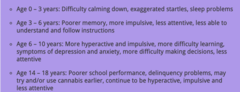
63
New cards
how can untreated depression ?
untreated depression can lead to negative social interactions, less eye contact and less playfulness which makes babies cry more and have trouble sleeping
64
New cards
Key issues in first trimester
Ectopic pregnancy, abnormal urine or blood tests, increased blood pressure, malnutrition, bleeding, miscarriage
65
New cards
Key issues in second trimester
gestational diabetes; excessive weight gain; increased blood pressure; Rh incompatibility of mother and fetus; miscarriage 13-20 weeks; premature labour 21+ weeks
66
New cards
Key issues in third trimester
increased blood pressure, bleeding, premature labour, bladder infection, toxemia
67
New cards
environment correlations
the processes by which genetic factors contribute to variations in the environment
68
New cards
passive genotype-environment correlations
occurs when children passively inherit the genes and the environments their family provides
69
New cards
evocative genotype-environment correlations
refers to how the social environment reacts to individuals based on their inherited characteristics
70
New cards
Genotype-Envrionment Interaction
involves genetic susceptibility
71
New cards
epigenetic framework
Relationship between heredity and environment
72
New cards
Mitosis vs. Meiosis
Mitosis: one division forming 2 identical cells (clones); Meiosis: two divisions forming 4 genetically different cells
73
New cards
sex chromosomes
X and Y chromosomes.
74
New cards
Genotype
sum of total of all genes a person inherits
75
New cards
Phenotype
the features that are actually expressed
76
New cards
Homozygous
same version of gene from mom and dad
77
New cards
Heterozygous
different version of a gene from mom and dad
78
New cards
Polygenetic
many characteristics are the result of several genes working together
79
New cards
sickle cell anemia
a genetic disorder that causes abnormal hemoglobin, resulting in some red blood cells assuming an abnormal sickle shape - recessive disorder
80
New cards
cystic fibrosis
A genetic disorder that is present at birth and affects both the respiratory and digestive systems. - recessive disorder
81
New cards
Phenylketonuria (PKU)
an inherited disorder of protein metabolism in which the absence of an enzyme leads to a toxic buildup of certain compounds, causing intellectual disability - recessive disorder
82
New cards
Tay-Sachs disease (TSD)
a hereditary disease marked by progressive physical degeneration, mental retardation, and early death- recessive disorder
83
New cards
albinism
Absence of pigment in the skin, hair, and eyes- recessive disorder
84
New cards
Huntington's disease
A human genetic disease caused by a dominant allele; characterized by uncontrollable body movements and degeneration of the nervous system; usually fatal 10 to 20 years after the onset of symptoms.- autosomal dominant disease
85
New cards
Tourette syndrome
involuntary, spasmodic, twitching movements; uncontrollable vocal sounds; and inappropriate words- autosomal dominant disorders
86
New cards
Achondroplasia
A form of human dwarfism caused by a single dominant allele; the homozygous condition is lethal- autosomal dominant disorders
87
New cards
Fragile X Syndrome
a disorder produced by injury to a gene on the X chromosome, producing mild to moderate mental retardation- sex linked
88
New cards
Hemophilia
A hereditary disease where blood does not coagulate to stop bleeding- sex linked
89
New cards
Duchenne Muscular Dystrophy (DMD)
progressive disease that weakens the muscles of the shoulder and pelvic girdle- sex linked
90
New cards
Down Syndrome (Trisomy 21)
A genetic disorder caused by the presence of all or part of a third copy of chromosome 21.- autosomal chromosome
91
New cards
Trisomy 9 Mosaicism
Caused by having an extra chromosome 9 in some cells. The severity of effects relates to the proportion of cells with extra chromosomes. The effects include fetal growth restriction resulting in low birth weight and multiple anomalies, including facial, cardiac, musculoskeletal, genital, kidney, and respiratory abnormalities.- autosomal chromosomes
92
New cards
trisomy 13
*Extra 13th* chromosome
47 instead of 46 chromosomes
Severe birth defects: clefts, extra fingers/toes
Often heart, brain or spinal abnormalities
Short life span - autosomal chromosome
47 instead of 46 chromosomes
Severe birth defects: clefts, extra fingers/toes
Often heart, brain or spinal abnormalities
Short life span - autosomal chromosome
93
New cards
trisomy 18
Edwards syndrome
94
New cards
Turner Syndrome (XO)
affects females, short stature, infertility- sex linked chromosomal
95
New cards
Klinefelter Syndrome (XXY)
an extra X chromosome causes physical abnormalities- sex linked chromosomal
96
New cards
XYY syndrome
A chromosomal disorder in which males have an extra Y chromosome. - sex linked chromosomal
97
New cards
Triple X Syndrome (XXX)
Extra X chromosome. Tallness and impaired verbal intelligence. Female sexual development and fertility are normal.- sex linked chromosomal
98
New cards
the germinal period
The first two weeks of prenatal development after conception, characterized by rapid cell division and the beginning of cell differentiation.
99
New cards
the embryonic period
the period from two to eight weeks after fertilization, during which the major organs and structures of the organism develop
100
New cards
fetal period
9 weeks to birth
 Note
Note  Flashcards (393)