Stdy pack 2 bio/ biochem passage 7
 Studied by 0 people
 Call Kai
 Learn
Learn Practice Test
 Spaced Repetition
 Match
Match Flashcards
 Knowt Play
1/10

There's no tags or description
Looks like no tags are added yet.
Name | Mastery | Learn | Test | Matching | Spaced | Call with Kai |
|---|
No analytics yet
Send a link to your students to track their progress
11 Terms
Which enzyme is required for the production of cDNA from an RNA template?
_
A
Deoxyribonuclease
B
Peptidyl transferase
C
Reverse transcriptase
D
RNA polymerase
Solution: The correct answer is C.
Deoxyribonuclease is used to break down, not synthesize, DNA molecules such as cDNA.
Peptidyl transferase is used to link amino acids, not to form cDNA.
The production of cDNA from RNA is performed during the reverse transcription polymerase chain reaction. This conversion is mediated by the enzyme reverse transcriptase.
To produce cDNA from an RNA template, a DNA polymerase referred to as reverse transcriptase must be used. RNA polymerases are not required for this conversion, as an RNA template is already available.
Just in case someone is wondering this question:
cDNA is synthesized from mRNA using reverse transcriptase
The synthesized single strand cDNA is synthesized into a double stranded cDNA using DNA polymerase
The double stranded cDNA is transferred into the vector and ligated at the ends with DNA ligase.
cDNA is essentially DNA that has been reverse transcribed from RNA. Basically it's DNA without the introns.
Initial State (0 cycles): You start with 1 double-stranded DNA molecule, both strands radioactive (R/R).
After Cycle 1: The original template separates, and new, non-radioactive (N) strands are synthesized, resulting in 2 molecules: one R/N and one N/R (both semi-radioactive).
After Cycle 2: Each of the two semi-radioactive molecules replicates, producing 4 total molecules:
From the R/N molecule: 1 R/N and 1 N/N
From the N/R molecule: 1 N/R and 1 N/N
Total: 1 R/N, 1 N/R, and 2 N/N molecules.
Result: Out of 4 total molecules, 2 contain at least one radioactive strand (the R/N and N/R molecules), making it 50%.
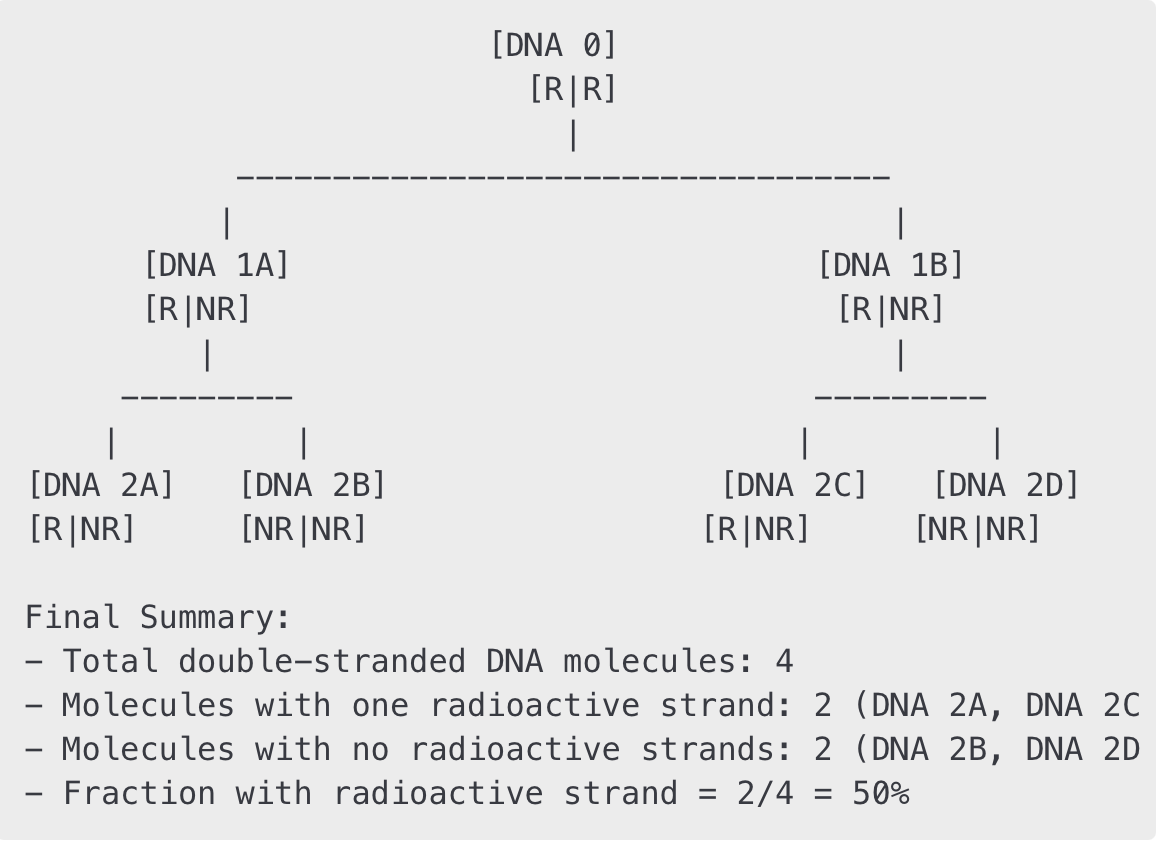
A PCR reaction is performed using non-radioactive nucleotides and a DNA template labeled with radioactive phosphate on both strands. After two rounds of PCR, what percentage of DNA molecules will contain radioactive phosphate on at least one strand?
_
A
0%
B
25%
C
50%
D
100%
DNA replication is semi-conservative. Each round of replication produces a DNA molecule consisting of one old DNA strand bound to a new DNA strand. Therefore, the original radioactive strands will persist through each round of replication.
After three rounds of replication, 25% of the resulting DNA molecules would be labeled with radioactive phosphate.
DNA replication is semi-conservative. This means that after one round of replication, every new DNA double helix will be a hybrid that consists of one strand of old DNA bound to one strand of newly synthesized DNA. If both DNA strands are initially labeled with radioactive phosphate, then after one round of replication, the resulting DNA will still be labeled on one strand. After a second round of replication, 50% of the resulting DNA molecules will still be labeled on one strand.
After one round of replication, both DNA molecules still have one strand that is labeled with radioactive phosphate. However, after two rounds, only 50% of the DNA molecules are labeled with radioactive phosphate.
I chose answer B correct was C
Which action will most likely increase FADH2 production in the citric acid cycle?
_
A
Inhibiting fumarase
B
Increasing fumarate levels
C
Decreasing succinate levels
D
Activating succinate dehydrogenase
Cdk1 controls the G2/M transition whereas Cdk2 controls the G1/S transition.Solution: The correct answer is D.
Fumarase converts fumarate to malate in the citric acid cycle. Inhibiting fumarase will, therefore, increase fumarate levels. Fumarate is produced from succinate; during this reaction FAD is reduced to FADH2. Therefore, if fumarate levels are increased, the conversion of succinate to fumarate will be opposed, which will prevent the production of FADH2.
Fumarate is produced from succinate. During this reaction, FAD is reduced to FADH2. Increasing fumarate levels will oppose its production from succinate, therefore decreasing FADH2 production.
FAD is reduced to FADH2 when succinate is converted to fumarate. Reducing succinate levels will oppose this reaction, decreasing FADH2 production.
Succinate dehydrogenase converts succinate to fumarate. During this reaction, FAD is reduced to FADH2. Therefore, activating succinate dehydrogenase will increase FADH2 levels.
review citric acid cycle
guess and got it correct
What is the most direct impact of a mutation that prevents cyclin binding to Cdk1 during the cell cycle?
_
A
Cells do not enter M.
B
Cells do not enter S.
C
Cells progress through G1 more rapidly.
D
Cells progress through G2 more rapidly.
Solution: The correct answer is A.
The association of cyclin with Cdk1 is required for mitosis, or M, to initiate. Therefore, blocking this interaction will prevent cells from entering mitosis.
The association of cyclin with Cdk1 controls entry into mitosis, not S phase.
The interaction between cyclin with Cdk1 controls the progression of G2 to M, but will not likely impact G1.
The association of cyclin with Cdk1 controls entry of a cell into mitosis. Therefore, blocking this interaction will prevent cells from entering mitosis. This will cause cells to remain in G2.
correct answer is A i answer B
Cdk1 controls the G2/M transition whereas Cdk2 controls the G1/S transition.
Passage 7 (6 questions)
Bartter syndrome is an inherited condition that impacts ion channels within the kidney tubule epithelial cells. There are several types of Bartter syndrome, including Type I, which affects the NKCC2 cotransporter in the thick ascending limb of the loop of Henle. This protein transports Na+ from the filtrate within the kidney tubules into the tissue fluid surrounding the tubules and collecting ducts within the kidney medulla. The NKCC2 cotransporter shows no ATPase activity.
Type I Bartter syndrome is inherited in an autosomal recessive manner and is caused by a loss-of-function mutation in the SLC12A1 gene, which encodes the NKCC2 cotransporter. Type II Bartter syndrome is also inherited in an autosomal recessive manner, but it is caused by a mutation to the KCNJ1 gene, which encodes the ROMK channel. The ROMK channel transports K+ from kidney tubule cells into the kidney filtrate.
One of the phenotypes of Bartter syndrome is increased urinary output. To compensate for subsequent alterations to plasma electrolyte levels, the body implements several hormonal mechanisms. Such alterations to hormone signaling can cause individuals affected by Bartter syndrome to exhibit reduced potassium concentrations, which creates a steeper K+ concentration gradient across membranes. To assess urine alterations in Bartter syndrome, researchers performed urinalysis on an infant carrying an A555T substitution within the NKCC2 cotransporter (Table 1).
Table 1. Urinalysis of Infant Affected by Bartter Syndrome
Physiological variable | Result | Standard |
Potassium (mmol/day) | 140 | 25–125 |
pH | 7.48 | 7.30–7.45 |
Which type of mutation is most likely the cause of Bartter syndrome in the infant that researchers assessed?
A
Frameshift
B
Missense
C
Nonsense
D
Silent
Solution: The correct answer is B.
Frameshift mutations result from nucleotide insertions or deletions that shift the frame of reference for translating nucleotide codons into amino acid sequences. Frameshifts typically produce major structural changes to proteins or introduce stop codons and are, therefore, unlikely to create only a single amino acid substitution.
Missense mutations are likely to cause a change in a single amino acid. The infant that researchers assessed contained an A555T substitution in the NKCC2 cotransporter.
Nonsense mutations introduce a stop codon that prematurely halts protein synthesis. This results in the loss of multiple amino acids from a protein rather than substituting a single amino acid.
Silent mutations do not cause a change in function or phenotype. Silent mutations could substitute a single amino acid as described in the passage; however, the mutation described affects channel function. It is, therefore, not silent.
In individuals affected with Type I Bartter syndrome, which event causes a change in aldosterone secretion?
A
Low plasma Na+ levels, which results in increased aldosterone secretion
B
Low plasma Na+ levels, which results in decreased aldosterone secretion
C
High plasma Na+ levels, which results in increased aldosterone secretion
Answer choice eliminated
D
High plasma Na+ levels, which results in decreased aldosterone secretion
Solution: The correct answer is A.
During Type I Bartter syndrome, there is a loss-of-function mutation to the NKCC2 cotransporter, which reabsorbs Na+ from the kidney filtrate into the surrounding tissue fluid. This decreases levels of Na+ in the plasma. Aldosterone is released when levels of Na+ in the plasma are low.
Low levels of Na+ in the plasma lead to increased, not decreased, aldosterone secretion.
High levels of Na+ in the plasma would decrease, not increase, aldosterone secretion.
During Type I Bartter syndrome, there is a loss-of-function mutation to the NKCC2 cotransporter. This cotransporter is responsible for reabsorption of Na+ from the kidney filtrate. Therefore, this leads to low, not high, levels of Na+ in the blood plasma during Type I Bartter syndrome.
got to correct reveiw aldostero fucntion
Aldosterone is released when levels of Na+ in the plasma are low
ype I, which affects the NKCC2 cotransporter in the thick ascending limb of the loop of Henle. This protein transports Na+ from the filtrate within the kidney tubules into the tissue fluid surrounding the tubules and collecting ducts within the kidney medull
If two parents carry a single allele of the same Bartter syndrome-causing SLC12A1 mutation, what is the percent probability of an offspring inheriting Type I Bartter syndrome?
A
0%
B
25%
C
50%
D
100%
Solution: The correct answer is B.
Since each parent contains a Bartter syndrome-causing allele, there is a chance that the child will inherit Bartter syndrome.
Since Type I Bartter syndrome is autosomal recessive, an individual needs to possess two copies of a mutated allele. Since each parent contains a single mutated allele, they each have a 50% chance of passing this allele to an offspring, making the chance of inheriting Bartter syndrome 25% (50% x 50%).
Each parent has a 50% chance of passing along the mutated allele that can cause Bartter syndrome. However, an offspring will need to inherit two copies of the mutated allele, giving the offspring a 25% chance (50% x 50%) of inheriting Bartter syndrome.
Since each parent contains a wild-type SLC12A1 allele, there is a chance that the offspring will not inherit Bartter syndrome.
got it correct
Which change in blood pressure is most likely associated with Bartter syndrome?
A
Increased blood pressure due to increased water reabsorption
B
Increased blood pressure due to decreased water reabsorption
C
Decreased blood pressure due to increased water reabsorption
Answer choice eliminated
D
Decreased blood pressure due to decreased water reabsorption
Solution: The correct answer is D.
In Bartter syndrome, there is increased urinary output. This is indicative of decreased, not increased, water reabsorption.
Decreased water reabsorption would lead to decreased, not increased, blood pressure.
Increased water reabsorption would lead to increased, not decreased, blood pressure.
In Bartter syndrome, there is increased urinary output, which is indicative of decreased water reabsorption. Decreased levels of water in the blood lead to low pressure.
was between a and d chose a got incorrect
Which conclusion regarding urine pH and potassium levels of the assessed infant is most accurate based on Table 1?
Compared to standard values:
A
the infant's urine pH is more acidic and has higher potassium levels.
B
the infant's urine pH is more basic and has higher potassium levels.
C
the infant's urine pH is more acidic and has lower potassium levels.
D
the infant's urine pH is more basic and has lower potassium levels.
Solution: The correct answer is B.
The infant's urine pH is more basic, not acidic, compared to standard values.
Based on Table 1, the infant's urine pH is slightly more basic compared to standard values. There is also a higher level of potassium in the urine compared to standard values.
Compared to standard values, the infant's urine has a higher, not lower, level of potassium. In addition, the urine pH is more basic, not acidic.
The infant's urine has higher, not lower, potassium levels compared to standard values.
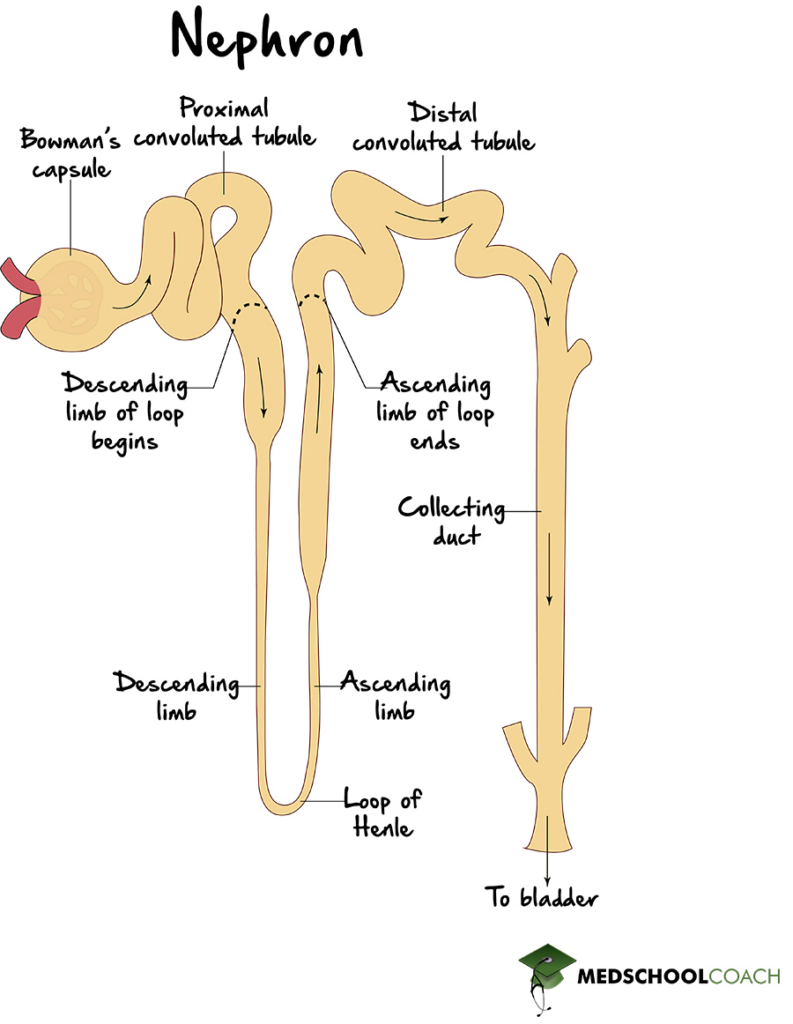
Which structure of the nephron immediately follows the nephron region impacted by Type I Bartter syndrome?
A
Glomerulus
Answer choice eliminated
B
Collecting duct
C
Distal convoluted tubule
D
Proximal convoluted tubule
The glomerulus is the initial portion of the nephron. The ascending loop of Henle and glomerulus are separated by several nephron regions, including the proximal convoluted tubule and descending loop of Henle.
The ascending loop of Henle is most directly impacted during Type I Bartter syndrome. The ascending loop of Henle is separated from the collecting duct by the distal convoluted tubule.
The passage indicates that Type I Bartter syndrome affects NKCC2 cotransporters in the ascending loop of Henle. The ascending loop of Henle is positioned directly adjacent to the distal convoluted tubule.
The ascending loop of Henle, which is directly affected during Type I Bartter syndrome, is separated from the proximal convoluted tubule by the descending loop of Henle.
 Note
Note  Flashcards (20)