Interactionist views of crime
 Call Kai
 Learn
Learn Practice Test
 Spaced Repetition
 Match
Match Flashcards
 Knowt Play
1/13

There's no tags or description
Looks like no tags are added yet.
Name | Mastery | Learn | Test | Matching | Spaced | Call with Kai |
|---|
No analytics yet
Send a link to your students to track their progress
14 Terms
What do interactionist believe about crime?
Everyone commits acts that would be considered criminal or deviant however it isn’t the act that gives the label it is the response of society which then labels individuals or groups.
What type of perspective is interactionism?
Micro perspective as they look at the way crime and deviance is socially constructed
What does Howard Becker say about labelling?
Crime and deviance is subjective, based on ‘moral entrepreneurs’ opinions and is a form of social control which is distributed between the powerful and deviant.
What are the consequences of labelling?
The labelled gain a ‘master status’ which shapes how others see them and creates stigma leading them to form deviant subcultures where deviance becomes more frequent.
What is the labelling process according to Becker?
Initial label placed on person due to act, receives rejection
Person believes others view them as label so encourages their deviance.
Then creates deviant career which many join and accept their labelled identity
Results in subculture formation with norms and values that support their deviance
What was Lemerts primary and secondary deviance theory?
Primary - includes deviant acts before public labelling e.g running a red light
Secondary -the reaction to societies reaction e.g continuing to fight because labelled dangerous
What was Jock Youngs ‘Hippies’ study?
Used labelling theory to investigate Notting Hill hippies in 1980s, found when labelled for exaggerated marijuana use police targeted and marijuana use increased as a result.
What did stan cohen say?
Examined youth subcultures “mods and rockers” which clashed and media created these subcultures of folk devils. This leading to Media creating moral panics by an over the top reaction
What is deviancy amplification? Wilkins
Social reaction to deviant acts leads to further defiance which leads to greater reaction
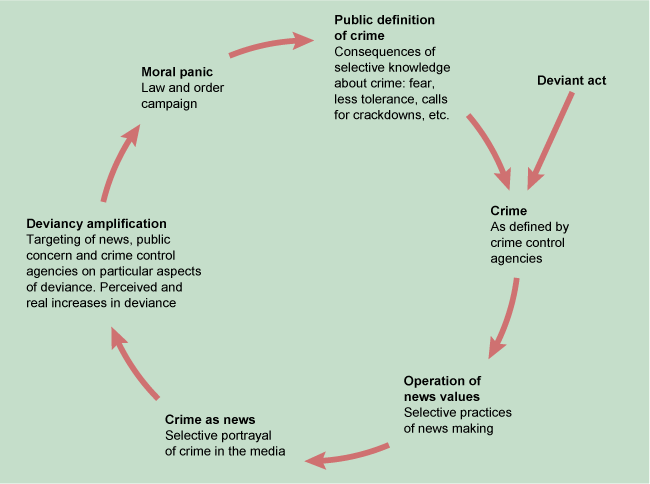
What did Triplett find (2000)?
Increasing tendency to label youth offenders as evil and to be less tolerant of minor deviance resulting in much harsher punishment which led to increased offending.
What is matza drift theory?
Young people drift in and out of criminal action but they share the same norms and values as society but hold 2 sets of values: conventional values and subterranean values.
What does cicourel say about labelling
Police are more likely to arrest those who fit the stereotype of a delinquent; working class, ethnic minority, aggressive which may suggest why theories state there is a delinquent subculture
What are the strengths of interactionism?
Differentiated between social deviance and situational deviance,
micro perspective,
supported with research
influenced realist perspectives
What are the weaknesses of interactionism?
Fails to explain why only some people are labelled and why only some activities are against the law
Too deterministic - not every label makes someone more deviant
Doesn’t explain origins of deviant acts
Adler - some people commit deviant acts either way labelled or not