Animal Behaviours
 Call Kai
 Learn
Learn Practice Test
 Spaced Repetition
 Match
Match Flashcards
 Knowt Play
1/81

There's no tags or description
Looks like no tags are added yet.
Name | Mastery | Learn | Test | Matching | Spaced | Call with Kai |
|---|
No analytics yet
Send a link to your students to track their progress
82 Terms
What is behaviour?
The observable actions (or inactions) of animals, including how they interact with their environments, conspecifics, and other species
T/F: Not all behaviours are intentional
True - they may also be driven by motivation
What is the Dead Man’s Test?
If a dead man can do it, it is not behaviour
Who emphasized that behaviour was subject to natural selection?
Darwin and Romanes
Romanes is introduced ___________________ focusing on animal intelligence and learning (made more rigorous by Lloyd Morgan)
Comparative psychology
What is comparative psychology?
the scientific study of similarities and differences in the behavior, cognition, and mental processes of different species, including humans and non-human animals
cross-species comparisons, especially cognition
focuses on understanding evolutionary, developmental, and functional aspects of behavior
often applies principles from ethology and biology to explore learning, memory, and social interactions
Who are the founders of behaviourism?
Watson, Pavlov, and Skinner
Note: Behaviourism = stimulus response learning
Who is associated with classical ethology (studied a wide variety of
behaviour in natural habitats)?
Lorenz, Tinbergen, and von Frisch
When did ethology and comparative psychology begin to merge?
After WWII
What are Darwin’s two fundamental tenets?
Behaviour is an adaptation
Behaviour resulted from selection pressures operating in the past
Ex. Death feigning in red flour beetles
What is the Farm-Fox Experiment? (Belyaev et al. - silver foxes)
Foxes selected and sorted according to tameness
Tame foxes were bred
Selection proved to change morphological features seen in dog domestication
Take-Home: can select for tameness and other traits
Debated as previous experiment (unknown at time) may have impacted results
Describe George Romanes take on early comparative psychology
advocate for natural selection
compare animal intelligence across species
continuity for mental traits, perception, memory, and problem solving
Used anecdotes and prone to anthropomorphism and over-interpretation: rats forming supply lines, monkey showing a hunter blood on its hand
Describe Lloyd Morgan’s take on early comparative psychology
continuation of comparative psychology - but emphasized experimentation
work laid the foundations for ethology
simple > complex
What is Morgan’s Canon?
“But surely simplicity of an explanation is no necessary criterion of its truth”
simple > complex
emphasizes that all else being equal, simpler explanations are preferred
What did Clever Hans (horse that “solves” math) teach us?
need for strict controls - isolation from handlers
benefits of blind and double blind experiments
against researcher expectations that influence results of live subjects
Relevance to bias in artificial intelligence
What is behaviourism?
theory focusing on observable behaviors as learned responses to environmental stimuli, emphasizing that actions are shaped by conditioning (rewards/punishments)
focus on stimulus response, observable behaviours
What are the key points of behaviourism?
Lab animals and experiments (to avoid ‘uncontrollable’ chaos of natural environment)
Emphasized need for systematic, replicable experiments
Behaviours considered simple reflexes linked by conditioning
Considered animals ‘black boxes’, ‘tabulae rasa’
Not interested in ‘why’ an animal was selected to behave
Interested in mechanisms of learning (conditioning, positive and negative reinforcement)
Describe the work of John Watson
founder of behaviourism
mental states are not scientifically measurable
focuses on learning
humans are shaped solely by the environment
What was John Watson’s view on mental states?
mental states are not scientifically measurable and behaviour should be the focus
What was the “Little Albert” experiment?
conditioned "Little Albert," to fear a white rat (a neutral stimulus) by
repeatedly pairing it with a loud noise (an unconditioned stimulus) indicating that fear, could be learned
What researcher is associated with the infamous “Little Albert” experiment?
John Watson
What behaviour does behaviourism emphasize?
Stimulus-response learning and conditioning
Describe the work of Ivan Pavlov
Classical Conditioning
Pavlov’s dog (physiology of digestion) - taught dogs to drool at the sound of a bell
Conditioned and unconditioned stimuli
What is the difference between conditioned and unconditioned stimuli?
An unconditioned stimulus (US) triggers a natural, automatic, unlearned response (unconditioned response), like food causing salivation
A conditioned stimulus (CS) is a previously neutral stimulus that, after being paired with a unconditioned stimulus (US), comes to trigger a learned response (conditioned response), like a bell (CS) causing salivation after being paired with food (US)
Key difference is the involvement of learning: US is innate, while CS requires association
What is Ethology?
the scientific study of animal behavior, focusing on instinct, evolution, and natural habitats, established as a modern discipline by Konrad Lorenz, Nikolaas Tinbergen, and Karl von Frisch.
Focus on adaptive significance of behaviour in natural environments
Evolutionary “why”
how genetics influence behaviour
the importance of the environment (interactions, umwelt, etc.)
What is umwelt? Provide an example.
sensory-perceptual world of an organism, different species perceive different stimuli as important
Ex. birds react to UV, dogs and olfactory senses to “see”, snakes detect IR, etc.
Who are the 3 people associated with Ethology?
Konrad Lorenz
Karl von Frisch
Niko Tinbergen
What did Konrad Lorenz do?
Studies instinct
Imprinting
Fixed Action Patterns (FAP)
What are Fixed Action Patterns (FAPs)?
stereotyped behaviour triggered by a simple stimulus, runs indefinitely
Ex. goose chasing rolling egg to bring back to nest
Who is Karl von Frisch?
studied animal sensory processes
Ex. Honey bee figure 8 dance as form of communication
Also looked at hearing in fish and alarm substances
Who is B.F. Skinner and what did he do?
Experimental studies on animal training and learning theory
Skinner’s Box — Pigeons and Operant Conditioning
Niko Tinbergen
employed hypothesis testing and experiments in the field to ask questions about the adaptive significance, or mechanisms about natural animal behaviour
Tinbegen’s 4 questions
What was Tinbergen’s Beewolf Experiment?
Wasps that use landmarks to find their nests, helped to identify mechanisms of animal behaviour
Sub-disciplines: Behavioural physiology
study of physiological bases of behaviour (e.g., neuroethology, ethnoendocrinology)
Sub-disciplines: Behavioural genetics
inheritance and molecular mechanisms of behaviour
Sub-disciplines: Cognitive Ethology
animal cognition and learning
Sub-disciplines: Behavioural Ecology
how ecology shapes behaviour and survival
Sub-disciplines: Sociobiology
evolutionary functions of social behaviour
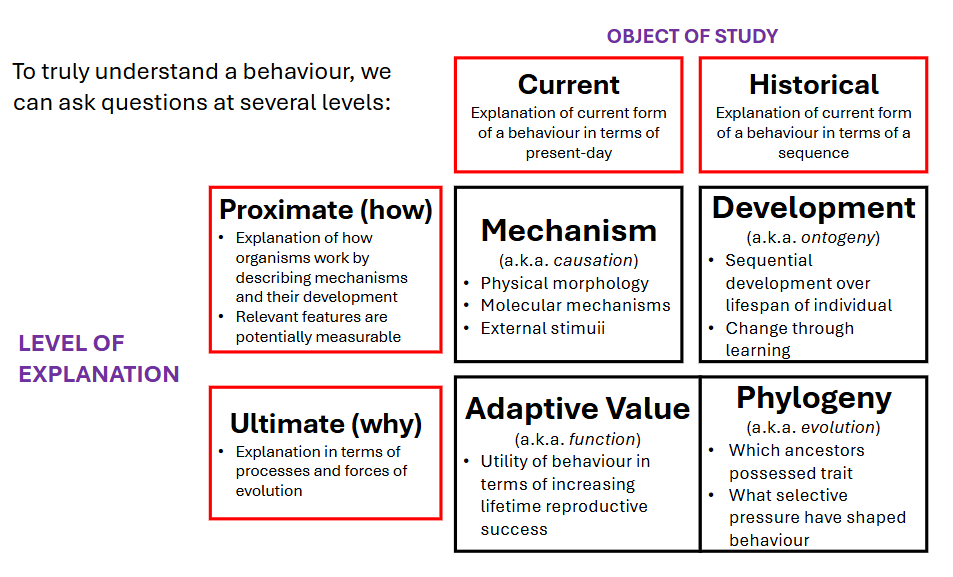
What are Tinbergen’s 4 Questions?
Mechanism (anatomy, physiology, regulation — “how it works”)
Development/Ontogeny (role of genes and environment — “how the behaviour is developed”)
Adaptive Value (how does the behavipur promote survival and reproduction)
Phylogeny (how has it evolved and why it persisted)
What was Skinner’s Pigeon Box Experiment?
taught pigeons to peck red lights in order to obtain food
positive reinforcement, dopamine reinforces neural pathways
operant conditioning
Proximate VS Ultimate Causes
Proximate: how or why an organism behaves (mechanism + ontogeny)
Ultimate: How or why that behaviour evolved (phylogeny + adaptive value)
What is learning?
a relatively permanent change in behaviour resulting from experience
Changes in neural representation (not temporary)
Must store recall memories
Ex. birds refining song through practice, rat navigating a maze, etc.
What are the types of learning?
associative
operant
classical
non-associative
habituation
sensitization
generalization
social learning (teaching)
Associative learning
any learning process where organisms form an association between an behaviour and its outcome, or between two stimuli
Operant conditioning
behaviour modified by consequences (reinforcement or punishment — i.e. trial and error)
voluntary behaviour (exploration, choices, actions)
controls what happens + core to human/animal learning
works as info from experience/stimuli are perceived via sensory receptors (reinforced by dopamine)
Ex. Skinner’s pigeons, learning to navigate a maze, Macaques choosing opposite hand to obtain peanut reward, etc.
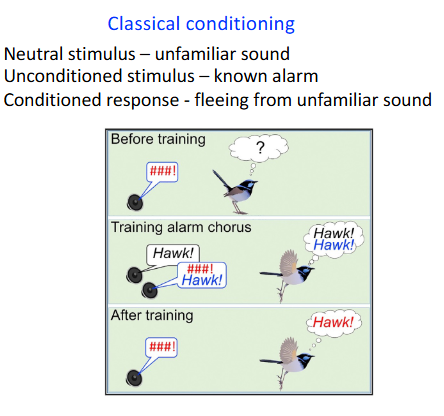
Classical Conditioning
learning when a neutral stimulus is paired with an unconditioned stimulus to elicit a reflexive response (no prior learning)
involuntary, automatic, passive learning that involves reflexes and predicting what will happen
Ex. Pavlov’s dog (drool at sound of a bell)
What is the Garcia Effect?
animals learn to associate taste with illness (even hours after and after only one experience)
associated with classical conditioning
natural selection pairs taste cues with illness
Habituation
decrease in response to a repeated, harmless stimuli (simplest forms of learning - not to waste energy on irrelevant stimuli)
Ex. reduced startle response (moth + chickadee, red-winged blackbird + whistling caterpillar)
Sensitization
increase in strength or likelihood of behavioural response following repeated exposure to strong, novel, or noxious stimulus
increases an animal’s readiness to response to danger
Ex. sea slug shows progressive gill withdrawal after tail shocks
Occurs immediately, whereas classical conditioning requires repetition
Generalization
learned response to a particular stimulus by novel stimuli that are similar with response strength declining as stimulus similarity decreases
learning extends beyond exact experiences to shape behaviour in novel situations
Ex. Pigeon identifying hover flies vs wasps
Social learning + teaching
learning from others
Teaching: Active participation of an experienced individual facilitating by a naive conspecific
Teaching modifies a behaviour, incurs a cost and the pupil learns faster
Ex. bird song, follower ants
Social learning has a role in cultural spread of innovations (ex. dolphins with tools, chimpanzees + sticks in ears)
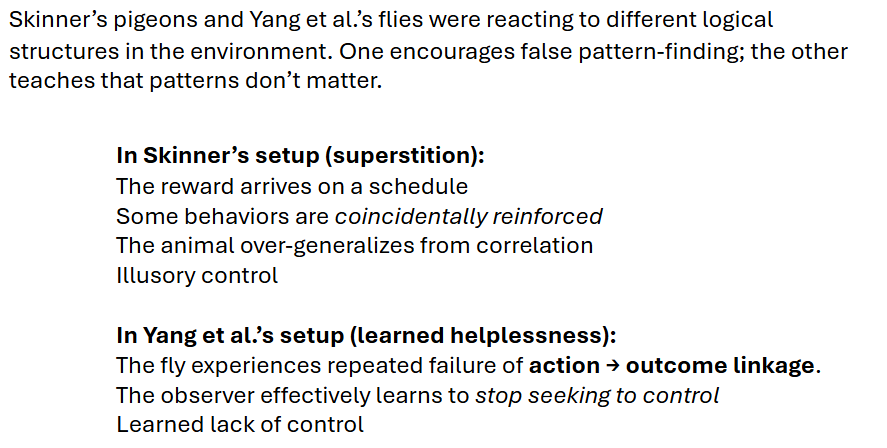
Learned Helplessness and Superstition
Learned Responses VS Innate Behaviour
Learned Response: requires environmental input and changes over life history
Innate Behaviour: genetic basis, no prior experiences, changes over evolutionary history
Interaction — imprinting and predator recognition
Movement
any spatial displacement (foraging, commuting)
Search
movement to find a goal (ex. shelter, prey item)
Dispersal
one-way movement with permanent relocation (game, natal, adult)
Homing
movement with the goal of reaching a known area or resource
Migration
repeated, oriented, seasonal movements between distinct areas (usually return, usually long distance)
Zugunruhe
migratory restlessness, a behavioural manifestation of physiological change before migration
Orientation
movement in a given direction (not necessarily a location)
Navigation
guided movement from one location to another, typically using a compass or landmarks
Stopover
prolonged pause in migration for food and shelter (refueling)
Why do insects commonly orbit lamps?
Artificial light interferes with the dorsal light response (DLR) that orients themselves upwards
Movement ecology paradigm
argues that animal and plant movement can only be understood by jointly considering motivation, biomechanics, navigation and environment (rather than movement paths alone)
Levy Flight
random, memoryless walk where step-lengths have a probability distribution that is heavily tailed (extreme>exponential) — outdated
Area Restricted Search (ARS)
cue and expectation driven walks, movement patterns, for searching
Extensive (global) search — fast, directional, explore
Intensive (local) search — slow movement concentrated near a recent resource encounter
What are the major selective drivers of dispersal?
avoidance of inbreeding (ex. male squirrels disperse while females stay in home range)
reduction of kin competition
escape from high densities, parasites, or depleted resources
colonization of new/empty habitat
How and why does s e x based dispersal vary between mammals and birds?
Birds: Female biased dispersal because social monogamy so males defend territories & benefit from staying
Mammals: Male biased dispersal because there is frequent polygyny so males compete for mates and disperse
Dispersal Morphs
alternative phenotypes within a single species that are specialized for movement
Developmental plasticity mediated by hormonal/epigenetic mechanisms (genetic background)
What is an example of dispersal for colonization of a habitat?
Spider ballooning where spiders produce silk to catch wind and disperse to a new habitat. This is influenced by atmospheric electric fields
What is hitch-hiking and phoresy?
one organism travels on another for dispersal (commensalism, mutualism, parasitism)
Ex. mites, flies
Describe homing of Rock Doves
Navigate using the sun as a compass with their internal clock to interpret the sun’s position. Use Earth’s magnetic field as a backup compass.
Pigeons use environmental odours for spatial distribution, alongside geomagnetic field, learned visual landmarks, and social cues from more experienced birds.
Examples of homing
rock doves
ant odometers — count steps
spiny lobsters — geomagnetic map
african dung beetle — starry sky orientation
Inclination
angle of field lines with Earth
Intensity
strength of field
Magnetic coordinates
combined intensity and inclination
What are the mechanisms of migration?
hormones regulate migratory restlessness (zugunruhe)
Melatonin, prolactin, glucocorticoids influence timing, fattening, activity
Energy reserves act as a go/no-go gate
Circadian and circannual clocks schedule migration
Photoperiod is a key time cue
Temperature and food act as modifiers
The tendency to migrate is shaped by…
ecological opportunity (seasonality, resources, habitat)
multiple constraints (energetic costs, parasites, mortality, navigation)
Partial migration
not all individuals migrate; balanced fitness for residency vs migration
Seasonal migration — stay and cope or leave and return
** Migration is phylogenetically labile (readily appears and disappears across lineages)**
What are the genetic and social components to migration?
Genetics provides the rules and predispositions (e.g. migratory restlessness, general compass direction, timing).
Social learning and individual experience fine-tune routes and decisions, especially in long-lived and socially migrating species
Example: Whooping Crane Migration (innate timing and direction but social learning improves route accuracy)
What are the benefits of migration?
food + water availability
shelter
reproduction + mating benefits
reduced competition
reduced parasitism