IB HL BIOLOGY C1.2 cell respiration
 Call Kai
 Learn
Learn Practice Test
 Spaced Repetition
 Match
Match Flashcards
 Knowt Play
1/39

There's no tags or description
Looks like no tags are added yet.
Name | Mastery | Learn | Test | Matching | Spaced | Call with Kai |
|---|
No analytics yet
Send a link to your students to track their progress
40 Terms
What is the purpose of NAD?
A coenzyme (molecule needed for an enzyme to work)
Key in CR because it is a hydrogen carrier (Can be reduced and oxidised)
What is NAD’s role in CR?
Is an oxidiser (oxidises/dehydrogenates other molecules)
it becomes reduced itself (NADH)
Important in CR because there are some stages where a substrate needs to be oxidized
Also important for oxidative phosphorylation at end of CR (carries e and H+)
What is the first stage of cellular respiration? Does this occur regardless of aerobic or anaerobic type CR?
Glycolysis
yes
Where does glycolysis occur? What is the general summary?
Cytoplasm
Splits 1 molecule glucose (6C) into 2 x pyruvate (3C)
10 steps
Describe the 4 main phases of glycolysis
phosphorylation
2 molecules of ATP is used to phosphorylate glucose
The 2 Pi is added to glucose
Glucose is now unstable (in form of fructose-1,6-bisphosphate)
Lysis
the fructose-1,6-bisphosphate splits into 2 TP/G3P
Oxidation of each G3P molecule
reduces 2 molecules of NAD —> NADH
Released energy adds another Pi to G3P
ATP formation/Substrate level phosphorylation (From each G3P)
Enzymes remove Pi to be added to ADP to make ATP
Generates 2 x ATP for each G3P
Forms the final product of pyruvate
What are the reactants and products of glycolysis?
Reactants: 1 glucose, 2 ATP
Products: 2 NET ATP, 2 pyruvate, 2 NADH
What is substrate level phosphorylation?
The process of generating ATP from ADP and a Pi taken from the substrate
Does aerobic or anaerobic produce more ATP?
Aerobic
Does glycolysis need O2 to occur? What happens if it continues in anaerobic conditions?
No
in a short time, the NAD of the cell would all be turned into NADH —> glycolysis would stop
What is the purpose of anaerobic cell respiration?
Allows the regeneration of NAD so that glycolysis can continue (and some ATP is still produced)
Also removes pyruvate buildup so glycolysis continues
How is NAD regenerated in humans and yeast?
In humans: lactic acid fermentation
Pyruvate is converted into lactate by reducing pyruvate using NADH
This oxidizes NADH back into NAD (goes back into glycolysis)
In yeast: alcohol fermentation
1. Conversion of pyruvate into ethanal
Through decarboxylating the pyruvate (Releases CO2)
2. Conversion of ethanal to ethanol
The ethanal was reduced by NADH into ethanol
This regenerates the NAD for glycolysis
This makes 2 products = CO2 + ethanol
When would anaerobic respiration be useful?
Much faster than aerobic, so it can generate a relatively large amount of ATP for short exercises
List the stages in cellular respiration
Glycolysis
Link reaction
Krebs cycle
ETC/chemiosmosis
What happens in the link reaction? 3 steps
(Before: After glycolysis, the 2 pyruvates move into the mitochondria matrix via active transport)
decarboxylation of pyruvate
converts it into acetyl (2C)
CO2 released as waste
Oxidation of acetyl
Reduces NAD to NADH
Formation of Acetyl CoA
Acetyl groups combine with CoA
What are the 4 steps in Krebs cycle
Formation of citrate
The acetate from acetyl CoA binds with oxaloacetate (4C)
This releases coA to continue link reaction
Oxidative decarboxylation
Removes CO2
Reduces NAD
Oxidizes citrate (6C —> 5C)
Oxidative decarboxylation
Removes CO2
Reduces NAD
Makes 1x ATP (substrate-level phosphorylation)
5C —> 4C
*Now, all 6C from OG glucose molecule has been released as 6CO2
*For cycle to continue, oxaloacetate must be regenerated
Oxidation of 4C (Regeneration of oxaloacetate)
Reduces NAD
Reduces FAD
Now oxaloacetate is available
Summarize the Krebs cycle
Completed the breakdown of OG glucose molecule
Generates majority of NADH and FADH2 that will deliver e to ETC
How many times does the Krebs cycle turn
2
(1 for each glucose/pyruvate/acetyl CoA)
What is the budget (for H carriers) at each step in CR?
*Per glucose molecule
Glycolysis (2 NADH)
Link (2 NADH)
Krebs (6 NADH, 2 FADH)
ETC (1 NADH gives 3 ATP, 1 FADH2 gives 2 ATP)
Products of link reaction
The products are 2 acetates (2C), which combine with coA to make 2acetyl COA
Where does ETC occur?
Inner mitochondria membrane/mitochondria matrix
What structures are involved in ETC?
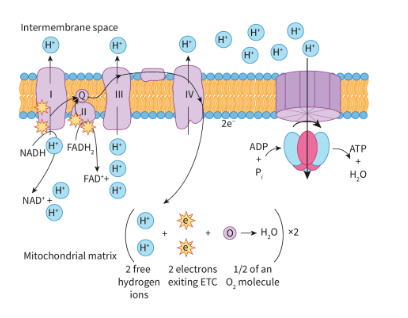
4 membrane bound protein complexes w/2 electron carriers
Describe the 3 mains steps in ETC
NADH delivers 2 e (carried from glycolysis/link/krebs) to Complex I
These electrons power the pumping of H+ across the membrane (from matrix to IM space)
FADH2 also delivers 2 e to the ETC, but at complex II (pumps less H+)
e are transported along ETC (pumps more H+ along the way)
What is created from the ETC
Proton gradient
The e from the 10 NADH and 2 FADH2 pump many H+ into the IM space
Since this space is narrow, and H+ can’t diffuse across membranes, this establishes a high [ ] gradient of H+ in IM space compared to matrix side
Important to generate ATP, as H+ want to move down gradient but can’t
How is ATP finally generated (last step in CR)?
H+ can only flow down [ ] in one pathway, down ATP synthase (protein channel)
This flow of H+ (PMF) generates energy needed to phosphorylate ADP (using Pi) to make ATP
Through oxidative phosphorylation
ATP synthase has a turbine, which generates ATP when H+ flow
This process is chemiosmosis (flow of H+ down electrochemical gradient, driving ATP formation)
How many H+ is needed to phosphorylate one ADP into ATP
Average is 3, but ranges 2-4
How much ATP is made at the end of CR?
30-34 ATP
4-8 ATP were used for transporting molecules in/out of mito
What is the role of O2 in the ETC? What does it do?
Its the terminal electron acceptor
after e have passed along ETC, they need to go somewhere —> they are accepted by oxygen
To do this, each molecule of O2 splits, and accepts 4e, 4H+, forming 2 molecules of H2O
What happens if O2 is not present at end of aerobic respiration
More electrons cannot join ETC (if O2 doesn’t accept it)
Thus, NAD and FAD cannot be regenerated (by oxidation) —> No longer a supply of NAD and FAD to continue the link/krebs
Creates a “molecular traffic jam”
What property determines the energy content of a respiratory substrate? Why?
The amount of H available when the molecule is broken down
The more H, the more NAD can be reduced
The more reduced NAD produced, the more protons transported across IMM (Generates more PMF, more ATP)
*However, more O2 is also required
Do lipids or carbohydrates reduce more NAD?
Lipids, since they are composed of long chains of carbon with hydrogens
In increasing order, list the energy content of lipids, proteins and carbohydrates as respiratory substrates
Carbohydrates, proteins, lipids
How do lipids enter cell respiration vs. carbohydrates?
Carbohydrates can enter glycolysis (after being modified by the liver)
lipids can’t be broken down through glycolysis
Can lipids and carbs both undergo anaerobic respiration? Why?
No, only carbs. Since lipids can’t be broken down in glycolysis (the previous step)
How does a lipid molecule serve as a respiratory substrate (how does it enter the CR cycle)
It’s first broken down into glycerol and fatty acids
glycerol is used in glycolysis
fatty acids are broken down into acetyl groups —> directly participate in the link reaction to form acetyl CoA, then enter Krebs
What reaction is the formation of ATP? Hydrolysis?
Endergonic (energy from oxidation of nutrients is stored in high energy bond. There’s an input of energy, and ATP has higher potential energy than ADP)
Exergonic (energy is released)
Why are there high energy bonds in ATP? which bonds are broken during hydrolysis of ATP
Due to the negatively charged phosphate groups repelling eachother (unstable covalent bond = high energy)
These unstable bonds are easily hydrolyzed (low Ea)
Energy is released when the bond holding the 2nd to 3rd phosphate is broken
Where do the electrons in ETC come from
The splitting of H atoms from NADH/FADH2
Summarize the ETC and chemiosmosis together
While electrons move down ETC, energy is released in small amounts to pump H+ from matrix into IM space
This creates a proton gradient, accumulating H+ in IM space
Protons move down gradient by difussion through channels called ATP synthase
As H+ move from IM to matrix, ATP synthase harnesses this energy and phosphorylates ADP to make ATP
Define chemiosmosis
Formation of ATP driven by proton gradient
Fatty acids yield how much more ATP than carbohydrate
20%

