Intergroup conflict studies
 Call Kai
 Learn
Learn Practice Test
 Spaced Repetition
 Match
Match Flashcards
 Knowt Play
1/7

There's no tags or description
Looks like no tags are added yet.
Name | Mastery | Learn | Test | Matching | Spaced | Call with Kai |
|---|
No analytics yet
Send a link to your students to track their progress
8 Terms
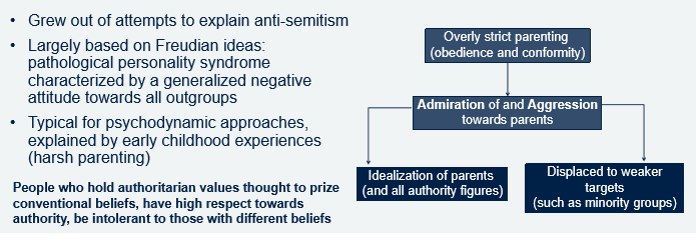
Adorno et al (1950)
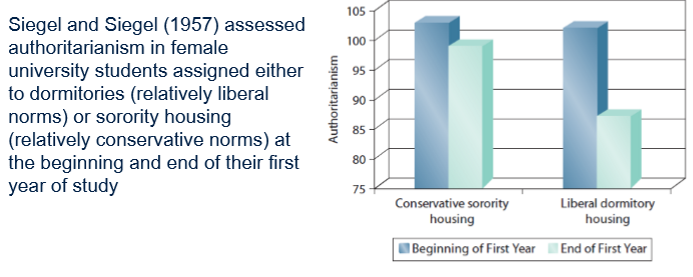
Siegel and Siegel (1957)
Pettigrew (1958)
Tested this (authoritarianism) in cross cultural comparison
Found white people from SA and southern US significantly more racist than northern US though didn't differ in how authoritarian their personalities are
Personality can predispose but culture of prejudice that embodies societal norms legitimising prejudice is necessary and sufficient
Piff (2012)
Seven studies using experimental and naturalistic methods reveal that upper-class individuals behave more unethically than lowerclass individuals.
In studies 1 and 2, upper-class individuals were more likely to break the law while driving, relative to lower-class individuals. In follow-up laboratory studies, upper-class individuals were more likely to exhibit unethical decision-making tendencies (study 3), take valued goods from others (study 4), lie in a negotiation (study 5), cheat to increase their chances of winning a prize (study 6), and endorse unethical behavior at work (study 7) than were lowerclass individuals.
Mediator and moderator data demonstrated that upper-class individuals’ unethical tendencies are accounted for, in part, by their more favorable attitudes toward greed.
Unsure where this would slot in - maybe social dominance theory?
Tyerman and Spencer (1983)
replicated Sherif with a scout group in the UK
no increase in ingroup solidarity nor intergroup conflict
subordinate membership is scouting as a whole
mere existence of separately acting, competing groups is not a sufficient condition to produce intergroup conflict and to heighten in-group solidarity
Kerr and Hogg (2018)
investigated why some had replicated Tajfel and some hadn’t by analysing methodological differences and their impacts
example differences included
whether they were socially isolated or not when being categorised and during task looking at identification within group
written vs verbal instructions
shows how important method is but could also suggest the findings are easily not found from small changes and so is it that valid???
Brewer (1999)
ingroup favouritsm doesn’t necessarily lead to outgroup hostility
prejudice may come from favouritism towards own group rather than a dislike or conflict with others
unless someting like competition arises
review of research
Kinzler and Spelke (2011)
In Experiment 1, 10-month-old infants took toys equally from own- and other-race individuals.
In Experiment 2, 2.5-year-old children gave toys equally to own- and other-race individuals
Experiment 3, 5-year-old children, in contrast, expressed explicit social preferences for own-race individual

