unit 3 vocab APAH
0.0(0)
 Studied by 2 people
 Call Kai
 Learn
Learn Practice Test
 Spaced Repetition
 Match
Match Flashcards
 Knowt Play
Card Sorting
1/43

Earn XP
Description and Tags
Last updated 5:21 AM on 10/27/22
Name | Mastery | Learn | Test | Matching | Spaced | Call with Kai |
|---|
No analytics yet
Send a link to your students to track their progress
44 Terms
1
New cards
maytr
A martyr is someone that suffers persecution and death for advocating, renouncing, or refusing to renounce or advocate, a religious belief or other cause as demanded by an external party
2
New cards
Ambulatory
A passageway around the apse or altar of a church
3
New cards
Apse
The endpoint of a church where the altar is located
4
New cards
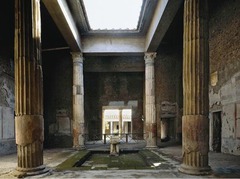
Atrium (plural: atria)
The formal entrance hall of an ancient Roman house, open to the sky at the center and usually featuring a pool for the collection of rain water
5
New cards
Basilica
a longitudinal building with an apse at one of the short ends; occasionally the apse is at the long end at both short ends
6
New cards
Catacomb
An underground passageway used for burial
7
New cards
Central-plan
a plan in which the parts of a building radiate from a central point
8
New cards
Longitudinal
A church with a long nave whose focus is the apse, so-called because it is designed along an axis
9
New cards
Old testament
The Old Testament is the first division of the Christian biblical canon, which is based primarily upon the 24 books of the Hebrew Bible or Tanakh, a collection of ancient religious Hebrew writings by the Israelites. The second division of Christian Bibles is the New Testament, written in Greek
10
New cards
New testament
The New Testament is the second division of the Christian biblical canon. It discusses the teachings and person of Jesus, as well as events in first-century Christianity
11
New cards
nimbus
radiant circle or disk surrounding the head of a holy person, a representation of spiritual character through the symbolism of light; also called a halo
12
New cards
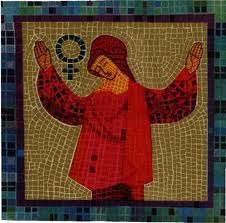
orant
a figure in a posture of prayer, usually standing upright with raised arms
13
New cards
icon
a person, symbol, image or picture that is widely admired for its conspicuous feature or allegiance. mostly refers to a religious painting (usually Jesus Christ or another holy/ religious figure)
14
New cards
iconoclast
a person who attacks cherished beliefs or institutions
15
New cards
iconoclasm
the action of attacking or assertively rejecting cherished beliefs and institutions or established values and practices
16
New cards
iconophile
those who supported the use of religious images
17
New cards
tesserae
a small block of stone, tile, glass, or other material used in the construction of a mosaic
18
New cards
pathos
a quality that evokes pity or sadness. appeals to emotions
19
New cards
theocracy
Theocracy is a form of government in which one or more deities of some type are recognized as supreme ruling authorities, giving divine guidance to human intermediaries who manage the day-to-day affairs of the government
20
New cards
orthodox
conforming to what is generally or traditionally accepted as right or true; established and approved.; referring to a religion usually
21
New cards
Chi-Rho
a Christian monogram and symbol formed from the first two letters X and P of the Greek word for Christ
22
New cards
Edict of Milan
The Edict of Milan was the February 313 AD agreement to treat Christians benevolently within the Roman Empire
23
New cards
Diptych
A diptych is any object with two flat plates which form a pair, often attached by hinge. For example, the standard notebook and school exercise book of the ancient world was a diptych consisting of a pair of such plates that contained a recessed space filled with wax.
24
New cards
Triptych
A triptych is a work of art that is divided into three sections, or three carved panels that are hinged together and can be folded shut or displayed open. It is therefore a type of polyptych, the term for all multi-panel works
25
New cards
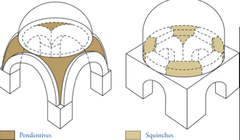
Squinch
a straight or arched structure across an interior angle of a square tower to carry a superstructure such as a dome
26
New cards
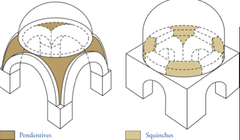
Pendentive
a curved triangle of vaulting formed by the intersection of a dome with its supporting arches
27
New cards
Heresy
belief or opinion contrary to orthodox religious (especially Christian) doctrine
28
New cards
theocrat
a person who rules, governs as a representative of God or a deity, or is a member of the ruling group in a theocracy, as a divine king or a high priest
29
New cards
revelations
The Book of Revelation is the final book of the New Testament. Its title is derived from the first word of the Koine Greek text: apokalypsis, meaning "unveiling" or "revelation". The Book of Revelation is the only apocalyptic book in the New Testament canon. It occupies a central place in Christian eschatology
30
New cards
Gospels
Gospel originally meant the Christian message, but in the 2nd century it came to be used also for the books in which the message was set out.
31
New cards
Evangelists
a person who seeks to convert others to the Christian faith, especially by public preaching
32
New cards
Muhammad
prophet of Islam, believed by Muslims to be the last in a long line of prophets that includes Moses and Jesus
33
New cards
Muslim
followers of Islam
34
New cards
Islam
Islam is an Abrahamic monotheistic religion centred primarily around the Quran, a religious text considered by Muslims to be the direct word of the God of Abraham as it was revealed to Muhammad, the main and final Islamic prophet
35
New cards
Quran
The Quran, also romanized Qur'an or Koran, is the central religious text of Islam, believed by Muslims to be a revelation from God. It is organized in 114 chapters, which consist of verses
36
New cards
Kaaba
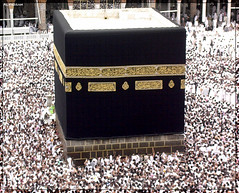
The Kaaba, also spelled Ka'bah or Kabah, sometimes referred to as al-Kaʿbah al-Musharrafah, is a building at the center of Islam's most important mosque, the Masjid al-Haram in Mecca, Saudi Arabia. It is the most sacred site in Islam
37
New cards
Allah
the one and only God in Islam
38
New cards
Shiite
an adherent of the Shia branch of Islam
39
New cards
Sunnis
the larger of the two main branches of Islam, which differs from Shia in its understanding of the Sunna, its conception of religious leadership, and its acceptance of the first three caliphs
40
New cards
Minaret
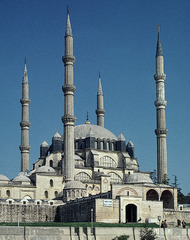
the tower from which the faithful are called to prayer five times each day by a muezzin, or crier, built into or adjacent to mosques
41
New cards
Arabesque
The arabesque is a form of artistic decoration consisting of "surface decorations based on rhythmic linear patterns of scrolling and interlacing foliage, tendrils" or plain lines, often combined with other elements.
42
New cards
Caligraphy
Calligraphy is a visual art related to writing. the art of writing
43
New cards
finial
A finial or hip-knob is an element marking the top or end of some object, often formed to be a decorative feature
44
New cards
muqarnas
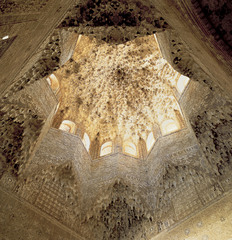
ornamentation and transition element applied in Islamic architecture. The muqarnas, which is a transition and filling element that provides a three-dimensional image, is an architectural art element that fills the inner parts of the semi-domes with its honeycomb shape
 Note
Note  Flashcards (44)