Lec 1 (Historical perspective & milestones)
 Studied by 0 people
 Call Kai
 Learn
Learn Practice Test
 Spaced Repetition
 Match
Match Flashcards
 Knowt Play
1/17

There's no tags or description
Looks like no tags are added yet.
Name | Mastery | Learn | Test | Matching | Spaced | Call with Kai |
|---|
No analytics yet
Send a link to your students to track their progress
18 Terms
By careful observations of chick embryos it was found that the egg acquired its form over time (not pre formed), who discovered this?
Aristotle
Oviparity
birth from eggs
Viviparity
Live birth
Ovoviviparity
Production of an egg that hatches inside the body
Holoblastic cell division
cleavage where the entire egg is divided into successively smaller cells
frogs, salamanders
Meroblastic cell division
cleavage where only part of the egg is destined to become the embryo, while the other portion (yolk) serves as nutrition for the embryo
What is Aristotle’s theory of epigenesis?
Organs develop gradually in the embryo and are no preformed
Who depicted a human uterus opened to reveal the foetus and associated membranes
Leonardo da Vinci
Foetus
A fetus or foetus is the unborn offspring of a viviparous animal that develops from an embryo
Who made many illustrations of embryos and foetuses at different stages of development?
Hieronymus Fabricius
Who published illustrations of canine and ovine embryos in 1552?
Bartolomeo Eustachius
Prior to the preformation theory there was? What did it apply to?
Spontaneous generation of animals
only applied to “lower” animals (flies)
Ovism model
location of preformed parts in egg
Spermism model
location of preformed parts in sperm
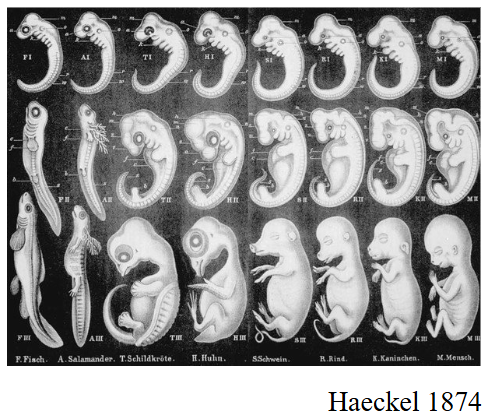
“Ontogeny recapitulates phylogeny” Who said this? And why is it incorrect?
Ernst Haeckel: embryos of ‘higher’ animals pass through stages that resemble the adult forms of their evolutionary ancestors
outdated, higher & lower animals not relative as every organism is evolved to full capacity
modern biology emphasizes the complexity of evolutionary processes
How did Wilhelm His contribute to the study of Developmental Biology?
contributions to embryology and the study of brain, muscle and heart development
cell tracing techniques: origin of tissues and organs and differentiation
How did Hans Spemann contribute to the study of Developmental Biology?
Nobel prize
Early amphibian “organizer” region in gastrulation
Induction events of transplanted tissue
Autonomous versus conditional specification
 Note
Note  Flashcards (72)