Environmental influences to anxiety
 Studied by 1 person
 Call Kai
 Learn
Learn Practice Test
 Spaced Repetition
 Match
Match Flashcards
 Knowt Play
1/17

There's no tags or description
Looks like no tags are added yet.
Name | Mastery | Learn | Test | Matching | Spaced | Call with Kai |
|---|
No analytics yet
Send a link to your students to track their progress
18 Terms
how many people have an anxiety disorder?
1/14 at any given time around the world
what is the prevalence of anxiety disorders in 3-17 year olds?
global median is approx. 6%
what is the DSM-5 criteria for a social anxiety disorder?
A persistent fear of social or performance situations in which the person is exposed to unfamiliar people or to possible scrutiny by others. The individual fears that he or she will act in a way (or show anxiety symptoms) that will be embarrassing and humiliating.
Exposure to the feared situation almost invariably provokes anxiety.
The person recognizes that this fear is unreasonable or excessive.
The feared situations are avoided or endured with intense anxiety and distress.
The avoidance, anxious anticipation, or interferes significantly with the person's normal routine, occupational (academic) functioning, or social activities or relationships.
The fear, anxiety, or avoidance is persistent, typically lasting 6+ months.
Not due to physiological effects of a substance, general medical condition or another mental disorder
how do genetic factors influence anxiety?
anxiety is approx. 30% heritable
poly genetic - many genes have very small effects
beginning to identify actual genetic variants using genome-wide association scans (GWAS)
how do environmental factors influence anxiety?
Eley et al. (2015) - support for direct environmental transmission of anxiety via e.g. verbal info, vicarious learning
Scaini, Belotti & Ogliari (2014) - non-shared factors play a larger role than genetic factors
what does the etiological model of social anxiety disorder (Spence and Rapee, 2016) do?
attempts to explain how high levels of social anxiety might emerge across early development
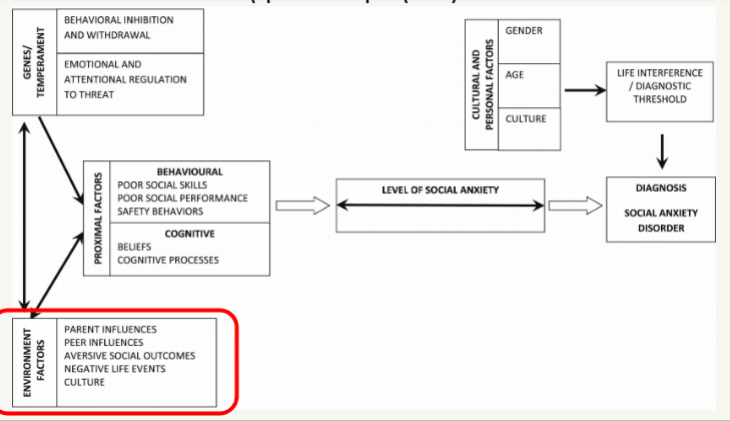
what are the assumptions of the etiological model of social anxiety disorder (Spence and Rapee, 2016)?
interaction of risk factors
equifinality (different pathways and combinations of factors can result in SAD)
multifinality (any one risk factor can lead to multiple outcomes, not just SAD)
reciprocal risk factors (social anxiety in young person influences probability of
experiencing a risk factor, which in turn magnifies young person’s risk for SAD)
what did Blote, Miers, Heyne et al. (2015) find about the development of SAD?
aversive social learning experiences with peers play a role in the development and maintenance of SAD
characteristics of socially anxious children
Have fewer friends.
Have lower quality friendships.
Are less well liked and accepted by peers.
Have more negative peer interactions.
Are more likely to be rejected, neglected and victimised.
Affiliate less with peer crowds.
Are rated as less socially skilled
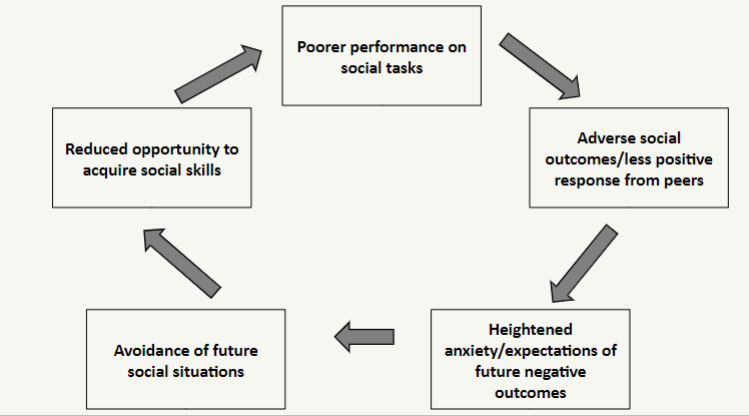
why do socially anxious young people experience adverse social outcomes?
due to the cyclical nature of the negative consequences of social anxiety
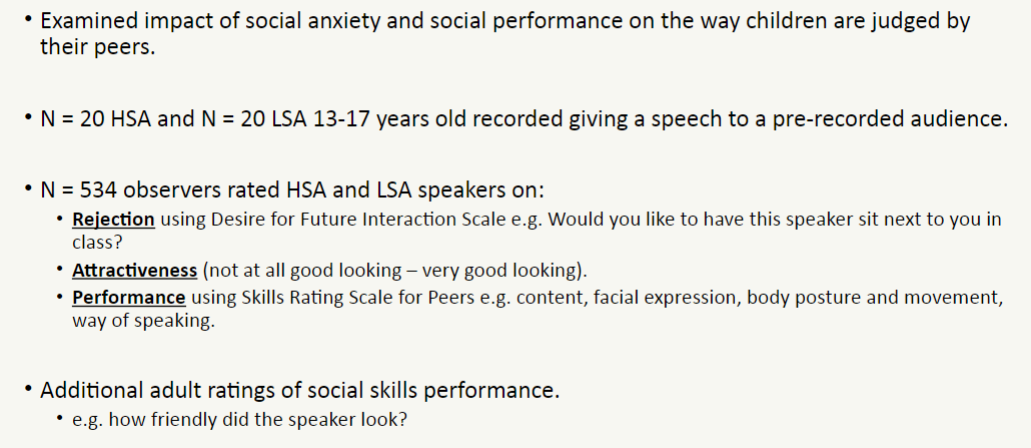
results of Blote, Miers & Westernberg (2015)
higher rejection of HSA adolescents partially mediated by them being less physically attractive and having poorer social performance
HSA adolescents were judged by their peers and adult observers as having lower social skills performance
HSA adolescents were rated as less physically attractive compared to LSA adolescents
how do peers influence development of SAD?
cross-sectional studies show that socially anxious children are more likely to experience peer victimisation (e.g. Ranta et al., 2009)
prospective longitudinal studies suggest a causal role for victimisation increasing future risk for social anxiety (e.g. Hamilton et al., 2016)
social anxiety is not just a consequence of victimisation - it may also increase chances of being victimised (Ranta et al., 2013)
what are the types of victimisation?
direct/overt (physical and verbal behaviour aimed at causing harm)
relational (harms social standing and reputation; withdrawal of friendships and attention, exclusion from activities, spreading rumours)
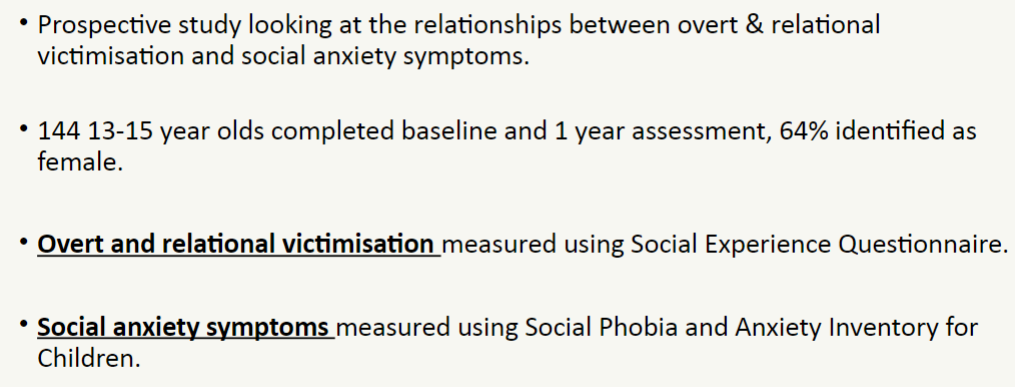
describe the results of Storch et al. (2005)
time 1 relational victimisation predicted time 2 social phobia symptoms
no significant association with overt victimisation
how does trauma/stressful life events in childhood affect SAD?
increases risk of developing SAD
Rates of social anxiety twice as likely in a trauma exposed vs. non-exposed group in a community sample (Copeland et al., 2007)
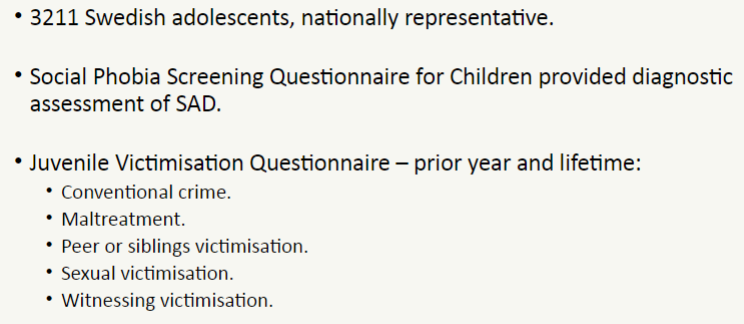
describe the results of Gren-Landell et al. (2011)
10.6% prevalence rate for SAD overall (higher in females than males; 14.9% vs 6.2%)
in male participants, those with SAD had significantly more experiences of peer/sibling victimisation
in female participants, those with SAD had significantly rates of overall lifetime victimisation, peer/sibling victimisation, sexual victimisation and maltreatment
how does culture affect social anxiety?
expression of social anxiety
thresholds for clinical diagnosis and prevalence
societal reactions and impact of withdrawn/reticent behaviour
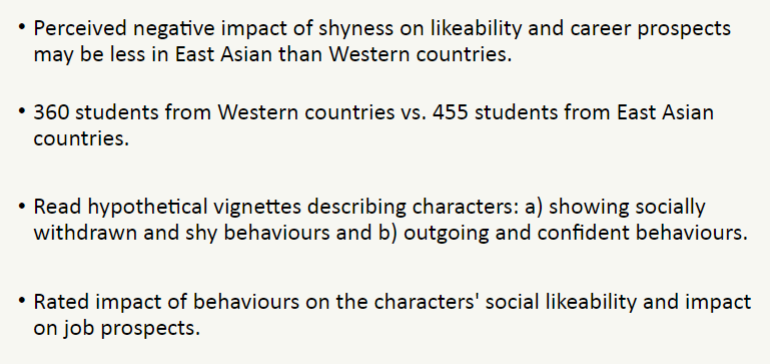
describe results of Rapee, Kim, Wang et al. (2011)
western participants rated outgoing characters as more likeable than East Asian participants
East Asian participants rated the job prospects of shy characters higher than Western participants
 Note
Note  Flashcards (49)