CS 143A Midterm 1
 Studied by 0 people
 Call Kai
 Learn
Learn Practice Test
 Spaced Repetition
 Match
Match Flashcards
 Knowt Play
1/117

There's no tags or description
Looks like no tags are added yet.
Name | Mastery | Learn | Test | Matching | Spaced | Call with Kai |
|---|
No analytics yet
Send a link to your students to track their progress
118 Terms
What is an Operating System
OS is the software that acts an intermediary between the user applications and computer hardware
What are the four computer system components
Hardware, Operating System, Apllication Programs, Users
What is the CPU Execution Sequence
Fetch Instruction at Program Counter
Decode Instruction
Execute Instruction
Write results to registers or memory
Increase the Program Counter
Synchronous I/O
After I/O is requested, program stops executing and waits till I/O is done
Asynchronous I/O
After requesting I/O, other parts of the program can continue while one part is waiting for I/O to finish
Interrupts, what are they, how do they work, what are some special things that happen when an interrupt occurs
Interrupts are messages sent to I/O when finished
Interrupt Handler / Interrupt Service Routine is the part of the CPU that knows how to handle the interrupt, it knows where to go from the Interrupt Vector Table
Incoming interrupts are disabled while CPU is already handling an interrupt, however, a message is sent back to I/O saying that the interrupt was blocked/not-recieved and to try again.
What is DMA, how does it work
I/O has direct access to memory through the device controller, CPU is interrupted after memory-I/O interaction is complete
User Mode, what is it, what happens when privileged instructions are executed in user mode, what is that called?
Execution is done on behalf of the user
Executing priveleged in the user mode causes a trap, which is a software generated interrupt and switches the mode from user to kernal mode to handle it
Kernal Mode, What is it
Execution is done on behalf of the operating systems
Privileged instructions are only executable in the kernal modes
What are system calls
User code that causes a trap (causing switch to kernel to handle syscall).
What is a process
An instance of a program
How is timer used in CPU protection
Timer for process execution on CPU, once timer hits 0, send interrupt to switch off program (incase corrupted program is just idling on CPU)
Memory Protection: Base and Limit
Give program a certain amount of memory in the range based on two registers
Base Register holds smallest address
Limit Register Contains how much address space u can use (so max address is base+limit)
What is a command interpreter system do
Place to give commands that go directly to operating system
What is the Hierarchy for memory
Registers
Cache
Main Memory
SSD
Hard Drive
Optical Disk
Magnetic Tapes
What is a Monolithic Operating System
Large kernels with lots of components
Ex: Linux, Windows, MAC
What is a Microkernel Operating System, what are some advantages, vs disadvantages
Only small core components in OS, reset is dependent on User-Level Processes
Advantages:
More reliable, secure, easier to port over to new architecture
Disadvantage
- Performance is worse
What is a virtual Machine
Running one ore multiple OS’s on top of another OS (VMM)
What is the process states
New - Process is being created
Running - Instructions are being executed
Waiting - Waiting for some event to occur (ex: I/O wait)
Ready - Waiting to be assigned to processor
Terminated : Process has finished executed
What is contained in the Process Control Block
Process State
Process Number/ID
Program Counter
CPU Registers
CPU Scheduling Information (Type of scheduling going on)
Memory Management Information
List of Open Files
I/O Status Information - List of I/O Devices
Accounting Information - Time Limits
Job queue
Set of all processes in System
Ready Queue
Set of all processes in main memory that are ready and waiting to execute
Device Queue
Set of processes waiting for an I/O (I/O queue)
Context Switch, what is it, what part of the process does it save?
Thing that switches CPU from one process to another
Saves PCB state of old process and loads new one
Long-Term Scheduler / Job Scheduler
Selects which process process should be brought into ready queue, infrequent
Short-Term Scheduler / CPU Scheduler
Selects which process should execute next and allocates CPU, frequent
Medium Term Scheduler
Swaps out process temporarilyis
I/O bound process
Spends more time in I/O
CPU BOund Process
Spends more time in CPU executing
Parent / Child Process, what is copied, what is required to be allocated
When a process (parent) creates another process (child)
New PCB allocated
New Page Tables for address space
Multithreading
Splitting a process/program into threadsT
Thread, what is it, what is shared with other peer threads, what is private, what is a thread control block
Thread is simple process
Shares Content of memory (global variables, heap), and I/O State (file system, etc.) with other threads
Private to each thread → Thread Control Block, Execution Stack
Thread Control Block contains execution state, ID, Program Counter, CPU Register values, stack pointer, scheduling priority
Heavyweight Process
Task/Process with one thread
Kernal Threads
Threads supported directly by the kernel
User Threads
Threads Supported above the kernel by library calls, (thread management is done at user level)
Many-To-One
Many user level threads map to a single kernel thread
One-to-One
Each user-level thread maps to a kernel thread
Many-To-Many
Many User level threads are mapped to many kernel threads
Signal
UNIX notifications that an event happened (basically UNIX versions of interrupt)
User-Define Handler vs Default Handeler
User-Defined signal handler can overrun default, default handler will handle every signal though
Thread Pool
Pool of threads waiting for work
Multiprocessing
Multiple CPUS
Multithreading
Multiple threads per process
Multiprogramming
Multiple Processes one one CPU
Interprocess Communication (IPC), what is it, what are two ways its implemented
Can be implement by shared memory
Can be implemented by messaging system
Can do both
Increase the amount of memory available for a particular process - User or Kernel Mode
Kernel, changing amount of memory means accessing memory not given to process
Read a character from the keyboard. - User or kernal mode?
Kernal, I/O access needs kernal
Execute a matrix multiplication operation. - User or Kernal
User, Even though we use CPU, User processes can use CPU without every contacting kernal
Modify the content of an in-memory table. - User or Kernal
User - Assuming its modifying memory content that was already allocated to it for its memory space
What is the following an example of: An exception generated by the CPU at predictable places in the user code
System Call
What is this an example of: the program don’t need to wait and will be informed when event is finished
Asynchronous I/O
What is this an excample of: the program is notified when an event occurs without needing to wait
Interrupt
What is this an example of - program keep checking the state of an event
Polling
What is this an example of - a request made by a user-level program to go into kernel mode
System Call
What is this an example of - The program has to wait for the event to finish before it can proceed
Synchrnous I/O or Interrupt or trap or systemcall
What is this an example of - An event that may occur at any unpredictable point during the execution of user code
Interrupt
What is this an example of - handle events external to the processor
Interrupt
.Which one is more time efficient? Why? polling-driven implementation or interrupt implementation?
Interrupt
Are traps asynchronous or synchronous
Synchronous
Are interrupts asynchronous or synchronous
asynchronous
Trap or Interrupt - A user program executes a system call instruction (e.g., syscall)
Trap
Trap or Interrupt - A division by zero occurs during program execution
Trap
Trap or Interrupt - A timer expires causing the OS scheduler to run
Interrupt
What does the UNIX System call Open Do, What are its parameters, what does it return
Use:
- The open() function is used to open an existing file or create a new one.
Parameters:
- pathname: A string representing the relative or absolute path to the file you want to open.
- flags An integer that specifies the access mode. You must include one of the following: O_RDONLY: Open for reading only. O_WRONLY: Open for writing only. O_RDWR: Open for both reading and writing, O:CREAT: For creating a new file
- mode: This parameter is only used when O_CREAT is specified it defines the permissions (e.g., 0644) for the new file.
Return
- On success: Returns file descriptor
- On failure: Returns -1
What does the UNIX System call Close Do, What are its parameters, what does it return
Use:
- The primary purpose of close() is to release a file descriptor so it can be reused by the process (Closes the file)
Parameters:
- fd: This is the file descriptor
Return
- On Success: Returns 0
- On failure: Returns -1
What does the UNIX System call Read Do, What are its Parameters, what does it return
Use:
- Reads a certain number of bytes from a file
Parameters:
- fd: The file descriptor of the file to be read
- buf: A pointer to the buffer (a memory area) where the data read from the file should be stored.
- count: The maximum number of bytes you want to read.
Return:
- Success: Returns the number of bytes actually read. (May be less then count if EOF is reached)
- Failure: Returns -1,
What does the UNIX System call Write Do, What are its parameters, what does it return
Use:
- write() takes data from a buffer in the process’s memory and writes it to the file or stream associated with a file descriptor.
Parameters:
- fd: The file descriptor where the data will be written
- buf: A pointer to the buffer containing the data you want to save. (Data you want to write to the file)
- count: The number of bytes from the buffer that you want to write to the file.
Return:
- Success: Returns the number of bytes actually written. (Might be less then count if disk becomes full)
- Failure: Returns -1,
What does the UNIX System call Fork Do, What are its Paraameters, what does it return
Use:
- fork() is used to create a "child" process that is an almost exact duplicate of the "parent" process. The child inherits the parent's memory space (variables, stack, heap), file descriptors, and environment.
Parameters:
- None
Return Value
- In parent: Process ID of child
- In child: 0
- On Failure: -1 to parent, child is not created
Hard Real Time
Deadlines are absolute. Missing even one deadline = system failure.
Correctness depends on both the result and the timing.
Soft Real Time
Deadlines matter, but occasional misses are tolerated.
Performance degrades, but the system still works.
Not Real Time
Only correctness of the output matters, not when it arrives.
What is time-sharing
Time-sharing is an OS technique where multiple processes share the CPU by each getting a small slice of time, creating the illusion that they’re running simultaneously.
Non-Preemptive Scheduling
Once CPU has been allocated to a process, process keeps the CPU till its done (or switches to waiting state (waiting for I/O))
Preemptive Scheduling
Process can be interrupted and must release the CPU
Dispatcher (What 3 things does it do)
Performs context switch
Switches to user mode
Jumps to proper location in user program for instructions
What is dispatch latency
Same as context switching latency, time it takes for it to switch from one process to another, must be fast
CPU Utilization
Idea to keep the CPU and other resources as busy as possible
Throughput
The # of processes that complete their execution per unit of time
Turnaround Time
Amount of time to execute a particular process from its entry time
Waiting
Amount of time a process has been waiting in the ready queue
Response Time
Waiting Time + Context Switch + First Response is produced (basically waiting time till it first gets CPU)
First Come First Serve Scheduling, What is it, How do you calculate waiting time, How about turnaround time
Non-Preemptive
Just a queue of processes based on arrival time, once a process gets the CPU, it has it till it finishes
Turnaround Time = Completion Time - Arrival Time
Waiting Time = Turnaround Time - Burst Time
Shortest Job First Scheduling (Non-Preemptive), What is it, how does it work, how do calculate waiting time, turnaround time?
Each process is ordered in a queue ranked by the burst time, once a process gets the CPU, it has it till completion
Waiting Time = Turnaround Time - Burst Time
Turnaround Time = Completion Time - Arrival Time
Shortest Job First Scheduling (Preemptive), What is it, how does it work, how do calculate waiting time, turnaround time?
Each process is ordered in a queue ranked by the burs time, if a process joins the queue that is shorter then the remaining time of the process already in the CPU, the process in the CPU is switched out
Waiting Time = Turnaround Time - Burst Time
Turnaround Time = Completion Time - Arrival Time
What is the exponential Averaging Equation
𝜏n+1 = a tn + (1-a)𝜏n
𝜏n+1 - Predicted value for next CPU Burst
a - weight (between 0 and 1)
tn - Actual length of nth burst
𝜏n - Predicted length of nth burst
Priority Scheduling, What is it, What’s an example of it, What is a problem with it, what is a solution to it
A scheduling algorithm where a priority value is associated with each process, and a process is ranked by that priority
SJF is a priority scheme
Problem: Starvation - Lowest Priority Process may never execute
Solution: Aging- as time progresses increase the priority of the process
Round Robin, What is it, how does it work, how do calculate waiting time, turnaround time?
Processes are in a queue by arrival time, each process is allocated a certain amount of time in the CPU (Called a time quantum)
Turn Around Time = Completion Time - Arrival Time
Waiting Time = Turnaround Time - Burst Time
What is a multilevel queue, are processes assigned to queues forever
Ready Queue is separated into multiple queues
Once a process is assigned to a queue, it is in that queue permanently (no switching between queues)
What is a multilevel feedback queues, are processes assigned to queues forever
Ready Queue is separated into multiple queues with priorities
Processes CAN move between the queues
What is self-scheduled multi-processor scheduling vs manager-worker scheduling
Both these are CPU scheduling with multiple CPUs
Self-Schedule: Each CPU dispatches a job from the ready Q
Manager-Worker: One CPU schedules the other CPU
What is asymmetric Multiprocessing
When there are multiple processors (or cores), one runs the kernal, the others run the programs
What is a load balancer
Distributes load acroases all participants uniformly (distributed scheduling)
What is a periodic scheduler
There is a fixed arrival rateW
What is a demand-driven scheduler
There is a variable arrival rate
What are deadline schedulers
Priority is determined by deadline
What is the Priority Inversion problem and the inheritance solution
Priority Inversion: Higher priority process is waiting on lower priority process that is using a resource, so it isn’t getting scheduled
Priority inheritance: Low priority process inherits high priority until it has completed
Critical Selection Problem, What is it, what are its requirements
Idea n processes are competing to access shared data, only one process may be in this critical section at a time
Requiremetns
- Mutual Exclusion: No other processes can be executing critical sections while Pi is in its critical section
- Progress: If a process wants to enter critical section, and no other process is in its critical section, then it must be allowed in eventually (can’t delay indefinitely)
- Bounded Waiting: Limit on how many times x process can enter its critical section before y process can enter its.
Bakery Algorithm
Before entering its critical section, process recieves a number, holder of the smallest number enters critical section
If processes Pi and Pj receive the same number, process that comes first in process array (process with smaller index) is served first
Test-and-Set
Hardware solution to critical section problem
Uses a loop to test if lock is taken, if its not taken, it turns it to true (taken) and executes critical section, otherwise loops until lock is changed to false so that the next process can take it
boolean TestAndSet(boolean *lock) {
boolean old = *lock;
*lock = true;
return old;
}
do {
while (TestAndSet(&lock))
; // busy wait (spin)
// critical section
lock = false;
// remainder section
} while (true);
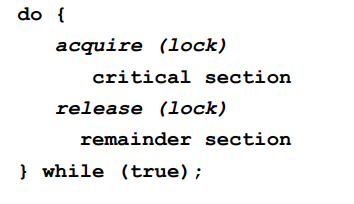
Mutex Lock
Basically the lock that implements test and set
 Note
Note  Flashcards (71)