Balance of payments and exchange rate
 Call Kai
 Learn
Learn Practice Test
 Spaced Repetition
 Match
Match Flashcards
 Knowt Play
1/18

There's no tags or description
Looks like no tags are added yet.
Name | Mastery | Learn | Test | Matching | Spaced | Call with Kai |
|---|
No analytics yet
Send a link to your students to track their progress
19 Terms
What is the BoP?
Value of all financial transactions made between consumers, firms and the government in one country with other nations
What is the current account?
the value of balance of trade, primary and secondary income
What is BoP made up of and describe the last two
current account
Capital account = records investment flows between countries (FDI)
financial account = transactions that result in change of ownership of fincnaisl assets and liabilities (FDI)
5 causes of current account deficit cyclical and structural
under investment
relatively low productivity
not enough R&D or innovation
boom in domestic demand
recession in export markets
Why is current account deficit bad?
slow real GDP growth
loss of jobs in the export sector
exchange rate weakness -> reduced living standards and higher yield on government debt
China has a trade surplus
higher AD
internationally competitive
jobs
less variety of goods within China
demand pull inflation
vulnerable to economic shocks
results in more tariffs and protectionism → retaliation
What is expenditure switching?
change in the pattern of spending by either decreasing consumption of imports or increasing foreigners purchase off exports
What is portfolio investment?
buying financial assets rather than controlling firms like government bonds or shares
What determines the value of a currency in a freely floating exchange market?
supply and derived demand
Three factors that lead to currency appreciation
demand of exports (goods), higher interest rate, speculation
FDI vs portoflio
long vs short term
more stable vs volatile
What is a floating exchange rate?
the value of the currency depends on market forces of supply and demand
no target rate, no intervention
What is a managed exchange rate?
when the central bank may choose to intervene in FOREX markets to affect the value of a currency
evaluate managed
giving up control of interest rates (monetary policy) as it is used to control currency not the macroeconomy
Between 1990-1992 the UK managed the exchange rate. The UK £ was fixed at around 2.95DM. How was the currency managed in this system?
diagram
photo + bands
the government sees demand for the £ falling in value close to lower band due to falling UK exports.
The BoE can then use interest rates to defend their target of DM2.95. Demand falling to D2 increases interest rates so there is attraction of hot money as reward on assets has increased.
BoE can also use reserves to buy the £ therefore decreasing supply to S2 in the market to keep demand within the target
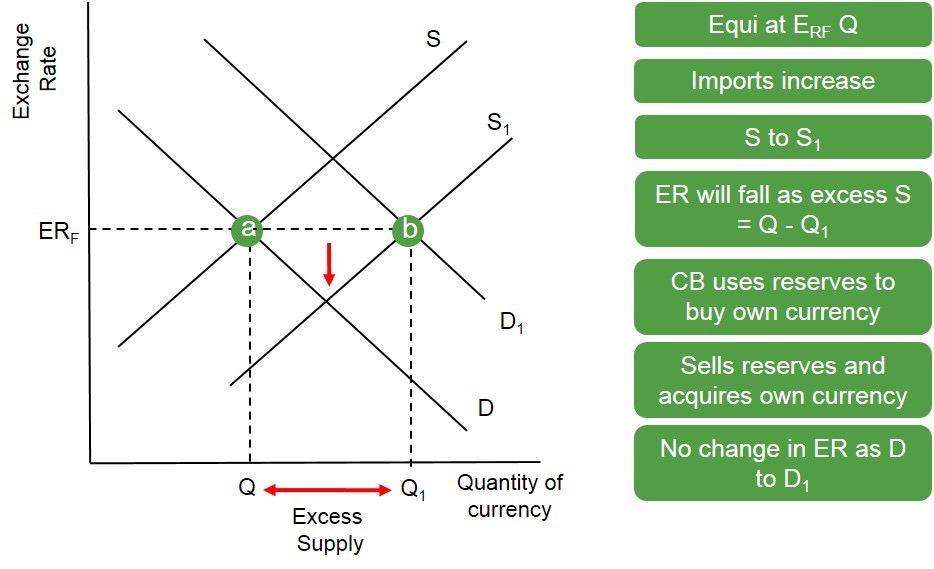
What does BoE do if demand is increasing too much above target?
decrease interest rates
sell £ by buying other currencies (what China has been doing as they have the largest US$ reserves in the world outside the USA)
Example of country with successful managed exchange rate
Singapore → high exports, flexibility to respond to shocks, maintain stability
Pakistan case study ( three economy figures, exports, BoT and current,weaknesses)
GDP per capita = $1500 (183rd)
Gini 0.33
HDI = 0.55 (170th)
low income country (at the top of band tho)
50% Textiles → comeptitiev
20% food → voltaile prices
2% refined copper → shows potential
BoT deficit → widening due to potential structural problems?
could use protectionism on infant industries/ attract FDI/ lower e/r/Borrow
75% depreciaton from 2017
This should be increasing exports but it is not
High dollar debt → need to attract FDI
inflation, weak currency, poor governance, decline in foreign reserves, low productivity
marshall lerner conditions
PED of exports and imports >1 then depreciation of currency will lead to improvement of BoT

