10.3 part 3 Profit Maximization in the Short Run: Marginal-Revenue–Marginal-Cost Approach
 Call Kai
 Learn
Learn Practice Test
 Spaced Repetition
 Match
Match Flashcards
 Knowt Play
1/51

There's no tags or description
Looks like no tags are added yet.
Name | Mastery | Learn | Test | Matching | Spaced | Call with Kai |
|---|
No analytics yet
Send a link to your students to track their progress
52 Terms
What does a firm compare in the MR–MC approach?
It compares marginal revenue (MR) to marginal cost (MC) for each additional unit to decide whether producing that unit increases profit or reduces loss
What happens if MR > MC for a unit?
Producing that unit increases profit (or reduces loss). The firm should produce it
What happens if MC > MR for a unit?
Producing that unit reduces profit (or increases loss). The firm should NOT produce it
What is the profit‑maximizing rule?
Produce the quantity where MR = MC (as long as producing is better than shutting down)
Why does MR usually exceed MC at low output levels?
Because marginal cost is low when production is small — the firm is in the increasing returns stage
Why does MC eventually exceed MR at high output levels?
Because of diminishing returns — marginal cost rises as output increases
What if MR and MC are equal at a fractional output?
Produce the last whole unit where MR > MC
Example:
MR (price) = 131
MC at Q = 8 = 130
MC at Q = 9 = 150
The exact equality MR = MC would happen somewhere between Q = 8 and Q = 9 — like 8.3 units or 8.6 units.
But a firm cannot produce 8.3 units.
You can’t produce a fraction of a car, a fraction of a shirt, or a fraction of a wheat bushel
When does the MR = MC rule apply?
It applies to all market structures: pure competition, monopoly, monopolistic competition, and oligopoly
What condition must be met before applying MR = MC?
Producing must be better than shutting down
Price (MR) must be ≥ minimum AVC
In pure competition, what is the relationship between price and MR?
Price = MR because the firm is a price taker
How does the MR = MC rule look under pure competition?
It becomes P = MC
What does P = MC tell a competitive firm?
Produce the quantity where price equals marginal cost, as long as price ≥ minimum AVC
Why is the MR curve horizontal for a competitive firm?
Because the firm is a price taker — it can sell any quantity at the market price
What is the firm’s goal in the MR–MC approach?
To maximize total profit, not per‑unit profit
Why is the MR curve horizontal in pure competition?
Because the firm is a price taker — it can sell any quantity at the market price, so MR = P and is constant
What is the profit‑maximizing rule for all firms?
Produce the quantity where MR = MC (as long as producing is better than shutting down)
What is the profit‑maximizing rule specifically for pure competition?
Since P = MR, the rule becomes: Produce where P = MC
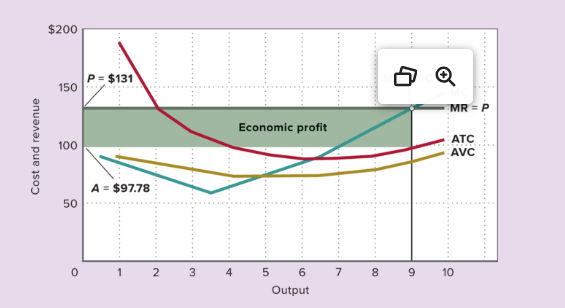
At P = $131, why should the firm produce the first 9 units?
Because for units 1–9, MR > MC, so each unit adds to total profit
Why should the firm NOT produce the 10th unit?
Because MC (150) > MR (131) — producing it would reduce profit
What is the profit‑maximizing output when P = $131?
Q = 9 units, where MR = MC
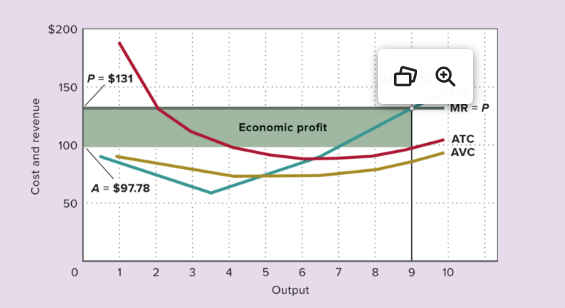
How do you compute total revenue at Q = 9?
TR = P × Q = 131 × 9 = 1,179
How do you compute total cost at Q = 9?
TC = ATC × Q = 97.78 × 9 ≈ 880
What is total economic profit at Q = 9?
Profit = TR – TC = 1,179 – 880 = 299
What is per‑unit profit at Q = 9?
P – ATC = 131 – 97.78 = 33.22 per unit
How do you get total profit from per‑unit profit?
Per‑unit profit × Q = 33.22 × 9 = 299
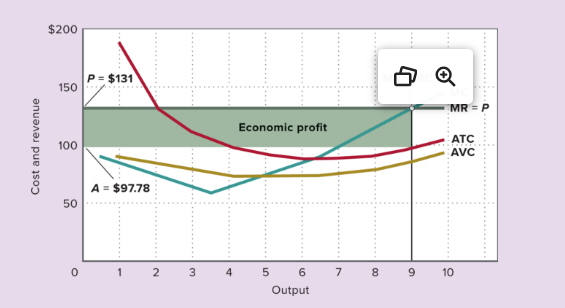
Why is the green rectangle in the graph the total profit?
Because its height = (P – ATC) and width = Q, so area = total profit
Total profit formula
(P - ATC) x Q
Why doesn’t the firm stop at 7 units, where per‑unit profit is highest?
Because the firm maximizes total profit, not per‑unit profit. Units 8 and 9 still add to total profit
What happens if price falls from $131 to $100?
The profit‑maximizing output decreases, because MR = P falls and intersects MC at a lower Q
At 7 units and P = $131, what should the firm do?
Expand output, because MR > MC at Q = 7
What decision rule is the firm following when it produces 9 units?
Produce where total revenue exceeds total cost by the greatest amount
When price falls below profit‑maximizing levels, what is the firm’s first question?
Should we produce at all? Compare price (MR) to minimum AVC
What condition must be met for a firm to continue producing in the short run?
Price must be ≥ minimum AVC. If price < AVC → shut down
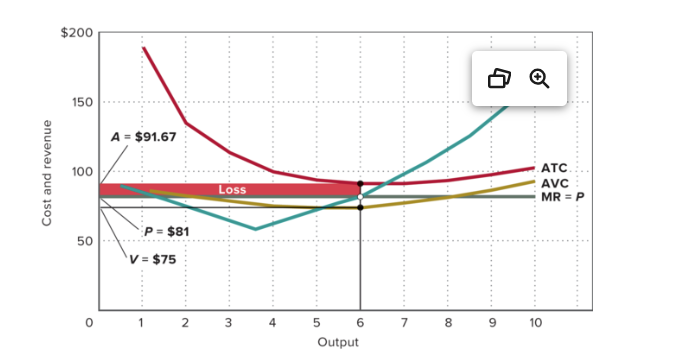
In the loss‑minimizing case (P = $81), why does the firm NOT shut down?
Because price ($81) > minimum AVC ($74). The firm can cover variable costs and part of fixed costs
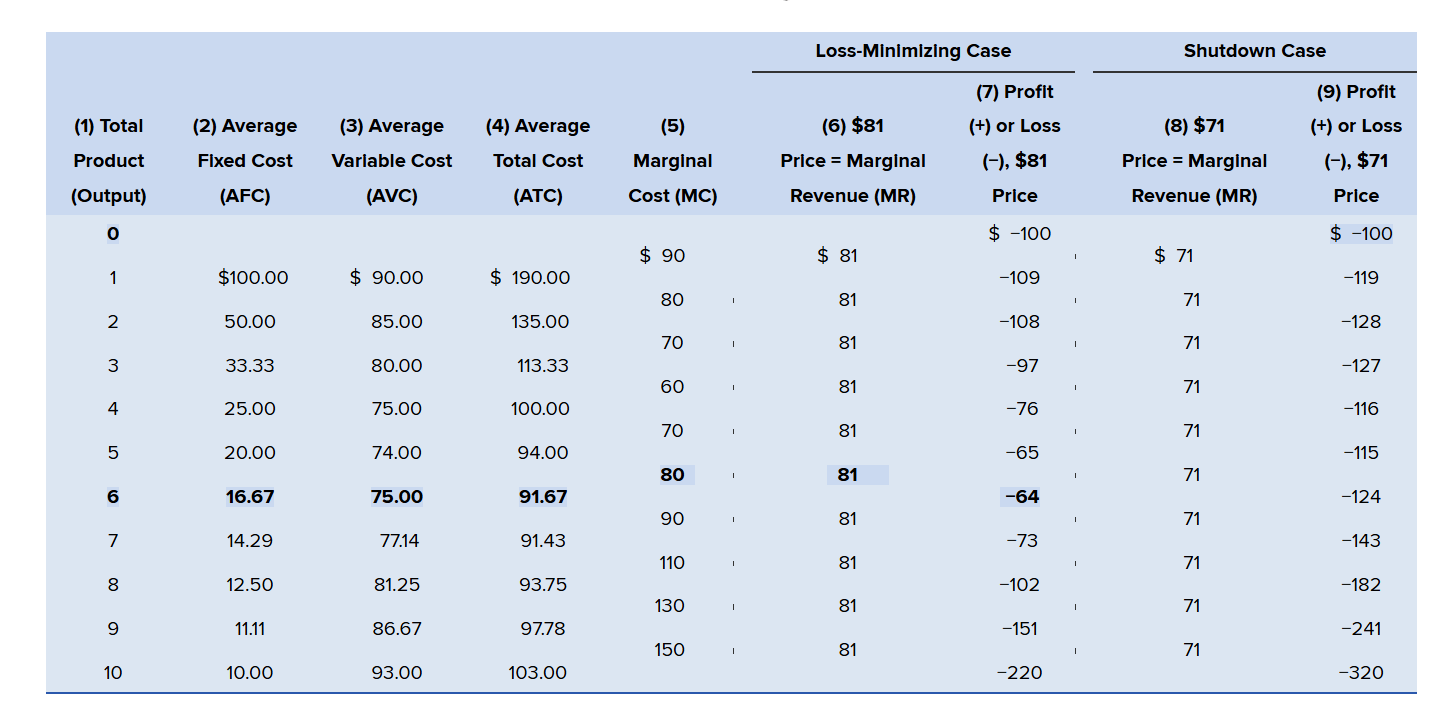
At P = $81, why does the firm produce 6 units?
Because for units 2–6, MR > MC, so each unit reduces the loss. At unit 7, MC > MR, so producing more increases the loss
What is the loss at Q = 6 when P = $81?
ATC = 91.67
Loss per unit = 81 – 91.67 = –10.67
Total loss = –10.67 × 6 = –64
Why is producing 6 units better than shutting down?
Shutting down → lose $100 (fixed cost).
Producing → lose $64.
Producing minimizes the loss
What does each unit contribute at Q = 6 when P = $81?
Price ($81) covers AVC ($75) and contributes $6 per unit toward fixed costs
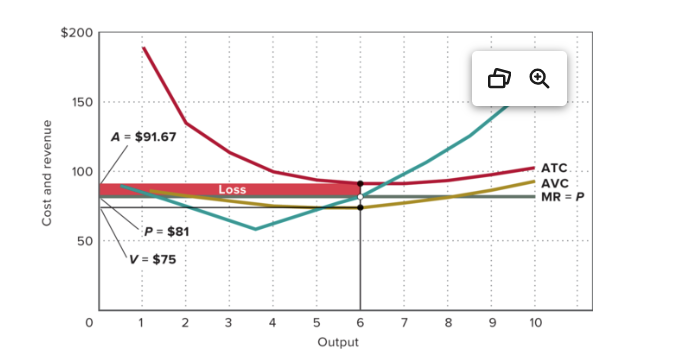
Graphically, what does the red shaded area represent in the loss‑minimizing case?
The firm’s total loss, equal to (ATC – P) × Q
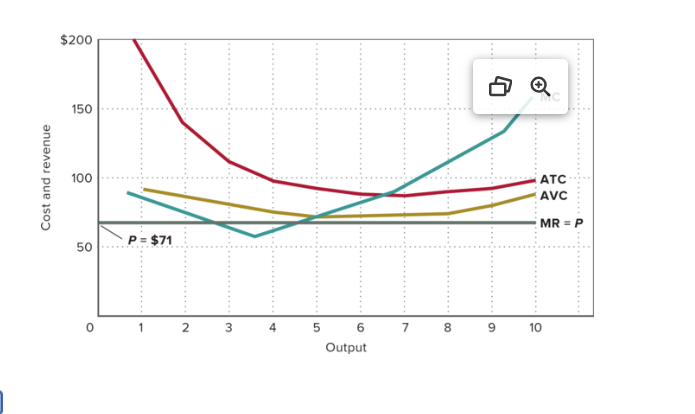
Why does the firm shut down when P = $71? —> SHUTDOWN CASE
Because price < AVC at every output level. The firm cannot cover variable costs
What is the loss if the firm shuts down?
The firm loses only its fixed cost = $100
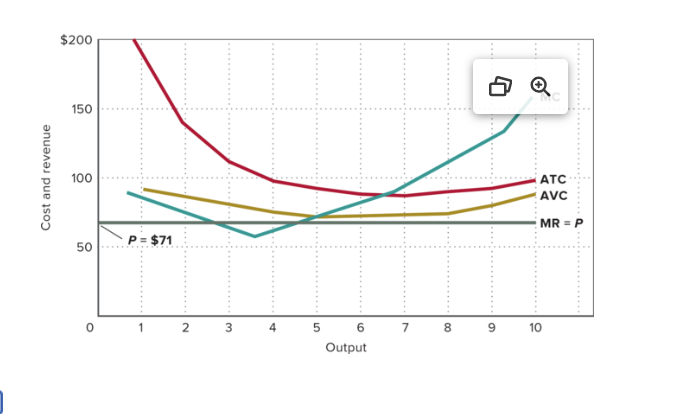
What happens if the firm produces 5 units at P = $71?
Loss = fixed cost (100) + variable loss (3 × 5 = 15)
Total loss = 115, which is worse than shutting down
What is the shutdown rule?
If P < minimum AVC, the firm should shut down immediately.
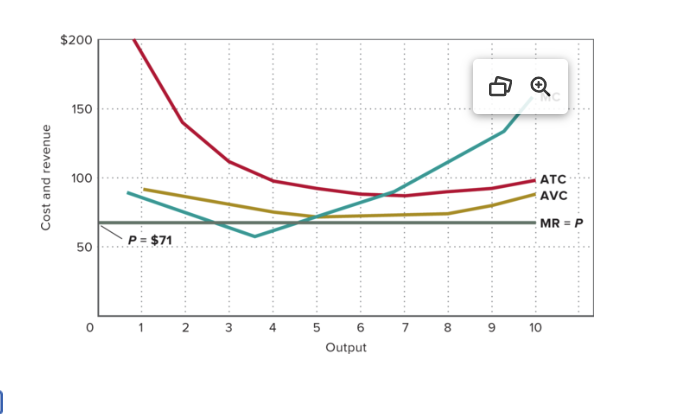
What does the shutdown graph show?
The price line lies below the AVC curve, so no output level covers variable costs. Shut down to minimize loss
What is the relationship between MR = MC and shutdown?
The firm uses MR = MC only if
P ≥ minimum AVC.
Otherwise → shut down
In the shutdown case, why is producing ANY output worse?
Because every unit adds more to cost than to revenue, increasing the loss beyond fixed costs
What is the firm’s loss‑minimizing choice at P = $71?
Shut down and lose only the fixed cost of $100.
When deciding output
If P ≥ AVC, produce.
If P < AVC, shut down.
Profit-maximizing case (P > ATC)
Price is higher than average total cost.
The firm earns economic profit.
Example: P = $131, ATC = $97.78 → profit per unit = $33.22.
Total profit = (P – ATC) × Q = $299 at Q = 9 units.
Graph: Green rectangle between P and ATC = profit area.
Loss-Minimizing Case (AVC < P < ATC)
Price covers variable costs but not total costs.
The firm loses money but still produces because it reduces the loss.
Example: P = $81, ATC = $91.67, AVC = $75 →
Per‑unit loss = $10.67
Total loss = $64
Shutting down would lose $100 (fixed cost), so producing is better.
Graph: Red shaded area between P and ATC = loss area.
Shutdown Case (P < AVC)
Price doesn’t even cover variable costs.
Producing makes the loss worse than shutting down.
Example: P = $71, AVC = $74 →
Producing 5 units loses $115
Shutting down loses $100
→ Better to shut down.
Graph: Price line below AVC curve → no output level helps.
A firm maximizes profit or minimizes loss by producing the quantity where MR = MC, as long as
P ≥ AVC.
If P < AVC, it shuts down

