FIN 3414 Textbook Q's
 Call Kai
 Learn
Learn Practice Test
 Spaced Repetition
 Match
Match Flashcards
 Knowt Play
1/23

There's no tags or description
Looks like no tags are added yet.
Name | Mastery | Learn | Test | Matching | Spaced | Call with Kai |
|---|
No analytics yet
Send a link to your students to track their progress
24 Terms
a. Accept A
b. Accept B
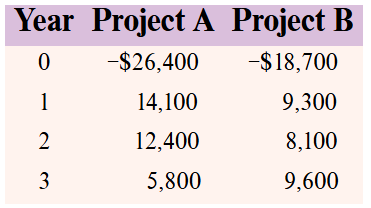
a. Suppose the company’s payback period cutoff is two years. Which of these two projects should be chosen?
b.Suppose the company uses the NPV rule to rank these two projects. Which project should be chosen if the appropriate discount rate is 15 percent?
2.28, 4.31, None
An investment project provides cash inflows of $835 per year for eight years. What is the project payback period if the initial cost is $1,900? What if the initial cost is $3,600? What if it is $7,400?
3.73, 4.23, none
An investment project costs $19,000 and has annual cash flows of $5,100 for six years. What is the discounted payback period if the discount rate is 0 percent? What if the discount rate is 5 percent? If it is 19 percent?
16.46%
The Marieta Group has invested $39,000 in a high-tech project lasting three years. Depreciation is $12,500, $16,200, and $10,300 in Years 1, 2, and 3, respectively. The project generates earnings before tax of $4,160 each year. If the tax rate is 25 percent, what is the project’s average accounting return (AAR)?
1.43, Accept
Bill plans to open a self-serve grooming center in a storefront. The grooming equipment will cost $219,000. He expects aftertax cash inflows of $73,000 annually for seven years, after which he plans to scrap the equipment and retire to the beaches of Nevis. The first cash inflow occurs at the end of the first year. Assume the required return is 14 percent. What is the project’s PI? Should it be accepted?
18.7, Accept
A firm evaluates all of its projects by applying the IRR rule. If the required return is 14 percent, should the firm accept the following project?
Year Cash Flows
0 −$41,000
1 20,000
2 23,000
3 14,000
25.5%
Your firm is contemplating the purchase of a new $535,000 computer-based order entry system. The system will be depreciated straight-line to zero over its five-year life. It will be worth $30,000 at the end of that time. You will save $165,000 before taxes per year in order processing costs, and you will be able to reduce working capital by $60,000 (this is a one-time reduction). If the tax rate is 24 percent, what is the IRR for this project?
Project A
Consider the following cash flows on two mutually exclusive projects:
Year Project A Project B
0 −$75,000 −$85,000
1 36,000 39,400
2 37,500 45,300
3 26,000 31,800
The cash flows of Project A are expressed in real terms while those of Project B are expressed in nominal terms. The appropriate nominal discount rate is 10 percent and the inflation rate is 4 percent. Which project should you choose?
$71,000,000
Sparkly Spring Water, Inc., expects to sell 7.5 million bottles of drinking water each year in perpetuity. This year, each bottle will sell for $1.09 in real terms and will cost $.43 in real terms. Sales and costs occur at year-end. Revenues will rise at a real rate of 2 percent annually, while real costs will rise at a real rate of 1.5 percent annually. The real discount rate is 6 percent. The corporate tax rate is 21 percent. What is the company worth today?
0 | −880,000 |
1 | 187,160 |
2 | 193,150 |
3 | 199,380 |
4 | 205,860 |
5 | 312,019 |
Sanchez, Inc., is considering an investment of $850,000 in an asset with an economic life of five years. The firm estimates that the nominal annual cash revenues and expenses at the end of the first year will be $295,000 and $103,000, respectively. Both revenues and expenses will grow thereafter at the annual inflation rate of 4 percent. The company will use the straight-line method to depreciate its asset to zero over five years. The salvage value of the asset is estimated to be $90,000 in nominal terms at that time. The one-time net working capital investment of $30,000 is required immediately and will be recovered at the end of the project. The tax rate is 22 percent. What is the project’s total nominal cash flow from assets for each year?
38,684
SGS Golf Academy is evaluating different golf practice equipment. The “Dimple-Max” equipment costs $115,00, has a seven-year life, and costs $14,300 per year to operate. The relevant discount rate is 12 percent. Assume that the straight-line depreciation method is used and that the equipment is fully depreciated to zero. Furthermore, assume the equipment has a salvage value of $17,000 at the end of the project’s life. The relevant tax rate is 23 percent. All cash flows occur at the end of the year. What is the EAC of this equipment?
EAC XX40 ≈ 963
EAC RH45 ≈ 798
Choose RH45
Office Automation, Inc., must choose between two copiers, the XX40 or the RH45. The XX40 costs $2,100 and will last for three years. The copier will require a real aftertax cost of $120 per year after all relevant expenses. The RH45 costs $2,600 and will last five years. The real aftertax cost for the RH45 will be $210 per year. All cash flows occur at the end of the year. The inflation rate is expected to be 5 percent per year, and the nominal discount rate is 12 percent. Which copier should the company choose?
0.73
Tube, Inc., recently issued new securities to finance a new TV show. The project costs $45 million, and the company paid $2.2 million in flotation costs. In addition, the equity issued had a flotation cost of 7 percent of the amount raised, whereas the debt issued had a flotation cost of 2 percent of the amount raised. If the company issued new securities in the same proportion as its target capital structure, what is the company’s target debt-equity ratio?
$29.17
Orca Industries is considering the purchase of Shark Manufacturing. Shark is currently a supplier for Orca and the acquisition would allow Orca to better control its material supply. The current cash flow from assets for Shark is $6.8 million. The cash flows are expected to grow at 11 percent for the next five years before leveling off to 4 percent for the indefinite future. The costs of capital for Orca and Shark are 12 percent and 10 percent, respectively. Shark currently has 2.3 million shares of stock outstanding and $50 million in debt outstanding. What is the maximum price per share Orca should pay for Shark?
58.51, 56.36, 55
Chauhan Corp. has a debt-equity ratio of .65. The company is considering a new plant that will cost $55 million to build. When the company issues new equity, it incurs a flotation cost of 6 percent. The flotation cost on new debt is 2.4 percent. What is the initial cost of the plant if the company raises all equity externally? What if it typically uses 60 percent retained earnings? What if all equity investment is financed through retained earnings?
8.53%
A firm has a proposed investment with an initial cost of $84 million. Debt represents 44 percent of the capital structure. The cost of equity is 14.5 percent, the pretax cost of debt is 5.45 percent, and the tax rate is 21 percent. What is the company's WACC?
7.15%
A company is planning a $120 million expansion. Its target capital structure is 35% debt and 65% equity. The company’s stock currently trades at $48 per share, and the next expected dividend is $2.40 per share. Dividends are expected to grow at 6% per year indefinitely. The company’s debt has a coupon rate of 5%, sells for $950 per $1,000 face value, and the corporate tax rate is 25%. What is the company’s WACC?
8.16%
Sunrise Inc. wants to raise $60 million for a new project. The company will finance the project with 60% equity and 40% debt. Of the equity portion, 70% comes from retained earnings, and 30% from new stock issues with flotation costs of 7%. The stock price is $35, the next dividend is $1.75, and dividends are expected to grow at 4%. Debt has a 6% coupon rate and is sold at par. The corporate tax rate is 30%. What is the project’s WACC?
7.90%
A firm has a proposed investment requiring $150 million. The capital structure is 50% equity and 50% debt. The debt is split into two issues: 60% of the debt is 10-year bonds with a 6% coupon and selling at $1,050, and 40% is 5-year notes with a 5% coupon selling at $980. The company’s cost of equity is 12%, and the tax rate is 21%. Calculate the WACC.
9.21
A company plans a $90 million investment, with 55% equity and 45% debt. The debt carries a 5.5% coupon, sells at $1,020 per $1,000 face value, and the corporate tax rate is 24%. The company’s stock pays a $3.00 dividend next year and is priced at $50 per share. Dividends are expected to grow at 5% per year. What is the firm’s WACC
NPV = 37,116 , Accept
A firm is considering buying new equipment costing $120,000. The equipment has a 5-year life, no salvage value, and will be depreciated using the 5-year MACRS schedule from your table. The equipment is expected to generate pre-tax cash inflows of $40,000 per year. The company’s tax rate is 21%, and the WACC is 10%.
Task: Compute the after-tax cash flows each year and the NPV of the project.
$426,426
A firm is considering a 3-year project with an initial cost of $636,000. The equipment is classified as MACRS 7-year property. The MACRS table values are 0.1429, 0.2449, 0.1749, 0.1249, 0.0893, 0.0892, 0.0893, and 0.0446 for Years 1 to 8, respectively. At the end of the project, the equipment will be sold for an estimated $279,000. The tax rate is 35 percent, and the required return is 17 percent. An extra $23,000 of inventory will be required for the life of the project. Annual sales are estimated at $379,000 with costs of $247,000. What is the total cash flow for Year 3?
Crossover Rate
NPVs are equal
not profitable/diff NPV
When crossover > discount?

