Statistics 3 week 6
 Call Kai
 Learn
Learn Practice Test
 Spaced Repetition
 Match
Match Flashcards
 Knowt Play
1/14

There's no tags or description
Looks like no tags are added yet.
Name | Mastery | Learn | Test | Matching | Spaced | Call with Kai |
|---|
No analytics yet
Send a link to your students to track their progress
15 Terms
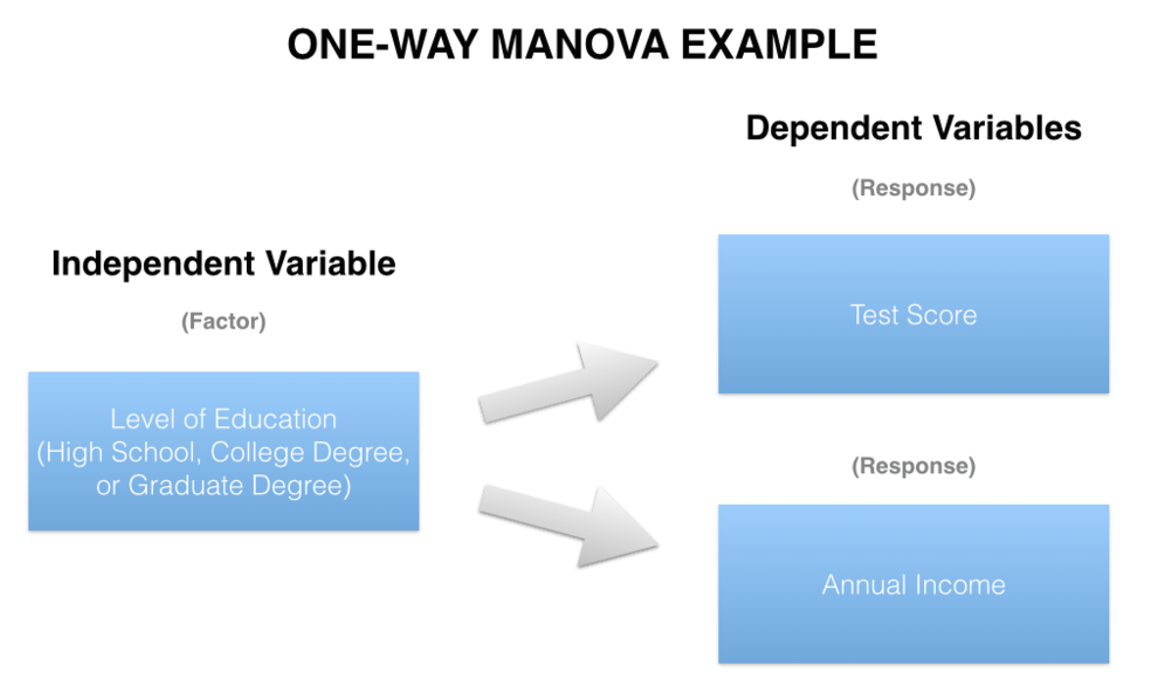
One-way MANOVA
One independent variable (factor) and two or more dependent variables (outcomes)
Two-way MANOVA
Two independent variables (factors and two or more dependent variables (outcomes)
Multivariate Analysis of Variance (MANOVA)
For MANOVA (compared to ANOVA) at least one extra dependent variable is added to model.
Goal of MANOVA is to test whether groups/conditions/cells differ for k different groups on a set of p different dependent variables.
MANOVA takes into account possible correlations between dependent variables
Assumptions MANOVA
Analogous to ANOVA but in multivariate setting:
Extra 1: linear relationship between dependent variables (plot scatter plot matrix)
Extra 2: no multicollinearity between dependent variables (calculate Pearson correlations) → No perfect correlation (over 0.9)
Extra 3: equal variance-covariance matrices (perform Box’s M-test)
Univariate cs Multivariate testing
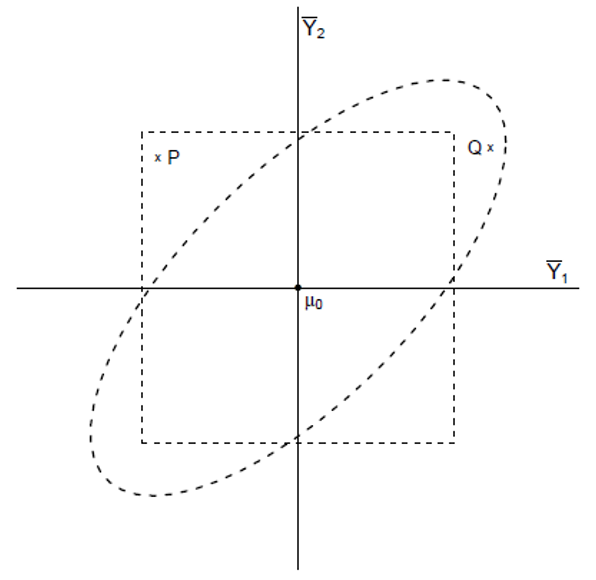
The space outside the square is the rejection-area for two univariate tests (i.e., for at least 1 outcome the null hypothesis will be rejected).
With 2 univariate tests, multivariate H0 is rejected if Y1, Y2, or both fall outside the interval indicated by the square
Twice univariate testing assumes that both hypotheses are independent (orthogonal)
The space outside the ellipse is the rejection-area for multivariate testing of 2 outcomes (i.e., for at least 1 outcome the null hypothesis is rejected).
When Y1 and Y2 are correlated (in this case positively), rejects null hypothesis less quickly if (Y_1 ) ̅ are both relatively high (or low), compared to when deviations are opposed
Why not multiple ANOVAS?
Type 1 error-problem with multiple testing:
“Running several univariate ANOVAs and reporting p different significance tests may result in an inflated risk of Type I error; a MANOVA provides a single “omnibus” test.”
Taking into account possible relationship between Y’s:
“In MANOVA, each Y outcome variable is assessed while statistically controlling for inter-correlations with other Y outcomes; this makes it possible to assess the unique variance associated with each individual Y variable in the context of other Y outcomes.”
Significant difference in patterns without individual significant differences:
“Sometimes an intervention effect can only be detected by examining the pattern of responses (there may be significant differences among groups in response pattern even if the individual Y variables considered in isolation do not differ significantly across groups).”
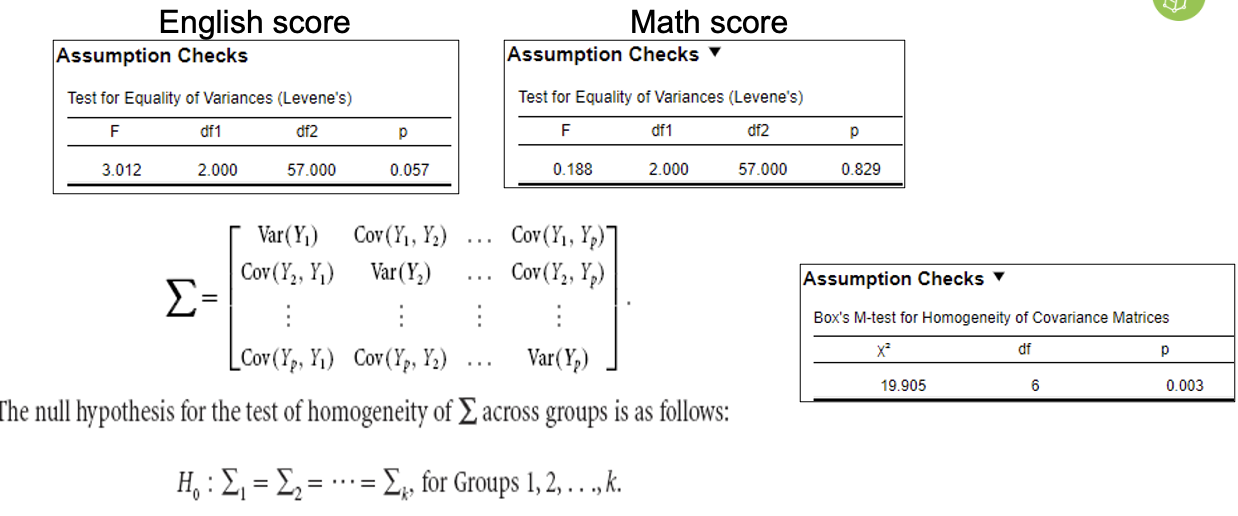
Assumption: equal variance-covariance matrices
This MANOVA-assumption is the multivariate generalisation of the univariate ANOVA-assumption of equal variances:
Equal variances (SS: sum of squares) for each Y and equal covariances. The total of cross products is used. (SCP: sum cross products).
Box’s M Test for equal covariances is used with critical p-value: 0.001
In this example, this assumption thus does not seem to be violated.
Effect sizes MANOVA
Most popular MANOVA-test statistic is Wilks’ Lambda (Λ)
The smaller, the larger the group effect
With only one variable, Λ only uses the Sum of Squares
That’s why the following effect sizes are used
Eta-squared
Partial Eta-squared
Where s is used for conversion-correction (not exam material)
Paradox for Box’s M-test and Levene’s test
Both tests only have sufficient power with a relatively large N.
However, unequal variances and covariances are mainly problematic for studies with a small N.
In other words, for studies for which violating these assumptions is most problematic, it is hardest to decide whether the problem exists.
Other ANOVA-analyses that can be applied to MANOVA
E.g.: contrasts to test for more complex hypotheses a priori.
E.g.: pair-wise comparisons to get more post-hoc insights into where group differences exist.
MANOVA vs Repeated Measures ANOVA
MANOVA: Multiple quantitative Y’s of different scales observed per subject,
and qualitative X’s as predictor variables.Repeated measures ANOVA: Multiple quantitative Y’s of the same scale observed per subject, and qualitative X’s as predictor variables.
Advantages and disadvantages of repeated measures
More measurements per observation, more info, subjects are their own control:
Filter out individual differences à focus on difference scores within subjects
For a specific required power, often fewer participants are needed
Possible problem of carry over- and order-effects
Specific equal variance-assumption for repeated measures:
Sphericity (ε): equal variances of differences between repeated measures. (Mauchly’s test)
Sphericity
Sphericity in within-subject analysis is analogous to the equal variances-assumption in between-subjects ANOVA:
When the assumption is violated, the probability of a Type I-error increases (a lot).
Correction is possible by multiplying the number of degrees of freedom with epsilon (ε), which lies between 0 (no sphericity) and 1 (perfect sphericity):
Greenhouse-Geisser, Huynh-Feldt and Lower-bound are standard corrections given by SPSS
Problem: Mauchly’s test for sphericity has low power for small samples (see above)

