Topic 5: Communicable disease
 Call Kai
 Learn
Learn Practice Test
 Spaced Repetition
 Match
Match Flashcards
 Knowt Play
1/38

There's no tags or description
Looks like no tags are added yet.
Name | Mastery | Learn | Test | Matching | Spaced | Call with Kai |
|---|
No analytics yet
Send a link to your students to track their progress
39 Terms
What is our health a state of
physical and mental well-being
What are the main factors that affect how healthy you are
Diet
Stress
Life situations
Disease
What is a pathogen
A microbe that causes disease
Ways pathogens can be spread
Air
Water
Direct Contact
Describe the difference between communicable and non-communicable diseases
Communicable diseases -
Caused by pathogens and can be passed on from person to person
Non - communicable diseases -
cannot be transmitted from one person to another eg, heart disease and arthritis
Bacteria -
(eg tuberculosis/salmonella)
Large pathogen
Made of living cells
Release toxins
Reproduce by binary fission
Viruses -
(eg aids/cold)
Very small pathogen
Not living
Damage cells
Live and reproduce inside cells
How do bacteria cause disease
Reproducing rapidly (cell division)
Releasing toxins
What is bacteria growth rate affected by
Temperature
Available nutrients
Oxygen levels
PH
Water
Why are viruses hard to treat
They are not killed by antibiotics
They enter cells to hide from the immune system
How bacteria and viruses make us ill
Bacteria multiply rapidly by binary fission and release toxins
Viruses inject their genetic material into host cells, which then makes that cell make new viruses, which then burst out of the cell, which damages it
How the spread of diseases can be reduced or prevented
Hygiene (hand-washing, clean food prep)
Vaccination (building immunity)
Isolation (keeping sick people away)
Vector control (nets for mosquitoes)
Lifestyle choices (condoms)
Why communicable diseases spread rapidly following a natural disaster
clean water supplies + sanitation systems are often damaged
People live in crowded shelters with poor hygeine, which makes it easier for pathogens to spread
Health care services are disrupted
Explain why the number of bacteria on an agar plate will eventually stop growing.
They run out of essential nutrients, waste products build up creating a toxic environment ,and oxygen becomes limited, leading to a stationary phase and then a death phase
Explain why it is important to use an uncontaminated culture to investigate bacterial growth
Contamination can lead to inaccurate, unreliable results
Preparing an uncontaminated culture and the rules
The petri dishes and culture medium must be sterilised before use (eg by heating to a high temperature), to kill any unwanted microorganisms that may be lurking on them
If an inoculating loop is used to transfer the bacteria to the culture medium, it should be sterilised first by passing it through a hot flame
After transferring the bacteria, the lid of the petri dish should be lightly taped on to stop microorganisms from the air getting in
The petri dish should be stored upside down to stop drops of condensation from falling onto the agar surface
Chemicals to stop bacteria growth
Disinfectant - kills bacteria on surfaces
Antiseptic - Kills bacteria on skin
Antibiotics - Kills bacteria inside you
Mealses
Type of pathogen - virus
Symptoms - high fever, cough, runny/blocked nose
Mode of transmission - when a sick person coughs, breathes
How is transmission prevented - vaccination
Treatment - supportive care
HIV
Type of pathogen - virus
Symptoms - fever, sore throat, headaches
Mode of transmission - blood, semen, vaginal fluid, breast milk
How is transmission prevented - condoms, not sharing needles
Treatment - drugs, prep
Salmonella
Type of pathogen - bacteria
Symptoms - diarrhea, fever, abdominal cramps
Mode of transmission - contaminated food + drink
How is transmission prevented - cook at 75 degrees
Treatment - rest, fluids, antibiotics
Gonorrhoea
Type of pathogen - bacteria
Symptoms - burning sensation while peeing, swelling of the genitals
Mode of transmission - unprotected sex
How is transmission prevented - protected sex
Treatment - injection, antibiotics
Athletes Foot
Type of pathogen - fungi
Symptoms - flaky skin, scaly rash, itchy
Mode of transmission - contamination
How is transmission prevented - clean socks, feet
Treatment - creams, sprays, powders
Rose Black Spot
Type of pathogen - fungi
Symptoms - small black spots on leaves
Mode of transmission - release spores
How is transmission prevented - chop of affected leaves
Treatment - chop of affected leaves
Tobacco Mosaic Virus
Type of pathogen - virus
Symptoms - crinkled leaves, mosaic pattern on leaves
Mode of transmission - people touching it + spreading it
How is transmission prevented - don’t touch other leaves
Treatment - chop of affected leaves
Crown Galls
Type of pathogen - bacteria
Symptoms - formation of swelling on plants
Mode of transmission - soils
How is transmission prevented - avoiding the plant, clean soil
Treatment - sanitation, physical removal
Malaria
caused by
spread by
symptoms
plasmodium
mosquitoes
headaches, fever, sweats, chills, dizziness, vomiting
Why is malaria hard to prevent
What are the best ways to prevent it
Mosquitoes are everywhere and can bite you whenever
Early diagnosis, bite prevention, awarness
How is malaria spread between people
If a mosquito bites someone who has malaria, when they bite another person it passes the malaria to them
Describe similarities and differences between salmonella and gonorrhoea
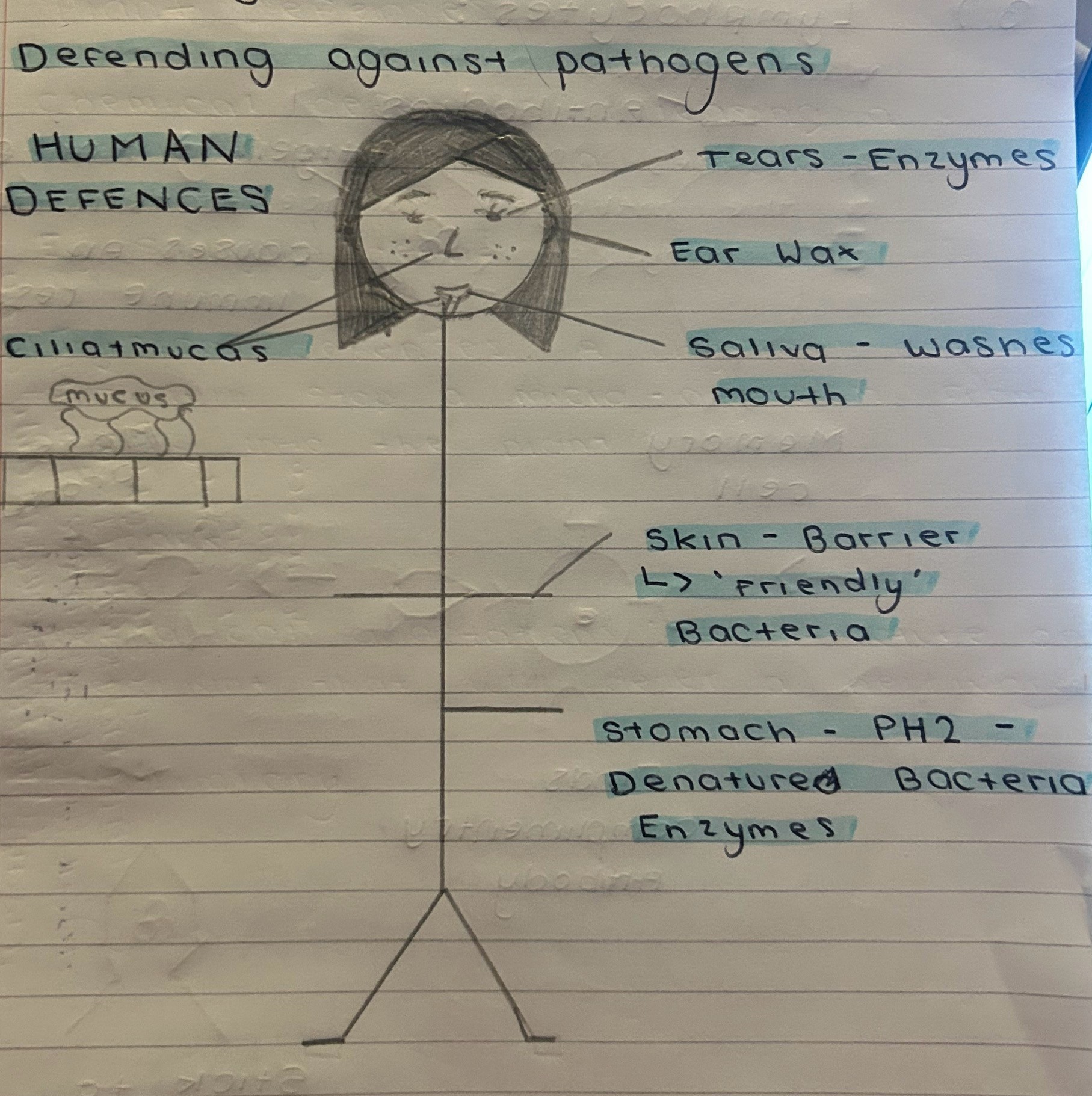
Human Defences against pathogens
Tears - enzymes
Ear wax - filter
Cilitatmucas (in nose and mouth)
Saliva - washes mouth
Skin - barrier, friendly bacteria
Stomach - PH2, denatured bacteria enzymes
Describe the role of white blood cells in the defence against disease
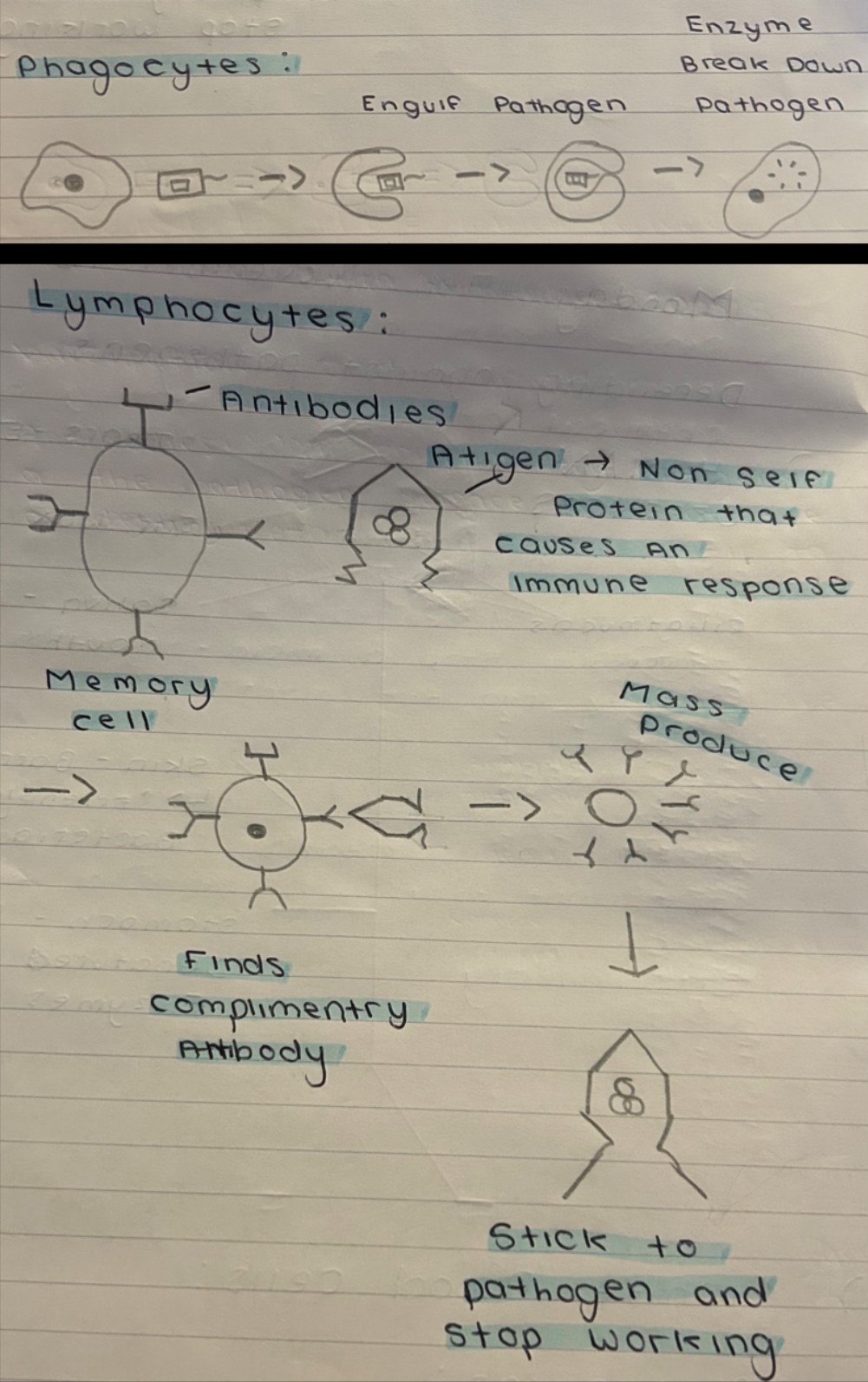
White blood cells help to defend against pathogens by:
phagocytosis
antibody production
antitoxin production
Phagocytes:
Track the pathogen down
Bind to them
Engulf them
Destroy them
How does disease damage a plant
Interfering with its vital functions, such as photosynthesis and water transport
what can plant diseases be detected by
• stunted growth
• spots on leaves
• areas of decay (rot)
• growths
• malformed stems or leaves
• discolouration
• the presence of pests
what can plant disease Identification be made by:
• reference to a gardening manual or website
• taking infected plants to a laboratory to identify the pathogen
• using testing kits that contain monoclonal antibodies.
Plant Defenses
Chemical Defences - releasing a chemical to deter a herbivore eg stinging nettle
Physical Defences - a physical barrier that will stop a micro-organism from getting into the plant eg bark
Mechanical Defences - a structure on plants that will deter a herbivore eg mimicry
Describe physical, chemical, and mechanical plant defence responses
Physical defence responses:
• Cellulose cell walls.
• Tough waxy cuticle on leaves.
• Layers of dead cells around stems (bark on trees), which fall off.
Chemical plant defence responses:
• Antibacterial chemicals.
• Poisons to deter herbivores.
Mechanical adaptations:
• Thorns and hairs deter animals.
• Leaves which droop or curl when touched.
• Mimicry to trick animals.
Signs of plant disease to ion deficiency.
Stunted growth caused by nitrate deficiency
Chlorosis caused by magnesium deficiency
Calculate the number of bacteria in a population after a certain time if given the mean division time.
Calculate the area of the clear circle around colonies using r²
Explore top notes

