Pre-Lecture Lesson 1.3: Energetic constraints on anatomy
 Studied by 4 people
 Call Kai
 Learn
Learn Practice Test
 Spaced Repetition
 Match
Match Flashcards
 Knowt Play
1/15

There's no tags or description
Looks like no tags are added yet.
Name | Mastery | Learn | Test | Matching | Spaced | Call with Kai |
|---|
No analytics yet
Send a link to your students to track their progress
16 Terms
What do cells need to obtain in order to perform aerobic cellular respiration?
Oxygen (O2)
Glucose (or other organic molecules)
What is diffusion?
The movement of a chemical through a medium through random through random, thermal motions
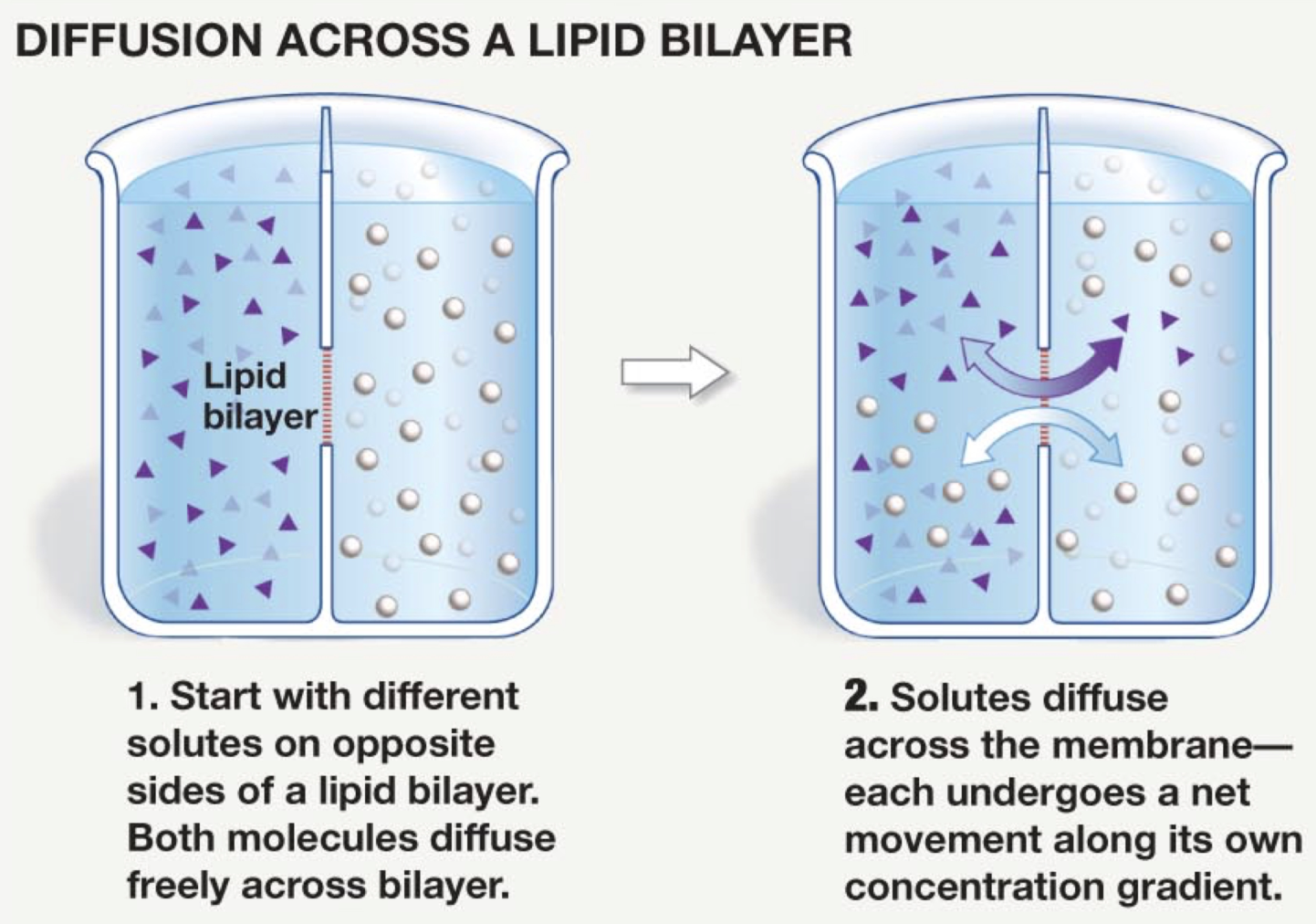
How does diffusion result in the movement of chemical substances, such as respiratory gases, from one medium into another (such as into or out of an organism)?
The direction of diffusion is from a region of high concentration to a region of low concentration, simply due to probability as these molecules are randomly moving about
(entropy increases, more molecules on the high-concentration side)
Concentration Gradient (partial pressure gradient)
The HIGHER the concentration gradient the HIGHER the diffusion rate Q
Area (the surface area across which diffusion can take place)
The LARGER the surface area, the HIGHER the diffusion rate Q
Length
The SHORTER the length of the diffusion path (L), the HIGHER the rate of diffusion (because the longer the path, the longer it takes for the molecule to diffuse that distance)
Diffusion Coefficient (permeability)
The HIGHER the permeability (D), the HIGHER the rate of diffusion (Q) (the greater D, the less stuck the molecule gets and faster it gets to the other side)
Why are the variables D, A, and (Phigh -Plow) in the numerator of the Fick’s Law equation, but L is in the denominator?
D, A, and (Phigh -Plow) are POSITIVELY related to Q; as they increase so does Q. L is INVERSELY related to Q; as L increases, Q decreases
Can we change the concentration gradient of oxygen from the environment to inside the organism to make up for a larger L in a big organism?
No, the organism is stuck with whatever oxygen concentration happens to be in the environment
What do you observe in your graph?
Both volume and surface area increase, but the volume increases faster
What did you find?
As the cubic organism grows, its surface area to volume ratio decreases
The 2 body shapes that are optimal solutions
Linear and Sheet
What is the effective surface of an organism for gas exchange?
The surface area available per unit volume (like a cell) for gas exchange
Individual cells ALWAYS depend solely on diffusion across their external membrane for gas exchange. How then can you explain that you can find cells of virtually any shape, including spherical cells - where spheres have the lowest surface area to volume ratio of any shape?
Surface area to volume ratio of any shape is high when the object is very small.
How might a "non-flat" organism like you are reduce the diffusion length between the high oxygen concentration in the air and each of your body cells?
Move the dissolved gasses with "mass flow" (rapid bulk movement of a substance in a current)
Which of the following are examples of mass flow?
Blood flow in a circulatory system
Water moving over gills
Pulling air into a lung by contracting your diaphragm. (breathing)
 Note
Note  Flashcards (260)