Stress Management Midterm
 Call Kai
 Learn
Learn Practice Test
 Spaced Repetition
 Match
Match Flashcards
 Knowt Play
1/62

There's no tags or description
Looks like no tags are added yet.
Name | Mastery | Learn | Test | Matching | Spaced | Call with Kai |
|---|
No analytics yet
Send a link to your students to track their progress
63 Terms
What is stress?
Stress is a perceived threat (real or imagined) to our mind, body, spirit, or emotions
What is a stressor?
Any real or imagined situation, circumstance, or stimulus that is perceived to be a threat
What is acute stress?
Stress that is intense in nature but short in duration
What is chronic stress?
Stress that is not as intense as acute stress but that lingers for a prolonged period of time (e.x. financial problems)
What is the stress response?
The body preparing for fight or flight (stages of this stress response formulated by Walter Cannon)
What is the first stage of the stress response (Walter Cannon)?
Stimuli is sent to the brain
What is the second stage of the stress response (Walter Cannon)?
Brain deciphers stimuli as a threat and the nervous system is activated for survival
What is the third stage of the stress response (Walter Cannon)?
Body stays activated until the threat is over
What is the fourth stage of the stress response (Walter Cannon)?
Body returns to homeostasis (physiological calmness, once the threat is gone)
What are physical symptoms of the stress response (fight or flight)?
Increased blood pressure, heart rate, blood clotting ability, and perspiration
What is “rest and digest”?
response triggered by the parasympathetic nervous system (PNS) where the which activates when the body is safe, relaxed, or digesting food, slowing the heart rate and increasing digestion
What are the major sources of stress?
Climate change
Economic uncertainty
A divisive Society
What are the corresponding coping mechanisms to major sources of stress?
The trauma response is the over-adaptive coping response and consists of:
Fight
Flight
Freeze
Fawn
What is “tend and befriend”?
Theory presented by Shelley T aylor that states that women who experience stress don’t necessarily run or fight, but rather turn to friends to cope with unpleasant events and circumstances
Yerkes-Dodson Principle
theory that some stress (eustress) is necessary for health and performance, but that beyond an optimal amount, both will deteriorate as stress increases
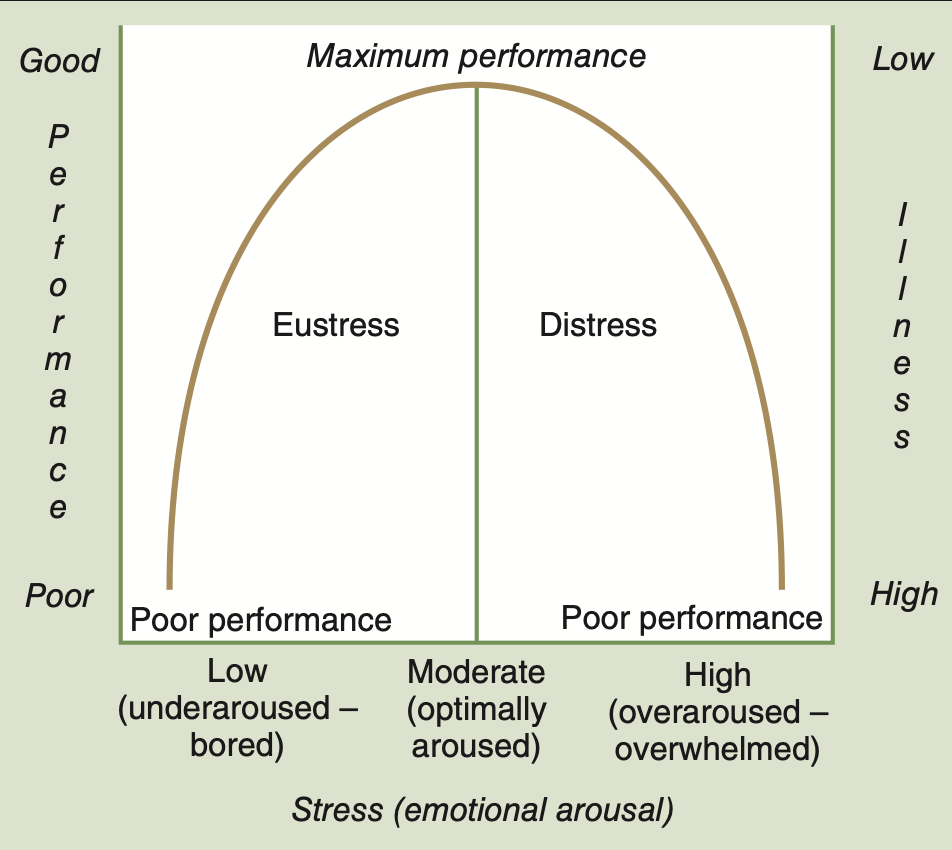
What is eustress?
Good stress (first half of curve in Yerkes-Dodson)
What is neustress?
Neutral stress (middle of Yerkes-Dodson curve)
What is distress?
Bad stress (right-end of Yerkes-Dodson curve)
What is Selye’s General Adaptation Syndrome (GAS)?
Termed coined by Hans Selye that describes the three distinct physiological phases in
reaction to chronic stress:
Alarm Phase
Resistance Phase
Exhaustion Phase
Difference between Yerkes-Dodson and General Adaptation Syndrome?
Yerkes-Dodson is U-shaped model focusing on acute stress for task performance, while GAS is a three-stage model focusing on chronic stress
What is the holistic wellness paradigm?
the whole is greater than the sum of the parts; model where total wellness is the balance, integration, and harmony of the physical, intellectual, emotional, and spiritual aspects of the human condition
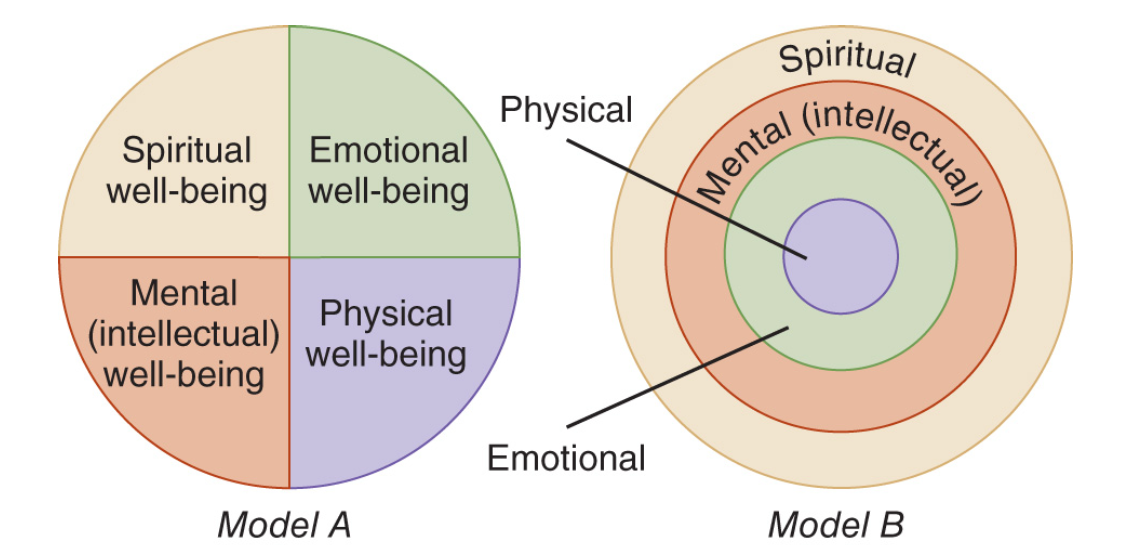
What are the implications of the Holistic Wellness Paradigm?
all parts must be looked at as one system
all aspects of the individual must be treated equally in medicine
treating symptoms of stress with solely drugs/surgery is wrong, also need to acknowledge the link to mental and emotional health
should consider alternative medicine like biofeedback, meditation, massage
therapy, and mental imagery
should consider integrative medicine which uses both Western and mind-body-spirit medicine
What is technostress?
stress caused by technological fast-paced lifestyle with emails, phones, texting, and computers which (opposite to their original design) give people less leisure time
What is digital wellness?
an intentional and healthy relationship with screen technology for brain, body, and spirit and in a safe manner
What are the impacts of digital wellness on psychological health?
Incorporating self awareness, behavior change, and common sense to decrease doom scrolling and help with eye health
What is occupational stress?
the harmful physical, emotional, and mental response that occurs when job requirements do not match a worker's capabilities, resources, or needs
What is role stress?
The unease or pressure an individual feels when trying to meet the obligations of a role, often stemming from incompatible expectations
How do environmental factors influence stress perception?
Environmental disconnect (people have distanced themselves so much from the natural environment that they cannot fathom the magnitude of their impact on it)
Nature deficit disorder (growing abyss between people and the outdoor world)
Climate change (ex. lack of drinking water) increases prices
Economic Stress
Eventual extinction
How do social factors influence stress perception?
stress results from a perceived threat, can include stereotyping, prejudice, discrimination, harassment, and even physical harm (ex. bullying, social cliques, alienation)
fix through anti-bullying campaigns and diverse roles in media
What is the central nervous system?
Portion of the nervous system that consists of the brain and the spinal cord
What is the sympathetic nervous system?
The branch of the central nervous system that triggers the fight-or-flight response when some element of threat is present
How does the sympathetic nervous system work?
The amygdala detects danger, signals the hypothalamus which orders the adrenal glands to release norepinephrine and epinephrine; if stress continues the HPA axis is activates and releases cortisol
How does the parasympathetic nervous system work?
Once activated by the vagus nerve, ACh is released which returns the body to homeostasis by reducing heart rate, blood pressure, and muscle tension
How does stress affect the cardiovascular system?
adrenaline and epinephrine increase heart rate, constrict blood vessels, and elevate blood pressure
How does stress affect the digestive system?
HPA axis induces cortisol and slows down digestion as a non-essential function
How does stress affect the nervous system?
How does stress affect the immune system?
cortisol causes immunosuppression and inflammation
Describe the role of the vagus nerve in the relaxation response?
prime messenger of the parasympathetic nervous system that when stimulated reduces ACh to reduce heart rate, blood pressure, and aid digestion
Explain the HPA axis?
Stress triggers the hypothalamus to send a signal to the pituitary gland to release ACTH which activates the adrenal cortex, producing cortisol to mobilize energy and surpress immunity
Describe the role of the endocrine system in the sympathetic nervous system?
Endocrine is the slower messaging system than nervous system with electrical impulses. It actives the adrenal glands to produce cortisol which allow for longer stress effect
Describe the role of the endocrine system in the parasympathetic nervous system?
hypothalamus activates endocrine system to send signal to glands to secrete insulin (lower blood sugar), oxytocin, and melatonin
Explain how chronic stress contributes to disease development
overstimulates the HPA axis and sympathetic nervous system which release cortisol that supress immune function and accelerate aging
What is allostatic load?
the "wear and tear" on the body resulting from chronic, accumulated, or intense stress. It represents the cumulative biological burden of repeatedly adapting to stressors
What is perception?
an interpretation of some event that we perceive as a threat.
What is Boryshenko’s model?
Stress-related diseases can be placed into two categories:
1. overresponsive autonomic nervous system
2. dysfunctional immune system
What are the symptoms of an overresponsive nervous system?
bronchial asthma, tension headaches (face muscle contraction), migrane headaches (half of head), joint dysfunction, IBS, and heart disease
What are the symptoms of a dysfunctional immune system?
Common cold/flu, allergies, arthritis, lupus, ulcers, and cancer
What is the driving cause of nervous system overreactions?
organs bombarded by constant secretion of stress hormones increase their metabolic rate and begin to falter
What is the driving cause of immune system underreactions?
stress alters the molecular structure which reduces the number and function of leukocytes — this makes the body more vulnerable to diseases
What are the positive emotions of fear?
excitement, joy, relief, motivation
What are the negative emotions of fear?
anxiety, panic, paranoia, irritability
What is fear’s adaptive value?
Fear serves as a primitive warning system that allows the body to prepare for a possible threat
What is the role of perception in stress appraisal?
stress begins as a perception (an interpretation of some event that we perceive as a threat) and it thus influences how we respond physically
What is the process of perception?
All stimuli received by the brain are processed through interpretation and classified as negative, neutral, or positive
What is the cognitive model of stress?
Developed by Lazarus and has the stages:
Primary appraisal → Secondary appraisal → Coping strategies (two types) → Reappraisal
What is primary appraisal in the cognitive model of stress?
individual sees an event and categorizes its relevancy, then categorizes its threat level (whether damage is done, will be done, or opportunity for growth)
What is secondary appraisal in the cognitive model of stress?
individual assesses their options to cope with the stress (“can I deal with this?”)
What are the coping strategies in the cognitive model of stress?
Problem-focused: addressing it
Emotion-focused: addressing how you feel about it
What is the reappraisal model of stress?
continuous process after seeing threat of updating with new information
What are cognitive distortions?
thinking a situation is worse than it actually is due to perception
What are examples of cognitive distortions?
jumping to conclusions, all-or-none thinking, overgeneralization
What is cognitive restructuing?
a four stage model to change negative thoughts to positive ones by altering your perception
What are the steps of cognitive restructuring?
Awareness: figure out the stressor, why its a stressor + emotional reaction, and
Reappraisal of the situation:
Adoption and substitution:
Evaluation:

