PSY215 LECTURES 1-3
0.0(0)
 Studied by 3 people
 Call Kai
 Learn
Learn Practice Test
 Spaced Repetition
 Match
Match Flashcards
 Knowt Play
Card Sorting
1/120

Earn XP
Last updated 5:14 AM on 4/14/23
Name | Mastery | Learn | Test | Matching | Spaced | Call with Kai |
|---|
No analytics yet
Send a link to your students to track their progress
121 Terms
1
New cards
**What is addiction?**
Addiction is not limited to drug ingestion → many behaviours can be addictive
* such as: gambling, overeating, exercise, internet use, work, etc
* such as: gambling, overeating, exercise, internet use, work, etc
2
New cards
**Addictive behaviours include (2):**
substance and non-substance behaviours
3
New cards
**Characteristics of addictive behaviours (4)**
1. Repetitive pattern that increases risk of disease + personal and social problems
\
2. Feeling of “loss of control” over the behaviour → unable to achieve abstinence or moderate use despite wanting to
\
3. immediate gratification (short term reward) + delayed damaging effects (long term cost) → short term reward with long term cost
\
4. Attempt to change behaviour (ie. through treatment) results in high relapse rates
4
New cards
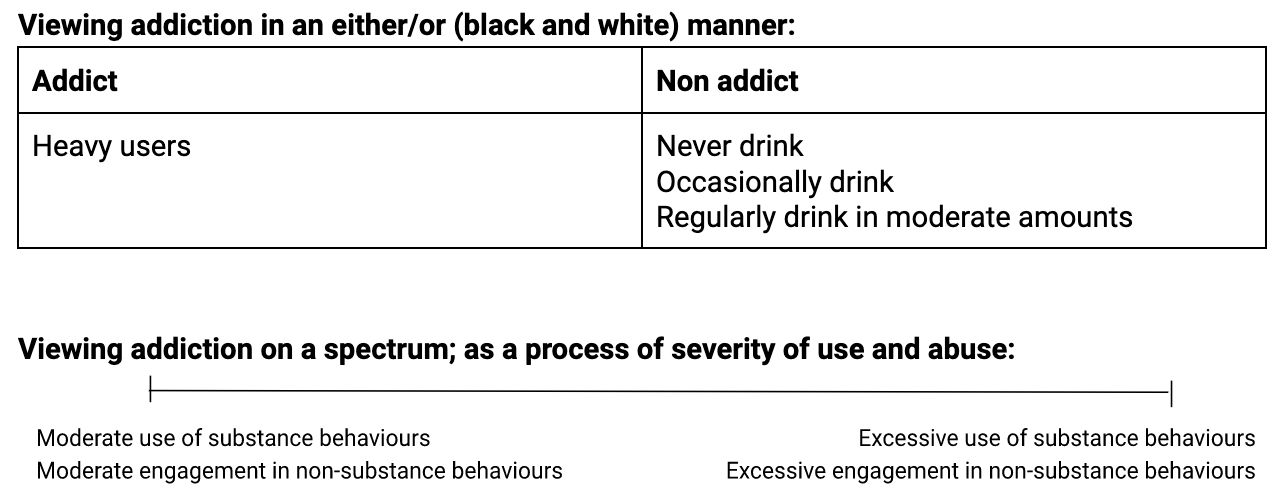
**Two different viewpoints of addiction**
1. **Black and white manner**
\
2. **Seen on spectrum of severity**
5
New cards
**Advantage of “spectrum of severity” viewpoint**
Advantage: may reduce stigmatization attached to the word “addiction”
* Alcohol use disorders = most stigmatized mental disorders followed by illegal drug use disorders
* Thus, some suggest the use of the word (prolonged) “heavy use” instead of “substance use disorder”
* By putting moderate and heavy users on the same spectrum, it may overtime reduce stigmatization
* Alcohol use disorders = most stigmatized mental disorders followed by illegal drug use disorders
* Thus, some suggest the use of the word (prolonged) “heavy use” instead of “substance use disorder”
* By putting moderate and heavy users on the same spectrum, it may overtime reduce stigmatization
6
New cards
**Is it possible to use drugs and not misuse them?**
Yes
7
New cards
**Is it possible to use drugs and not become addicted to them?**
* Yes
* But we do not know ahead of time who will develop dependence
* But we do not know ahead of time who will develop dependence
8
New cards
**DSM-5**
* Diagnostic and Statistical Manual of Mental Disorders, 5th Edition
* American psychiatric association (APA), 2013
* Widely accepted system for diagnosing and describing mental disorders
* Sets standard for making diagnoses of psychological disorders
* American psychiatric association (APA), 2013
* Widely accepted system for diagnosing and describing mental disorders
* Sets standard for making diagnoses of psychological disorders
9
New cards
**Substance-related & addictive disorders**
* Range of problems associated with the use + abuse of drugs that alter the way one thinks + feels + behaves
\
* Many addicts use substances or engage in addictive behaviours to modify mood + self-medicate
\
* Include separate classes of drugs
* although pharmacological mechanisms by which each class of drugs produces reward is different, they all directly activate the brain reward system + produce feelings of pleasure (arousing “high” or de-stressing “numbing” or __**both**__)
* __**both**__ **= psychology overrides physiology** due to expectation effects
* eg. smoker smokes first thing in the morning to become aroused and ready for the day (physiology), and later after work to destress (psychology)
\
* Many addicts use substances or engage in addictive behaviours to modify mood + self-medicate
\
* Include separate classes of drugs
* although pharmacological mechanisms by which each class of drugs produces reward is different, they all directly activate the brain reward system + produce feelings of pleasure (arousing “high” or de-stressing “numbing” or __**both**__)
* __**both**__ **= psychology overrides physiology** due to expectation effects
* eg. smoker smokes first thing in the morning to become aroused and ready for the day (physiology), and later after work to destress (psychology)
10
New cards
**Non-substance related disorders**
* Gambling disorder
* Gambling behaviours → similar to drugs, activate the brain reward system + produce comparable behavioural symptoms
* other behavioural addictions (ie. internet gaming addiction) not included due to insufficient research to identify them as mental disorders)
* Gambling behaviours → similar to drugs, activate the brain reward system + produce comparable behavioural symptoms
* other behavioural addictions (ie. internet gaming addiction) not included due to insufficient research to identify them as mental disorders)
11
New cards
**Substances-related disorders includes:**
**Substance use disorders: problematic use of a substance**
\
AND
\
**Substance-induced disorders: specific conditions resulting from use**
* depressive, anxiety, psychotic, or manic symptoms that occur as a physiological consequence of the use of substances of abuse
* may occur during active use, intoxication or withdrawal
\
AND
\
**Substance-induced disorders: specific conditions resulting from use**
* depressive, anxiety, psychotic, or manic symptoms that occur as a physiological consequence of the use of substances of abuse
* may occur during active use, intoxication or withdrawal
12
New cards
**Substance**
Chemical compounds that alter mood/behaviour
13
New cards
**Substance use**
The ingestion of substances in moderate amounts that **do not** interfere with **functioning**
14
New cards
**Substance intoxication**
Physiological reaction to ingested substances
* eg. getting high
* eg. getting high
15
New cards
**Substance use disorder**
Defined in terms of how significantly substance use interferes with one’s life (rather than the amount of substance ingested)
* described as __**addiction**__
* described as __**addiction**__
16
New cards
**Physiological dependence**
* Using increasingly greater amounts of the drug(s) to experience the same effect → tolerance
* Experiencing a negative physical response when the substance is no longer ingested → withdrawal
* Experiencing a negative physical response when the substance is no longer ingested → withdrawal
17
New cards
**Tolerance**
The need for increased amounts of a substance to achieve desired effects, or a diminished effect with continued use of the same amount
* the degree to which tolerance develops varies across individuals and substances
* the degree to which tolerance develops varies across individuals and substances
18
New cards
**Withdrawal**
Experiencing negative physiological reactions to the removal of a substance which can be reduced or diminished by the use of the same or a similar substance
* Withdrawal symptoms vary across different classes of substances → separate criteria sets are provided in DSM-5
\
Not all substances are physically addictive + result in physical withdrawal (ie. LSD)
* Withdrawal symptoms vary across different classes of substances → separate criteria sets are provided in DSM-5
\
Not all substances are physically addictive + result in physical withdrawal (ie. LSD)
19
New cards
**Tolerance and Withdrawal are:**
BOTH **physiological** reactions to the substance being used
20
New cards
**Withdrawal from Alcohol**
Alcohol withdrawal delirium or DTs (delirium tremens)
* experiencing hallucinations and body tremors
* other alcohol withdrawal symptoms: vomiting, nausea, insomnia, etc.
* experiencing hallucinations and body tremors
* other alcohol withdrawal symptoms: vomiting, nausea, insomnia, etc.
21
New cards
**Withdrawal from Cocaine**
* anxiety
* sleep changes
* lack of motivation
* boredom
* sleep changes
* lack of motivation
* boredom
22
New cards
**Withdrawal from Cannabis**
* irritability
* nervousness
* appetite change
* sleep disturbance
* nervousness
* appetite change
* sleep disturbance
23
New cards
**Psychological dependence**
Behavioural reactions to drugs
* drug-seeking behaviours (ie. stealing money to buy more drugs, standing in the cold to smoke, etc.)
* drug-seeking behaviours (ie. stealing money to buy more drugs, standing in the cold to smoke, etc.)
24
New cards
**DSM-5 diagnostic criteria for substance use disorders**
In order to meet the criteria for a substance use disorder, at least 2 DSM-5 symptoms must be met in the last year __which has resulted in clinically significant impairment or distress__ (ie. has interfered with functioning)
* Must specify severity:
* **Mild →** presence of 2-3 symptoms
* **Moderate →** presence of 4-5 symptoms
* **Severe →** presence of 6 or more symptoms
* Must specify severity:
* **Mild →** presence of 2-3 symptoms
* **Moderate →** presence of 4-5 symptoms
* **Severe →** presence of 6 or more symptoms
25
New cards
**Problematic pattern of substance use leading to clinically significant impairment/distress, as shown by** __**at least 2**__ **of the following (**__**within the last year**__**):**
1. Substance is taken in larger amounts or over a longer period than was originally intended
\
2. There is persistent desire, or unsuccessful efforts, to cut down or control use
\
3. A great deal of time is spent in activities necessary to obtain the substance, use of the substance, or recovery from its effects
\
4. Craving or strong desire to use the substance
\
— — — — — 1 - 4 = **“impaired control”** symptoms — — — — —
5. Recurrent substance use resulting in a failure to fulfill major role obligations at work, school or home
\
6. Continued use despite having recurrent social or interpersonal problems caused by the effects of the substance
\
7. Important social, occupational or recreational activities are given up or reduced because of use
\
– — – – – – 5 - 7 = **“social impairment”** symptoms — – – – – –
\
8. Recurrent use in situations in which it is physically hazardous
\
9. Use is continued despite knowledge of having a recurrent physical or psychological problem that is likely to have been caused by the substance
\
– — – – – – – – 8 - 9 = **“risky use”** symptoms — – – – – – – – –
\
10. **Tolerance – defined as either or both of the following:**
* A need for markedly increased amounts of substance to achieve intoxication or desired effect
* A markedly diminished effect with continued use of the same amount of substance
\
11. **Withdrawal, as manifested by either of the following:**
* The characteristic withdrawal symptoms of the substance
* The substance – or a similar substance – taken to relieve or avoid withdrawal symptoms
\
– — – 10 - 11 = **“pharmacological criteria”** symptoms — – – –
26
New cards
**“impaired control”** symptoms (4)
1. Substance is taken in larger amounts or over a longer period than was originally intended
\
2. There is persistent desire, or unsuccessful efforts, to cut down or control use
\
3. A great deal of time is spent in activities necessary to obtain the substance, use of the substance, or recovery from its effects
\
4. Craving or strong desire to use the substance
27
New cards
**“social impairment”** symptoms (3)
5. Recurrent substance use resulting in a failure to fulfill major role obligations at work, school or home
\
6. Continued use despite having recurrent social or interpersonal problems caused by the effects of the substance
\
7. Important social, occupational or recreational activities are given up or reduced because of use
28
New cards
**“risky use”** symptoms (2)
8. Recurrent use in situations in which it is physically hazardous
\
9. Use is continued despite knowledge of having a recurrent physical or psychological problem that is likely to have been caused by the substance
29
New cards
**“pharmacological criteria”** symptoms (2)
10. **Tolerance – defined as either or both of the following:**
* A need for markedly increased amounts of substance to achieve intoxication or desired effect
* A markedly diminished effect with continued use of the same amount of substance
\
11. **Withdrawal, as manifested by either of the following:**
* The characteristic withdrawal symptoms of the substance
* The substance – or a similar substance – taken to relieve or avoid withdrawal symptoms
30
New cards
**4 groupings of the 11 symptoms of the problematic pattern of substance use**
1. **impaired control**
2. **social impairment**
3. **risky use**
4. **pharmacological criteria**
31
New cards
**Some minor variations in symptoms across different substances:**
* Some symptoms are less salient (prominent, noticible) for some substances
* Some symptoms do not apply to some substances (ie. withdrawal symptoms are not specified for inhalant use disorders)
* Some symptoms do not apply to some substances (ie. withdrawal symptoms are not specified for inhalant use disorders)
32
New cards
**What is a psychological disorder?**
A psychological dysfunction within an individual that is associated with \[1\] __***distress***__ *and* \[2\] __***impairment in functioning***__ & \[3\] __***a response that is not typical or culturally expected***__
* \[1\] and \[2\] and \[3\] must be present for a psychological disorder diagnosis to be met
\
Atypical or not culturally expected
* Atypical behaviour which violates social norms in a culture
* Important to consider cultural difference in psychological disorders
* \[1\] and \[2\] and \[3\] must be present for a psychological disorder diagnosis to be met
\
Atypical or not culturally expected
* Atypical behaviour which violates social norms in a culture
* Important to consider cultural difference in psychological disorders
33
New cards
**Addiction is an interconnected process involving interplay between 3 factors:**
1. **Individual factors →** personal vulnerability factors
* Biological or genetic predispositions
* Psychological factors (ie. personality, unconscious motivations, attitudes, beliefs, etc.)
\
2. **Situational factors →** social environment (ie. culture, family, friends, etc.)
\
3. **Structural factors →** nature of the substance or addictive behavior (not hypothetically possible to become addicted to anything ie. gardening)
34
New cards
**Biopsychosocial approach to addiction**
Biopsychosocial approach to addiction due to combination of individual + situational + structural factors
35
New cards
**Variable**
a quality that differs and can take different values for different people
* age, self-confidence, kindness, etc.
* age, self-confidence, kindness, etc.
36
New cards
**2 types of variables**
1. **Independent variable:** variable that influences another variable
2. **Dependent variable:** variable that is influenced by the independent variable (ie. what we measure)
37
New cards
**4 research designs**
1. **Correlational**
2. **Experimental**
3. **Case studies**
4. **Naturalistic observations**
38
New cards
**Naturalistic observation**
studying behaviours in “real world” settings as they naturally occur with no attempt to manipulate
* eg. studying and observing animals in their natural habitats
* eg. studying and observing animals in their natural habitats
39
New cards
**Advantages of naturalistic observation (4)**
* we can understand a range of behaviours as they naturally occur
* we can measure “true” behaviours
* avoids social desirability bias → participants don’t know they're being observed
* high in external validity (extent to which we can generalize findings to the real world)
* we can measure “true” behaviours
* avoids social desirability bias → participants don’t know they're being observed
* high in external validity (extent to which we can generalize findings to the real world)
40
New cards
**Disadvantages of naturalistic observation (3)**
* Slow progress (have to wait for behaviours to occur, have to be in the right place at the right time to capture them)
* Low in internal validity (the extent to which we can make conclusions about causal relationships)
* Problematic if people are aware they are being observed (results in social desirability bias)
* Low in internal validity (the extent to which we can make conclusions about causal relationships)
* Problematic if people are aware they are being observed (results in social desirability bias)
41
New cards
**Case studies**
* In-depth examination of one person (or small group of people) for a long period of time
* Interviewing the person or people that know them, analyzing writings, etc.
* Sigmund freud depended heavily on case studies in his work
* Interviewing the person or people that know them, analyzing writings, etc.
* Sigmund freud depended heavily on case studies in his work
42
New cards
**Advantages of case studies**
* Find out about personality in great detail
* Formulate a general hypothesis that can be tested on a larger sample
* In-depth knowledge about a rare phenomena
* Formulate a general hypothesis that can be tested on a larger sample
* In-depth knowledge about a rare phenomena
43
New cards
**Disadvantages of case studies**
* Results cannot be generalized to all people → low in external validity
* Cannot establish causality (cannot make conclusions about causal relationships – low in internal validity)
* Cannot establish causality (cannot make conclusions about causal relationships – low in internal validity)
44
New cards
**Correlational studies**
determining whether there is a relationship between two variables, without manipulation
\
examines the relationship between variables as they occur naturally
* eg. if alcohol affects confidence
\
examines the relationship between variables as they occur naturally
* eg. if alcohol affects confidence

45
New cards
Correlation coefficient (+1 to -1)
\+1 = very strong +ve relationship between two variables
0 = no relationship
\-1 = very strong -ve relationship between two variables
\
\
Example research question: Is there a relationship between self-esteem and happiness?
\
Positive relationship:
* as self esteem increases, happiness also increases
* as self esteem decreases, happiness decreases
\
Negative relationship:
* As self-esteem increases, happiness decreases
* As self-esteem decrease, happiness increases
0 = no relationship
\-1 = very strong -ve relationship between two variables
\
\
Example research question: Is there a relationship between self-esteem and happiness?
\
Positive relationship:
* as self esteem increases, happiness also increases
* as self esteem decreases, happiness decreases
\
Negative relationship:
* As self-esteem increases, happiness decreases
* As self-esteem decrease, happiness increases
46
New cards
**Advantages of correlational studies**
Examines the relationship between variables as they occur naturally (no manipulation involved)
47
New cards
**Disadvantages of correlational studies**
* Not designed to identify causal relationships (directionality problem; third variable problem) → **correlation does not indicate causation**
\
* Directionality problem: we don’t know the direction of the relationship; we don’t know what variable is causing the other
* eg. we know that being happy and being outgoing are positively correlated, but we don’t know if being happy causes someone to be outgoing or if being outgoing causes someone to be happy
OR:
\
* Third variable problem: we don’t know if there's another variable involved that's causing the relationship
\
* Directionality problem: we don’t know the direction of the relationship; we don’t know what variable is causing the other
* eg. we know that being happy and being outgoing are positively correlated, but we don’t know if being happy causes someone to be outgoing or if being outgoing causes someone to be happy
OR:
\
* Third variable problem: we don’t know if there's another variable involved that's causing the relationship
48
New cards
**Third variable problem**
We don’t know if there's another variable involved that's causing the relationship
49
New cards
**Experimental method**
used to determine causality – whether one variable (independent variable) causes another (dependent variable)
* ie. whether a drug (independent variable) reduces cigarette craving (dependent variable)
* dependent variable is always what you measure
* ie. whether a drug (independent variable) reduces cigarette craving (dependent variable)
* dependent variable is always what you measure
50
New cards
**3 groups in experimental design**
1. **Experimental group** → drug
\
2. **Control group** → no drug
\
3. **Placebo control group** → sugar pill (placebo)
51
New cards
**Placebo effect**
a change in behaviour resulting in a person's expectation of change
52
New cards
**2 key requirements of experimental method**
1. **Random assignment of participants to conditions**
2. **Manipulation of an independent variable**
53
New cards
**2 main classes of experimental design**
1. **Between-group design**
2. **Within-group design**
54
New cards
**Between-group designs**
apply different interventions to different groups of people and compare the effects on the outcome measure across groups
55
New cards
**Within-group designs**
apply different interventions to the same people at different times and compare the effects on the outcome measure following each intervention
56
New cards
**2 key requirements of within-group design:**
1. Manipulation of independent variables → manipulation within group
2. Ensuring equality between participants in the different experimental conditions → counterbalancing
57
New cards
**Example of experimental design**
Example: does a drug (independent variable) reduce cigarette craving (dependent variable)
\
Between-group design:
Drug + sugar pill (placebo) groups → manipulation across groups → between-group design
\
Within-group design:
Give all participants drug and test their cigarette cravings then sometime later give the same participants a sugar pill and test their cigarette cravings again → within-group design → each participant is in both groups during the experiment (drug and sugar pill group)
\
Between-group design:
Drug + sugar pill (placebo) groups → manipulation across groups → between-group design
\
Within-group design:
Give all participants drug and test their cigarette cravings then sometime later give the same participants a sugar pill and test their cigarette cravings again → within-group design → each participant is in both groups during the experiment (drug and sugar pill group)
58
New cards
**Conclusions about causal relationships**
* Experimenter’s deliberate action (manipulation allows us to determine the direction of the relationship between two variables → manipulation could not have been caused by the outcome
* However, in other research designs we cannot infer causation due to the directionality problem → can only conclude whether or not two variables are related
* However, in other research designs we cannot infer causation due to the directionality problem → can only conclude whether or not two variables are related
59
New cards
**2 types of between-group designs**
1. **Individually randomized between-group design**
2. **Randomized controlled trial (RCT)**
60
New cards
**Individually randomized between-group design**
* Participants are randomly assigned to a condition
* Independent variable is manipulated, thus each group/condition is being treated differently
* The effects of this difference are assessed on an outcome measure (dependent variable)
* If a difference is observed in the DV → this can be either attributed to chance or the independent variable
* Estimate the probability of getting a difference of the size observed merely by chance
* p < 0.05 → there is merely a 5% chance that the results occurred merely due to chance
* Statistical significance → the probability of obtaining our finding merely by chance is small
* Independent variable is manipulated, thus each group/condition is being treated differently
* The effects of this difference are assessed on an outcome measure (dependent variable)
* If a difference is observed in the DV → this can be either attributed to chance or the independent variable
* Estimate the probability of getting a difference of the size observed merely by chance
* p < 0.05 → there is merely a 5% chance that the results occurred merely due to chance
* Statistical significance → the probability of obtaining our finding merely by chance is small
61
New cards
**Randomized controlled trial (RCT)**
* used to evaluate the effective of an intervention with:
* no intervention → control group
* another intervention believed to be less effective → control group
* … or several interventions can be compared against each other → intervention groups
* no intervention → control group
* another intervention believed to be less effective → control group
* … or several interventions can be compared against each other → intervention groups
62
New cards
**Advantages of within-group designs**
* a small number of participants available
* avoids individual differences (ie. sex, age, etc.)
* avoids individual differences (ie. sex, age, etc.)
63
New cards
**Limitations of within-group designs**
* Inappropriate when being exposed to one intervention affects participant’s response to a later intervention
* Inappropriate when there is a significant risk of losing participants before the completion of all conditions
* Inappropriate when there is a significant risk of losing participants before the completion of all conditions
64
New cards
**Blind studies**
Blind → being unaware whether one is in the experimental or control group
* avoids the placebo effect → Drug A (new/being tested) vs Drug B (established/already proven)
* avoids the placebo effect → Drug A (new/being tested) vs Drug B (established/already proven)
65
New cards
**Double-blind studies**
Double-blind → neither researchers nor participants are aware of whose in the experimental or control group
* avoids the experimenter expectancy effect
* Experimenter expectancy effect or Rosenthal effect → unintentional
* Confirmation bias: having researchers aware of conditions is a potential source of bias
* avoids the experimenter expectancy effect
* Experimenter expectancy effect or Rosenthal effect → unintentional
* Confirmation bias: having researchers aware of conditions is a potential source of bias
66
New cards
**Advantages of Experimental Methods**
Can establish causal relationships between variables
67
New cards
**Disadvantages of Experimental Methods**
* Cannot identity relationships between variables as they occur naturally in everyday life
* Maybe impractical or unethical in some cases
* Demand characteristics: when participants pick up cues during a study which alters their behaviour
* Participants acting in ways they think the experimenter wants them to act, their behaviour + the study’s findings will be biased
* To avoid: create a cover story to tell the participants before the study begins (deception) → important to debrief participants afterwards
* “Distractor” tasks or “filler” items
* Maybe impractical or unethical in some cases
* Demand characteristics: when participants pick up cues during a study which alters their behaviour
* Participants acting in ways they think the experimenter wants them to act, their behaviour + the study’s findings will be biased
* To avoid: create a cover story to tell the participants before the study begins (deception) → important to debrief participants afterwards
* “Distractor” tasks or “filler” items
68
New cards
**When to use which method?**
* Each design has strength and weaknesses that make it more/less suitable for specific research questions
* The research design choice depends on the research question and the goals of the research
* Strength of one design may be the weakness of another
* The research design choice depends on the research question and the goals of the research
* Strength of one design may be the weakness of another
69
New cards
**Research Ethics Board (REB)**
* REB’s insist on informed consent
* Duration of the study
* Potential risks and discomfort
* Volunteer participation and right to withdraw
* Duration of the study
* Potential risks and discomfort
* Volunteer participation and right to withdraw
70
New cards
**When there is a strong reason to believe that a particular intervention is effective in helping people with addiction, is it not unethical to randomly assign participants to a control condition with an intervention that is known to be ineffective?**
* Having a strong reason to believe that a particular intervention is effective in helping is different from having direct evidence to support an intervention's effectiveness
* It may be ethical for an individual to participate in a study in which there is a risk of harm if there is good prospect that there will be benefit for other people (ie. testing COVID-19 vaccination safety & effectiveness)
* Participants must fully understand the consent forms (informed consent)
* It may be ethical for an individual to participate in a study in which there is a risk of harm if there is good prospect that there will be benefit for other people (ie. testing COVID-19 vaccination safety & effectiveness)
* Participants must fully understand the consent forms (informed consent)
71
New cards
**Experimenter decisions**
**Is an experiment appropriate?**
\
**What kind of experimental design?**
\
**What recruitment strategy and criteria (based on target population)?**
* eg. study of drug in reducing alcohol cravings → you would obviously pick participants that are addicted to alcohol, but would you mindfully exclude participants that have additional problems as well (such as a mental illness, or another drug dependence) or not?
* Must gather a representative (not ‘pure’) sample of their target population
* Deciding the “state” of the individuals during testing
* Choosing which motivation of participants to include and which to exclude → to recruit participants that have decided that want to make this change (in addictive behaviour) or participants that have not decided this yet
\
**How can results be generalizable?**
* Large sample size (high power)
* Representative sample (including both sexes, wide age range, different backgrounds, different socio-economic status, etc)
\
**What outcome measures?**
* To measure abstinence → self-reports? Biochemical tests at follow-up?
* Follow “best practice” in the field:
* Alcohol → self-reports
* Smoking → biochemical tests
* Illicit drug use → self-report, but urine screening is essential
\
**What kind of experimental design?**
\
**What recruitment strategy and criteria (based on target population)?**
* eg. study of drug in reducing alcohol cravings → you would obviously pick participants that are addicted to alcohol, but would you mindfully exclude participants that have additional problems as well (such as a mental illness, or another drug dependence) or not?
* Must gather a representative (not ‘pure’) sample of their target population
* Deciding the “state” of the individuals during testing
* Choosing which motivation of participants to include and which to exclude → to recruit participants that have decided that want to make this change (in addictive behaviour) or participants that have not decided this yet
\
**How can results be generalizable?**
* Large sample size (high power)
* Representative sample (including both sexes, wide age range, different backgrounds, different socio-economic status, etc)
\
**What outcome measures?**
* To measure abstinence → self-reports? Biochemical tests at follow-up?
* Follow “best practice” in the field:
* Alcohol → self-reports
* Smoking → biochemical tests
* Illicit drug use → self-report, but urine screening is essential
72
New cards
**Tricky question:** a statistically significant finding indicates that there is a _____ that the finding of the study occurred due to chance alone
==**a. a low probability**== **→ answer**
b. a high probability
c. absolutely no way
d. all of the above can be correct, depending on the research design, aim and question
b. a high probability
c. absolutely no way
d. all of the above can be correct, depending on the research design, aim and question
73
New cards
**Genetic factors of addiction**
Genetic factors contribute to the risk of addiction making some individuals more/less vulnerable
74
New cards
**Drug addiction**
a chronic disorder in which drug-seeking & drug-taking behaviour persists despite serious negative consequences
* addiction substances induce pleasant states (ie. euphoria) + relieve stress
* addiction substances induce pleasant states (ie. euphoria) + relieve stress
75
New cards
**Continued drug use induces:**
adaptive changes in the central nervous system (CNS) which lead to → tolerance, physical dependence, sensitization, craving & relapse
76
New cards
**Groups of substances (4)**
1. **Depressants**
2. **Stimulants**
3. **Opioids**
4. **Hallucinogens**
77
New cards
**Depressants**
* Result in behavioural sedation + relaxation
* include:
* alcohol
* sedative (calming)
* hypnotic (sleep-inducing)
* anxiolytic (anxiety-reducing) drugs
* Decrease CNS activity + reduce levels of physiological arousal
* Among the most likely to produce symptoms of tolerance and withdrawal
* include:
* alcohol
* sedative (calming)
* hypnotic (sleep-inducing)
* anxiolytic (anxiety-reducing) drugs
* Decrease CNS activity + reduce levels of physiological arousal
* Among the most likely to produce symptoms of tolerance and withdrawal
78
New cards
**Alcohol-related disorders**
* Cognitive, behavioural, biological + social problems associated with alcohol use + abuse
* The most commonly used substance in the group of depressants
* Apparent stimulation is the initial effect of alcohol (although a depressant)
* Initially → feel more outgoing
* Then gradually → reaction time slows, judgment becomes poor, motor coordination is impaired, etc.
* The most commonly used substance in the group of depressants
* Apparent stimulation is the initial effect of alcohol (although a depressant)
* Initially → feel more outgoing
* Then gradually → reaction time slows, judgment becomes poor, motor coordination is impaired, etc.
79
New cards
**Effects of alcohol on the body**
* Affects many body parts & neurotransmitters
* Path traveled throughout the body after ingestion:
* Stomach – small amounts absorbed
* Small intestine – absorbed into the bloodstream
* Circulatory system distributes alcohol throughout the body
* Contacts major organs: heart, lungs (vaporizes, is exhaled), and liver
* ie. breathalyzer tests
* Path traveled throughout the body after ingestion:
* Stomach – small amounts absorbed
* Small intestine – absorbed into the bloodstream
* Circulatory system distributes alcohol throughout the body
* Contacts major organs: heart, lungs (vaporizes, is exhaled), and liver
* ie. breathalyzer tests
80
New cards
**Effects of alcohol on the brain (GABA, glutamate system, serotonin system, dopamine reward system)**
**GABA:** inhibitory neurotransmitter (reduces the activity across the synapse)
* Inhibits anxiety → may explain anti-anxiety properties of alcohol
\
**Glutamate system:** may explain blackouts/loss of memory period of intoxication
\
**Serotonin system:** affects mood, sleeping + eating behaviour
* May explain alcoholic cravings
\
**Dopamine reward system:** may explain pleasurable feelings experiences during alcohol consumption
* Inhibits anxiety → may explain anti-anxiety properties of alcohol
\
**Glutamate system:** may explain blackouts/loss of memory period of intoxication
\
**Serotonin system:** affects mood, sleeping + eating behaviour
* May explain alcoholic cravings
\
**Dopamine reward system:** may explain pleasurable feelings experiences during alcohol consumption
81
New cards
**Consequences of excessive drinking**
**Liver disease + cardiovascular disorders**
\
**Dementia:** deterioration of brain functioning
* Can be a direct result of neurotoxicity or poisoning of the brain by excessive amounts of alcohol
\
**Wernicke-korsakoff syndrome:** results in confusion + loss of muscle coordination
* Caused by a deficiency in thiamine (vitamin metabolized poorly by heavy drinkers)
\
**Fetal alcohol syndrome (FAS):** pattern of problems including learning difficulties, behaviour deficits + characteristic physical flaws
* Alcohol does not permanently kill neurons
\
**Dementia:** deterioration of brain functioning
* Can be a direct result of neurotoxicity or poisoning of the brain by excessive amounts of alcohol
\
**Wernicke-korsakoff syndrome:** results in confusion + loss of muscle coordination
* Caused by a deficiency in thiamine (vitamin metabolized poorly by heavy drinkers)
\
**Fetal alcohol syndrome (FAS):** pattern of problems including learning difficulties, behaviour deficits + characteristic physical flaws
* Alcohol does not permanently kill neurons
82
New cards
**Prevalence of alcoholism**
Men are more likely to drink + do so more heavily
Heavy drinking:
* Men: 5+ drinks on one occasion at least once a month in the past year
* Women: 4+ drinks
\
Higher rates of alcohol use disorders in European (Hungary + Russia) and American (USA) regions
\
Rate of alcohol use varies across countries:
* different attitudes toward drinking
* Availability of alcohol
* Social norms
* Physiological reactions
Heavy drinking:
* Men: 5+ drinks on one occasion at least once a month in the past year
* Women: 4+ drinks
\
Higher rates of alcohol use disorders in European (Hungary + Russia) and American (USA) regions
\
Rate of alcohol use varies across countries:
* different attitudes toward drinking
* Availability of alcohol
* Social norms
* Physiological reactions
83
New cards
**Predictors of later abuse (alcohol)**
* Drinking at an early age (ie. between 11-14 years old is predictive of developing later alcohol-related disorders
* Lacking (or experiencing milder) physiological response to the sedative effects of alcohol may increase the likelihood of later abuse
* Mixing alcohol with highly caffeinated energy drinks may be problematic
* Lacking (or experiencing milder) physiological response to the sedative effects of alcohol may increase the likelihood of later abuse
* Mixing alcohol with highly caffeinated energy drinks may be problematic
84
New cards
**Stimulants**
* Enhance alertness + activity + elevate mood, arousal + concentration
* Include: amphetamines, cocaine, nicotine + caffeine
* The most commonly consumed drugs in Canada
* Include: amphetamines, cocaine, nicotine + caffeine
* The most commonly consumed drugs in Canada
85
New cards
**Caffeine use disorder**
* Most commonly used stimulant in North America
* A gentle stimulant → less harmful than other addictive drugs (but still problematic)
* A gentle stimulant → less harmful than other addictive drugs (but still problematic)
86
New cards
**Caffeine use disorder**
cognitive, biological, behavioural + social problems associated with the use + abuse of caffeine
87
New cards
**Caffeine effects**
* In small doses: elevates mood + reduces fatigue
* In larger doses: causes insomnia
* Regular use results in: tolerance, dependence, intoxication, withdrawal
* Withdrawal example: headache if you don’t have your morning coffee
* In larger doses: causes insomnia
* Regular use results in: tolerance, dependence, intoxication, withdrawal
* Withdrawal example: headache if you don’t have your morning coffee
88
New cards
**Tobacco-related disorders**
cognitive, biological, behavioural + social problems associated with the use + abuse of nicotine
* smoking prevalence higher in men
* smoking prevalence higher in men
89
New cards
**Nicotine**
a psychoactive substance in tobacco that produces patterns of dependence, tolerance + withdrawal
\
Nicotine is inhaled into the lungs → enters the bloodstream
* After 7-19 seconds reaches the brain
\
Nicotine is inhaled into the lungs → enters the bloodstream
* After 7-19 seconds reaches the brain
90
New cards
**Tobacco withdrawal symptoms**
* depressed mood
* insomnia
* irritability
* anxiety
* difficulty concentrating
* increased appetite
* weight gain
* insomnia
* irritability
* anxiety
* difficulty concentrating
* increased appetite
* weight gain
91
New cards
**Tobacco effects**
In small doses → can relieve stress + improve mood
* can also cause high blood pressure + increase risks of heart disease + cancer
* bi-directional relationship between smoking + depression
* simultaneous smoking may make drinking alcohol more rewarding in terms of the effects on the dopamine reward system
* can also cause high blood pressure + increase risks of heart disease + cancer
* bi-directional relationship between smoking + depression
* simultaneous smoking may make drinking alcohol more rewarding in terms of the effects on the dopamine reward system
92
New cards
**Amphetamines + cocaine**
* Increase blood pressure + pulse rate
* Induce the release of corticotropin-releasing factor + cortisol
* Long-term use → irritability, aggressive + stereotyped behaviour + paranoid-like psychosis
* mild signs of withdrawal →insomnia, depression + lack of energy, intense cravings
* Induce the release of corticotropin-releasing factor + cortisol
* Long-term use → irritability, aggressive + stereotyped behaviour + paranoid-like psychosis
* mild signs of withdrawal →insomnia, depression + lack of energy, intense cravings
93
New cards
**Opioids**
family of addictive psychoactive substances that include natural opiates, synthetic variations & comparable substances that occur naturally in the brain (ie. endorphins) -- which cause euphoria and reduce pain
* Include: Heroin, opium, codeine & morphine
* Include: Heroin, opium, codeine & morphine
94
New cards
**Opiate**
natural chemicals in the opium poppy that have a narcotic effect
95
New cards
**Opioid-related disorders**
* **Opioid-related disorders** → cognitive, biological, behavioural & social problems associated with the use & abuse of opiates & their synthetic variants
* Clinicians must be aware of the potential for abuse & minimize inappropriate prescription
* Canada is currently experiencing an opioid crisis (prescription AND illegal use)
* Clinicians must be aware of the potential for abuse & minimize inappropriate prescription
* Canada is currently experiencing an opioid crisis (prescription AND illegal use)
96
New cards
Opioid effects
* euphoria
* drowsiness
* slowed breathing
* death
* reduces pain and thus is sometimes given to patients before/after surgery (ie. morphine)
* drowsiness
* slowed breathing
* death
* reduces pain and thus is sometimes given to patients before/after surgery (ie. morphine)
97
New cards
**Opioid withdrawal**
Very unpleasant which leads to continued use despite desire to stop
\
Symptoms include:
* excessive yawning
* nausea
* vomiting
* chills
* muscle aches
* diarrhea
* insomnia
\
Symptoms include:
* excessive yawning
* nausea
* vomiting
* chills
* muscle aches
* diarrhea
* insomnia
98
New cards
**Consequences of opioid use**
* Mortality rates are 6 to 20 times more than the general population
* Relapse is common
* Many replace opioids with alcohol or other drugs
* Only 30% experience stable abstinence
* Increased risk of HIV infection (due to intravenous use)
* The high or rush experienced by opioid users → activation of the body’s natural opioid system (ie. endorphins) by the opioids taken (ie. heroin, opium, morphine & etc.)
* Relapse is common
* Many replace opioids with alcohol or other drugs
* Only 30% experience stable abstinence
* Increased risk of HIV infection (due to intravenous use)
* The high or rush experienced by opioid users → activation of the body’s natural opioid system (ie. endorphins) by the opioids taken (ie. heroin, opium, morphine & etc.)
99
New cards
**Hallucinogens**
* Alter sensory perception & produce delusions paranoia + hallucinations
* Cannabis & LSD
* Physical symptoms → blurred vision, rapid heart rate
* Most hallucinogens do not have withdrawal symptoms but pose the possibility of psychotic reactions and “bad trips”
* Cannabis & LSD
* Physical symptoms → blurred vision, rapid heart rate
* Most hallucinogens do not have withdrawal symptoms but pose the possibility of psychotic reactions and “bad trips”
100
New cards
**LSD**
* Produced synthetically in laboratories
* Sometimes referred to as “acid”
* “trips” and “bad trips”
* Tolerance develops quickly
* Sometimes referred to as “acid”
* “trips” and “bad trips”
* Tolerance develops quickly
 Note
Note  Flashcards (105)