the human genome project

0.0(0)
studied byStudied by 0 people
call kaiCall Kai
learnLearn
examPractice Test
spaced repetitionSpaced Repetition
heart puzzleMatch
flashcardsFlashcards
GameKnowt Play
Card Sorting

1/9

encourage image

There's no tags or description

Looks like no tags are added yet.

Last updated 7:00 PM on 2/7/26
Name
Mastery
Learn
Test
Matching
Spaced
Call with Kai

No analytics yet

Send a link to your students to track their progress

10 Terms

1
New cards

sanger sequencing

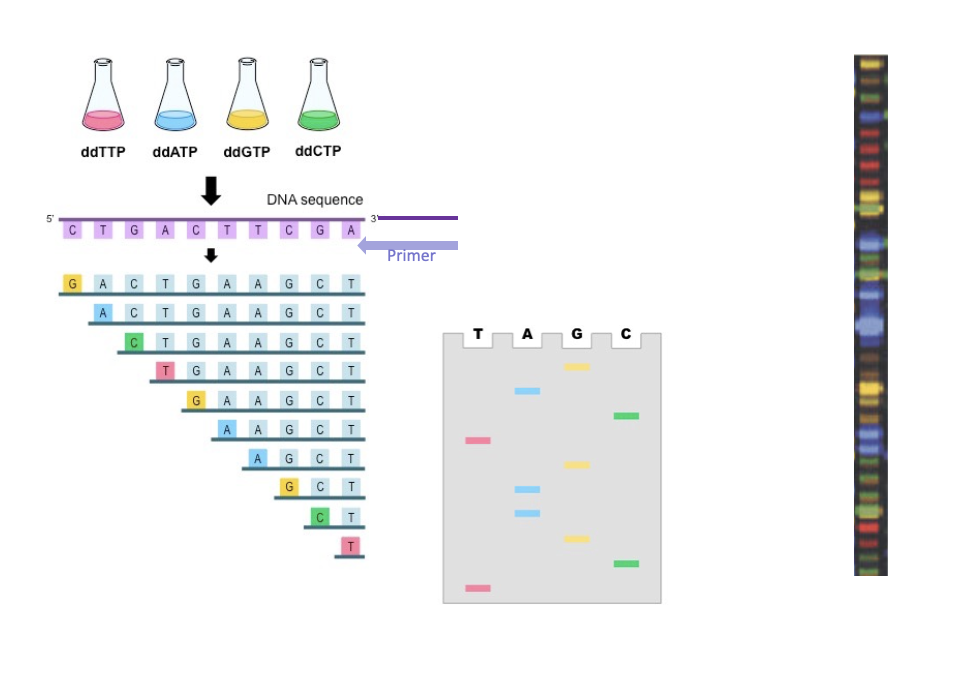
  • DNA clones to be sequenced are generated by standard PCR reaction 

  • The clones are then subject to a polymerase-mediated synthesis step

    • Critical is the random termination of extension at each nucleotide position 

  • reaction mixture contains DNA template, primer, DNA polymerase, ddNTPs and dNTPs

  • The random termination results in DNA fragments of varying sizes which can be analysed to determine nucleotide sequence 
2
New cards
<p>ddNTP</p>

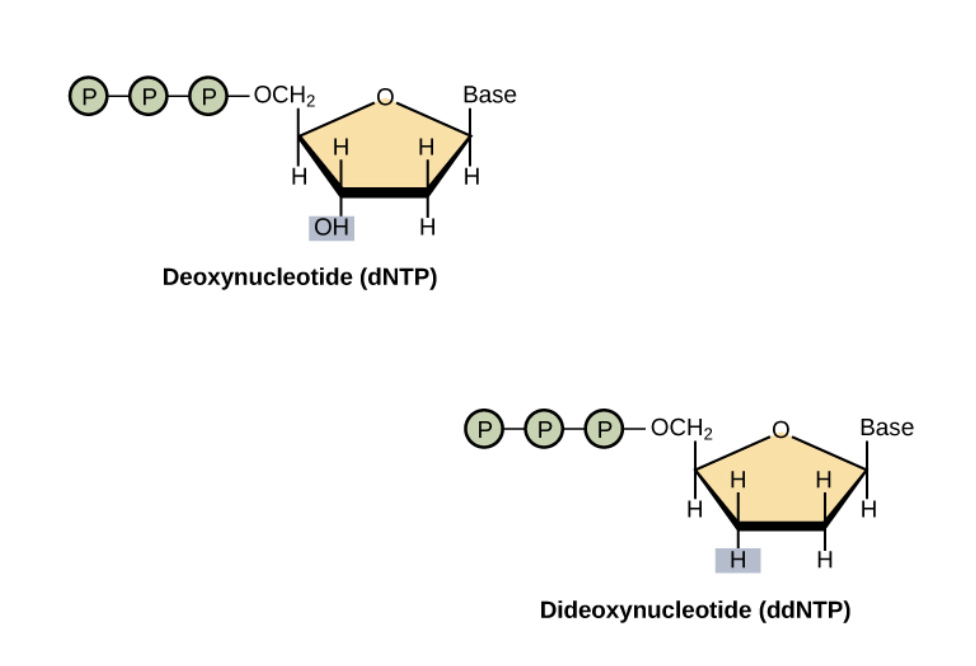
ddNTP

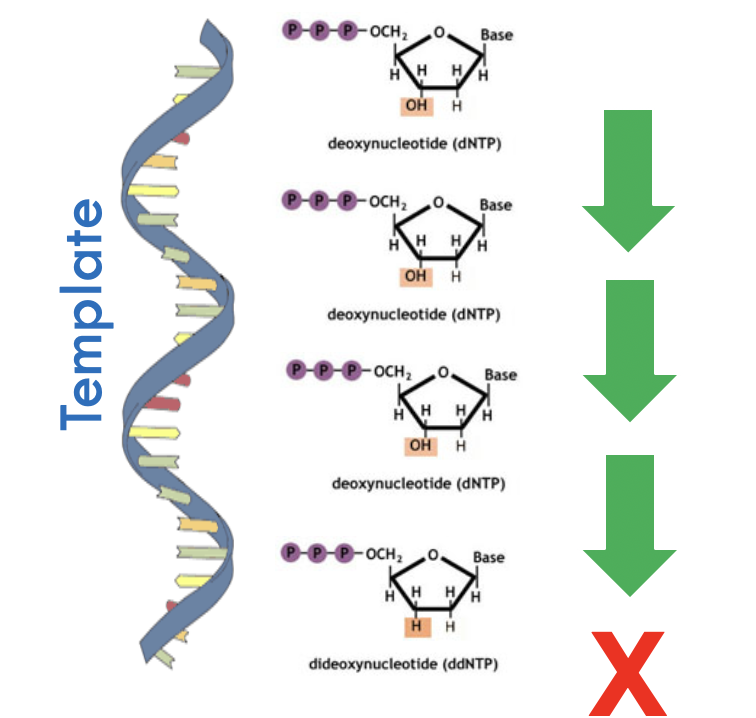
  • ddNTP have a hydrogen replaced from hydroxyl in dNTP 

    • The hydroxyl is important for addition of next nucleotide 

    • Thus next nucleotide is not able to be added 

  • dNTPs are added in excess over ddNTPs in reaction mixture

  • Termination Is random 

    • But will have termination at every single position 

    • Provided there are enough clones 

  • ddNTPs are labelled but dNTPs are not

    • with fluorophores

<ul><li><p class="Paragraph SCXO189466053 BCX4" style="text-align: left;"><span style="background-color: inherit; line-height: 19.55px; color: windowtext;"><span>ddNTP have a hydrogen replaced from hydroxyl in dNTP</span></span><span style="line-height: 19.55px; color: windowtext;"><span>&nbsp;</span></span></p><ul><li><p class="Paragraph SCXO189466053 BCX4" style="text-align: left;"><span style="background-color: inherit; line-height: 19.55px; color: windowtext;"><span>The hydroxyl is important for addition of next nucleotide</span></span><span style="line-height: 19.55px; color: windowtext;"><span>&nbsp;</span></span></p></li><li><p class="Paragraph SCXO189466053 BCX4" style="text-align: left;"><span style="background-color: inherit; line-height: 19.55px; color: windowtext;"><span>Thus next nucleotide is not able to be added</span></span><span style="line-height: 19.55px; color: windowtext;"><span>&nbsp;</span></span></p></li></ul></li><li><p class="Paragraph SCXO189466053 BCX4" style="text-align: left;">dNTPs are added in excess over ddNTPs in reaction mixture</p></li><li><p class="Paragraph SCXO189466053 BCX4" style="text-align: left;"><span style="background-color: inherit; line-height: 19.55px; color: windowtext;"><span>Termination Is random</span></span><span style="line-height: 19.55px; color: windowtext;"><span>&nbsp;</span></span></p><ul><li><p class="Paragraph SCXO46196968 BCX4" style="text-align: left;"><span style="background-color: inherit; line-height: 19.55px; color: windowtext;"><span>But will have termination at every single position</span></span><span style="line-height: 19.55px; color: windowtext;"><span>&nbsp;</span></span></p></li><li><p class="Paragraph SCXO46196968 BCX4" style="text-align: left;"><span style="background-color: inherit; line-height: 19.55px; color: windowtext;"><span>Provided there are enough clones</span></span><span style="line-height: 19.55px; color: windowtext;"><span>&nbsp;</span></span></p></li></ul></li><li><p class="Paragraph SCXO46196968 BCX4" style="text-align: left;">ddNTPs are labelled but dNTPs are not</p><ul><li><p class="Paragraph SCXO46196968 BCX4" style="text-align: left;">with fluorophores</p></li></ul></li></ul><p></p>
3
New cards

reading DNA

  • Need a primer 

  • Run on a polyacrylamide gel 

  • Shortest DNA fragments run faster 

    • Will be at the bottom 

<ul><li><p class="Paragraph SCXO157879703 BCX4" style="text-align: left;"><span style="background-color: inherit; line-height: 19.55px; color: windowtext;"><span>Need a primer</span></span><span style="line-height: 19.55px; color: windowtext;"><span>&nbsp;</span></span></p></li><li><p class="Paragraph SCXO157879703 BCX4" style="text-align: left;"><span style="background-color: inherit; line-height: 19.55px; color: windowtext;"><span>Run on a polyacrylamide gel</span></span><span style="line-height: 19.55px; color: windowtext;"><span>&nbsp;</span></span></p></li><li><p class="Paragraph SCXO157879703 BCX4" style="text-align: left;"><span style="background-color: inherit; line-height: 19.55px; color: windowtext;"><span>Shortest DNA fragments run faster</span></span><span style="line-height: 19.55px; color: windowtext;"><span>&nbsp;</span></span></p><ul><li><p class="Paragraph SCXO157879703 BCX4" style="text-align: left;"><span style="background-color: inherit; line-height: 19.55px; color: windowtext;"><span>Will be at the bottom</span></span><span style="line-height: 19.55px; color: windowtext;"><span>&nbsp;</span></span></p></li></ul></li></ul><p></p>
4
New cards

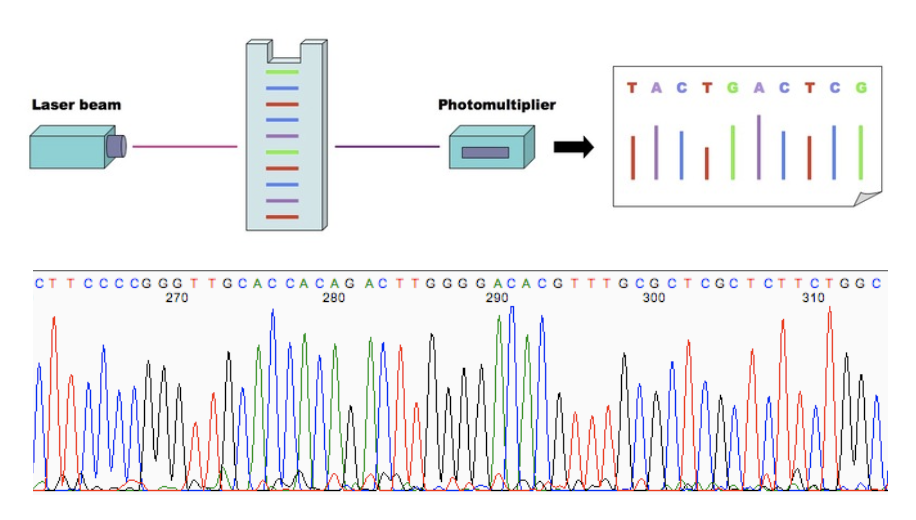
fluorescence detection systems

  • Fluorescence detection systems are used to image the fluorescence producing an electropherogram 

    • Peaks is due to number of DNA strands with that sequence 

  • Capillary electrophoresis allows the standard gel electrophoresis step to be bypassed 

  • Further technical upgrades meant that 384 samples could be run in parallel 
<ul><li><p class="Paragraph SCXO173098021 BCX4" style="text-align: left;"><span style="background-color: inherit; line-height: 19.55px; color: windowtext;"><span>Fluorescence detection systems are used to image the fluorescence producing an electropherogram</span></span><span style="line-height: 19.55px; color: windowtext;"><span>&nbsp;</span></span></p><ul><li><p class="Paragraph SCXO173098021 BCX4" style="text-align: left;"><span style="background-color: inherit; line-height: 19.55px; color: windowtext;"><span>Peaks is due to number of DNA strands with that sequence</span></span><span style="line-height: 19.55px; color: windowtext;"><span>&nbsp;</span></span></p></li></ul></li><li><p class="Paragraph SCXO173098021 BCX4" style="text-align: left;"><span style="background-color: inherit; line-height: 19.55px; color: windowtext;"><span>Capillary electrophoresis allows the standard gel electrophoresis step to be bypassed</span></span><span style="line-height: 19.55px; color: windowtext;"><span>&nbsp;</span></span></p></li><li><p class="Paragraph SCXO173098021 BCX4" style="text-align: left;"><span style="background-color: inherit; line-height: 19.55px; color: windowtext;"><span>Further technical upgrades meant that 384 samples could be run in parallel</span></span><span style="line-height: 19.55px; color: windowtext;"><span>&nbsp;</span></span></p></li></ul><p></p>
5
New cards

sequencing the human genome for the first time

  • Sanger sequencing yields only up to a maximum of 1000 nucleotides per reaction 

    • Challenge for large scale projects 

  • The sequencing strategy was shaped by 3 key limitations of sanger sequencing 

    • The necessity to have a clone of the DNA template (so that the levels of fluorescence emitted is able to be detected) 

    • The requirement that at least some sequence information is known beforehand (so that primers can bind to the template) 

    • The short sequencing read length 

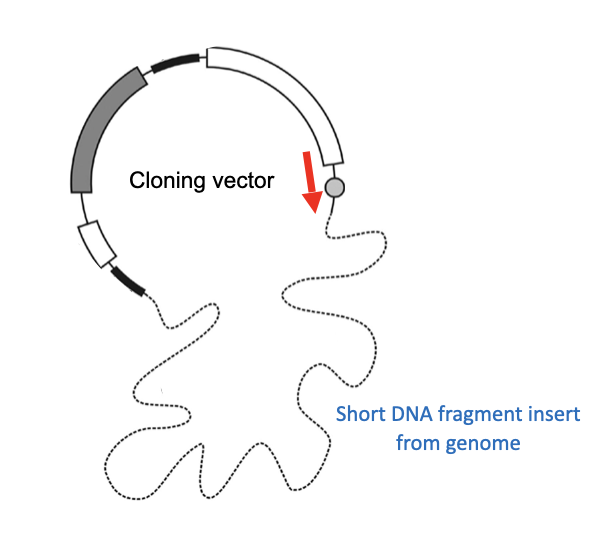
  • Due to using a vector, the primer can be designed to be complimentary to the vector 
<ul><li><p class="Paragraph SCXO180417329 BCX4" style="text-align: left;"><span style="background-color: inherit; line-height: 19.55px; color: windowtext;"><span>Sanger sequencing yields only up to a maximum of 1000 nucleotides per reaction</span></span><span style="line-height: 19.55px; color: windowtext;"><span>&nbsp;</span></span></p><ul><li><p class="Paragraph SCXO180417329 BCX4" style="text-align: left;"><span style="background-color: inherit; line-height: 19.55px; color: windowtext;"><span>Challenge for large scale projects</span></span><span style="line-height: 19.55px; color: windowtext;"><span>&nbsp;</span></span></p></li></ul></li><li><p class="Paragraph SCXO180417329 BCX4" style="text-align: left;"><span style="background-color: inherit; line-height: 19.55px; color: windowtext;"><span>The sequencing strategy was shaped by 3 key limitations of sanger sequencing</span></span><span style="line-height: 19.55px; color: windowtext;"><span>&nbsp;</span></span></p><ul><li><p class="Paragraph SCXO180417329 BCX4" style="text-align: left;"><span style="background-color: inherit; line-height: 19.55px; color: windowtext;"><span>The necessity to have a clone of the DNA template (so that the levels of fluorescence emitted is able to be detected)</span></span><span style="line-height: 19.55px; color: windowtext;"><span>&nbsp;</span></span></p></li><li><p class="Paragraph SCXO180417329 BCX4" style="text-align: left;"><span style="background-color: inherit; line-height: 19.55px; color: windowtext;"><span>The requirement that at least some sequence information is known beforehand (so that primers can bind to the template)</span></span><span style="line-height: 19.55px; color: windowtext;"><span>&nbsp;</span></span></p></li><li><p class="Paragraph SCXO180417329 BCX4" style="text-align: left;"><span style="background-color: inherit; line-height: 19.55px; color: windowtext;"><span>The short sequencing read length</span></span><span style="line-height: 19.55px; color: windowtext;"><span>&nbsp;</span></span></p></li></ul></li><li><p class="Paragraph SCXO180417329 BCX4" style="text-align: left;"><span style="background-color: inherit; line-height: 19.55px; color: windowtext;"><span>Due to using a vector, the primer can be designed to be complimentary to the vector</span></span><span style="line-height: 19.55px; color: windowtext;"><span>&nbsp;</span></span></p></li></ul><p></p>
6
New cards

process

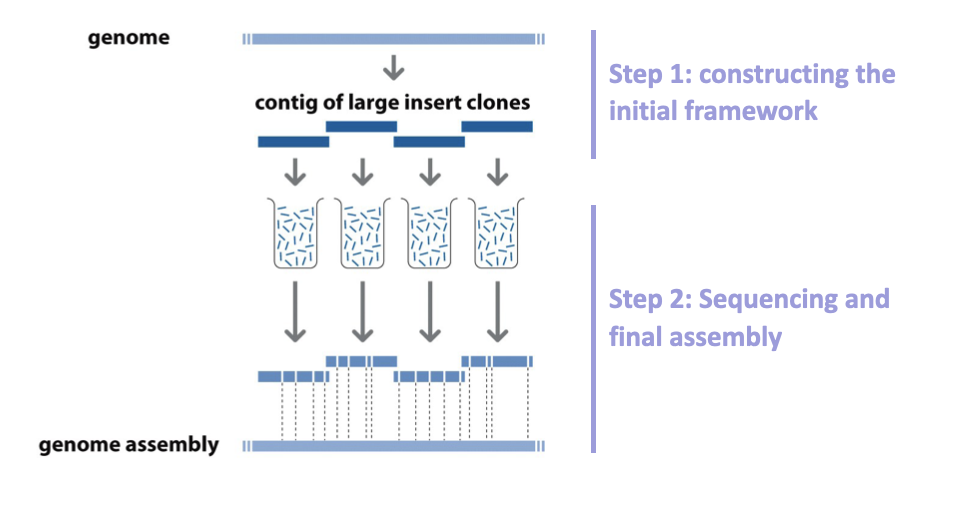
  • Fragment a chromosome 

  • Order them 

  • Fragment those fragments 

  • Sequence 

  • Reorder fragments 

problem = fragmentation happens randomly
<ul><li><p class="Paragraph SCXO63066126 BCX4" style="text-align: left;"><span style="background-color: inherit; line-height: 19.55px; color: windowtext;"><span>Fragment a chromosome</span></span><span style="line-height: 19.55px; color: windowtext;"><span>&nbsp;</span></span></p></li><li><p class="Paragraph SCXO63066126 BCX4" style="text-align: left;"><span style="background-color: inherit; line-height: 19.55px; color: windowtext;"><span>Order them</span></span><span style="line-height: 19.55px; color: windowtext;"><span>&nbsp;</span></span></p></li><li><p class="Paragraph SCXO63066126 BCX4" style="text-align: left;"><span style="background-color: inherit; line-height: 19.55px; color: windowtext;"><span>Fragment those fragments</span></span><span style="line-height: 19.55px; color: windowtext;"><span>&nbsp;</span></span></p></li><li><p class="Paragraph SCXO63066126 BCX4" style="text-align: left;"><span style="background-color: inherit; line-height: 19.55px; color: windowtext;"><span>Sequence</span></span><span style="line-height: 19.55px; color: windowtext;"><span>&nbsp;</span></span></p></li><li><p class="Paragraph SCXO63066126 BCX4" style="text-align: left;"><span style="background-color: inherit; line-height: 19.55px; color: windowtext;"><span>Reorder fragments</span></span><span style="line-height: 19.55px; color: windowtext;"><span>&nbsp;</span></span></p></li></ul><p class="Paragraph SCXO63066126 BCX4" style="text-align: left;"></p><p class="Paragraph SCXO63066126 BCX4" style="text-align: left;">problem = fragmentation happens randomly</p><p></p>
7
New cards
<p>ordering larger fragments</p>

ordering larger fragments

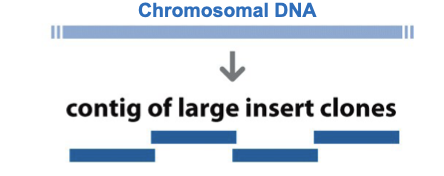
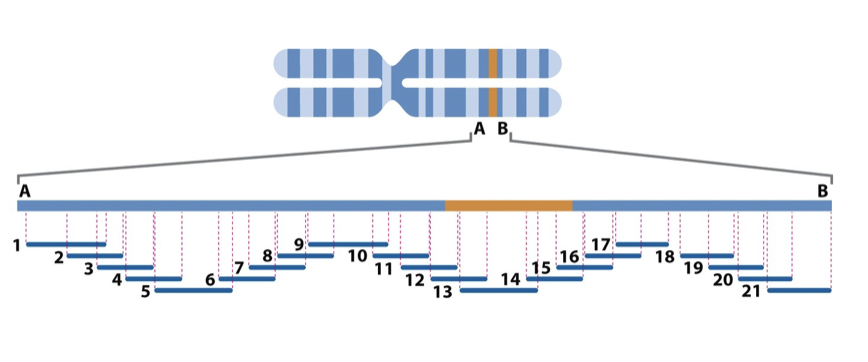
  • Chromosomal DNA was initially fragmented into large pieces and cloned into vectors known as YACs (yeast artificial chromosomes) 

  • The clones were then mapped in terms of their original chromosomal location by 2 major techniques 

    • FISH-type experiments 

      • Label specific sequences 

      • Can be detected on both chromosome and fragments 

      • Can thus be reordered 

    • PCR-based screening for STSs 

      • Bits have already been sequenced 

      • Called sequence tagged sites 

      • Use sequence to design a complimentary primer 

      • One that is positive thus has the same sequence and comes from the same location 

  • A series of overlapping clones whose chromosomal location had been mapped was thus generated and these were referred to as clone contigs 

    • No gaps 

<ul><li><p class="Paragraph SCXO40021848 BCX4" style="text-align: left;"><span style="background-color: inherit; line-height: 19.55px; color: windowtext;"><span>Chromosomal DNA was initially fragmented into large pieces and cloned into vectors known as YACs (yeast artificial chromosomes)</span></span><span style="line-height: 19.55px; color: windowtext;"><span>&nbsp;</span></span></p></li><li><p class="Paragraph SCXO40021848 BCX4" style="text-align: left;"><span style="background-color: inherit; line-height: 19.55px; color: windowtext;"><span>The clones were then mapped in terms of their original chromosomal location by 2 major techniques</span></span><span style="line-height: 19.55px; color: windowtext;"><span>&nbsp;</span></span></p><ul><li><p class="Paragraph SCXO40021848 BCX4" style="text-align: left;"><span style="background-color: inherit; line-height: 19.55px; color: windowtext;"><span>FISH-type experiments</span></span><span style="line-height: 19.55px; color: windowtext;"><span>&nbsp;</span></span></p><ul><li><p class="Paragraph SCXO40021848 BCX4" style="text-align: left;"><span style="background-color: inherit; line-height: 19.55px; color: windowtext;"><span>Label specific sequences</span></span><span style="line-height: 19.55px; color: windowtext;"><span>&nbsp;</span></span></p></li><li><p class="Paragraph SCXO40021848 BCX4" style="text-align: left;"><span style="background-color: inherit; line-height: 19.55px; color: windowtext;"><span>Can be detected on both chromosome and fragments</span></span><span style="line-height: 19.55px; color: windowtext;"><span>&nbsp;</span></span></p></li><li><p class="Paragraph SCXO40021848 BCX4" style="text-align: left;"><span style="background-color: inherit; line-height: 19.55px; color: windowtext;"><span>Can thus be reordered</span></span><span style="line-height: 19.55px; color: windowtext;"><span>&nbsp;</span></span></p></li></ul></li><li><p class="Paragraph SCXO40021848 BCX4" style="text-align: left;"><span style="background-color: inherit; line-height: 19.55px; color: windowtext;"><span>PCR-based screening for STSs</span></span><span style="line-height: 19.55px; color: windowtext;"><span>&nbsp;</span></span></p><ul><li><p class="Paragraph SCXO40021848 BCX4" style="text-align: left;"><span style="background-color: inherit; line-height: 19.55px; color: windowtext;"><span>Bits have already been sequenced</span></span><span style="line-height: 19.55px; color: windowtext;"><span>&nbsp;</span></span></p></li><li><p class="Paragraph SCXO40021848 BCX4" style="text-align: left;"><span style="background-color: inherit; line-height: 19.55px; color: windowtext;"><span>Called sequence tagged sites</span></span><span style="line-height: 19.55px; color: windowtext;"><span>&nbsp;</span></span></p></li><li><p class="Paragraph SCXO40021848 BCX4" style="text-align: left;"><span style="background-color: inherit; line-height: 19.55px; color: windowtext;"><span>Use sequence to design a complimentary primer</span></span><span style="line-height: 19.55px; color: windowtext;"><span>&nbsp;</span></span></p></li><li><p class="Paragraph SCXO40021848 BCX4" style="text-align: left;"><span style="background-color: inherit; line-height: 19.55px; color: windowtext;"><span>One that is positive thus has the same sequence and comes from the same location</span></span><span style="line-height: 19.55px; color: windowtext;"><span>&nbsp;</span></span></p></li></ul></li></ul></li><li><p class="Paragraph SCXO40021848 BCX4" style="text-align: left;"><span style="background-color: inherit; line-height: 19.55px; color: windowtext;"><span>A series of overlapping clones whose chromosomal location had been mapped was thus generated and these were referred to as clone contigs</span></span><span style="line-height: 19.55px; color: windowtext;"><span>&nbsp;</span></span></p><ul><li><p class="Paragraph SCXO224475993 BCX4" style="text-align: left;"><span style="background-color: inherit; line-height: 19.55px; color: windowtext;"><span>No gaps</span></span><span style="line-height: 19.55px; color: windowtext;"><span>&nbsp;</span></span></p></li></ul></li></ul><p></p>
8
New cards
<p>reordering smaller fragments</p>

reordering smaller fragments

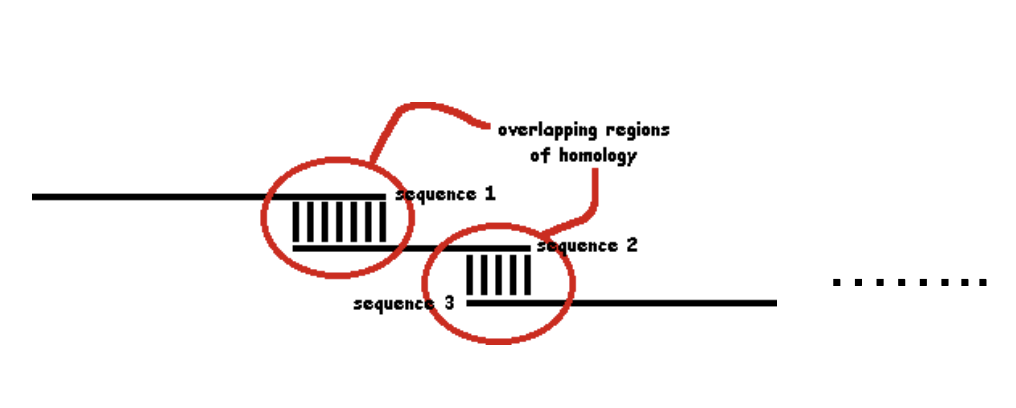
  • Do reaction so that fragmentation only happens at certain sites 

  • Add restriction endonuclease at smaller concentrations  

  • Random fragments 

  • Overlap 

  • And match overlapping ends (sequences of homology) 
<ul><li><p class="Paragraph SCXO133981863 BCX4" style="text-align: left;"><span style="background-color: inherit; line-height: 19.55px; color: windowtext;"><span>Do reaction so that fragmentation only happens at certain sites</span></span><span style="line-height: 19.55px; color: windowtext;"><span>&nbsp;</span></span></p></li><li><p class="Paragraph SCXO133981863 BCX4" style="text-align: left;"><span style="background-color: inherit; line-height: 19.55px; color: windowtext;"><span>Add restriction endonuclease at smaller concentrations&nbsp;</span></span><span style="line-height: 19.55px; color: windowtext;"><span>&nbsp;</span></span></p></li><li><p class="Paragraph SCXO133981863 BCX4" style="text-align: left;"><span style="background-color: inherit; line-height: 19.55px; color: windowtext;"><span>Random fragments</span></span><span style="line-height: 19.55px; color: windowtext;"><span>&nbsp;</span></span></p></li><li><p class="Paragraph SCXO133981863 BCX4" style="text-align: left;"><span style="background-color: inherit; line-height: 19.55px; color: windowtext;"><span>Overlap</span></span><span style="line-height: 19.55px; color: windowtext;"><span>&nbsp;</span></span></p></li><li><p class="Paragraph SCXO133981863 BCX4" style="text-align: left;"><span style="background-color: inherit; line-height: 19.55px; color: windowtext;"><span>And match overlapping ends (sequences of homology)</span></span><span style="line-height: 19.55px; color: windowtext;"><span>&nbsp;</span></span></p></li></ul><p></p>
9
New cards

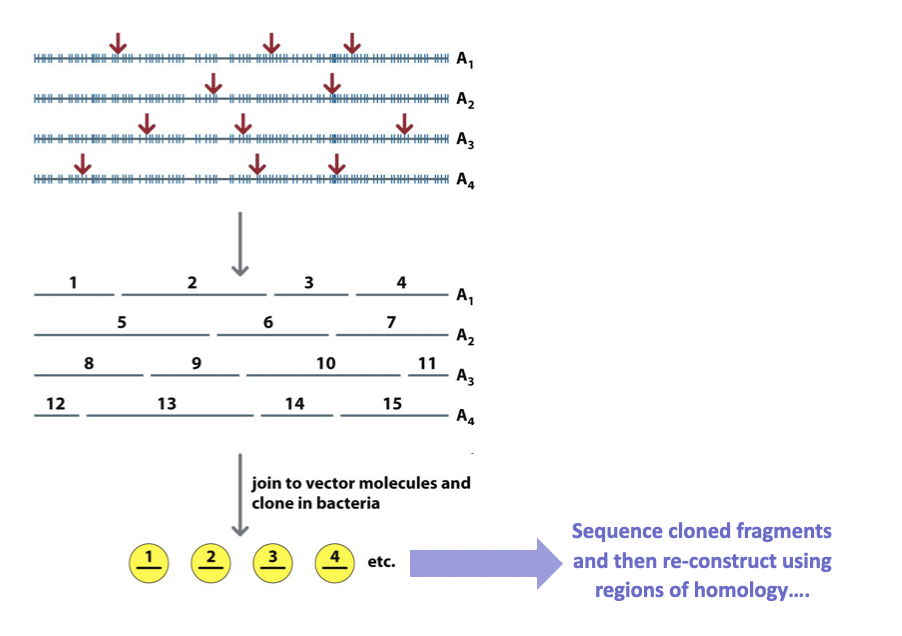
whole genome shotgun sequencing

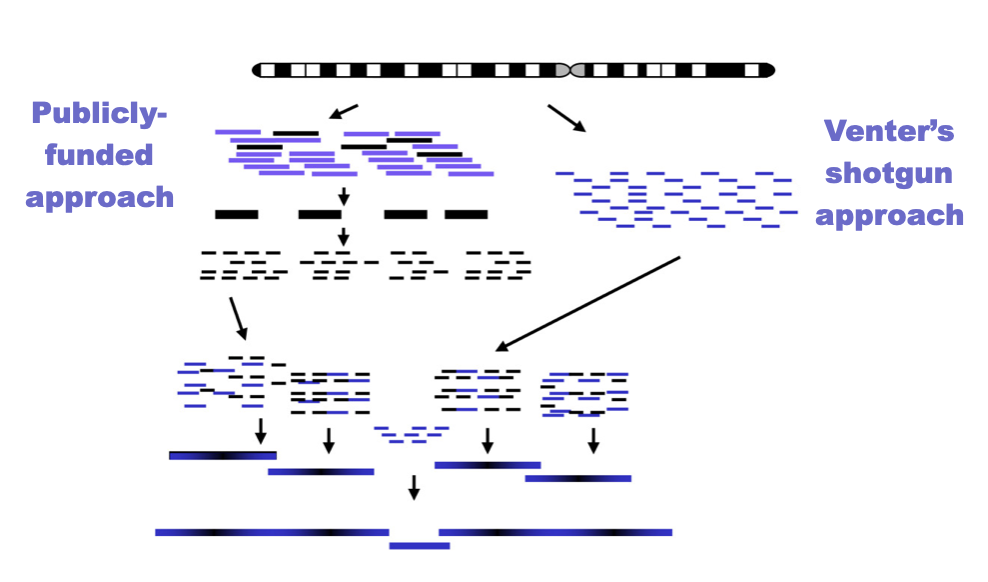
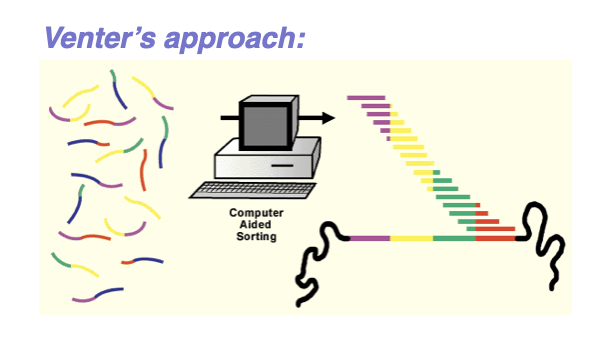
  • Shotgun sequencing is used to determine the DNA sequence of an entire genome.

  • The genome is broken into many small, random fragments.

  • These fragments are cloned into vectors or prepared as sequencing libraries.

  • Each fragment is sequenced individually.

  • Sequencing produces many overlapping DNA reads.

  • Computers compare overlaps between reads.

  • Overlapping sequences are assembled into longer contigs.

  • Contigs are ordered and oriented to reconstruct the genome.

  • The randomness increases the chance that every region is sequenced.

  • Shotgun sequencing is faster and more efficient than sequencing DNA in order.
<ul><li><p>Shotgun sequencing is used to <strong>determine the DNA sequence of an entire genome</strong>.</p></li><li><p>The genome is <strong>broken into many small, random fragments</strong>.</p></li><li><p>These fragments are <strong>cloned into vectors</strong> or prepared as sequencing libraries.</p></li><li><p>Each fragment is <strong>sequenced individually</strong>.</p></li><li><p>Sequencing produces many <strong>overlapping DNA reads</strong>.</p></li><li><p>Computers <strong>compare overlaps</strong> between reads.</p></li><li><p>Overlapping sequences are <strong>assembled into longer contigs</strong>.</p></li><li><p>Contigs are <strong>ordered and oriented</strong> to reconstruct the genome.</p></li><li><p>The randomness increases the chance that <strong>every region is sequenced</strong>.</p></li><li><p>Shotgun sequencing is <strong>faster and more efficient</strong> than sequencing DNA in order.</p></li></ul><p></p>
10
New cards

capillary sequencing / automated Sanger sequencing

  • Capillary sequencing is used to determine the nucleotide sequence of DNA fragments.

  • DNA is first amplified (often by PCR).

  • The sequencing reaction uses dideoxynucleotides (ddNTPs) to terminate DNA synthesis.

  • Each ddNTP is fluorescently labeled with a different color.

  • DNA fragments of varying lengths are produced.

  • The fragments are loaded into a thin capillary tube filled with polymer.

  • An electric field separates fragments by size during electrophoresis.

  • Shorter fragments move faster through the capillary.

  • A laser detects fluorescence as fragments pass a detector.

  • A computer reads the colors to determine the DNA sequence.
<ul><li><p>Capillary sequencing is used to <strong>determine the nucleotide sequence of DNA fragments</strong>.</p></li><li><p>DNA is first <strong>amplified</strong> (often by PCR).</p></li><li><p>The sequencing reaction uses <strong>dideoxynucleotides (ddNTPs)</strong> to terminate DNA synthesis.</p></li><li><p>Each ddNTP is <strong>fluorescently labeled</strong> with a different color.</p></li><li><p>DNA fragments of <strong>varying lengths</strong> are produced.</p></li><li><p>The fragments are loaded into a <strong>thin capillary tube</strong> filled with polymer.</p></li><li><p>An <strong>electric field</strong> separates fragments by size during electrophoresis.</p></li><li><p>Shorter fragments <strong>move faster</strong> through the capillary.</p></li><li><p>A <strong>laser detects fluorescence</strong> as fragments pass a detector.</p></li><li><p>A computer <strong>reads the colors</strong> to determine the DNA sequence.</p></li></ul><p></p>