Virology: Picornaviridae (+) ssRNA
 Studied by 0 people
 Call Kai
 Learn
Learn Practice Test
 Spaced Repetition
 Match
Match Flashcards
 Knowt Play
1/48

Earn XP
Description and Tags
Family: Picornaviridae
Name | Mastery | Learn | Test | Matching | Spaced | Call with Kai |
|---|
No analytics yet
Send a link to your students to track their progress
49 Terms
What baltimore group is Picornviridae?
Group IV (+) ssRNA
What is a benefit of (+) ssRNA?
It is already an mRNA and can be immediately translated.
Pico-RNA-virus means
Small RNA virus
Picornviridae family is a non-enveloped or enveloped virus?
They are non-enveloped!
How do these picornviridae virus get out of the cell?
They do not bud (for enveloped viruses)! They lyse out of the cell. It happens this way because it is non-developed.
Are picornaviridae pathogens environmentaly stable?
Yes! Because they are non-enveloped. They can handle pH changes, alcohol and detergents due to the hard CAPSID shell.
Name the human pathogens within the picornviridae family (5 total)
Poliovirus
Rhinoviruses
Hepatitis A virus
Coxsackieviruses
Other entero viruses
What is poliovirus?
Dicovered in the 1940s and 50s, paralyzed or killed >500,000 people per year
Nearly eradicated (destroyed) by vaccine
Early model system for field of virology
What is a Rhinovirus?
“The common cold” most often
>50 million infections/year and ~100,000 deaths/year.
Hepatitis A virus infections/year and deaths are
Hepatitis A virus has had >100 million infections/year ~100,000 deaths/year.
Coxackieviruses (cox-ackee-viruses) is also known as…
Hand foot and mouth disease and some cardiac inflammatory diseases.
Other enteroviruses infect what?
Infect gastointestinal tract
Incorrectly called ‘the stomach flu’
What is a non human pathogen?
Foot and mouth disease and several others (devastating for livestock)
Related viruses of picornavirusviridae
Norovirus (“the cruise ship virus”)
Formally a member of Calciviridae
Mention a few characteristics of Poliovirus and Poliomyelitis
Most infections are asymptomatic
~0.5% of poliovirus infections result in muscle weakening (weaken muscles for breathing).
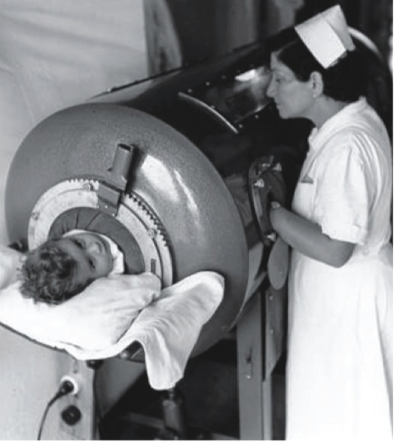
“Iron lung”
Most people recover
In come cases people die or are permanently paralyzed
Chlorine is in swimming pools to reduce infections!
Poliovirus is a gastrointenstinal virus (transitted orally and fecally)
There is also a vaccine
Poliovirus is a gastrointestinal virus, how can one get infected?
It is transmitted orally and fecally
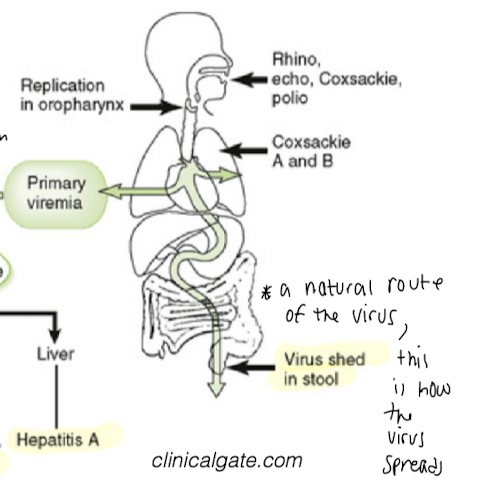
Most poliovirus pathogenesis is caused by ‘off target’ replication of virus. What does off target mean?
Polio virus is transmitted orally and fecally
The virus replicates in the oropharynx
In rare cases, the virus goes ‘off target’ and ends up in the nervous system which is NOT beneficial to the virus (~1% of the time).
When it ends up in other parts of the body, it can be lethal leading to eternal paralysis or death.
Who contracted poliomyelitis at age 39 and became a strong supporter of vaccine efforts?
Franklin D. Roosevelt
What are the two competing polio vaccines? Who created them?
1952 Salk vaccine: Jonas Salk
1961 Sabin vaccine: Albert Sabin
Describe the Salk vaccine
Injected
“Dead virus vaccine”
Inactivated polio virus
Virus can no longer replicate
Induces antibodies, but not at intestinal route of infection.
Describe the Sabin Vaccine
Orally taken (Sugar cubes)
“Anttenuated virus vaccine”
Exposure to weaker strain
Natual route of infection
Can also spread to uninfected people, exposing them to the varient (population vaccination)
Cons of the Salk vaccine (Killed/inactivated)?
More costly and difficult ot manufacture
Must be precise with every batch of vaccines, want to deactivate the replication cycle but not destroy it to the point the imune system cannot recognize the virus
Needs to be injected (ouch!)
Cons of Sabin vaccine (live attenuated)
Less stable environmentally
Small chance of reactivation
Must generate a great number of mutations to prevent reactivation.
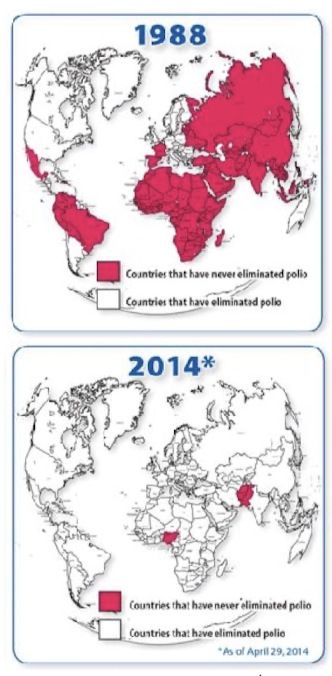
Poliovirus was eradicated by which vaccine?
Sabin vaccine (sugar cubes that contained weaker strains)
Picornavirus are ____-_____ _______ viruses
Picornaviruses are non-enveloped lytic viruses!
Describe the life cycle of picornavirus
Receptor binding to CAPSID protein
Entry via endocytosis
Host ribosomes assist with IRES dirven translation and proteins are made
Polyproteins are made and do 5 things
One of them (most important) is that the viral replication complex make more (-) and (+) stands making more copies for packaging
Cell lysis occurs and viruses exit the cell
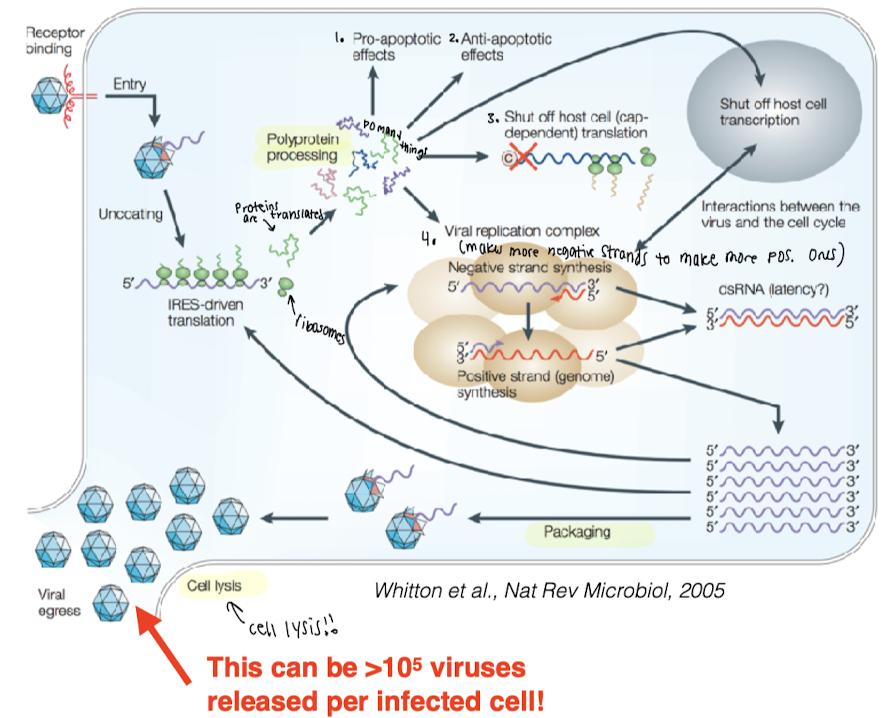
Describe attachment and genome delivery
Poliovirus protein on CAPSID binds to receptors
Uncoating occurs once brought in via endocytosis
Results in CAPSID docking onto endocytic membrane and mRNA is secreted
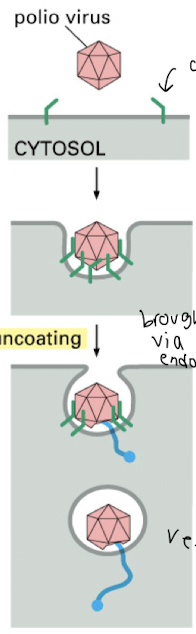
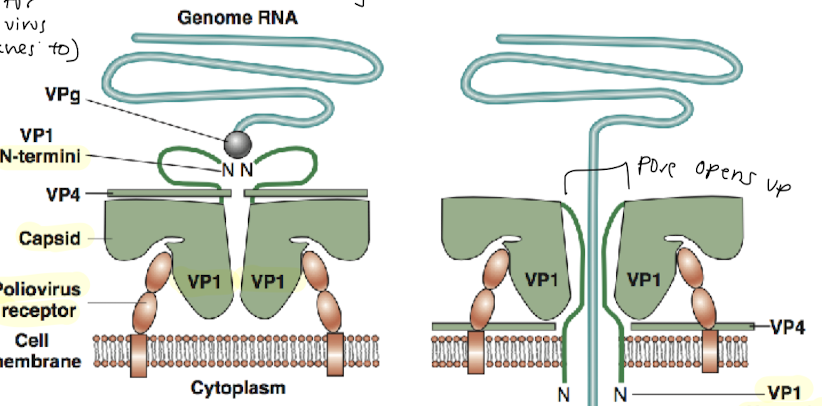
Describe genome delivery at a ‘molecular’ level
CAPSID protein (VP1) binds to receptors at N termini
Pore opens up and the VP1 N-termini opens up by a confomational change
genome ( +ssRNA is released and enters the cytoplasm
Genome structure: Doing a lot with only a little genome. Describe what the genome structure.
VPg is a protein that replaces the 5’ CAP found in all of our mRNAs.
5’ non-coding region
Internal ribosome entry site
Binding site for replicase complex
P1 ecodes for capsid proteins
P2 and P3 encode foe non-structural proteins (critical for the replication cycle)
Protein processing
Host shutoff
RNA replication
3’ end non-coding region
Binding site for replicase complex
Followed by poly-A tail
An IRES must be present for (+) ssRNA translation, what does it recruit?
A virus does not need a 5’ cap, a VPg is there instead to avoid the RNA from being chewed up by nucleases.
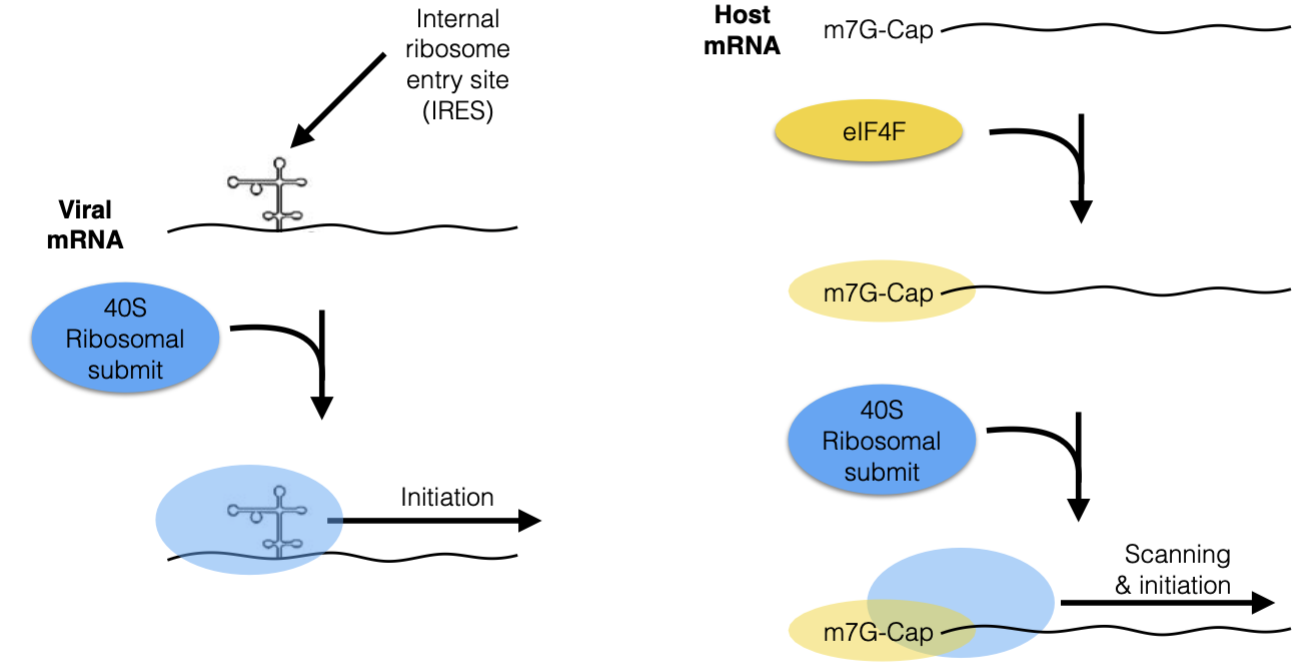
IRES is a complicated RNA structure that recruits ribosomes (40s ribosomal subunit)
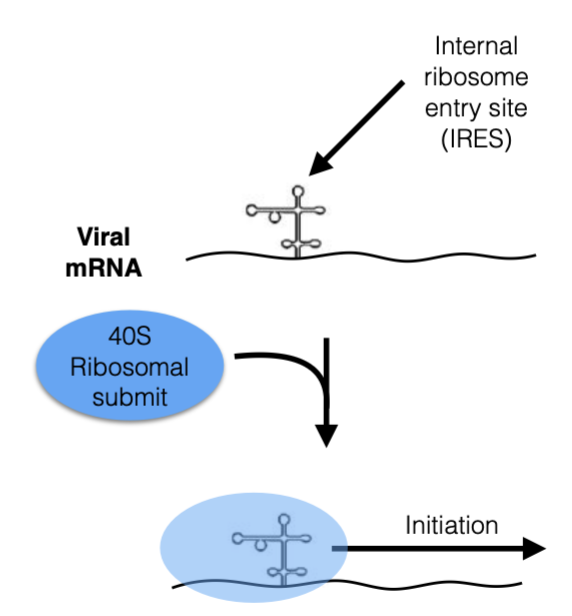
Describe the viruses strategies used to disrupt host protein synthesis
They cleave or degrade eIF4F comonents to block host synthesis
They also hijack the ribosomal 40s subunit to attach to the IRES to initiate viral translation
Viral proteins are all translated as a single polyprotein and then cleaved by …
Proteases! A pair of molecular scissors.
Proteases are essential to be able to process things to their individual pieces.
We have vaccines that inhibit these proteases.
Where does replication occur?
At the membrane!
Allows the virus to localize proteins, production, etc
Also allows the virus to ESCAPE immune detection
Cool stuff weve learned from studying members of the picornaviridae
One of the best studied group of virsues
First animal virus discovered (foot and mouth disease virus)
First evidence of RNA dependent RNA polymerase
Proteins are expressed as a single polyprotein and cleaved by viral protease.
IRES mediated by cap-independent translation
Vaccine research
Evolution of RNA viruses (e.g error catastrophe, quasi species, viral recombination)
What is error catastrophe?
When a virus replicates so much and introduces many more errors to the point it dies out
Ribavirin is used a a mutagenic drug to drive —> error catastrophe '
Ribavirin is a nucleoside that causes mutations and pushes the viral replication over the error threshold to the point the virus cant survive
What is R0? (“R naught”)
It is the basic reproductive number.
One person is infected. How many more people will they infect in a naive group?
Give me the R naught equation, tell me the signifigance on R naught values.
R0 = number of contacts in a given time X transmission probability per contact X Duration of infection
R0>1 = Endemic continues (bad)
R)<1 = Endemic dies out (good)
Give me the estimates for some epidemic viruses:
MERS, Measles, Polio, Influenza, HIV, Ebola, SARS-Cov-2 (original), SARS-CoV-2 (varient)
MERS: <1
Measles :12-18
Polio: 5-7
Influenza: 1-3
HIV: 2-5
Ebola: 1.5-2.5
SARS-Cov-2 (original): 2-3
SARS-CoV-2 (varient): >5?

What are two ways to reduce R0?
Cure the infection faster
Distance yourself, reduces number of contacts in given time
Masking yourself, lower transmission probability
Efective R equation is…
Effective R = R0 X Fraction of susceptible population
Effective R should = to 1
Tells us how much of the population needs to be vaccinated
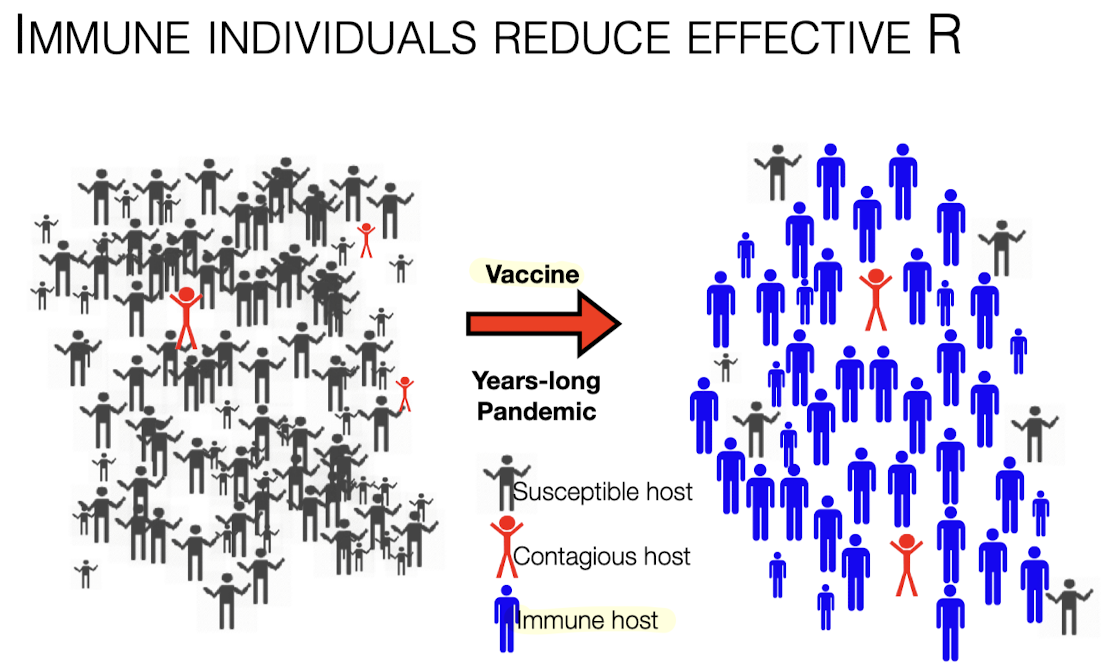
What is one way to reduce the effective R?
Vaccinate!
Immune individuals reduce effective R
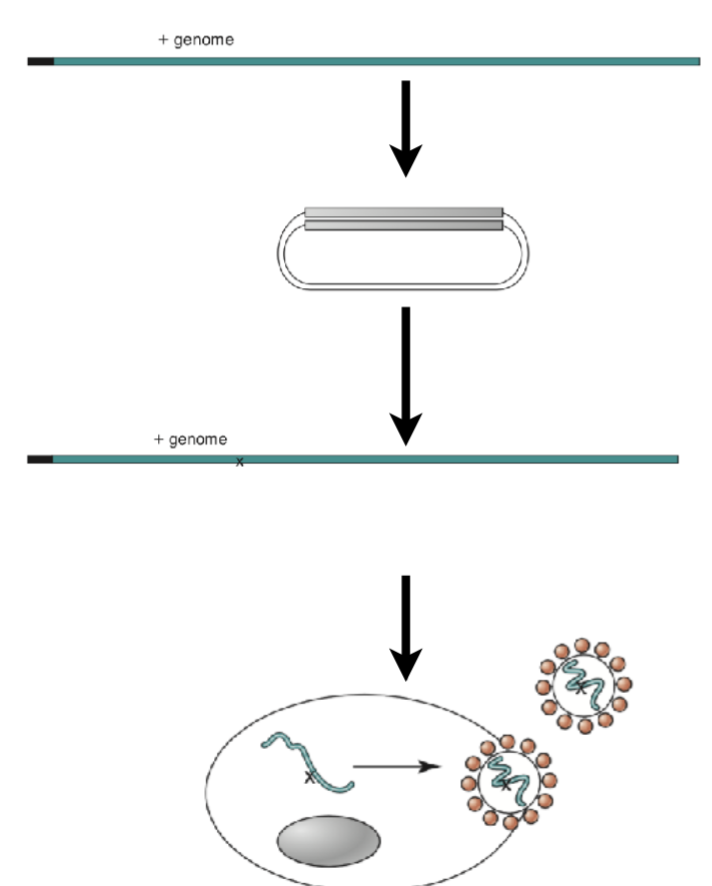
Reverse genetics in RNA viruses. What does it do?
Help us hypothesize about viruses by introducing mutations
Describe “forward genetics”
Done by randomly mutating the virus, looking for a phenotype and sequencing that virus.
Describe “reverse genetics”
We make individual mutations and test whether it produces a given phenotype.
Which Baltimore group of RNA viruses do you think will be easiest to do reverse genetics on?
IV, (+) ssRNA. This is because it is readily available to translate due to being (+) readily acts as an mRNA.
Reverse genetics in (+) ssRNA, decribe the steps
Reverse trascribe viral genome and insert into vector (mutations)
Can make mutations at this step via standar molecular biology techniques
Transcribe the RNA using a DNA dependent RNA polymerase
Often use a phage polymerase (T7) becuase they are small, robust, and have little regulatory requirements.
Get mRNA into cells and recover virus.
Either transfect or electroporate to get mRNA inside mammalian cell.
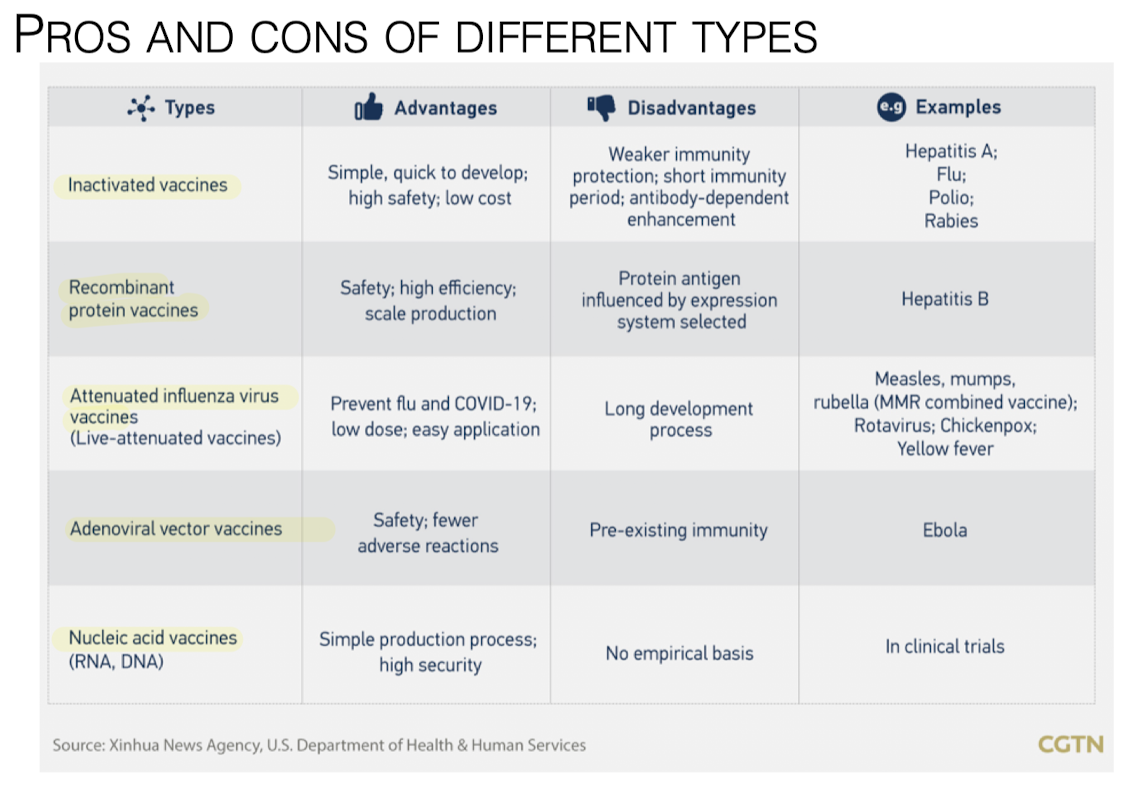
Pros and Cons of many different viruses
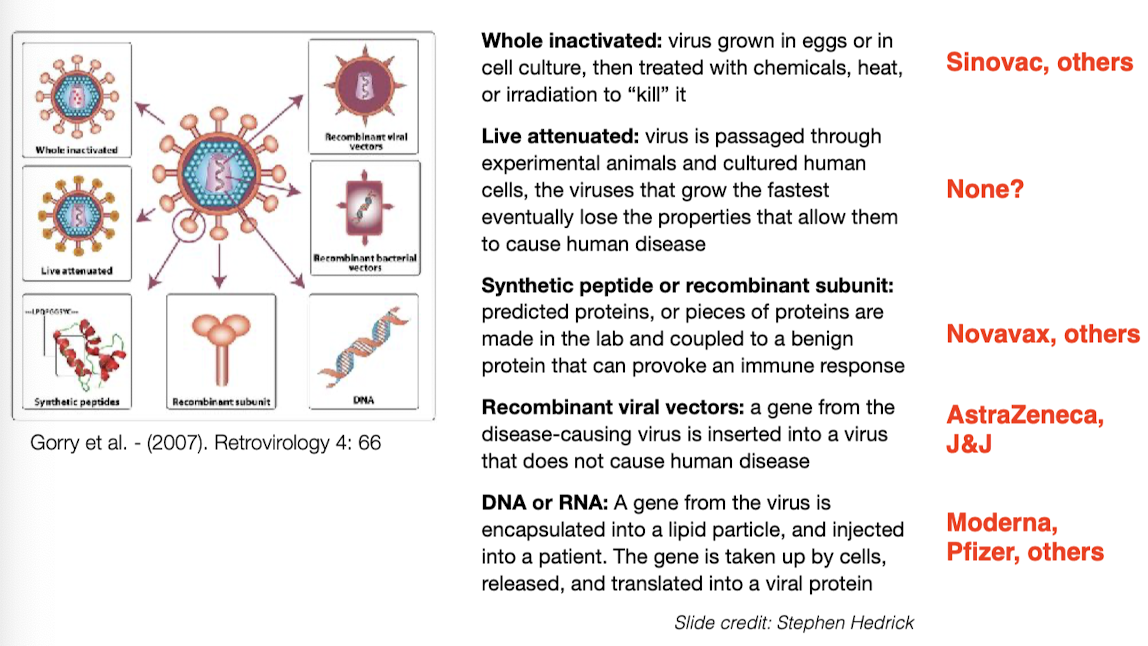
What are the types COVID 19 vaccines?
Whole inactivated, Live attenuated, Synthetic peptide or recombinant subunit, Recombinant viral vectors, DNA or RNA.
Decription of each COVID 19 vaccines
 Note
Note  Flashcards (491)